



CMS COP15 Concluded in Campo Grande, Brazil
- Context (DTE): 15th Meeting of the Conference of the Parties (COP15) to the CMS concluded in Campo Grande, Brazil, under the theme “Connecting Nature to Sustain Life“.
- Next COP: Germany will host COP16 to the CMS in Bonn in 2029, coinciding with the 50th anniversary of the Convention.
Key Outcomes of CMS COP15
- Species Protection: 40 species, subspecies, and populations were added to the CMS Appendices. Giant Otter, Striped Hyena, and Thresher Sharks were added to Appendix I.
- Mining Moratorium: Countries were urged to pause deep-seabed extraction until scientific evidence confirms the safety of migratory marine ecosystems.
- Enforcement Body: COP15 established the Global Initiative on the Taking of Migratory Species (GTI) to combat illegal hunting and exploitation of migratory species.
- Blue Corridors: Transboundary migration routes for whales, turtles, and sharks were promoted for protection under the Blue Corridors Framework.
- Seamount Designation: Seamounts were designated as Critical Habitat, calling for restrictions on bottom-trawling and commercial fishing.
- Ocean Flyways: Six major flyways were mapped for the first time to coordinate avian protection over open oceans.
- Infrastructure Standards: National planning was urged to integrate wildlife-friendly infrastructure standards for roads and railways.
- Hemispheric Flyways: Atlas of the Migratory Routes of the Americas was launched to synchronise bird conservation across the Western Hemisphere
- Noise Limits: Shipping and seismic surveys were targeted by updated guidelines on underwater noise to minimise physiological trauma to deep-diving cetaceans.
- Catfish Protection: The Amazonian Catfish Action Plan was adopted to protect the world’s longest freshwater migration route in the Amazon basin.
World’s Largest Digital Census Begins with Phase I Rollout
- Census 2027 Phase I began on 1 April with self-enumeration, while House Listing & Housing Census (HLO), field exercise will run from 16 April to 15 May 2026 in notified States & UTs.
- It is India’s first fully digital Census and the world’s largest population-count exercise.
- Key Focus: This phase records housing conditions, household amenities, and assets, while individual demographic and socio-economic details are collected in Phase II.
- Self-Enumeration: For the first time, respondents can self-enumerate through a secure web portal in 16 languages; this facility is limited to residents present in India.
- Questionnaire: It includes 33 questions covering housing infrastructure and household assets such as internet access, smartphones, cooking fuel, and related amenities.
- Marital Classification: A ‘live-in couple’ treating their relationship as a “stable union” will be recorded as a married couple for census purposes.
- Digital Mapping: Census operations will use digital methods, like web mapping and mobile apps, for house-listing block creation and data collection.
- Census 2027 will be India’s first fully digital census and the first complete caste enumeration since 1931, conducted by the Ministry of Home Affairs under the Census Act, 1948, & Census Rules, 1990.
Energy Statistics India 2026
- Context (PIB): The National Statistics Office has released the 33rd edition of the Energy Statistics India Report 2026 to provide official energy data.
- Objective: To present integrated statistics on reserves, production, consumption, capacity, and trade of all major energy resources for informed policymaking.
Key Highlights of the Energy Statistics India 2026
- Energy Supply: India’s Total Primary Energy Supply increased by 2.95% in FY 2024–25, reaching 9,32,816 Kilo Tonnes of oil Equivalent (ktoe).
- Renewable Energy Potential: India’s RE potential stands at 47 lakh MW, with solar energy contributing ~71%, followed by wind and hydro.
- Regional Concentration of RE: Over 70% of RE potential is concentrated in six states—Rajasthan, Maharashtra, Gujarat, Andhra Pradesh, Karnataka, and Madhya Pradesh.
- Renewable Capacity: Installed renewable energy capacity increased from 90,134 MW (2016) to 2,29,346 MW (2025), recording a CAGR of 10.93%.
- Renewable Power Generation: Renewable electricity generation rose from 1,89,314 GWh to 4,16,823 GWh (2015–16 to 2024–25), growing at a 9.17% CAGR.
- Energy Consumption: Per capita energy consumption increased to 18,096 megajoules/person, reflecting higher demand due to development.
- Power Efficiency: Transmission & Distribution losses reduced from 22% to 17%, indicating better efficiency in electricity delivery.
- Coal: Coal remains the primary energy source, with supply rising to 5,52,315 Ktoe, highlighting dependence on fossil fuels.
- Final Energy Demand: Total Final Consumption increased by over 30%, driven by industrialisation and economic expansion.
- Financial Support: Credit flow to the energy sector grew over six times from ₹1,688 crore (2021) to ₹10,325 crore (2025).
National Statistics Office
- NSO is the nodal statistical agency of India, under the Ministry of Statistics & Programme Implementation (MoSPI).
- NSO is responsible for collecting, compiling, and publishing official data on GDP, inflation, employment, and various socio-economic indicators.
Rural Digital Governance through eGramSwaraj and SabhaSaar
- Context (PIB): Ministry of Panchayati Raj (MoPR) has achieved significant milestones in rural digital governance through the eGramSwaraj and SabhaSaar initiatives.
About eGramSwaraj Portal
- It is a unified web portal and mobile application developed by MoPR to strengthen e-governance in Panchayati Raj Institutions (PRIs) across India.
- Decentralised Planning: Supports creating and monitoring the Gram Panchayat Development Plan (GPDP), making local development efforts publicly accessible.
- Transparency: Its integration with the Public Financial Management System (PFMS) enables online payments to vendors, reducing delays and corruption.
- Asset Verification: It allows geo-tagging of village assets with GPS for verification and monitoring.
- Digital Procurement: It has been integrated with the Government e-Marketplace (GeM) for purchasing goods online, ensuring competitive prices.
- Key Achievements: Over 2.59 lakh PRIs use the platform, transferring over ₹3 lakh crore through transparent digital payments.
About SabhaSaar
- It is an advanced AI-enabled voice-to-text meeting summarisation tool launched by MoPR in 2025.
- Integrated with the BHASHINI platform, it enables transcription and translation in major Indian languages.
- Infrastructure: It securely operates on the IndiaAI Compute Portal under the Ministry of Electronics and Information Technology (MeitY).
- Key Achievements: Supports 23 Indian languages; over 1.15 lakh Gram Panchayats use it for automatic meeting documentation and summarisation.
NASA’s Artemis II Mission
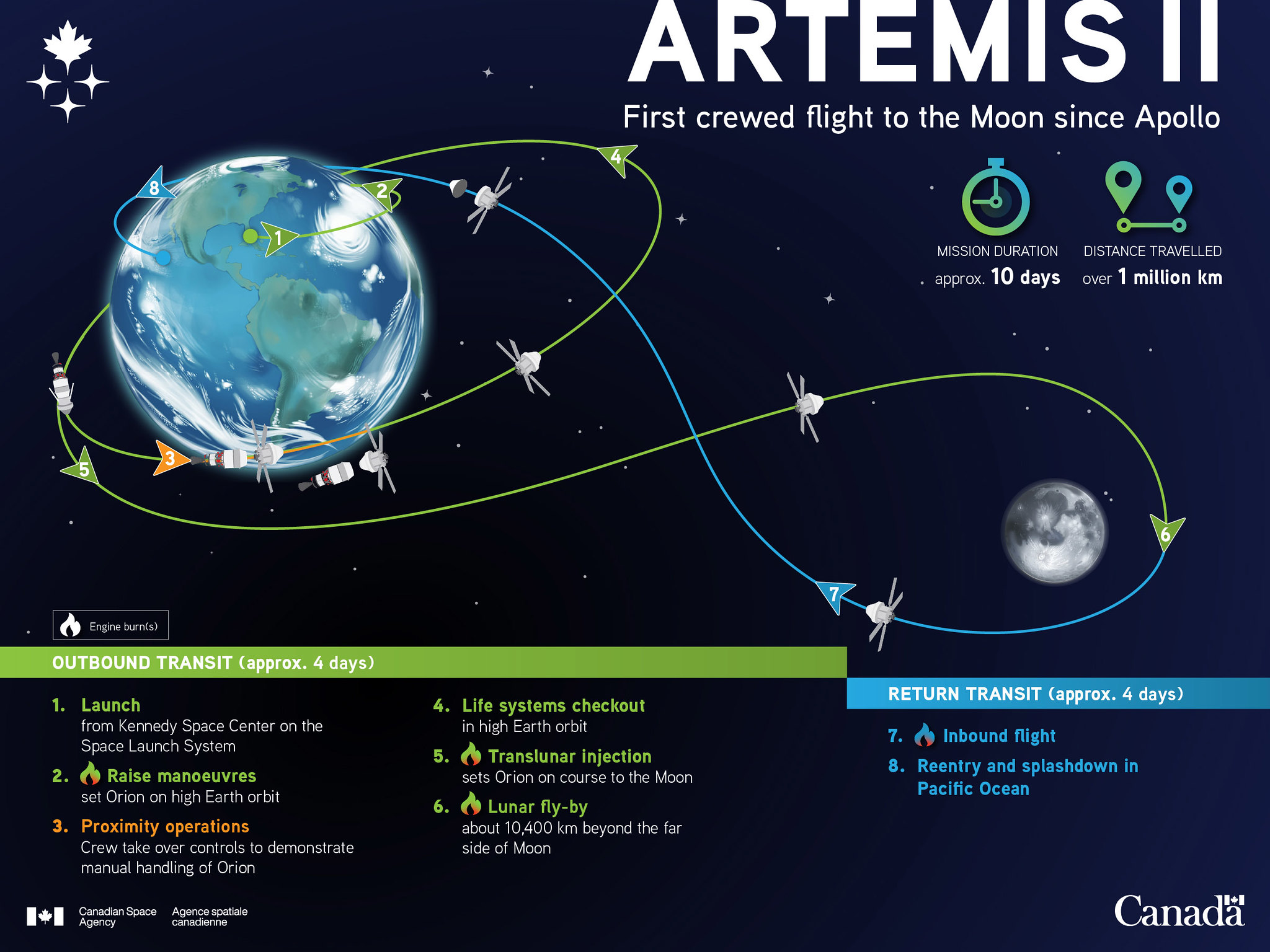
- NASA’s Artemis II mission launches today, making it the first crewed lunar mission in over 50 years.
- It will carry four astronauts, including the first woman and the first person of colour.
- International Partners: NASA has partnered with the European Space Agency (ESA), Japan Aerospace Exploration Agency (JAXA), and the Canadian Space Agency (CSA) for its Artemis program.
- Launch Vehicle: It will launch on the Space Launch System (SLS) rocket carrying the Orion spacecraft.
- Significance: It is the first crewed Artemis mission and the foundational step for upcoming missions aimed at a renewed human lunar landing and a sustained presence.
Artemis II Flight Path and Phases
- Lift-off Phase: The SLS lifts off and places the crewed Orion spacecraft into an elliptical high Earth orbit (HEO) to test onboard life-support systems.
- Lunar Phase: Orion will orbit the far side of the Moon, reaching ~7,600 km beyond the lunar surface, enabled by a Trans-Lunar Injection (TLI).
- Return Path: It uses a free-return trajectory, letting the Moon’s gravity redirect it to Earth, ensuring passive safety if engines fail.
- Re-entry Phase: Orion will re-enter Earth’s atmosphere at about 40,000 km/h, testing the largest heat shield ever built before Pacific Ocean splashdown.
| TLI is a crucial engine burn in Earth orbit that increases spacecraft velocity to escape Earth’s gravity and set it on a trajectory towards the Moon. |
India–Russia Arctic Partnership
- Recent India–Russia bilateral discussions highlighted Arctic collaboration for long-term energy security amidst the escalating Middle East crisis.
Need for India-Russia Arctic Cooperation
- Gas Security: Domestic gas production meets only half of India’s demand; long-term Russian supplies reduce reliance on volatile traditional markets.
- Hydrocarbon Base: The Russian Arctic holds ~80% of its gas reserves and vast untapped oil, which can assist India in diversifying its crude oil imports.
- Critical Minerals: The partnership facilitates access to coking coal, rare earths, and other vital minerals for India’s green energy and high-tech manufacturing.
- Logistics Efficiency: Developing the Northern Sea Route (NSR) and Chennai-Vladivostok Maritime Corridor (CVMC) reduces transit times compared to the Suez Canal route.
- Geopolitical Balancing: A stronger Indian presence in the Russian Arctic counters China’s expanding influence and its ‘Polar Silk Road’ initiative in the region.
Key Initiatives Driving India-Russia Arctic Partnership
- Policy Framework: The 2025 summit endorsed stronger economic cooperation in the Russian Far East and Arctic under the 2024–2029 programme.
- Joint Projects: Indian companies have stakes in major Russian energy projects and are exploring opportunities for involvement in Arctic LNG ventures.
- Training: Russia is training Indian specialists in polar navigation for year-round Arctic operations.
- Logistical Support: Under the Reciprocal Exchange of Logistic Support (RELOS) agreement, India gained access to Russian Arctic naval bases for replenishment and repairs.
- LNG Engagement: India resumed LNG supply negotiations with Russia, including potential contracts with NOVATEK Arctic projects.
AERB approves Excavation for Nuclear Project in Rajasthan
- Approval of excavation for the construction of the Mahi Banswara Rajasthan Atomic Nuclear Power Project (MBRAPP) units one and two was given by The Atomic Energy Regulatory Board (AERB).
About Mahi Banswara Rajasthan Atomic Nuclear Power Project (MBRAPP)
- Location: Banswara, Rajasthan near the Mahi Dam on River Mahi.
- Capacity: 4 x 700 MWe PHWR (4 nuclear power units of Indigenous PHWRs (Pressurized Heavy Water Reactors)).
- PHWRs use natural uranium as fuel and heavy water (deuterium oxide) as coolant and moderator.
- Development: By Anushakti Vidhyut Nigam (ASHVINI), a joint venture between Nuclear Power Corporation India Limited (NPCIL) and National Thermal Power Corporation Limited (NTPC).
- The project is part of India’s “fleet mode” initiative.
- Under this Initiative, ten identical 700 MW reactors are being built across India under uniform design and procurement plans.
Steps taken to boost nuclear energy production in India
- Nuclear Energy Mission: Announced in Union Budget 2025–26 focused on research and development (R&D) of Small Modular Reactors (SMRs) aiming to develop at least five indigenously designed and operational SMRs by 2033.
- Nuclear Energy Target: 100 GW nuclear power capacity by 2047.
- SHANTI Act, 2025: Consolidating and modernising India’s nuclear legal framework.
Nuclear Power Capacity in India
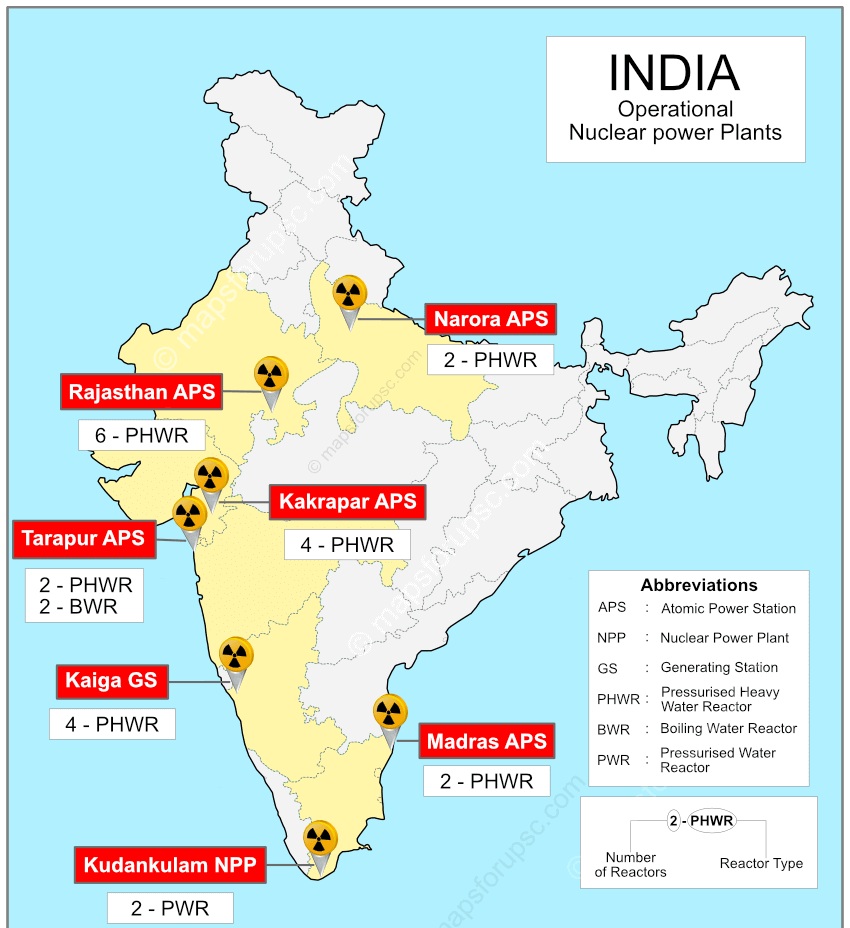
- India currently has 24 reactors across 7 power plants with installed nuclear energy capacity of 8,780 MW comprising 24 nuclear power plants (excluding RAPS-1 – 100 MW). (March 2026)
- The government plans to increase this to 22,480 MW by 2031-32.
- Nuclear power accounts for around 3.1 % of India’s total electricity generation in, making it the fifth-largest Non-fossil fuel source of electricity. (2024–25)
Pradhan Mantri Awaas Yojana – Gramin (PMAY-G) completed 10 years
- Launched in 2016, PMAY-G was restructured from Indira Awas Yojana, which was started in 1996.
Key Features of PMAY-G
- Aim: Provide “Housing for All” in Rural Areas.
- It helps financial assistance to eligible rural households, including houseless families and those living in zero, one, or two-room kutcha houses, to construct pucca homes with basic amenities.
- Targets: Government initially set a target of 2.95 crore houses for FY 2016– 17 to FY 2023–24 and approved continuation for another five years (FY 2024–25 to FY 2028–29) with an additional target of 2 crore houses.
- Financial Assistance: Minimum Unit Size of 25 sq. m. and Rs. 1.20 lakh in plain and Rs 1.30 lakh in hilly states.
- Funding: Cost of unit assistance is to be shared between Central and State Government in the ratio 60:40 in plain areas and 90:10 for North Eastern and the Himalayan States.
- Beneficiary Selection: Using housing deprivation parameters in the Socio Economic and Caste Census (SECC), 2011, which is to be verified by the Gram Sabhas.
- Programme Monitoring: Implementation and monitoring through end to end e-Governance model- Using AwaasSoft and Awaas App.
- Monitoring also through community participation (Social Audit), Member of Parliament (DISHA Committee), Central and State Government officials, National Level Monitors etc.
Reforms in the Scheme
- Direct Benefit Transfer (DBT): Financial assistance is released directly into the beneficiary’s bank account.
- Geo‑tagging of Houses: At every stage of construction, time and date-stamped photographs are uploaded, allowing real-time monitoring of progress.
- Village‑level Functionaries: Each sanctioned house is tagged to a local functionary who follows up with the beneficiary.
- Block and District Inspections: Officers at the block level inspect around 10% of houses, while district officers inspect 2% at each stage of construction.
- Social Audits: Every Gram Panchayat conducts a formal social audit at least once a year.
Nagoya Protocol on Access and Benefit-sharing (ABS)
- India has emerged as the global leader in biodiversity compliance, issuing 3,561 Internationally Recognized Certificates of Compliance (IRCCs), which accounts for over 56% of the total certificates issued worldwide under the Nagoya Protocol.
About Nagoya Protocol on Access and Benefit-sharing (ABS):
- The Nagoya Protocol is a supplementary agreement to the Convention on Biological Diversity (CBD). It provides a transparent legal framework for the effective implementation of one of the three objectives of the CBD: the fair and equitable sharing of benefits arising out of the utilization of genetic resources.
- Adopted in: October 29, 2010, in Nagoya, Japan.
- Entered into Force: October 12, 2014.
Members:
- There are currently 141 parties to the Nagoya Protocol (including 140 UN member states and the European Union).
India and the Nagoya Protocol:
- Signatory: India signed the protocol in 2011 and ratified it in 2012.
- Legal Framework: India implements the protocol through the Biological Diversity Act, 2002, and the Biological Diversity Rules, 2004.
- Authorities: The National Biodiversity Authority (NBA), headquartered in Chennai, acts as the primary body.
Key Features:
- Access Obligations: Creates predictable conditions for access to genetic resources, ensuring Prior Informed Consent (PIC) is obtained from the provider country.
- Benefit-Sharing Obligations: Ensures that benefits (monetary or non-monetary) are shared fairly with the provider country based on Mutually Agreed Terms (MAT).
- Compliance Obligations: Requires parties to take measures to ensure that genetic resources utilized within their jurisdiction have been accessed in accordance with the provider country’s laws.
- Traditional Knowledge: Covers traditional knowledge associated with genetic resources held by indigenous and local communities.
- ABS Clearing-House: An IT platform for exchanging information to help implement the protocol.
Internationally Recognized Certificates of Compliance (IRCCs): What It Is?
- An IRCC is an electronic permit generated through the ABS Clearing-House that serves as official evidence that a user has legally accessed a genetic resource.
- It proves that Prior Informed Consent (PIC) was granted and Mutually Agreed Terms (MAT) were established between the user (e.g., a researcher or company) and the provider (e.g., a local community or national government).
How It Works?
- Application: A user applies to the National Competent Authority (in India, the NBA) for access to a biological resource.
- Agreement: The authority ensures the user has obtained consent (PIC) and negotiated how benefits will be shared (MAT).
- Permit Issuance: Once the national permit is granted, the authority uploads the information to the international ABS Clearing-House.
- Generation of IRCC: The Clearing-House then converts this national permit into an IRCC, making the legal status of that resource visible to all parties globally.
Significance:
- Provides users with clean legal titles to the resources they are using, which is often required for patent applications or product commercialization.
- Allows provider countries to track how their genetic resources are being used across international borders.
Neoloboptera peninsularis
- Researchers have identified Neoloboptera peninsularis, a new cockroach species, in Pune, Maharashtra.
- India Record: It is only the third Neoloboptera species recorded in India and the first cockroach identified using DNA technology.
- Appearance: The species has a glossy, yellowish-brown body with asymmetrical cerci.
- Habitat: It was found in palm shrubs and dry, decaying leaf litter.
- Distribution: N. peninsularis is endemic to Peninsular India.
Centre Notifies Bhavasagara as National Deep-Sea Fauna Repository
- Context (PIB): Ministry of Environment, Forest and Climate Change (MoEFCC) designated “Bhavasagara” Referral Centre as India’s National Repository for Deep-Sea Fauna.
- The recognition was conferred under the provisions of the Biological Diversity Act, 2002.
- Bhavasagara is situated at the Centre for Marine Living Resources & Ecology (CMLRE) in Kochi, Kerala.
- Collection: It holds over 3,500 geo-referenced specimens of identified deep-sea vertebrates and invertebrates for scientific research.
- Custodianship: It is now the legal custodian for preserving the genetic data of newly discovered species within India’s Exclusive Economic Zone (EEZ).
- Significance: The designation strengthens India’s Deep Ocean Mission (DOM) and aligns with the UN Decade of Ocean Science for Sustainable Development (2021–2030).
- CMLRE is a leading national institute dedicated to marine ecosystem research and the conservation of marine biodiversity, operating under the Ministry of Earth Sciences (MoES).
CSIR Transfers Indigenous Bio-Bitumen Technology
- Context (PIB): Council of Scientific and Industrial Research (CSIR) transferred indigenously developed Bio-Bitumen technology for large-scale industry adoption.
- Collaboration: CSIR-Central Road Research Institute (CRRI) and CSIR-Indian Institute of Petroleum (IIP) jointly developed the technology.
- Significance: Industrial adoption will decrease India’s bitumen import costs, while utilising crop residue will aid in reducing stubble burning.
About Bio-Bitumen
- Bio-bitumen is a renewable, low-carbon structural binder made from non-food biomass, such as agricultural and forestry residues.
- It acts as a sustainable substitute for fossil-fuel-based asphalt in road construction applications.
- Composition: Contains lignin polymers, bio-oils, resins, and saturates derived from biomass. Biochar is sometimes incorporated to enhance its hardness and thermal resistance.
- Production Process: Agri-waste undergoes pyrolysis at 400–600°C in oxygen-free conditions to produce bio-oil, which is refined into road-grade bio-bitumen.
- Climate Impact: It lowers lifecycle carbon footprint by 30–40% and greenhouse gas emissions by up to 70% compared to conventional bitumen.
- Key Milestones: India became the first country to produce bio-bitumen commercially; the first national highway section using a 15% bio-bitumen blend was inaugurated on NH-44 in 2024.
IIT Guwahati Develops PCM Bricks for Energy-Efficient Buildings
- Researchers at IIT Guwahati have developed energy-efficient bricks that provide passive cooling for buildings.
- Thermal Stability: The bricks use Phase Change Materials (PCM) to stabilise indoor temperatures.
- Heat Cycle: During the day, the PCM melts to absorb excess heat; as temperatures drop in the evening, it solidifies to release the stored heat gradually.
- PCM Type: OM35, with a melting point of 35°C, was chosen for its suitability in tropical climates.
- Leakage Control: Porous, carbon-rich biochar absorbs and retains molten PCM within the brick matrix.
- Performance: These bricks can lower indoor wall temperatures by about 3°C, potentially reducing cooling energy demands by 10-20%.
Malwan: Anti-Submarine Warfare Shallow Water Craft
- The Indian Navy marked a significant step in its maritime defense capabilities with the official delivery of ‘Malwan’, the second of eight indigenously built Anti-Submarine Warfare Shallow Water Crafts (ASW SWC).
- About Malwan: Anti-Submarine Warfare Shallow Water Craft:
- Malwan is a high-tech, waterjet-propelled warship designed specifically for specialized naval operations in coastal and shallow waters. It is the second vessel in a series of eight ASW SWCs currently being commissioned by the Indian Navy to replace and upgrade its aging fleet.
Developed By:
- Manufacturer: The ship was indigenously designed and constructed by Cochin Shipyard Limited (CSL), Kochi.
- Specifications: It was built to the Indian Navy’s specific requirements and adheres to the Classification Rules of DNV (Det Norske Veritas).
Origin and Legacy:
- Historical Link: The name is derived from the coastal town of Malwan in Maharashtra, which is historically significant for its ties to the maritime heritage of Chhatrapati Shivaji Maharaj.
- Naval Tradition: The vessel continues the legacy of the erstwhile INS Malwan, a naval minesweeper that served the nation until 2003.
- Aim: The primary objective of this craft is to provide the Indian Navy with advanced capabilities for underwater surveillance and specialized combat in littoral (near-shore) zones, where larger submarines or ships might struggle to operate.
Key Features:
- Dimensions: The vessel measures approximately 80 metres in length and has a displacement of 1,100 tons.
- Propulsion: It utilizes advanced Waterjets for high maneuverability in shallow coastal regions.
- Offensive Weaponry: It is armed with torpedoes and multifunctional anti-submarine rockets.
- Sensors and Tech: Equipped with state-of-the-art sensors, including advanced radar and sonar systems for detecting submerged threats.
- Multi-Role Capability: Beyond anti-submarine warfare, it is capable of Low Intensity Maritime Operations (LIMO) and mine warfare.
Significance:
- With over 80% indigenous content, the ship is a major milestone for the ‘Aatmanirbhar Bharat’ (Self-Reliant India) initiative.
- The project successfully integrated systems developed by the domestic defense manufacturing ecosystem, including various MSMEs.
INS Agray
- Context (PIB): ‘Agray’, the fourth Anti-Submarine Warfare Shallow Water Craft (ASW SWC), was recently delivered to the Indian Navy.
- INS Agray is an Arnala-class ASW SWC with over 80% indigenous content, built by Garden Reach Shipbuilders and Engineers (GRSE), Kolkata.
- It is designed for sub-surface surveillance, search-and-attack missions and anti-submarine operations; also supports mine-laying and low-intensity maritime operations (LIMO).
- Arnala-class vessels are the largest water-jet-propelled warships (77 m) in the Indian Navy.
- Speed: It can attain ~25 knots, allowing for high manoeuvrability in shallow waters.
- Weapon Systems: Equipped with indigenous rocket launchers, lightweight torpedoes, a 30 mm Naval Surface Gun, Stabilised Remote-Controlled Guns, and an advanced SONAR suite.
- Significance: The Arnala-class will replace the Abhay-class ASW Corvettes to strengthen coastal anti-submarine capability and advance the Aatmanirbhar Bharat initiative.
Purvanchal Mahotsav ‘Maati-9’ Festival
- Speaker of Lok Sabha addressed the Purvanchal Mahotsav ‘Maati-9’ Festival highlighting the region’s cultural and spiritual heritage.
About Purvanchal Mahotsav ‘Maati-9’ Festival:
- MAATI-9 is a premier cultural festival of the Purvanchal region, centred on the theme Maati (soil).
- It celebrates the deep bond between people and their ancestral roots through heritage, food, tourism, and arts.
- Host: Organised as part of the Purvanchal Mahotsav with participation from cultural groups, artisans, and community representatives.
Aim:
- To preserve and promote the cultural heritage of Purvanchal.
- To strengthen the connection of youth with their regional identity and traditions.
Key Features:
- Cultural Showcase: Folk arts, music, local dialects, and traditional performances of the Purvanchal region.
- Cuisine & Heritage Promotion: Highlights traditional food, crafts, and tourism potential of the region.
- Diaspora Engagement: Recognises contributions of the Purvanchali diaspora in preserving cultural values globally.
Significance:
- Cultural Preservation: Protects local traditions, language, and community identity in a globalised world.
- Economic Opportunity: Promotes cultural tourism, local entrepreneurship, and sustainable regional development.
Launch of First Next Generation Offshore Patrol Vessel (Yard 1280, Shachi)
- The Indian Navy marked a major indigenous shipbuilding milestone with the launch of Shachi (Yard 1280), the first of eleven Next Generation Offshore Patrol Vessels (NGOPVs), at Goa Shipyard Limited.
What It Is?
- Shachi is the lead ship of the Next Generation Offshore Patrol Vessel (NGOPV) The name is derived from Indian mythology, meaning one who renders assistance. These vessels are designed to be highly versatile, indigenously built platforms that will significantly augment the Indian Navy’s existing fleet of ten Offshore Patrol Vessels.
Built By:
- The construction of the eleven-ship NGOPV project is being undertaken concurrently at two major Indian shipyards:
- Goa Shipyard Limited (GSL), Goa: Builder of the first ship, Shachi.
- Garden Reach Shipbuilders & Engineers (GRSE), Kolkata: Working on subsequent vessels in the class.
- Aim: The primary objective of the NGOPV project is to strengthen India’s maritime security by providing advanced platforms capable of performing multi-domain operations.
Key Features:
- Indigenous Design: The ships are entirely designed and built within India, showcasing domestic engineering capabilities.
- Multi-Domain Versatility: Capable of executing a wide array of missions, including:
- Defence and Surveillance: Monitoring maritime boundaries and territorial waters.
- Search and Rescue (SAR): Conducting life-saving operations at sea.
- Protection of Offshore Assets: Guarding critical infrastructure like oil rigs and pipelines.
- Humanitarian Assistance and Disaster Relief (HADR): Providing rapid aid during natural calamities.
- Anti-Piracy Missions: Securing sea lanes against maritime crime.
- Symbolic Identity: The crest design of the NGOPV class features the Ursa Major constellation and a red and white lighthouse, symbolizing guidance and vigilance.
Significance:
- The project is a major step in the Indian Navy’s pursuit of indigenous shipbuilding, reducing reliance on foreign hardware.
- The launch is in strict consonance with the Government of India’s Aatmanirbhar Bharat (Self-Reliant India) and Make in India initiatives.
Nyaya Setu AI Chatbot
- The Vice-President of India and the Minister of Law and Justice unveiled the Nyaya Setu AI Chatbot and its official mascot, Dishika, during the DISHA programme.
About Nyaya Setu AI Chatbot:
- Nyaya Setu is a voice-first, multimodal, and multilingual AI-powered legal assistant. It serves as a comprehensive digital bridge designed to simplify complex legal information for citizens.
- Developed By: The platform was built and is owned as a turnkey AI implementation by the Digital India BHASHINI Division (DIBD).
- Aim: The primary goal of Nyaya Setu is to democratize access to justice by ensuring that language and procedural complexities are no longer barriers for citizens seeking to understand their legal rights and processes.
How It Works?
- End-to-End Voice Stack: The platform enables seamless, voice-led user journeys by integrating a complete AI stack.
- Speech Recognition: It utilizes BHASHINI ASR (Automatic Speech Recognition) to understand spoken queries in various Indian languages.
- Conversational AI: It processes these queries through multilingual Natural Language Processing (NLP) systems to provide context-aware responses.
- Legal Guardrails: The AI is trained on frameworks such as the BNS (Bharatiya Nyaya Sanhita) to ensure responses are safe, responsible, and legally sound.
Key Features:
- Multilingual Support: Offers services across 36 text and 23 voice languages, including complex tribal dialects.
- Voice-First Design: Prioritizes voice interactions to assist users who may face literacy or linguistic challenges.
- Turnkey Implementation: Demonstrates a ready-to-use, scalable digital public infrastructure for justice delivery.
- Real-Time Processing: Capable of handling millions of daily inferences to provide immediate legal guidance.
About Mascot DISHIKA:
- Dishika is the official mascot and friendly digital interface of the Nyaya Setu AI Chatbot.
- Aim: The mascot is designed to enhance user engagement, trust, and accessibility, acting as a supportive guide for individuals—especially first-time users—navigating the complexities of the Indian justice system.
Features:
- Friendly Interface: Provides a welcoming and non-intimidating digital presence.
- Guided Navigation: Leads users through legal queries and explains the next steps in a simplified manner.
- Trust Builder: Helps bridge the gap between citizens and formal legal structures through interactive and relatable digital assistance.
7th round of Foreign Office Consultations between India and Algeria
- The 7th round of Foreign Office Consultations between India and Algeria was held in Algiers where both nations agreed to strengthen parliamentary cooperation and combat terrorism.
About Algeria:
- Algeria is the largest country in Africa and the Arab world by land area. It is a sovereign North African nation with a rich history, serving as a gateway between Africa and Europe.
Located In:
- Region: North Africa (The Maghreb).
- Coastline: It has a long northern coastline along the Mediterranean Sea.
- Capital: Algiers.
Bordering Nations:
- Tunisia: To the northeast.
- Libya: To the east.
- Niger: To the southeast.
- Mali and Mauritania: To the southwest.
- Western Sahara: To the west.
- Morocco: To the northwest.
Key Geological Features:
- The Sahara Desert: Covers more than 80% of the country’s territory in the south.
- Atlas Mountains: Two parallel ranges (Tell Atlas and Saharan Atlas) run across the north, separated by high plateaus.
- Ahaggar Mountains (Hoggar): A highland region in central Sahara with dramatic volcanic peaks.
- Tell Region: The fertile coastal strip along the Mediterranean where most of the population resides.
Significance to India:
- Algeria is a major producer of oil and natural gas, making it a strategic partner for India’s energy diversification.
- As a source of phosphates and urea, Algeria is critical for India’s food security and agricultural sector.
- Bilateral trade is growing (currently 1.7 billion dollars) with significant opportunities in pharmaceuticals, mining, and higher education.
New Income Tax Act 2025 comes into effect from April 1, 2026
- Income Tax Act, 2025 replaces the six-decades-old Income Tax Act, 1961 with objective to enhance predictability, transparency, reduce compliance burden, and offer taxpayers a streamlined and simplified tax filing process.
Key provisions of the Act
- Simpler language and Framework: Act has been condensed from 819 to 536 Sections, and 390 to 190 Forms.
- Provisions of Minimum Alternate Tax (MAT) and Alternate Minimum Tax (AMT) have been separated into two sub-sections.
- MAT bring into the tax net "zero tax companies" which in spite of having earned substantial book profits and having paid handsome dividends, do not pay any tax due to various tax concessions and incentives provided under the Income-tax Law.
- AMT has similar provisions as MAT which is applicable to non-corporate tax payers.
- The provisions of MAT are applicable to a corporate taxpayer only.
- "Tax Year" Concept: The traditionally separate concepts of Financial Year (FY) and Assessment Year (AY) have been merged into a single, unified term: "Tax Year".
Stability in Core Tax Elements
- Tax rates and regimes for individuals and corporations remain unchanged.
- There are no changes in offences and penalties.
- Most definitions have also been retained.
- Faceless collection of information and assessment of tax cases.
- Undisclosed Income: The definition of undisclosed income for assessing search cases, which previously included money, bullion, jewellery, or other valuable articles, is expanded to include virtual digital assets.
- Virtual Digital Space Access: Income tax authorities are now allowed to gain access to a virtual digital space during search and seizure proceedings.
- A "virtual digital space" is defined broadly to include email servers, social media accounts, online investment and trading accounts, and websites for storing details of asset ownership.
India’s Disaster Funding Framework under 16th Finance Commission
- India’s disaster funding framework underwent a structural overhaul under the 16th Finance Commission (2026-31)
Disaster Funding Formula under 16th Finance Commission
- Model Shift: The earlier additive disaster-funding model was replaced by a multiplicative Disaster Risk Index (DRI).
- Formula: DRI measures state disaster risk as a purely multiplicative formula: Hazard (H) × Exposure (E) × Vulnerability (V).
- Hazard (H): Historical frequency and severity of 10 specific natural disasters.
- Exposure (E): Projected population for October 2026, used as a proxy for lives, assets, and infrastructure at risk.
- Vulnerability (V): Per-capita Net State Domestic Product (NSDP); lower-income states score higher due to their limited fiscal cushion.
- DRI Logic: States with equal risk (H × E × V) receive identical DRI allocations. The formula does not adjust funding based on a state’s institutional readiness.
Financial Allocation
- Total Corpus: ₹2,04,401 crore was allocated for state-level disaster management over five years, a 27.6% increase over the 15th Finance Commission.
- Fund Split: The corpus is split 80:20 between the State Disaster Response Fund (SDRF) and the State Disaster Mitigation Fund (SDMF).
- Centre-State Ratio: The Centre-State funding ratio is 75:25 for general category states and 90:10 for NE and Himalayan states.
- Release Terms: Funds are released in two equal annual instalments, provided that states validate disaster data via the National Disaster Management Information System (NDMIS) portal.
- Withholding Rule: If a state’s unspent SDRF balance exceeds its past three years’ annual allocation, the Centre may withhold further releases until the balance drops.
- State Flexibility: States may use up to 10% of their SDRF for locally severe disasters not covered under the nationally notified list.
Key Structural Changes
- New Disasters: Heatwaves and lightning were added to the nationally notified disaster list, allowing states to access central funds for both.
- Discontinued Grants: Revenue Deficit Grants and sector-specific grants were discontinued. All state disaster funding now flows through the disaster management corpus.
- Mitigation Priority: Funding for Preparedness and Capacity Building shifted from the SDRF to the SDMF, prioritising proactive risk reduction over post-event response.
Issues with Disaster Funding under 16th Finance Commission
- Population Bias: Population-based Exposure (E) weighting reduces fiscal support for sparsely populated zones facing extreme ecological risks.
- Climate Blind Spot: Static historical averages for the Hazard (H) variable fail to account for the nonlinear acceleration of modern climate-induced disasters.
- Digital Bottlenecks: Mandatory NDMIS data validation disadvantages technologically lagging states, risking aid delays during active emergencies.
- Administrative Friction: The withholding rule does not account for legitimate delays such as procurement cycles and seasonal weather windows.
- Safety-Net Erosion: Discontinuing Revenue Deficit Grants removes the primary fiscal cushion for mountain states with permanent structural vulnerabilities.
Proposed Reforms for Disaster Funding
- Ecological Weighting: Replace population proxies in Exposure (E) with ecological risk factors to ensure sparsely populated, high-risk zones receive adequate fiscal support.
- Efficiency Rewards: Reintroduce Capacity (C) into the DRI as a positive multiplier to incentivise states for institutional disaster preparedness.
- Dynamic Modelling: Incorporate predictive climate simulations alongside historical averages to account for the non-linear acceleration of modern disasters.
- Equalisation Grants: Establish a dedicated Climate Resilience Grant for mountain states to replace the fiscal cushion lost with the removal of Revenue Deficit Grants.
- Risk Pooling: Develop a National Disaster Insurance Pool to reduce the direct fiscal burden on state budgets for high-magnitude catastrophes.