|
Balancing Religious Sentiments with Fundamental Rights
GS Paper I — Society GS II — Fundamental Rights
Why in News?
Punjab''s stringent legislation concerning acts of sacrilege against the Guru Granth Sahib has renewed debate over religious sentiments, secularism, freedom of expression and social reform.
Significance
- Freedom of religion : Article 25 protects freedom of conscience and religion.
- Freedom of speech : Article 19(1)(a) protects expression, subject to reasonable restrictions.
- Public order : Religious offences may have implications for communal harmony.
Impact
- Legal protection: Strengthens protection against deliberate acts targeting sacred religious objects.
- Constitutional concern: Excessively broad restrictions may affect legitimate speech, criticism and academic discussion.
Challenges
- Intent vs perception: Distinguishing deliberate religious insult from accidental or unintended acts can be difficult.
- False complaints: Stringent provisions may be misused to target individuals or settle personal disputes.
- Constitutional balance: Laws must balance protection of religious sentiments with Article 19(1)(a) freedom of speech and expression. India''s legal framework already places emphasis on deliberate and malicious intent in religious-insult offences.
Way Forward
- Legal certainty: Clearly define what constitutes sacrilege or religious insult.
- Intent requirement: Punishment should focus on intentional and malicious acts, rather than mere offence caused.
- Prevent arbitrary action: Ensure fair investigation, evidence-based prosecution and judicial oversight.
- Academic freedom: Laws should not be used against genuine criticism, research, literature or scholarship.
|
|
Deemed Distribution Licence
GS Paper II — Governance Energy Regulation Digital Infrastructure
Why in News?
The Andhra Pradesh Government proposed a Deemed Distribution Licence (DDL) for large hyperscale AI data centres, including the proposed Google–Adani data-centre project in Visakhapatnam. The proposal has faced legal and civil concerns.
What is DDL?
A DDL allows an entity to be treated as an authorised electricity distributor within a specified area without going through the normal distribution-licensing process.
Aim
- Meet huge electricity demand of AI data centres.
- Allow direct procurement of renewable power.
- Build dedicated electricity infrastructure.
- Attract large technology investments.
About
- Nodal Ministry: Ministry of Power, Government of India
- Regulatory framework: Electricity Act, 2003
- Key regulators: Central Electricity Regulatory Commission (CERC) and State Electricity Regulatory Commissions (SERCs).
Significance
- AI infrastructure : Hyperscale data centres require reliable, continuous power.
- Green transition: Enables direct renewable-energy procurement through PPAs and exchanges.
- Investment : Can make Andhra Pradesh more attractive for large technology projects.
|
|
Fiscal Outlook
GS Paper III — Economy Fiscal Policy Centre-State Relations
Why in News?
The Centre''s fiscal position is facing geopolitical and revenue pressures, while strong non-tax receipts and front-loaded capital expenditure are providing some cushion.
Aim
Maintain: Fiscal stability , economic growth , public investment.
Fiscal Deficit
- What is it? : Fiscal deficit is the excess of the government''s total expenditure over its total receipts excluding borrowings.
- Formula: Fiscal Deficit = Total Expenditure − Total Receipts (excluding borrowings)
Capital Expenditure
- what is it? : Capital expenditure (Capex) creates assets or improves the productive capacity of the economy.
- Central capex increased by 23.7% in Q1 FY27.
Significance
- Fiscal consolidation : Government aims to maintain fiscal discipline.
- Capital expenditure : Public investment supports infrastructure and economic activity.
- Macroeconomic stability : Fiscal management helps control borrowing and debt pressures.
Positive
- Higher public capex can stimulate private investment.
- Strong non-tax revenues provide fiscal support.
Challenges
- Revenue pressure : Tax rationalisation can reduce short-term receipts.
- Cesses : Non-shareable cesses can reduce the divisible tax pool for States.
- External shocks :Energy-price and currency volatility can raise fiscal pressures.
Way Forward
- Tax base : Expand compliance and formalisation.
- Capex : Maintain productive infrastructure investment.
- Federal finance : Ensure predictable transfers to States.
- Risk management : Use commodity and currency hedging where appropriate.
|
|
Friedreich’s Ataxia
GS Paper III — Science Health
Why in News?
Friedreich’s Ataxia (FRDA) was recently in the news amid new research and therapeutic developments aimed at addressing the underlying FXN/frataxin deficiency in this rare genetic disorder.
About
A rare inherited neurodegenerative disorder affecting coordination and movement.
- Rare genetic disorder : caused by mutations involving the FXN gene.
- Mitochondrial dysfunction : reduced production of frataxin affects cellular energy processes.
- Progressive disorder : primarily affects the nervous system and can also affect the heart.
- Emerging therapies : gene therapy, gene editing and frataxin-restoring approaches are being investigated.
|
Feature
|
FRDA
|
|
Full name
|
Friedreich’s Ataxia
|
|
Nature
|
Rare inherited genetic disorder
|
|
Gene
|
FXN
|
|
Inheritance
|
Autosomal recessive
|
|
Key protein
|
Frataxin
|
|
Major systems affected
|
Nervous system + heart
|
|
Key feature
|
Progressive loss of coordination (ataxia)
|
|
|
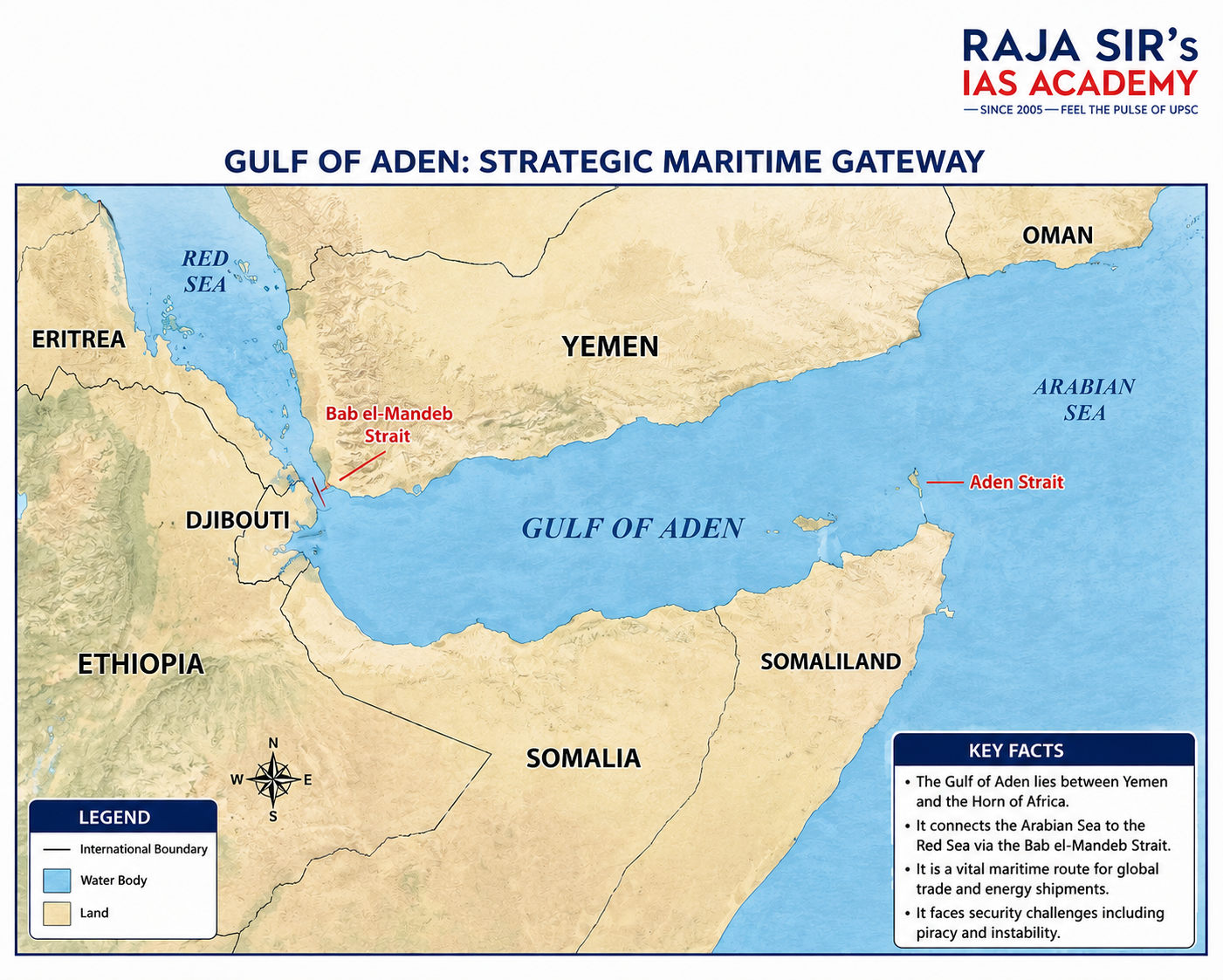
Gulf of Aden
GS Paper I/II — Geography | International Security
Location :
The Gulf of Aden lies between: Yemen — Arabian Peninsula, Somalia — Horn of Africa
Significance
Maritime Trade
- Connects the Arabian Sea with the Red Sea through the Bab-el-Mandeb Strait.
- Forms an important route for global shipping.
Strategic Importance
- Links the Indian Ocean with the Mediterranean Sea through the Red Sea and Suez Canal.
- Important for movement of energy and commercial goods.
Maritime Security
- Vulnerable to piracy, armed attacks and maritime insecurity.
- Security in the region is crucial for uninterrupted international shipping.
|
|
HUQUE-3 Y2 REUSABLE LAUNCH VEHICLE
GS Paper III — Science & Technology Space
About
Zhuque-3 is a reusable launch vehicle designed for repeated space launches.
Significance
Space Economy
- Lower Launch Costs: Reusability can reduce the cost of repeated space launches.
- Higher Efficiency: Recovered hardware can be used again instead of being discarded.
Technology
- Precision Landing: Enables controlled recovery of the launch vehicle.
- Advanced Propulsion: Required for efficient take-off, manoeuvring and landing.
- Thermal Protection: Protects the vehicle during atmospheric re-entry.
Global Competition
- Strategic Technology: Reusable launch systems are becoming a key area of global space competition.
- Commercial Space: Countries with reusable systems can gain an advantage in the growing space-launch market.
Impact
- Cost Reduction: Can reduce the marginal cost of subsequent launches.
- Launch Frequency: Faster turnaround can enable more frequent launches.
- Commercial Space : Strengthens the commercial space ecosystem.
Challenges
- Safe Recovery : Vehicle must withstand high-speed re-entry and land precisely.
- Refurbishment : Recovery is useful only if refurbishment is faster and cheaper than building a new vehicle.
- Repeated-Use Reliability : Components must remain reliable across multiple missions.
- High R&D Costs : Development of reusable systems requires substantial investment in technology, testing and infrastructure.
Way Forward
- Strengthen RLV Programmes : Accelerate development and testing of Reusable Launch Vehicles (RLVs).
- Indigenous TPS : Develop advanced indigenous Thermal Protection Systems for repeated re-entry.
- Autonomous Landing : Improve precision navigation, guidance and autonomous landing technology.
- Private-Sector Participation : Encourage startups and private companies to participate in reusable launch technology and the wider space ecosystem.
|
|
Kikuchi–Fujimoto Disease
GS Paper III — Science Health
Why in News?
A 32-year-old man from Visakhapatnam was recently diagnosed with Kikuchi–Fujimoto Disease (KFD) after suffering from recurrent lymph-node swelling for nearly six years and being repeatedly treated for suspected tuberculosis.
About
A rare, generally self-limiting condition involving lymph nodes, particularly cervical lymph nodes.
- Also called: Histiocytic necrotizing lymphadenitis
- Nature: Rare inflammatory lymph-node disorder
- Common site: Cervical lymph nodes
- Cause: Not clearly established
- Usually: Self-limiting
- Can mimic: Tuberculosis and lymphoma.
|
|
NATIONAL MEDICAL COMMISSION — NMC
GS Paper II - Governance
About
NMC is India''s apex statutory regulatory body for medical education and the medical profession.
Aim
- Improve quality of medical education.
- Regulate medical institutions.
- Establish standards for medical professionals.
- Promote ethical medical practice.
Significance
- Healthcare quality : Better medical education ultimately improves healthcare delivery.
- Regulation : Creates national standards.
Impact
- Greater Standardisation of Medical Education : Establishes common standards for medical education across institutions. Promotes greater uniformity in curriculum, training and assessment.
- Stronger Regulatory Oversight : Strengthens monitoring of medical colleges and medical education standards.
Challenges
- Doctor Shortages : Insufficient availability of doctors can affect access to quality healthcare, particularly in underserved areas.
- Regional Disparities : Unequal distribution of medical colleges and healthcare professionals creates differences in healthcare access across regions.
- Infrastructure Differences : Medical colleges vary in terms of facilities, equipment, hospitals and teaching resources.
Way Forward
- Strengthen Accreditation : Ensure medical colleges meet uniform quality and infrastructure standards.
- Expand Medical Education in Underserved Regions : Encourage new medical institutions in underserved and remote areas.
- Improve Faculty and Infrastructure : Strengthen teaching faculty, laboratories, hospitals and clinical-training facilities.
- Maintain Transparent Regulation : Ensure transparent, objective and consistent regulatory processes.
|
|
New definition of “Industry”
GS Paper II — Governance Labour Laws Judiciary
Why in News?
The Supreme Court ruled that the definition of “industry” under the Industrial Relations Code, 2020 must be interpreted independently and is not automatically governed by the 1978 Bangalore Water Supply judgment.
Background
The Bangalore Water Supply and Sewerage Board v. R. Rajappa (1978) judgment adopted a broad interpretation of “industry” under the Industrial Disputes Act.
Definition
Under Section 2(p) of the Industrial Relations Code, 2020, an industry means:
A systematic activity carried out through cooperation between employer and worker for the production, supply or distribution of goods or services to satisfy human wants or wishes, excluding purely spiritual or religious wants.
Significance
- Labour rights : Determines which establishments fall under industrial-relations protections.
- Judicial interpretation : Shows how new legislation may require fresh statutory interpretation.
- Employment : Can affect employers and workers covered by the Industrial Relations Code.
Impact
- May change the scope of establishments covered by labour protections.
- Creates greater clarity under the new labour-code framework.
Challenges
- Transition from old labour jurisprudence.
- Uncertainty for establishments.
- Balancing worker protection with ease of doing business.
Way Forward
- Clear rules under the new Code.
- Consistent judicial interpretation.
- Protect legitimate worker rights while reducing regulatory ambiguity.
|
|
One Day, One University
GS Paper II — Education Higher Education
Why in News?
The Centre is planning a nationwide “One Day, One University” outreach programme, under which a Union Minister would visit a university each day and interact directly with students.
Aim
Promote greater visibility and interaction with India''s universities by highlighting their:
- Research
- Innovation
- Academic achievements
- Institutional strengths
Significance
- Higher education : Encourages universities to showcase research and innovation.
- Knowledge economy : Connects academic institutions with broader society.
Impact
- National recognition: Highlights the university''s research and academic achievements.
- Innovation focus: Encourages students and institutions to undertake quality research and innovation.
- Knowledge transfer: Greater visibility can facilitate industry partnerships, internships and commercialisation of research.
Challenges
- Resource gap: Differences in faculty, infrastructure and research funding may create unequal participation.
- Quality concern: The initiative should focus on measurable research outcomes rather than becoming merely a promotional exercise.
Way Forward
- Outcome-based assessment: Measure universities through research quality, innovation and impact.
- Collaborative research: Strengthen links between universities and industries for innovation and skill development.
- Knowledge sharing: Create platforms to take successful university innovations to government, industry and society.
|
|
Putting the Child at the Centre
GS Paper II – Social Justice Child Rights Governance
Why in News?
The Central Adoption Resource Authority (CARA) is reviewing the Adoption Regulations, 2022 to address legal, procedural and implementationrelated bottlenecks, with particular attention to improving adoption of children with special needs, including those with treatable medical conditions.
What is CARA?
CARA is the statutory apex body and nodal authority for adoption of Indian children, functioning under the Ministry of Women and Child Development (MWCD).
It was established in 1990 and received statutory status under Section 68 of the Juvenile Justice (Care and Protection of Children) Act, 2015.
Key Functions
- Regulates incountry and intercountry adoption.
- Frames and updates adoption regulations.
- Coordinates with State Adoption Resource Agencies (SARAs) and Specialised Adoption Agencies (SAAs).
- Operates the CARINGS digital platform for adoptionrelated processes.
- Monitors adoption agencies and promotes ethical adoption.
- Acts as India''s Central Authority for intercountry adoption under the 1993 Hague Convention.
Significance
- Childcentric adoption : Ensures that the best interests of the child remain central to adoption.
- Prevention of trafficking : Regulated procedures reduce the possibility of illegal adoption and child trafficking.
- Transparency : Digital systems such as CARINGS provide a structured adoption process.
- Special needs children : Greater focus on children with disabilities and medical needs can reduce their prolonged stay in institutional care.
Positive
- Greater transparency and accountability.
- Standardised adoption procedures.
- Better protection of vulnerable children.
- Potentially greater adoption of older and specialneeds children.
Concern
- Procedural delays can discourage prospective adoptive parents.
- Complex intercountry adoption procedures may create administrative difficulties.
Challenges
- Procedural delays in adoption.
- Limited demand for older children and children with special needs.
- Coordination problems among multiple agencies.
- Balancing child protection with speedy adoption.
- Intercountry adoption involves additional legal and diplomatic requirements.
Way Forward
- Simplify procedures without weakening safeguards.
- Strengthen digital monitoring through CARINGS.
- Improve counselling and support for prospective adoptive parents.
- Create greater awareness regarding adoption of older and specialneeds children.
- Strengthen postadoption support and monitoring.
|
|
Safeguarding Spacecraft During Re-entry
GS Paper III — Space Technology
Why in News?
The Thermal Protection System (TPS) was highlighted in the context of India''s space missions and reusable/re-entry spacecraft.
What is TPS?
A TPS protects a spacecraft from the extreme heat generated during atmospheric re-entry.
Aim : Prevent spacecraft structures from overheating and failing during re-entry.
Significance
- Human Spaceflight: Ensures crew safety during atmospheric re-entry.
- Reusable Spacecraft: Enables safe repeated re-entry of spacecraft.
Impact
- Re-entry Safety: Protects spacecraft from extreme heat.
- Reusable Launch Vehicles: Supports repeated use of spacecraft.
- Human Spaceflight: Strengthens India''s human-spaceflight capabilities.
Challenges
- Extreme Temperatures: Re-entry generates intense heat.
- Material Degradation: Repeated thermal stress can damage TPS materials.
- Weight Constraints: TPS must be lightweight without compromising protection.
- Repeated-use Reliability: Must remain effective across multiple missions.
Way Forward
- Advanced Materials: Develop lightweight, heat-resistant materials.
- Testing Infrastructure: Improve thermal and re-entry testing facilities.
- Indigenisation: Strengthen indigenous TPS technology.
- Integrated Design: Incorporate TPS from the early stages of reusable-spacecraft design.
|
|
Securing the Seas
GS Paper III — Internal Security Maritime Security
Why in News?
The Coast Guard Global Summit (CGGS) was included in the 21 August Prelims section.
Significance
- Maritime security : Strengthens international cooperation against maritime threats.
- Search and Rescue : Encourages cooperation in maritime emergencies.
- Blue economy : Supports secure maritime trade and economic activity.
Impact
- Better Information Sharing : Greater exchange of maritime intelligence and operational information among participating coast guards.
- Greater Coordination : Improves coordination among different coast guard agencies during maritime emergencies, search-and-rescue operations and security incidents.
- Strengthened Maritime Domain Awareness : Better sharing of information helps countries maintain awareness of vessels, activities and potential threats at sea.
Challenges
- Transnational Maritime Crime : Criminal networks operate across national maritime boundaries, making unilateral action difficult.
- Piracy : Piracy threatens commercial shipping, crew safety and maritime trade.
- Illegal Fishing :Illegal, unreported and unregulated (IUU) fishing can undermine marine resources and coastal livelihoods.
- Jurisdictional Differences : Different national laws, maritime jurisdictions and enforcement capacities can make coordinated action difficult.
Way Forward
- Information-Sharing Networks : Develop stronger mechanisms for real-time maritime information and intelligence sharing.
- Joint Exercises : Conduct regular joint exercises and coordinated operations to improve interoperability.
- Maritime Surveillance : Strengthen coastal radar, satellite monitoring and other maritime surveillance capabilities.
- Capacity Building : Provide training, technology and institutional support to developing countries to strengthen their maritime-security capabilities.
|
|
South Korea''s plastic waste management
GS Paper III — Environment Waste Management
Why in News?
South Korea''s plastic-waste management system was highlighted as a potential model for improving recycling and resource recovery.
Aim
- Move from: Plastic waste → disposal
- Towards: Plastic waste → segregation → recycling → resource recovery
What is the Core Issue?
Recycling vs Recovery
South Korea historically counted thermal treatment for energy recovery within its broader recycling statistics.
South Korea''s EPR System
What is EPR?
- Extended Producer Responsibility (EPR) makes producers responsible for the environmental impact of their products and packaging after consumption.
- South Korea introduced EPR on 1 January 2003.
How does it work?
- Producer/Importer → Pays EPR obligation → KPRC → KORA → Collectors/Sorters/Recyclers
- Around 6,300 companies were covered in 2022.
- Producers pay according to: Quantity sold, Mandatory recycling rate, Cost per kg
- Around 80–90% of producer payments reaches collection, sorting and recycling stakeholders.
Significance
- Producer Responsibility : Makes producers financially responsible for the waste generated by their products.
- Municipal Financing : Producer money also supports local governments and collection operators, strengthening waste collection.
- High Recycling Obligations : Mandatory recycling rates are relatively high, reaching around 79–90% for several major packaging streams.
- Accountability : Producer obligations and costs are based on published rates and costperkg figures, making the system comparatively transparent.
Challenges
- Definition of Recycling : The biggest challenge is distinguishing material recycling ≠ Thermal recovery burning plastic for energy does not return the material into the production cycle.
- Plastic Waste Growth : Plastic waste remains high despite extensive wastemanagement infrastructure.
- Low Actual Material Recycling : The 2021 study cited in the source found only 16.4% material recycling of the household plastic examined.
- Economic Viability : Recyclers remain exposed to fluctuations in the market value of recycled plastic.
- Weak Targets : South Korea''s newer roadmap has been criticised because reductions are increasingly measured against projected future waste, rather than a clear historical baseline.
Way Forward
- Separate Recycling Categories Clearly distinguish: Material recycling → Reuse of plastic material from Energy recovery → Burning/incineration
- Strengthen EPR : Make producers financially responsible for the actual endoflife outcome, not merely collection.
- Transparent Targets : Targets should be measured against actual historical baselines, not only projected future waste.
What India Can Learn
What India Should Adopt
- High producer responsibility
- Published materialwise costs
- Strong auditing
- Municipal financing through EPR
- Clear producer obligations
What India Should Avoid
- Counting burning as material recycling
- weak or stagnant EPR fees
- Targets based mainly on projections
- Measuring success only by collection
|
|
Truth on the Plate: Regulating Food Claims and Consumer Protection
GS Paper II — Governance Consumer Protection
Why in News?
The Food Safety and Standards (Advertising and Claims) Regulations, 2018 appeared in the focus.
Aim : Prevent misleading claims in food advertising and labelling.
Significance
- Consumer Protection : Helps consumers make informed choices.
- Public Health :Controls exaggerated health and nutritional claims.
- Market Accountability : Promotes truthful and transparent advertising.
Impact
- Consumer Awareness : Reduces misleading food marketing.
- Transparency : Improves the reliability of information provided on food products.
Challenges
- Misleading Marketing : Innovative marketing techniques can make claims difficult to assess.
- Digital & Influencer Advertising : Online promotions can spread misleading claims rapidly.
- Verification of Health Claims : Some nutritional and health claims require scientific assessment.
Way Forward
- Stronger Monitoring : Improve monitoring of food advertisements and labels.
- Digital Oversight : Strengthen regulation of online and influencer-based advertising.
- Scientific Verification : Ensure health and nutritional claims are backed by scientific evidence.
- Consumer Awareness : Promote awareness about misleading food claims and labelling.
What is FSSAI?
- FSSAI is India''s apex statutory authority responsible for regulating and supervising food safety.It was established under the Food Safety and Standards Act, 2006.
- Ministry : Ministry of Health & Family Welfare.
- Headquarters: New Delhi.
|