|
A Decade of Banking the Unbanked
GS II Governance
Why in News?
PMJDY (Pradhan Mantri Jan Dhan Yojana ) completed 12 years since its launch in 2014. It is India''s flagship financial-inclusion programme.
Significance
- Financial inclusion : Provides formal banking access to previously unbanked citizens.
- JAM architecture : Jan Dhan accounts form the banking foundation of the Jan Dhan–Aadhaar–Mobile Trinity.
- Women empowerment : A substantial majority of accounts are held by women, improving their direct access to formal finance.
- Rural inclusion : Large-scale coverage of rural and semi-urban areas brings banking closer to underserved populations.
- Digital financial ecosystem : RuPay cards and digital payments help integrate low-income households into formal financial systems.
- Social-security delivery : Facilitates access to DBT, insurance and pension schemes.
Impact
- Before PMJDY - Exclusion → informal finance → leakages → high transaction costs
- After PMJDY - Bank account → Aadhaar/mobile linkage → DBT → reduced intermediaries → greater transparency
Major Challenges
- Dormant / Pass-through Accounts : Many Jan Dhan and basic bank accounts remain inactive or are used only to receive government transfers.
- Low Utilisation of Overdraft Facilities : Basic accounts may provide overdraft facilities, but many beneficiaries do not use them.
- Weak Business Correspondent (BC) Infrastructure : Bank Mitras/Business Correspondents are crucial for taking banking services to remote villages.
- Digital Illiteracy and Cyber Fraud : Increasing digital payments expose first-time users to phishing, fake links, OTP fraud and other cyber scams.
- Limited Access to Productive Credit : Having a bank account does not automatically ensure access to affordable credit.
- Sustainability Concerns for Banks : Very low-balance accounts generate limited revenue for banks while still requiring costs for account maintenance, customer service and transaction infrastructure.
Way Forward
- Access → Usage : Encourage beneficiaries to use accounts for payments, savings, remittances and other financial services.
- Strengthen Bank Mitra Networks : Improve the availability, connectivity, training and reliability of Business Correspondents/Bank Mitras.
- Improve Rural Digital & Financial Literacy : Teach people how to use UPI and digital banking, ATMs, Insurance products, Credit facilities, Cybersecurity precautions
- Expand Micro-Credit and Micro-Insurance : Link financially excluded households with small, affordable and productive credit.
|
|
Digital Panchayats
GS-II | Panchayati Raj | Digital Governance
Why in News?
The Ministry of Panchayati Raj has encouraged citizens, CSR entities and members of the diaspora to contribute computers to eligible Gram Panchayats.
What is DAANVEER?
DAANVEER is an initiative associated with the Ministry of Panchayati Raj that encourages citizens, CSR organisations and the Indian diaspora to donate computers and other digital equipment to verified Gram Panchayats that lack adequate IT infrastructure.
Core idea
Voluntary donation + Digital infrastructure → Stronger Gram Panchayat-level e-governance
Significance :
- Target Beneficiaries : The initiative focuses on Gram Panchayats with inadequate digital/IT infrastructure.
- Meri Panchayat App : The initiative is linked with the Meri Panchayat App, which is designed to improve citizens'' access to information about Panchayats and promote transparency and participation.
- DigiHaat / ONDC Ecosystem : The initiative uses the DigiHaat/ONDC ecosystem to facilitate the donation and delivery process.
|
|
Flood Dynamics in the Ganga Basin
GS I Geography
Why in News?
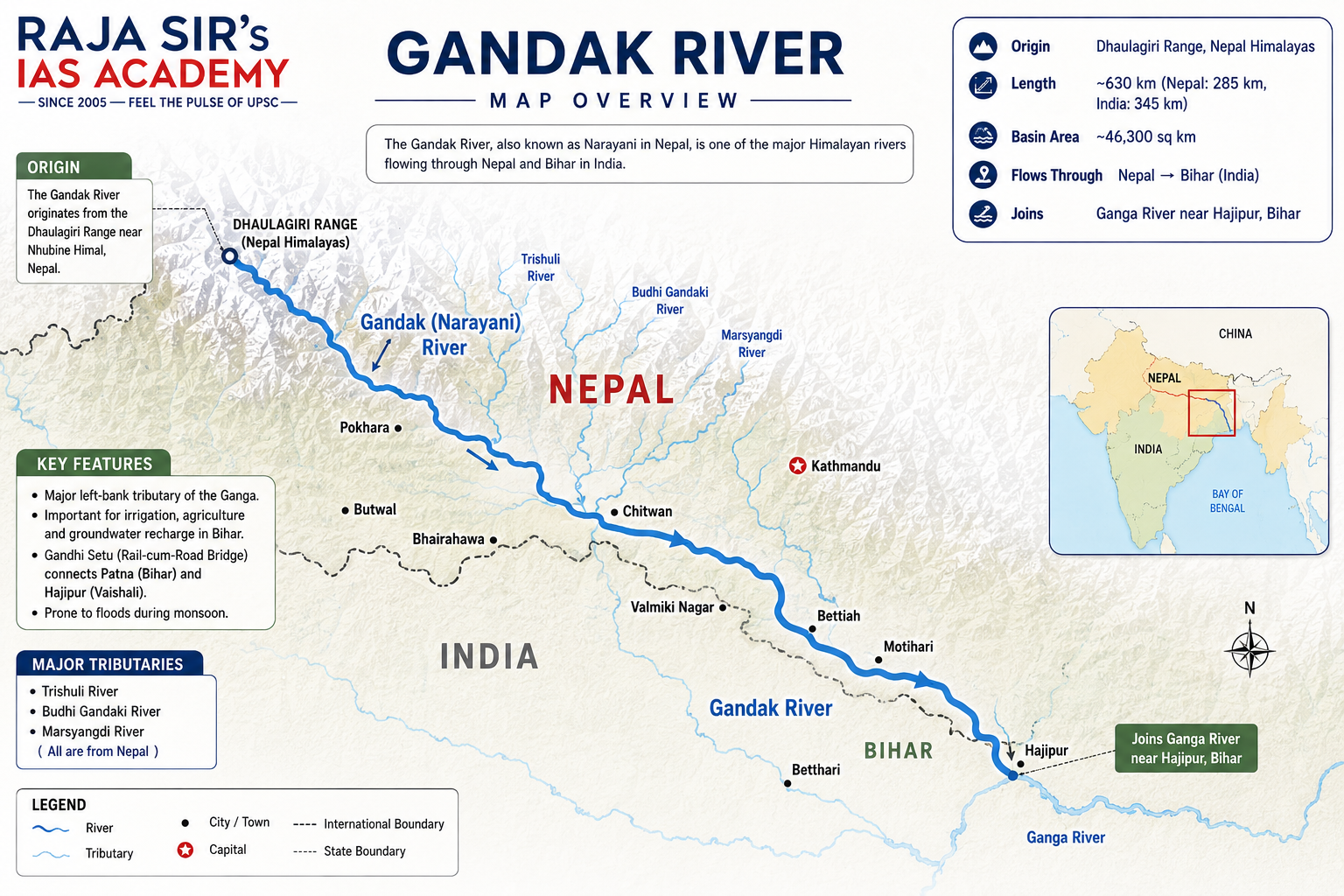
Recent flash floods in Nepal raised water levels in the Narayani–Gandak river system, creating flood concerns in downstream areas of Bihar and Uttar Pradesh.
What is the Gandak?
- The Gandak is a major Himalayan river and an important tributary of the Ganga.
- It is known by different names across its course: Gandaki/Narayani in Nepal → Gandak in India
About:
- Origin: Himalayan region of Nepal/Tibet.
- Enters the Indian plains near Valmikinagar in Bihar.
- Flows mainly through Bihar, with parts of its basin extending into Uttar Pradesh.
- Ultimately joins the Ganga near Sonpur/Hajipur in Bihar.
Gandak as a Tributary of Ganga
The Gandak is a left-bank tributary of the Ganga.
|
|
Lake Ontario
GS-I: World Geography
Why in News?
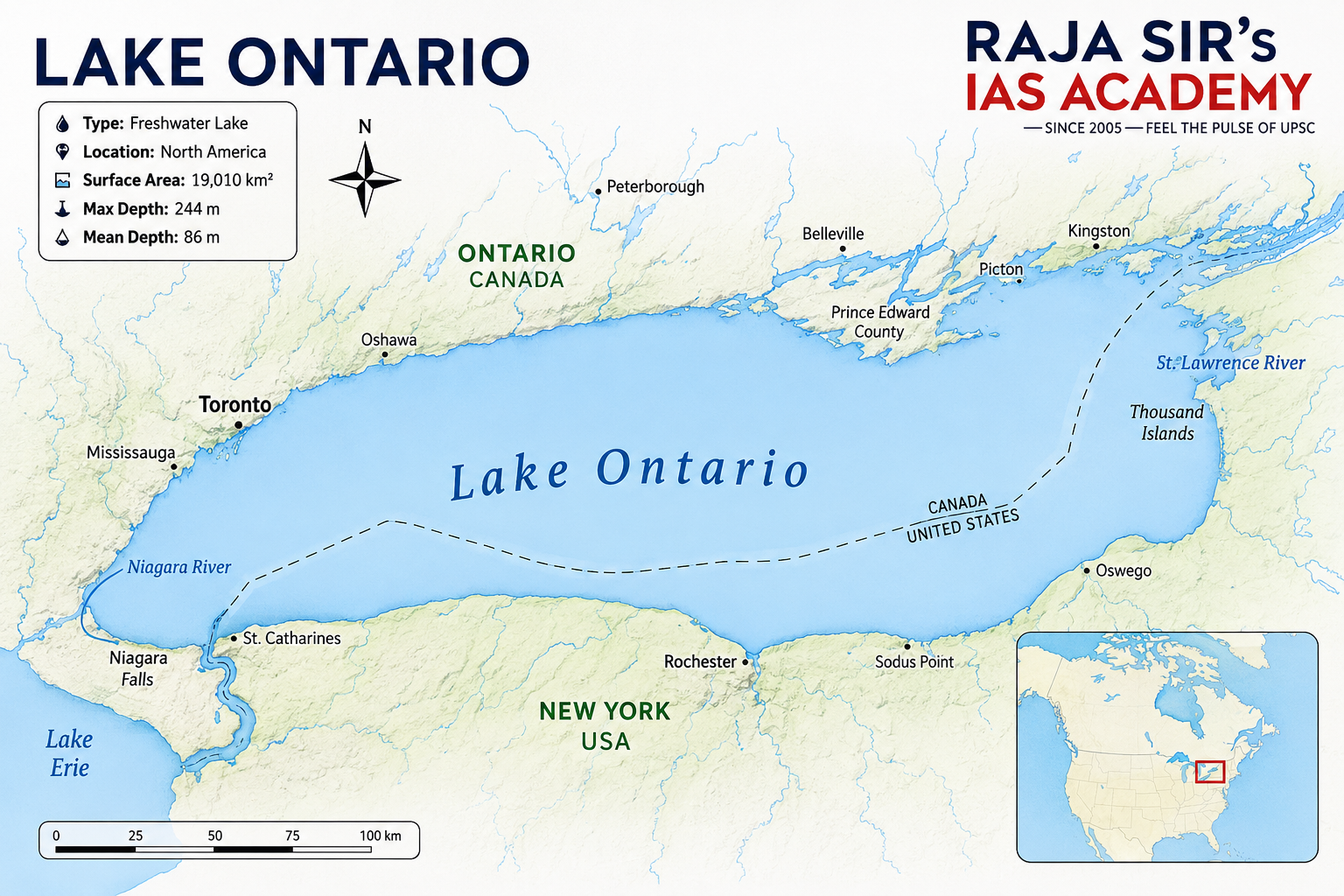
Lake Ontario came into focus in a geopolitical naming dispute involving the United States and Canada.
What is Lake Ontario?
Lake Ontario is one of the Five Great Lakes of North America and is the easternmost of the Great Lakes.
It lies between:
- Ontario, Canada — north
- New York, USA — south
Why is it called a Great Lake?
- The Great Lakes are a group of five large freshwater lakes located along the US–Canada border.
- West → East : Superior → Michigan → Huron → Erie → Ontario→ St. Lawrence River → Atlantic Ocean
|
Feature
|
Fact
|
|
Great Lakes Position
|
5th and easternmost of the Five Great Lakes
|
|
Surface Area
|
Smallest of the Five Great Lakes
|
|
Northern Shore
|
Ontario, Canada
|
|
Southern Shore
|
New York, USA
|
|
Major Inflow
|
Niagara River
|
|
Receives Water From
|
Lake Erie
|
|
Outflow
|
St. Lawrence River
|
|
Final Drainage
|
Atlantic Ocean
|
|
Canal Connection
|
Welland Canal
|
|
Important Function
|
Welland Canal bypasses Niagara Falls, providing a navigable route between Lake Erie and Lake Ontario
|
Welland Canal : The Welland Canal connects Lake Erie and Lake Ontario.
Why was it constructed? : The natural route between Lake Erie and Lake Ontario is obstructed by Niagara Falls.
|
|
Nepal
GS-I: Himalayan geography and drainage
Location
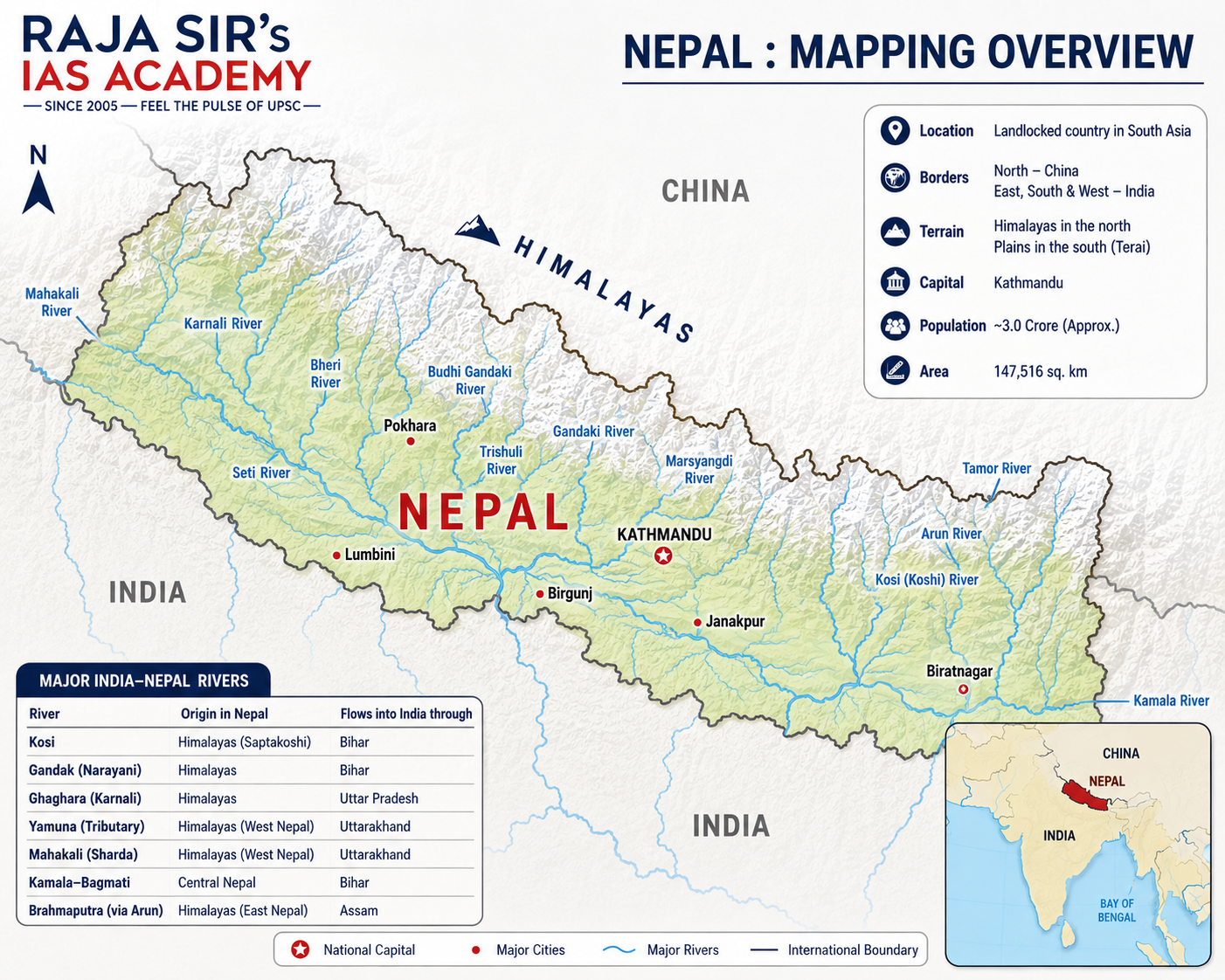
- Nepal is a landlocked South Asian country located in the central Himalayas.
- It is bordered by China to the north and India to the east, south and west.
India–Nepal Border States
India shares its border with Nepal through Uttarakhand, Uttar Pradesh, Bihar, West Bengal and Sikkim.
Important River Mapping
- Narayani (Nepal) → Gandak (India) → Ganga, making it important for understanding floods in Bihar.
- Sapta Kosi (Nepal) → Kosi (India) → Bihar → Ganga; the Kosi is known as the “Sorrow of Bihar” due to its flood and channel-shifting problems.
- Karnali (Nepal) → Ghaghara (India) → Ganga.
- Mahakali (Nepal) → Sharda (India) and forms part of the India–Nepal boundary.
Disaster Management
- Nepal''s Himalayan location makes it vulnerable to earthquakes, landslides, flash floods, cloudbursts and glacial hazards.
- Heavy rainfall and sudden discharge in Nepal can produce downstream flooding in the Indian plains, particularly in Bihar and Uttar Pradesh.
Transboundary Disaster
- Upstream hazard in Nepal → cross-border river flow → downstream impacts in India, highlighting the need for coordinated disaster management.
|
|
Precision Oncology
GS-III | Biotechnology
What is GIPCi?
- GIPCi is a small-molecule inhibitor being investigated as a potential therapeutic approach against treatment-resistant pancreatic cancer.
- It is designed to target GIPC1, a protein involved in cellular signalling and receptor trafficking.
What is GIPC1?
- GIPC1 (GAIP-interacting protein, C-terminus 1) is a protein involved in cellular signalling and trafficking of receptors within cells.
- It contains a PDZ domain, which is important for protein–protein interactions.
Why is the PDZ domain important?
PDZ domains help proteins interact with other molecules and participate in organising signalling pathways.
What is the Scientific Breakthrough?
- The important aspect is not simply the discovery of another cancer molecule.
- The study demonstrates the potential of Drug discovery
- Traditional drug discovery: Target identification → Screening → Candidate selection → Testing
- AI-assisted discovery can help: Large molecular search space → Computational prediction → Candidate identification → Laboratory validation
Why is this Significant?
- Difficult-to-Target Proteins : Many proteins are difficult to target using conventional drugs. If computational methods can identify molecules capable of interacting with such targets, they could expand the range of proteins accessible to drug discovery.
AI in Drug Discovery : AI and computational biology can help researchers:
- Predict molecular interactions
- Screen potential drug candidates
- Identify promising compounds
- Optimise molecules
- Reduce the time required for early-stage discovery
Pancreatic Cancer
Pancreatic cancer is particularly challenging because of:
- Late detection
- Aggressive disease progression
- Limited treatment options
- Development of treatment resistance
- GIPCi = promising research candidate, not a proven cure for pancreatic cancer.
|
|
Reconciling Demographic Representation with Federal Equity
Why in News?
The Constitution (131st Amendment) Bill, 2026 proposes increasing the constitutional ceiling of Lok Sabha seats from 550 to 850.
Significance
- Correcting representational imbalance : The present allocation is substantially linked to the 1971 Census, despite major demographic changes.
- Better MP–citizen ratio : A larger House can reduce the population burden represented by each MP and improve accessibility.
- Women''s representation : Expansion could facilitate implementation of the 33% reservation for women without substantially shrinking existing unreserved constituencies.
- Democratic proportionality : Population-based representation can improve the principle of “one person, one vote, one value.”
Concerns
- Federal balance : Southern States fear that population-based delimitation could reduce their relative political influence because of their successful population stabilisation.
- Political incentive problem : States that achieved lower fertility rates could perceive delimitation as a penalty for successful demographic management.
- Parliamentary functioning : An excessively large House could make debates, questioning and deliberation more difficult.
- Fiscal burden : More MPs imply additional expenditure on parliamentary infrastructure and related institutional facilities.
Impact
- The issue creates a fundamental constitutional tension between:
- Demographic representation ↔ Federal equity
- Therefore, delimitation is not merely a question of increasing seats; it is a question of reconciling democratic equality with India''s federal structure.
Way Forward
- Build political consensus among Union and State governments.
- Consider a calibrated increase rather than an abrupt expansion.
- Strengthen the Rajya Sabha''s federal role.
- Ensure transparent and independent delimitation through the Election Commission/Delimitation Commission framework.
- Consider increasing constituency accessibility through administrative and technological mechanisms as a complement to seat expansion.
|
Provision
|
Key Point
|
|
Article 81
|
Composition of Lok Sabha
|
|
42nd CAA, 1976
|
Froze inter-State allocation based on 1971 Census
|
|
84th CAA, 2001
|
Extended freeze
|
|
87th CAA, 2003
|
Allowed boundary readjustment using 2001 Census without changing State-wise seat allocation
|
|
104th CAA, 2019
|
Ended Anglo-Indian nomination
|
|
106th CAA, 2023
|
One-third reservation for women in Lok Sabha/State Assemblies, operational after relevant delimitation
|
|
|
Samarthak
GS-III | Defence Technology | Aatmanirbhar Bharat
Why in News?
Samarthak, an indigenous Multi-Purpose Vessel (MPV), was formally delivered to the Indian Navy.
What is Samarthak?
- Samarthak is an Indian-designed and Indian-built Multi-Purpose Vessel intended to perform a range of naval support and testing functions.
Who Built It?
- Builder: Larsen & Toubro (L&T)
- Shipyard: Kattupalli, Tamil Nadu
- Nature: Indigenous construction
- User: Indian Navy
Major Functions
- Weapons & Sensor Trials : Serves as a testbed for indigenous weapons and sensors, including radars, sonars and missile/gun systems.
- ASW & Gunnery Training : Supports fleet gunnery and Anti-Submarine Warfare (ASW) training through launching, towing and recovering targets.
- Unmanned Systems : Functions as a mothership for UAVs, USVs and UUVs for surveillance and mine-countermeasure operations.
- Heavy-Lift & Towing : Provides heavy-lift, towing and fleet logistics support for ships and offshore assets.
- Maritime Surveillance : Supports offshore patrolling, maritime surveillance and naval training.
- Pollution Control : Equipped for oil-spill containment and recovery to tackle marine pollution.
- HADR : Provides Humanitarian Assistance and Disaster Relief (HADR) through medical facilities and cargo-handling capability.
|
|
Subsea Cable Infrastructure
Why in News?
Visakhapatnam is emerging as an important subsea cable landing location alongside established hubs such as Mumbai and Chennai.
Significance
- Subsea fibre-optic cables form the physical backbone of global digital connectivity.
- They carry the overwhelming majority of intercontinental digital communications.
Impact
- Internet connectivity: carries a major share of international data traffic.
- Cloud & AI : enables cloud computing, data centres and AI workloads.
- Financial Systems: supports digital payments and financial transactions.
- Strategic Communications : critical for government, defence and international communications.
Vulnerabilities
- Anchor Damage : ship anchors can damage cables.
- Fishing Activity: fishing equipment can cause accidental damage.
- Seabed Hazards: landslides and other seabed disturbances can disrupt cables.
- Natural Disasters: earthquakes and related events can damage subsea infrastructure.
- Deliberate Disruption: cables may be targeted as part of hybrid or strategic threats.
Way Forward
- Route & Landing Diversification : develop multiple cable routes and landing stations.
- CLS Security : strengthen physical and cyber security of Cable Landing Stations.
- Rapid Repair Capacity : develop dedicated repair ships, equipment and response mechanisms.
- Network Redundancy: integrate terrestrial, subsea and satellitecommunication systems.
- Critical Infrastructure Status : treat subsea cables as critical national infrastructureand strengthen their protection and resilience.
|
|
The Pulaya Vanguard
GS I Modern India
Why in News?
Prime Minister paid homage to Mahatma Ayyankali (1863–1941) on his birth anniversary, highlighting his contribution to social justice and the upliftment of oppressed communities in Kerala.
Movements:
- First Agricultural Labor Strike (1907–1908): Led the first recorded agricultural strike in Kerala with the rallying cry: "If our children are denied education, weeds will grow in your fields." It successfully forced upper-caste landowners to accept the admission of Dalit children into schools.
- Kallumala Samaram / Perinad Mutiny (1915): Agitation against the caste restriction requiring lower-caste women to wear beaded stone necklaces (Kallumala) and stay bare-chested. Women discarded the necklaces en masse at the Kollam gathering, asserting their right to dignified attire.
- Interaction with Mahatma Gandhi (1937): Met Gandhi at Venganoor. Impressed by his grassroots mobilization, Gandhi affectionately referred to him as "Pulayaraja" (King of the Pulayas).
- Inspiration from Sree Narayana Guru: Inspired by Guru''s 1888 Aruvippuram installation and the SNDP Yogam (1903), Ayyankali modeled the Sadhu Jana Paripalana Sangham (SJPS) in 1907 to organize Dalit agricultural communities.
Chronological Milestones
Villuvandi Samaram (Chariot Agitation) - 1893
- Defied caste bans by riding a decorated bullock cart on public roads from Venganoor to Aralumoodu, asserting freedom of movement.
First School Initiative at Venganoor -1904
- Built a community school for Pulaya children, which was subsequently set on fire by upper-caste reactionaries.
Formation of Sadhu Jana Paripalana Sangham (SJPS) - 1907
- Established the organization to advance education, financial independence, and social welfare among oppressed castes.
First Agricultural Strike -1907–1908
- Mobilized farm workers to withhold labor from fields until schools were opened to Pulaya children.
Nomination to Sree Moolam Popular Assembly - 1910
- Became the first Dalit member nominated to the Travancore legislature, advocating for land distribution and educational access.
Kallumala Samaram (Stone Necklace Movement) - 1915
- Led the cultural rebellion where Dalit women broke their symbolic subjugation ornaments and adopted dignified clothing. a broader movement for education, labour rights, social dignity and political representation.
|
|
The Tech Corridor
GS-II | India–US Relations
What is the H-1B Visa?
The H-1B visa is a US non-immigrant visa that allows US employers to temporarily employ foreign workers in specialty occupations requiring specialised knowledge and usually a relevant degree or equivalent qualification.
Key Features
Non-Immigrant Visa
- H-1B is a non-immigrant employment visa.
- It does not itself provide permanent residence.
- However, an H-1B worker may potentially pursue permanent residence through a separate immigration process.
Duration
- Normally granted for an initial period of up to 3 years.
- Generally extendable to a maximum of 6 years, subject to applicable rules and exceptions.
Employer-Specific
- The H-1B is generally connected to the petitioning US employer and specified employment.
Annual Numerical Cap
- H-1B visas are subject to annual numerical limits.
- When registrations exceed available numbers, USCIS uses a selection process to determine which registrations can proceed.
Why is H-1B Important for India?
India is a major source of professionals using the H-1B route, particularly in technology and engineering-related occupations.
Therefore, H-1B policy has implications for:
- Indian IT sector
- Changes in US skilled-worker rules can affect the ability of Indian IT firms and professionals to deploy talent in the US.
Skilled migration
- The programme facilitates high-skilled labour mobility between India and the US.
Remittances
- Indian professionals working abroad contribute to India''s foreign-exchange earnings through remittances.
Major Issues Surrounding H-1B
Skilled-worker demand vs domestic employment
- Supporters argue that H-1B helps firms access specialised talent.
- Critics argue that excessive dependence on foreign workers could affect opportunities and wages for some domestic workers.
Visa dependence on employers
- Because the visa is generally employment-linked, workers can face difficulties when their employment situation changes.
Annual cap
- The numerical ceiling can create uncertainty for employers and skilled professionals when demand substantially exceeds supply.
Talent Mobility
- Restrictive policies may encourage highly skilled professionals to consider alternative destinations.
|
Feature
|
H-1B Visa
|
Green Card
|
|
Nature
|
Non-immigrant status
|
Permanent resident status
|
|
Purpose
|
Temporary employment in the U.S.
|
Permanent residence in the U.S.
|
|
Employment
|
Employment is subject to H-1B rules and conditions
|
Generally permits employment in the U.S.
|
|
Immigration Framework
|
Subject to specific H-1B rules, including applicable caps
|
Governed by the separate permanent-immigration framework
|
|
Permanent Residence
|
Does not itself confer permanent residence
|
Provides permanent resident status
|
|
|
Unlocking Innovation
GS II |Governance
Why in News?
NITI Aayog released the Ease of Doing Research & Development in India report. It examines the structural and procedural barriers that prevent India''s research ecosystem from converting available scientific talent and funding into high-quality research and innovation.
Core Issue
India''s problem is not only “how much money is spent on R&D”, but also how efficiently the research ecosystem functions.
Major Problems
Low R&D Intensity
- India''s Gross Expenditure on R&D (GERD) remains around 0.65% of GDP.
- This is considerably lower than leading innovation economies.
- Low investment limits research infrastructure, laboratories, fellowships and high-risk research.
Weak Private-Sector Participation
- India''s R&D ecosystem remains significantly dependent on government funding.
- In major innovation economies, industry contributes a much larger share of R&D expenditure.
Why does private R&D matter?
- Private firms can connect: Research → Technology → Product → Market
- Weak industry participation therefore contributes to the commercialisation gap in Indian research.
Concentration of Research Funding
- Research funding tends to be concentrated in premier institutions.
- Universities and institutions outside established research networks may face difficulty accessing competitive grants.
Consequence
- Funding concentration → unequal research capacity → underutilisation of talent
- The solution is not to reduce funding to leading institutions, but to broaden the research base.
Low Success Rate of Research Proposals
- A relatively small proportion of submitted research proposals receive funding.
- This can discourage researchers, particularly early-career researchers and researchers from less-established institutions.
Administrative Delays
- Researchers may spend substantial time dealing with:
- Multiple approvals, Procurement procedures, Fund-release delays, Reporting requirements, Administrative compliance
Why is this a problem?
A researcher should ideally spend time on:
- Research → experimentation → publication → innovation rather than:
- Proposal → approval → procurement → paperwork → fund release
This is the central idea behind “Ease of Doing R&D.”
Unified Project Management System — UPMS
The proposed Unified Project Management System (UPMS) is an important institutional reform.
What does it seek to do?
Create a common digital record and management framework for publicly funded R&D projects.
Way Forward
- Increase R&D Investment : Move towards GERD of around 2% of GDP over the longer term.
- Increase Private-Sector R&D : Encourage industry through R&D incentives, Public–private partnerships, Industry-linked research programmes, Technology-transfer mechanisms
- Reduce Bureaucratic Delays : Create time-bound approvals, simplified procurement and faster fund release.
- Diversify Research Funding : Create opportunities for State universities, Emerging institutions, Young researchers, Interdisciplinary teams, Regional research centres
Build University–Industry–Government Linkages : Promote the Triple Helix model
- Government → funding & policy
- Universities → knowledge & talent
- Industry → technology & commercialisation
|