



Immigration, Visa, Foreigners Registration & Tracking (IVFRT) Scheme
- Context (PIB): Union Cabinet approved continuation of the Immigration, Visa, Foreigners Registration & Tracking (IVFRT) Scheme for five years, till March, 2031.
- IVFRT Scheme is a Central Sector e-Governance project to modernise India’s immigration, visa, and foreigner management ecosystem.
- It was approved in 2010 and launched in mission mode under the National e-Governance Plan (NeGP).
- Nodal Agency: It is managed by the Ministry of Home Affairs, and executed by the Bureau of Immigration with technical support from the National Informatics Centre.
- Objective: Interlink and digitise visa issuance, immigration clearance, and foreigner tracking to balance seamless travel facilitation with strict national security.
- IVFRT 3.0 (2026–2031): It focuses on three pillars — emerging technology, core infrastructure transformation, and service optimisation via mobile services and self-service kiosks.
- Statutory Basis: The upgrade aligns with the Immigration and Foreigners Act, 2025, strengthening the system’s digital ability to manage illegal migration.
- Key Gains: 91.24% of e-Visa applications are now cleared within 72 hours, while e-gates of Fast Track Immigration-Trusted Traveller Programme (FTI-TTP) reduce clearance time to about 30 seconds.
Foreign Contribution Regulation Amendment Bill, 2026 introduced in Lok Sabha
- Government has introduced the FCRA Amendment Bill to address operational gaps, tighten regulation of foreign funds, & create a new authority to manage assets of NGOs that lose their licence.
Proposed Amendments to FCRA
- Designated Authority: To manage, take over, or dispose of assets created from foreign funds when NGO registration is cancelled/suspended.
- Expanded Definition: Widened to include directors, trustees, partners, governing members, and persons controlling the organisation.
- Liability of Officials: Key functionaries to be held accountable for FCRA violations, unless they prove due diligence.
- Prior Approval: State agencies must seek Central government approval before initiating FCRA probes.
- Timelines & Registration Rules: Introduces fixed timelines for fund utilisation and automatic cancellation on non-renewal/expiry.
- Penalty: Reduces maximum imprisonment from 5 years to 1 year, with clearer and consistent penalties.
Foreign Contribution Regulation Act (FCRA)
- Enactment: Originally enacted in 1976, later replaced by FCRA, 2010, with amendments in 2020.
- Purpose: Regulates foreign donations and funding to individuals, NGOs, and organisations to ensure they do not affect national interest or security.
- Administering Authority: Ministry of Home Affairs (MHA).
- Registration Requirement: NGOs must obtain FCRA registration or prior permission to receive foreign contributions legally.
- 2020 Amendment: Prohibits sub-granting of foreign funds, mandates Aadhaar identification, and requires a designated SBI account in New Delhi.
Modified UDAN Scheme
- Union Cabinet approved the redesigned UDAN (Ude Desh ka Aam Nagrik) scheme as ‘Modified UDAN’ to strengthen regional air connectivity.
- The scheme will run for 10 years from FY 2026-27 to FY 2035-36, with a sixfold budget increase.
- Key Focus: It prioritises the Northeast, hill regions, islands, and remote districts to improve last-mile and emergency connectivity.
- Expansion Target: Develop 100 airports from unserved airstrips using a “challenge-based approach” and build 200 modern helipads in remote regions.
- Funding Shift: Regional Connectivity Fund (RCF) now receives direct support from the Union government, replacing passenger- levy-based financing.
- Extended Subsidy: Viability Gap Funding (VGF) support period is extended from three to five years for airline sustainability.
- Indigenisation: The revamped scheme proposes procurement of Made-in-India aircraft, HAL Dhruv helicopters and HAL Dornier aircraft, for state-owned carriers.
About UDAN Scheme
- Ministry of Civil Aviation (MoCA) launched UDAN in 2016 for a period of 10 years under the National Civil Aviation Policy (NCAP).
- Objective: To make air travel more affordable and connect Tier-2 and Tier-3 cities for more balanced regional development.
- Nodal Agency: Airports Authority of India (AAI) implements the scheme.
- Key Features: Airlines get fee waivers for parking and navigation, subsidised fares for about 50% of seats, and State support for land, utilities, and security.
14th Ministerial Conference (MC14) of WTO
- The 14th Ministerial Conference (MC14) of the World Trade Organisation (WTO) is taking place in Yaoundé, Cameroon.
About WTO Ministerial Conference
- The Ministerial Conference is the highest decision-making body of the WTO.
- Provision: It was established under the Marrakesh Agreement, which requires meetings at least once every two years.
- Authority: It is the highest forum empowered to create, amend, or negotiate global trade rules.
Key Agendas of WTO MC14
- Dispute Reform: Restore a fully functional, two-tier binding dispute resolution system, which has been paralysed since 2019.
- Agriculture Security: Secure a permanent solution for public stockholding, reduce trade-distorting subsidies, and improve market access.
- Fisheries Subsidies: Finalise “Phase 2” rules to ban harmful subsidies that contribute to overcapacity and overfishing.
- Digital Trade: Decide continuation of E-commerce Moratorium on customs duties for electronic transmissions, currently set to expire this year.
- Plurilateral Integration: Incorporate Joint Statement Initiatives (JSI) like Investment Facilitation for Development (IFD) into the formal WTO legal framework.
- LDC Graduation: Establish transition mechanisms for countries losing Least Developed Country (LDC) status and related trade benefits.
- WTO E-commerce Moratorium is a 1998 agreement under which members commit to not imposing customs duties on electronic transmissions (e.g., software, music, films, digital services).
Key Challenges for WTO MC14
- Geopolitical Fragmentation: Rising “friend-shoring” and national security exceptions are undermining the Most-Favoured-Nation (MFN) principle.
- Consensus Erosion: The push for flexible plurilateral negotiations challenges the unanimous decision-making model that gives all members an equal voice.
- Digital Sovereignty: E-commerce moratorium creates a trade-off between global corporate interests and the “policy space” that developing states need to regulate digital trade.
- Institutional Deadlock: The absence of a functional Appellate Body has shifted the WTO from a “rules-based” to a “power-based” negotiation system.
- Policy Asymmetry: Outdated subsidy benchmarks continue to unfairly restrict food security programmes of developing nations while protecting historical subsidies of developed ones.
- Multilateral Irrelevance: The proliferation of Regional Trade Agreements (RTAs) is bypassing the WTO as the primary venue for global rule-making.
India’s Nationally Determined Contribution (NDC) for 2031-2035
- Context (PIB): Union Cabinet approved India’s Nationally Determined Contribution (NDC) for the 2031-2035 period.
- Implementation: India’s NDC is operationalised through the National Action Plan on Climate Change (NAPCC) and its nine national missions.
Nationally Determined Contribution (NDC)
- NDCs are self-defined national climate action plans submitted under the Paris Agreement.
- Legal Nature: Paris Agreement mandates reporting frameworks, but does not legally enforce achievement of NDC targets.
- Ratchet Mechanism: Countries must submit updated NDCs to the UNFCCC every five years.
- Ambition Rule: Each successive NDC must be more ambitious than the previous submission.
- Core Components: An NDC includes quantified mitigation targets, adaptation strategies, and conditional commitments linked to international support.
- Transparency: Countries must submit ICTU (Information to Facilitate Clarity, Transparency, and Understanding) alongside NDCs to explain their targets.
- Monitoring: UNFCCC assesses collective progress through the Global Stocktake (GST), conducted every five years.
- NDC 3.0: The third round of NDCs, due for submission by 2025-2026, covers climate targets for 2035.
India’s Updated Targets under NDC 3.0
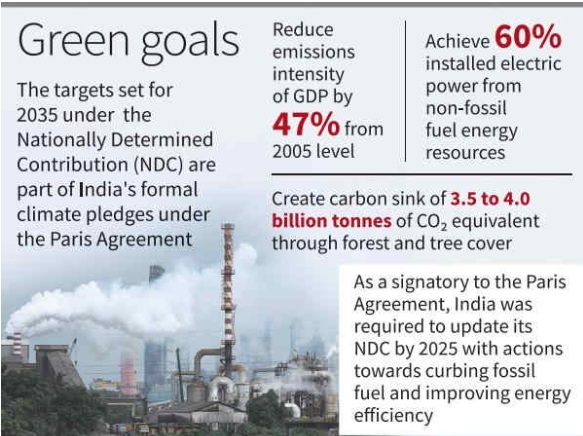
- Emission Intensity: A 47% cut in GDP emissions intensity from 2005 levels by 2035.
- Non-Fossil Share: 60% of cumulative installed electric power capacity from non-fossil sources by 2035.
- Carbon Sink: An additional 3.5-4.0 billion tonnes of CO₂ equivalent sink through forest and tree cover by 2035 from 2005 levels.
Qualitative Targets
- Sustainable Lifestyle: Embed sustainability into everyday life through the Mission LiFE movement.
- Green Growth: Expand renewables, battery storage, green corridors, and cleaner manufacturing aligned with Viksit Bharat @ 2047.
- Climate Adaptation: Scale up resilience across coastal ecosystems, agriculture, Himalayan states, and disaster management.
- Green Finance: Mobilise domestic resources and demand new, additional, low-cost climate finance from developed nations.
- Capacity Building: Strengthen institutional capacity, R&D, and international collaboration for climate technology innovation.
|
Commitment |
NDC 2.0 (2030) |
NDC 3.0 (2035) |
Current Progress |
|
Emissions Intensity |
45% reduction (2005 base year) |
47% reduction (2005 base year) |
36% reduction (2020) |
|
Non-Fossil Capacity |
50% installed capacity |
60% installed capacity |
52.57% (Feb 2026) |
|
Carbon Sink (CO₂ eq.) |
2.5-3.0 billion tonnes |
3.5-4.0 billion tonnes |
2.29 billion tonnes (2021) |
Antibiotic-Resistant Typhoid
- A recent study shows antibiotic-resistant typhoid is imposing a major economic burden in India, with fluoroquinolone-resistant infections accounting for about 87% of total typhoid-related costs in 2023.
- Fluoroquinolones are a class of broad-spectrum antibiotics commonly used to treat bacterial infections, including typhoid, respiratory infections, and urinary tract infections.
What is Typhoid Fever?
- Typhoid is a bacterial infectious disease caused by Salmonella Typhi.
- Transmission: Spreads through contaminated food and water, especially in areas with poor sanitation.
- Symptoms: High fever, fatigue, headache, abdominal pain, and weakness.
- Treatment & Prevention: Treated with antibiotics, but prevention relies on safe water, sanitation, hygiene (WASH), and vaccination.
- Typhoid Conjugate Vaccine (TCV): A single-dose injectable vaccine against Salmonella Typhi, offering long-term protection for children from 6 months of age.
Why Antibiotic Resistance Matters?
- Antibiotic resistance is a condition where bacteria evolve to survive despite antibiotic treatment.
- Cause: By overuse or misuse of antibiotics, allowing resistant bacteria to multiply.
- Impact: Makes infections harder to treat, increases treatment duration, cost, and risk of death.
- Examples: Seen in diseases like typhoid, tuberculosis, and hospital-acquired infections.
- WHO recognises antimicrobial resistance as a major global public health threat.
Central Armed Police Forces (CAPF) (General Administration) Bill, 2026 introduced in Rajya Sabha
- The Bill acts as an overarching law to regulate the recruitment, deputation, promotion, and conditions of service for officers in the Central Armed Police Forces (CAPFs), which are presently regulated by respective service acts.
- Bill specifically provides for deputation of IPS (Indian Police Service) Officers to posts in CAPFs.
- Earlier, Supreme Court, in 2025, directed progressive reduction in deputation of IPS Officers in CAPFs to the posts of DIG (Deputy Inspector General of Police) and IG (Inspector General) within a period of two years.
Key Provisions of the Bill:
- Powers to make Rules: It empowers the central government to make Rules on matters related to officers of specified CAPFs.
- Applicability: It applies to the five major CAPFs listed in the First Schedule to the Bill including Central Reserve Police Force (CRPF), Border Security Force (BSF), Central Industrial Security Force (CISF), Indo-Tibetan Border Police (ITBP), and Sashastra Seema Bal (SSB).
- Central Government may amend the Schedule to make bill applicable for other CAPFs.
- Positions to be filled by deputation: The following positions in CAPFs must be filled by deputation of IPS officers:
- 50% of the posts in the rank of Inspector General
- a minimum of 67% of the posts in the rank of Additional Director General,
- all posts in the ranks of Director General and Special Director General.
Flexible Inflation Targeting (FIT) Framework
- Union Government notifies the inflation target for 2026-2031 under Flexible Inflation Targeting (FIT) Framework
- In 2016, the Reserve Bank of India Act, 1934 was amended to provide a statutory basis for the implementation of the FIT framework in India.
- The FIT framework was recommended by an Expert Committee headed by Dr. Urjit Patel.
About FIT Framework
- As per Section 45ZA of the RBI Act, 1934, Central Government shall, in consultation with the Bank, determine the inflation target in terms of the Consumer Price Index (CPI), once in every five years.
- Target: Central Government then notified the inflation target of 4% with upper tolerance band of 6% and lower tolerance band of 2% for the period 2016-2021.
- This target was retained for 2021-2026 and now has been retained for 2026-2031 as well.
- Target Achievement: RBI Act provides for a Monetary Policy Committee (MPC) to determine the policy rate required to achieve the inflation target.
- Composition: It is a six-member body comprising:
- RBI Governor (ex-officio Chairperson)
- RBI Deputy Governor (in charge of monetary policy)
- One RBI officer nominated by the Central Board
- Three external members appointed by the central government with expertise in economics, banking and finance, or monetary policy
- Policy Failure: Inflation outside the tolerance band for three consecutive quarters is considered a failure of the monetary policy framework.
Transgender Persons (Protection of Rights) Amendment Bill, 2026
- The Transgender Persons (Protection of Rights) Amendment Bill, 2026 passed in Parliament it Introduces significant changes to the Transgender Persons (Protection of Rights) Act, 2019, aimed at providing better legal protection to the community.
Key Features of the Bill
- Revised Definition: Defines transgender persons as those with socio-cultural identities (kinner, hijra, aravani, jogta), biological variations, etc.
- Removes Right to Self Determination: It omits Section 4(2) of 2019 Act, removing the legal recognition of self-determination.
- Verification Authority: Establishes a medical board (headed by a Chief Medical Officer or Deputy CMO) to assist authorities in verifying transgender identity.
- Stronger Penal Provisions: Introduces graded punishments for offences against transgender persons with penalties up to life imprisonment.
- National Council for Transgender Persons: Modifies the composition to ensure representation from State Governments and UTs on a rotational basis.
Key Concerns Associated
- Loss of Agency: Shifts the framework from self-identification to state-mandated medical recognition.
- Exclusion due to narrow Definition: Unlike the 2019 Act, the Bill effectively exclude trans-men, non-binary people, and gender-queer individuals from legal protection.
- Violation of Privacy and Dignity: Medical examinations to prove gender identities is seen as a violation of privacy and human dignity.
- Medical Gatekeeping: Potentially promotes a Pathological approach with verification by Medical Board, leading to potential harassment.
- Lack of Consultation: Bill passed without referring to a Standing Committee or consulting the transgender community.
Initiatives for Welfare of Transgenders in India
- National Legal Services Authority (NALSA) vs Union of India, 2014: explicitly recognized transgender persons as a third gender; affirmed the right of self-identification of gender
- National Council for Transgender Persons: Statutory body to safeguard and promote the rights of transgender persons in India.
- National Portal for Transgender Persons: Enables online applications for identity certificates and access to benefits for transgenders.
- SMILE (Support for Marginalised Individuals for Livelihood and Enterprise) Scheme: For comprehensive rehabilitation and empowerment of transgender persons; Garima Grehs for shelter.
National District Mineral Foundation Summit
- Ministry of Mines organised the National District Mineral Foundation Summit 2026 under the theme “Effective Utilisation of District Mineral Funds for ADP/ABP Areas.”
- Objective: The summit aimed to strengthen inter-governmental coordination to improve outcome-oriented utilisation of DMF funds.
District Mineral Foundation (DMF)
- District Mineral Foundation (DMF) is a statutory, non-profit trust established by State Governments in mining-affected districts.
- Legal Basis: DMFs were instituted under Section 9B of the Mines and Minerals (Development and Regulation) Amendment Act, 2015 (MMDR Act).
- Objective: They work for the benefit of persons and areas affected by mining-related operations.
- Funding: It is funded through mandatory contributions from mining lease holders, paid in addition to standard royalties.
- Contribution Rate: Central Government fixed contribution rates at 10% of royalty for leases granted on or after January 12, 2015.
- Fund Use: The funds are non-lapsable and are used for implementation of the Pradhan Mantri Khanij Kshetra Kalyan Yojana (PMKKKY).
- Leadership: District Magistrate heads DMF and acts as Chairperson of its Governing Council.
- Scheduled Areas: In Fifth Schedule areas, Gram Sabha approval is required for all DMF plans, programmes, and projects.
G7 Foreign Ministers’ Meeting
- EAM S. Jaishankar will attend the G7 Foreign Ministers’ Meeting in France.
- While India is not a G7 member, it has been invited as a partner country by France, the current chair.
- India will participate in discussions with the G7 and partner countries on global issues.
Group of 7 (G7)
- G7 is an informal group of 7 advanced economies: the USA, UK, France, Germany, Italy, Canada, and Japan, along with the European Union.
- Originated in 1975 (G6) to address global economic crises; Canada joined in 1976, group became G7.
- Russia joined in 1998, forming the G8, but was suspended in 2014 after the annexation of Crimea.
- It is a non-treaty-based forum with no permanent secretariat; decisions are based on consensus.
National Centre for Organic and Natural Farming
- Context (PIB): National Centre for Organic and Natural Farming (NCONF) organised a seminar and exhibition to promote organic and natural farming across India.
- NCONF is the apex nodal organisation for promoting and developing chemical-free, sustainable agriculture like organic, natural, and regenerative farming.
- Originally established in 2004 as National Centre of Organic Farming, it was renamed NCONF in 2022.
- Administrative Setup: It operates under the Ministry of Agriculture and Farmers’ Welfare with its headquarters in Ghaziabad, Uttar Pradesh.
- Certification: Serves as the secretariat for India’s Participatory Guarantee System (PGS), a decentralised, low-cost, peer-review certification for organic produce.
- Programme Execution: Implements the National Project on Organic Farming (NPOF) and plays a key role in the National Mission on Natural Farming (NMNF).
- Natural Farming: A chemical-free system relying fully on ‘on-farm’ biological processes instead of synthetic inputs; Andhra Pradesh, Karnataka, and Himachal Pradesh lead in India.
- Organic Farming: A holistic production system that avoids synthetic fertilisers, pesticides, growth regulators, and artificial feed additives.
- India ranks first among organic producers and second in organic cultivation area; Sikkim became the world’s first 100% organic state in 2016.
Sperm Whale (Physeter macrocephalus)
- Scientists have recorded footage of sub-adult sperm whales headbutting, challenging the earlier hypothesis that only adult males used their heads for combat.
- Sperm Whale is the largest toothed predator on Earth & the only living member of the genus Physeter.
- Brain Size: It has the largest brain of all living animals, with its head making up one-third of its total body length.
- Spermaceti: The head contains a large cavity filled with a waxy liquid called spermaceti, used for echolocation and buoyancy regulation.
- Blowhole: Unlike most whales, its asymmetrical blowhole is positioned on the left side of the snout.
- Echolocation: It produces the loudest sound of any living creature (up to 230 dB) for echolocation.
- Habitat: Sperm whales prefer ice-free oceans deeper than 1,000 metres, especially near submarine canyons and continental shelf edges.
- Distribution: It has a cosmopolitan distribution across all deep oceans, from the equator to the edges of the Arctic and Antarctic.
- Diet: The whale primarily feeds on deep-sea squid; males at higher latitudes also consume bottom-dwelling sharks, rays and fish.
- Social Units: Females and young form stable units of about 12 individuals; distinct clan groups communicate using unique click patterns called ‘codas’.
- Ecological Role: It acts as a “whale pump”, transporting nutrients from deep-sea feeding zones to the surface through faeces.
- Key Threats: Vessel strikes, entanglement in fishing gear, ocean noise pollution, plastic ingestion.
- Conservation Status: IUCN: Vulnerable; CITES: Appendix I; CMS: Appendix I; WPA: Schedule II
National Biodiversity Authority (NBA)
- Context (PIB): National Biodiversity Authority (NBA) launched a new short-term Internship Programme for graduates and postgraduates focusing on biodiversity conservation.
- NBA is an autonomous statutory body established in 2003 under the Ministry of Environment, Forest and Climate Change (MoEFCC).
- Mandate: It implements the Biological Diversity Act, 2002 (as updated by the Amendment Act, 2023).
- Key Functions: It operationalises Access and Benefit Sharing (ABS), supports compliance with the Nagoya Protocol, combats biopiracy, and advises States on Biodiversity Heritage Sites (BHS).
- Composition: NBA is led by a Central Government-appointed Chairperson, includes ex officio ministry members and non-official biodiversity experts.
- Key Initiatives: It has formed an Expert Committee on Invasive Alien Species and expanded conservation capacity through the Biodiversity Samrakshan Internship Programme (BSIP).
- Biological Diversity Act, 2002, was enacted to fulfil India’s obligations under the Convention on Biological Diversity (CBD).
Natural Mineral Water
- New regulatory insights highlighted the rigorous standards for natural mineral water in India, which must be bottled at the source without chemical disinfection.
About Natural Mineral Water:
- It is water obtained directly from underground as opposed to surface sources (like rivers). To be labeled Natural Mineral Water in India (under IS 13428), it must be microbiologically wholesome and possess a constant level of minerals and trace elements.
- Unlike packaged drinking water, which can be treated by Reverse Osmosis (RO) and then re-mineralized, natural mineral water must remain in its original chemical state.
Origin:
- It originates from protected underground aquifers or natural springs. As rainwater or snowmelt percolates through geological layers like limestone, granite, or volcanic rock over decades, it naturally dissolves minerals from these stones.
- Natural pressure then pushes this enriched water to the surface or into subterranean reservoirs.
Key Characteristics:
- Source-Bottled: It must be bottled as close to the source as possible to prevent contamination or loss of minerals.
- No Chemical Treatment: Producers are strictly prohibited from using chlorine or other chemical disinfectants; they may only use filtration, aeration, or UV light.
- Stable Composition: The Total Dissolved Solids (TDS) and mineral proportions must remain consistent across all batches.
- Zero Contamination: The source must be naturally protected from environmental pollution by geological formations.
Minerals Found:
- The specific fingerprint of the water depends on the local geology:
- Calcium & Magnesium: Provide hardness and a smooth, chalky mouthfeel.
- Bicarbonates: Help neutralize stomach acidity and add a sweet finish.
- Sodium & Potassium: Essential electrolytes that can add a faint saline note.
- Sulphates: Often found in volcanic springs, contributing a crisp, bitter taste.
- Silica: Known for adding a glow to the skin and supporting tissue elasticity.
Significance:
- While not a replacement for food, it provides highly bioavailable calcium and magnesium that support bone density and cardiovascular health.
- Bicarbonate-rich and magnesium-rich waters are proven to assist with indigestion and functional constipation.
Corporate Laws (Amendment) Bill, 2026
- The Union Cabinet has moved the Corporate Laws (Amendment) Bill, 2026, in the Lok Sabha, subsequently referring it to a 31-member Joint Parliamentary Committee (JPC) for detailed scrutiny.
About Corporate Laws (Amendment) Bill, 2026:
- The Corporate Laws (Amendment) Bill, 2026, is a strategic legislative update designed to modernize the regulatory framework governing Indian businesses by amending the Companies Act, 2013, and the Limited Liability Partnership (LLP) Act, 2008.
Aim:
- The primary objective is to foster a more business-friendly environment in India by reducing the compliance burden and fear of imprisonment for minor mistakes. It seeks to align corporate governance with the current economic landscape and the vision of a Viksit Bharat.
Key Features:
- Decriminalization of Offences: Shifts 21 minor/technical offences from a criminal court-based system to an electronic e-adjudication platform where only monetary penalties are levied, removing the risk of imprisonment.
- CSR Threshold Revision: Increases the net profit threshold for mandatory Corporate Social Responsibility (CSR) from ₹5 crore to ₹10 crore, exempting many small companies from the 2% spending requirement.
- Hybrid Meetings: Enables companies to hold Annual General Meetings (AGM) and Extraordinary General Meetings (EGM) via video conferencing, with a mandatory physical meeting required only once every three years.
- Extended Timelines: Increases the time allowed to transfer unspent CSR funds for ongoing projects to a designated bank account from 30 days to 90 days.
- Self-Declaration Framework: Replaces several traditional affidavits required under the Acts with simple self-declarations, reducing paperwork and notarization costs.
- LLP Conversion: Introduces a new framework allowing specified trusts (registered under SEBI or IFSC) to convert into Limited Liability Partnerships (LLPs).
Significance:
- By removing criminal penalties for procedural errors, the Bill encourages entrepreneurship and reduces the inspector raj or discretionary power of officials.
- The relaxations provided to companies make it easier for smaller, unorganized businesses to register as formal corporate entities.
- The push for digital meetings and e-adjudication aligns Indian corporate law with global standards, increasing shareholder participation and transparency.
Veerangana Durgavati Tiger Reserve
- Madhya Pradesh Chief Minister has laid the foundation for a new soft release Boma (enclosure) at the Veerangana Durgavati Tiger Reserve (VDTR), marking the start of India’s third home for cheetahs.
About Veerangana Durgavati Tiger Reserve:
- It is a massive protected area formed by the notification of the erstwhile Nauradehi Wildlife Sanctuary and Durgavati Wildlife Sanctuary. It is unique for being a Land of Wolves and is now slated to become the first reserve in India where cheetahs will co-exist with a significant population of tigers and leopards.
- Located In: The reserve is spread across three districts in the Bundelkhand region of Madhya Pradesh: Sagar, Damoh, and Narsinghpur.
Established In:
- It was officially notified as a Tiger Reserve in September 2023, following the approval of the National Tiger Conservation Authority (NTCA).
Key Features:
- Vast Landscape: Spanning 2,339 square km, it offers a massive, contiguous habitat essential for the wide-ranging movements of large carnivores like tigers and cheetahs.
- Savannah-like Terrain: The topography of the Mohli Range within the reserve closely resembles the South African veld, characterized by open grasslands and scrub forests, which is the ideal hunting ground for cheetahs.
- Riverine Ecosystem: The reserve is intersected by the Bamner River, which supports diverse aquatic biodiversity, including rare turtle species like Tera Prince and Sundari.
- High Prey Base: It maintains a healthy population of chital, sambar, and blackbuck, alongside being a thriving habitat for the Indian Wolf and over 240 species of birds.
About Project Cheetah:
- Project Cheetah is the world’s first intercontinental large wild carnivore translocation project, aimed at restoring the only large mammal species that went extinct in independent India. The project involves the phased introduction of African Cheetahs (Acinonyx jubatus jubatus) into Indian deciduous forests and grasslands.
- Launched In: The project was officially launched by Prime Minister of India on September 17, 2022.
Designated Reserves:
- As of March 2026, the project has expanded to three designated homes in India (all within Madhya Pradesh)
- Kuno National Park (Sheopur): The primary site and current hub of the population.
- Gandhi Sagar Sanctuary (Mandsaur): The second site prepared to handle overflow and secondary populations.
- Veerangana Durgavati Tiger Reserve (Sagar/Damoh/Narsinghpur): The third home, currently under development for release in mid-2026.