|
Appointment of Deputy Election Commissioners in the ECI
GS Paper II — Election Commission | Constitutional Bodies
Why in News?
The Appointments Committee of the Cabinet (ACC) appointed Rajasthan-cadre IAS officer Prakash Rajpurohit (2010 batch) as Deputy Election Commissioner (DEC) in the Election Commission of India (ECI) for a tenure ending April 8, 2030.
Core Concept
Deputy Election Commissioners (DECs) are senior civil servants who assist the Election Commission of India in the administrative and operational management of elections. They are administrative officers, not constitutional members of the ECI.
Process of Appointment of Deputy Election Commissioners (DECs)
- Central Staffing Scheme (CSS): Provides the framework for deputation of eligible IAS, IPS, IFoS and Central Group ‘A’ officers to Central Government posts, subject to applicable rules.
- Offer List Formulation: The Establishment Officer (DoPT) coordinates nominations of eligible and willing officers from State Chief Secretaries and cadrecontrolling authorities.
- Civil Services Board (CSB): Screens eligible officers and recommends panels wherever required under the applicable procedure.
- Approval Authority: The Appointments Committee of the Cabinet (ACC), headed by the Prime Minister, approves appointments falling within its prescribed jurisdiction.
- Appointment Order: The competent authority issues the formal appointment order under the applicable service and staffing procedures.
- Constitutional Distinction: DECs are administrative officers assisting the ECI, not constitutional members appointed by the President under Article 324(2).
Key Constitutional Provisions
- Article 324: Vests the superintendence, direction and control of elections in the ECI.
- Article 325: Provides for one general electoral roll for every territorial constituency and prohibits exclusion from electoral rolls on specified grounds.
- Article 326: Provides for elections to the Lok Sabha and State Legislative Assemblies on the basis of adult suffrage.
- Article 327: Empowers Parliament to make laws concerning elections, subject to the Constitution.
- Article 328: Provides for State Legislature lawmaking on elections to State Legislatures, subject to the Constitution and Parliamentary law.
|
|
Appointment of Governors: Constitutional Role and Centre–State Relations
GS II — Polity | Federalism | Constitutional Provisions
Why in News?
On 12 October 2026, President Droupadi Murmu announced appointments and transfers of Governors across six States.
|
State
|
Governor appointed
|
Status
|
|
Tamil Nadu
|
Rajendra Vishwanath Arlekar
|
Transfer
|
|
Keralam (Kerala)
|
Om Prakash Mathur
|
Transfer
|
|
Sikkim
|
Dushyant Gautam
|
New appointment
|
|
Odisha
|
Braj Mohan Ram
|
New appointment
|
|
Karnataka
|
Sudha Yadav
|
New appointment
|
|
Uttarakhand
|
Dhal Singh Bisen
|
New appointment
|
Constitutional Framework
- Article 153: Provides for a Governor for each State; one person may serve as Governor of two or more States.
- Article 155: The President appoints the Governor.
- Article 156: The Governor holds office during the pleasure of the President; the normal term is five years.
- Article 157: Requires Indian citizenship and a minimum age of 35 years.
- Article 158: Specifies conditions of the Governor’s office.
- Article 200: Deals with the Governor’s options on State Bills.
- Article 201: Deals with Bills reserved for the President.
- Article 213: Provides the Governor’s ordinancemaking power, subject to constitutional conditions.
Key Functions
- Executive: Appoints the Chief Minister and, on the Chief Minister’s advice, other ministers; also appoints the Advocate General and State Public Service Commission members.
- Legislative: Summons and prorogues the State Legislature and may dissolve the Legislative Assembly in accordance with constitutional conventions and requirements.
- Legislative assent: May assent to a Bill, withhold assent, return a nonMoney Bill for reconsideration, or reserve a Bill for the President, as constitutionally permitted.
- Ordinance making: Promulgates ordinances when the legislature is not in session, subject to Article 213.
- Discretionary role: Exercises limited discretion in situations such as a hung Assembly and reports constitutional breakdown where appropriate.
|
|
Commission for Air Quality Management (CAQM)
GS III – Environment | Air Pollution and Governance
Why in News?
- An expert committee constituted by CAQM recommended phasing out BSIV vehicles by 2030, BSVI twowheelers by 2035 and BSVI fourwheelers by 2040 to reduce vehicular pollution in DelhiNCR. These are recommendations, not automatically enforceable deadlines.
- Emission burden: BSI to BSIII vehicles reportedly constitute around 30% of DelhiNCR’s vehicle fleet but contribute nearly 74% of particulate matter emissions.
What is CAQM?
The Commission for Air Quality Management (CAQM) is a statutory body established under the Commission for Air Quality Management in the National Capital Region and Adjoining Areas Act, 2021 to coordinate and improve air quality management across Delhi NCR and adjoining areas.
Key Features
Commission for Air Quality Management (CAQM)
|
Feature
|
Details
|
|
Jurisdiction
|
National Capital Region (NCR) and adjoining areas of Punjab, Haryana, Rajasthan and Uttar Pradesh that affect NCR air quality.
|
|
Core functions
|
Coordinates air-pollution control measures, monitors air quality and promotes research.
|
|
GRAP
|
Coordinates implementation of the Graded Response Action Plan (GRAP) according to pollution levels.
|
|
Composition
|
Chairperson, Central Government and State Government representatives, technical experts and non-governmental representatives, as prescribed under the Act.
|
|
Primacy of directions
|
CAQM directions prevail over conflicting directions of State Governments, CPCB and State Pollution Control Boards on matters covered by the Act.
|
|
Appellate forum
|
National Green Tribunal (NGT); civil courts’ jurisdiction is barred in matters covered by the Act.
|
Significance and Impact
- Regional coordination: Addresses pollution that crosses state boundaries instead of treating it as a Delhi only problem.
- Public health: Reduces exposure to particulate matter and associated respiratory and cardiovascular risks.
- Cleaner mobility: Encourages a shift towards cleaner vehicles and improved emission standards.
- Policy consistency: Enables coordinated action by multiple states and pollutioncontrol authorities.
- Environmental governance: Strengthens monitoring, accountability and emergency responses to severe pollution.
|
|
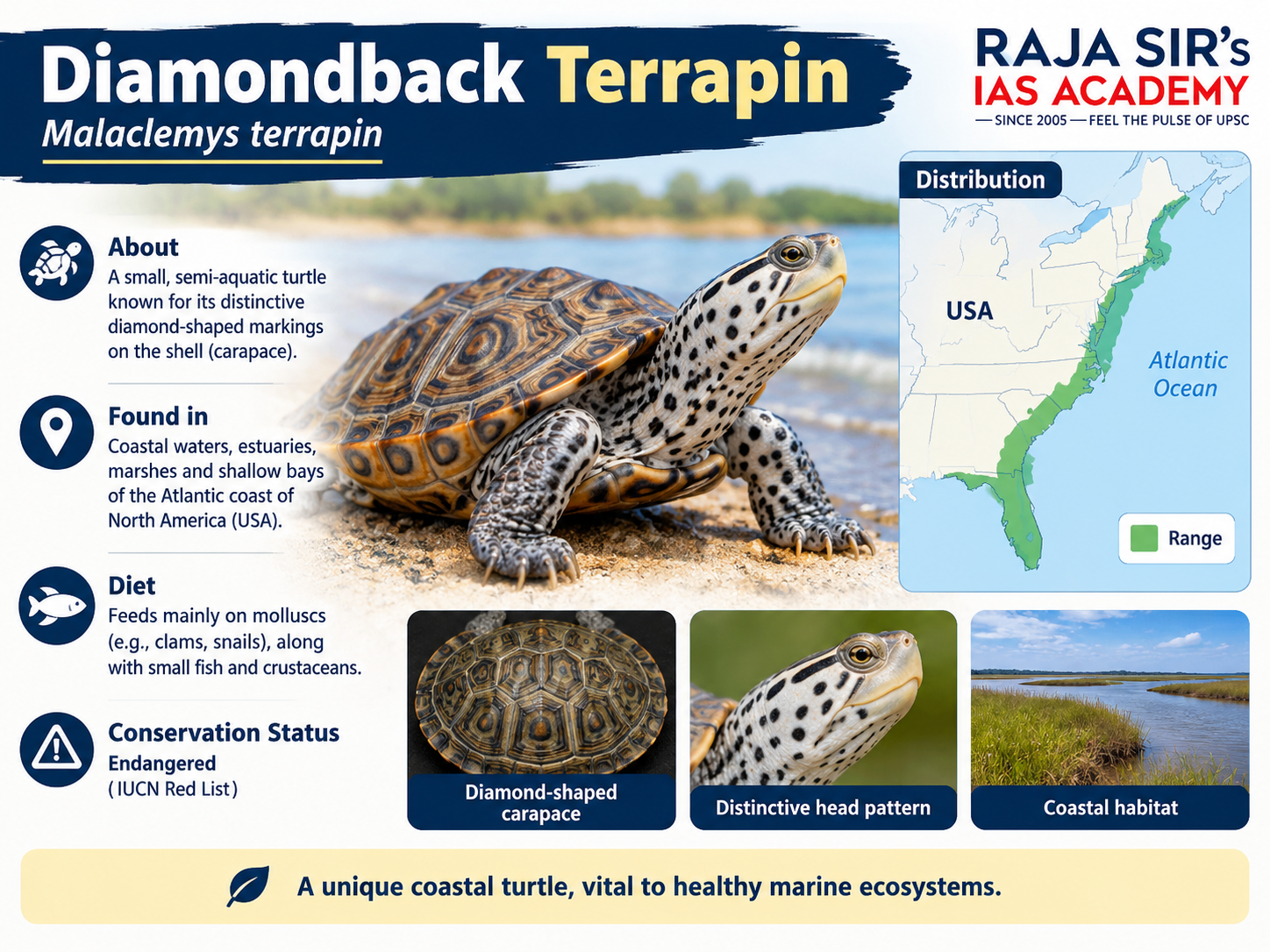
Diamondback Terrapin (Malaclemys terrapin)
GS III – Environment | Biodiversity and Conservation
Why in News?
A rare diamondback terrapin hatchling discovered at a protected nesting site on Cape Cod, Massachusetts, USA, exhibited bice phaly—a developmental abnormality in which an animal has two heads on one body, sometimes associated with incomplete separation of identical twins.
About Diamondback Terrapin
- Type: Coastal turtle adapted to brackish water environments.
- Identification: Diamond shaped concentric growth rings on the scutes of its upper shell (carapace), with pale skin marked by grey spots.
- Special adaptation: Salt glands near the eyes help excrete excess salt, supporting survival across changing salinity conditions.
- Habitat: Salt marshes, estuaries, tidal creeks and shallow bays.
- Distribution: Native to the United States, along the Atlantic coast from Massachusetts to Florida and the Gulf Coast to southern Texas.
- Ecological role: Predates on snails and other small organisms, helping maintain ecological balance in saltmarsh habitats.
Conservation Status
|
Framework
|
Conservation status
|
What it means
|
|
IUCN Red List
|
Vulnerable (VU)
|
Faces a high risk of extinction in the wild.
|
|
CITES
|
Appendix II
|
International trade is regulated to prevent exploitation from threatening the species'' survival.
|
|
|
Exercise KONKAN 2026: India–UK Maritime Cooperation
GS II: India–UK Relations; Defence Cooperation; Maritime Security
Why in News?
India''s guided missile stealth frigate INS Trishul arrived at Plymouth, United Kingdom, to participate in Exercise KONKAN26 with the Royal Navy. The exercise is scheduled off Plymouth from 8–15 October 2026.
What is Exercise KONKAN?
- Nature: Annual bilateral maritime exercise between the Indian Navy and the UK Royal Navy.
- Inception: Institutionalised in 2004.
- 2026 venue: Plymouth, United Kingdom.
- Indian participant: INS Trishul, a guided missile stealth frigate.
- Phases: Harbour phase and sea phase, involving professional interactions and operational cooperation.
Significance and Impact
- India–UK strategic partnership: Strengthens bilateral defence ties and supports the Comprehensive Strategic Partnership under India–UK Vision 2035.
- Indo Pacific security: Contributes to maritime stability and cooperation among partners.
- Operational preparedness: Improves mutual understanding and readiness for complex maritime contingencies.
- Rules based maritime order: Reinforces cooperation in support of international maritime law and freedom of navigation.
|
|
Five Years of PM GatiShakti National Master Plan
GS II: Government Policies and Interventions; Governance
GS III: Infrastructure; Investment Models
Why in News?
PM GatiShakti National Master Plan completed five years on 13 October 2026, highlighting India''s efforts to improve integrated infrastructure planning and multimodal connectivity.
What is PM GatiShakti?
Launched in October 2021, PM GatiShakti National Master Plan is a GISbased digital platform that integrates infrastructure planning across Central ministries and State governments. It aims to overcome fragmented planning through coordinated, multimodal infrastructure development.
Aim and Key Features
- Whole of government approach: Integrates infrastructure planning across ministries and States to reduce departmental silos.
- Seven infrastructure engines: Roads, railways, ports, waterways, airports, mass transport and logistics infrastructure.
- GIS based planning: Uses spatial data to identify connectivity gaps, overlapping projects and potential environmental constraints.
- Institutional coordination: The Empowered Group of Secretaries provides overall coordination, the Network Planning Group examines project proposals, and the Technical Support Unit provides technical assistance.
- Logistics integration: Complements the National Logistics Policy, Unified Logistics Interface Platform (ULIP) and multimodal logistics parks.
Significance and Impact
- Reduced logistics costs: Better coordination can minimise delays, inefficient freight movement and duplication of infrastructure investment.
- Seamless multimodal connectivity: Integrates roads, railways, ports and industrial corridors for efficient movement of goods.
- Improved project execution: Early identification of utility conflicts and other constraints can reduce delays and cost overruns.
- Balanced regional development: Better connectivity can improve market access for farmers, MSMEs and remote regions.
- Green growth: Efficient route planning and a shift towards suitable loweremission transport modes can reduce fuel consumption and emissions.
|
|
Global Innovation Index (GII) 2026
GS III – Economy | Science, Technology and Innovation
Why in News?
The World Intellectual Property Organization (WIPO) released the 19th edition of the Global Innovation Index (GII) 2026, assessing innovation performance across 139 economies.
What is the GII?
- Publisher: World Intellectual Property Organization (WIPO), a specialised agency of the United Nations.
- First published: 2007.
- Objective: Measures the innovation capabilities and outcomes of economies to assess their research capacity, technological progress and innovation ecosystems.
- Coverage: Evaluates 139 economies and identifies the world’s leading innovation clusters.
How is GII Calculated?
The index uses two equally weighted subindices, comprising seven pillars.
|
Sub-index
|
Pillars
|
What it measures
|
|
Innovation Input (50%)
|
1. Institutions 2. Human Capital and Research 3. Infrastructure 4. Market Sophistication 5. Business Sophistication
|
Enablers: Conditions that support innovation
|
|
Innovation Output (50%)
|
1. Knowledge and Technology Outputs 2. Creative Outputs
|
Results: Knowledge, technology and creative products generated through innovation
|
Overall score: Simple average of the Innovation Input and Innovation Output subindices.
Key Highlights of GII 2026
- Global leader: Switzerland retained the top position for the 16th consecutive year, followed by Sweden and the United States.
- European performance: Europe accounted for 14 of the top 25 innovation economies.
- Income group leaders: Switzerland, China, India and Rwanda led their respective income groups, as reported in the supplied source.
- India’s position: Ranked 38th among 139 economies, first among 36 lower middleincome economies and first among 11 economies in Central and Southern Asia.
|
|
ICMRCHAMP: High Altitude Medicine and Public Health Research
GS II – Health | GS III – Science & Technology, Disaster Management
Why in News?
The Union Health Minister laid the foundation stone for ICMRCHAMP at Key long, Lahaul and Spiti district, Himachal Pradesh, to strengthen healthcare research in high altitude regions.
Key Features
- First dedicated centre: ICMR’s first dedicated centre for high altitude medicine.
- Nodal institution: Indian Council of Medical Research (ICMR), under the Department of Health Research (DHR), Ministry of Health and Family Welfare.
- Research areas: High altitude physiology, acclimatisation, mountain medicine, climate sensitive diseases, mental health and disaster medicine.
- Digital healthcare: Exploring telemedicine, drone enabled medical logistics and real time public health surveillance for remote Himalayan communities.
ICMR
|
Feature
|
Details
|
|
Administrative department
|
Department of Health Research
|
|
Parent ministry
|
Ministry of Health and Family Welfare
|
|
Headquarters
|
New Delhi
|
|
Original name
|
Indian Research Fund Association (IRFA)
|
|
Renamed
|
1949
|
|
Research areas
|
Infectious diseases, non-communicable diseases, nutrition, public health and medical innovation
|
|
|
Implementation Gaps in the Right to Information Act, 2005
GS II — Transparency, Accountability and Citizen Centric Governance
Why in News?
As the RTI Act completes 21 years in 2026, concerns persist over weak proactive disclosure, Information Commission backlogs and inconsistent enforcement of penalties.
Aim and Key Features
- Section 4 - Proactive disclosure: Requires public authorities to publish prescribed information suo motu, reducing the need for individual applications.
- Section 7 - Time limit: Generally, information must be provided within 30 days; requests concerning life or liberty must be answered within 48 hours.
- Section 19 - Appeals: Provides for first and second appeals against decisions or nonresponse.
- Section 20 - Penalties: Permits penalties on Public Information Officers for specified defaults without reasonable cause.
- Sections 8 and 24 - Exemptions: Protect specified information and exempt certain organisations, subject to statutory conditions and exceptions.
Major Implementation Gaps
- Weak proactive disclosure: Outdated websites force citizens to file avoidable RTI applications.
- Appeal backlogs: Delays reduce the practical value of the right.
- Inconsistent penalty enforcement: Weak deterrence can encourage noncompliance.
- Institutional vacancies: Vacancies and inadequate capacity constrain Information Commissions.
- Threats to applicants: RTI users exposing corruption may face intimidation.
- Privacy–transparency tension: Public access must be balanced with legitimate privacy protections.
|
|
INS Mangrol
GS III – Internal Security
Why in News?
The Indian Navy commissioned INS Mangrol at the Naval Dockyard, Mumbai, to strengthen its antisubmarine warfare (ASW) capability in coastal and shallow waters.
About INS Mangrol
- Class: Maheclass AntiSubmarine Warfare Shallow Water Craft (ASWSWC).
- Builder: Cochin Shipyard Limited (CSL), Kochi.
- Indigenous content: Over 80%.
- Naming: Named after Mangrol, a coastal town in Gujarat. An earlier vessel of the same name, a minesweeper, was decommissioned in 2004.
- Programme: Part of the Navy’s plan to induct 16 ASWSWCs to replace Abhayclass corvettes. CSL is building eight Maheclass vessels, while Garden Reach Shipbuilders & Engineers (GRSE) is building eight Arnalaclass vessels.
Key Features
|
Feature
|
Details
|
|
Primary role
|
Detecting, tracking and countering submarines in shallow coastal waters
|
|
Sonar
|
Abhay hull-mounted sonar
|
|
Weapons
|
Lightweight torpedoes and an indigenous anti-submarine rocket launcher
|
|
Torpedo defence
|
Maareech Advanced Torpedo Decoy System, developed by DRDO
|
|
Propulsion
|
Waterjet system for manoeuvrability in shallow waters
|
|
Maximum speed
|
25 knots
|
|
Secondary roles
|
Subsurface surveillance, coastal minelaying, search and rescue (SAR), and Low-Intensity Maritime Operations (LIMO)
|
|
|
Kappatagudda Wildlife Sanctuary
GS III — Biodiversity
Why in News?
The Karnataka State Board for Wildlife reportedly rejected four stonequarrying proposals located 422–997 metres from Kappatagudda Wildlife Sanctuary, citing restrictions applicable to its 1km EcoSensitive Zone (ESZ).
About Kappatagudda Wildlife Sanctuary
- Location: Gadag district, northern Karnataka.
- Physiography: Part of the Deccan Plateau, characterised by a semiarid landscape, dry grasslands and scrub vegetation. It is often called the Sahyadri of North Karnataka.
- Area: Approximately 244.15 sq. km for the sanctuary; the supplied report gives 423.7 sq. km for the surrounding ESZ.
- Ecological significance: Known for its medicinal plant diversity and its role in conserving grassland and scrubland ecosystems.
Key Characteristics
- Flora: Rich medicinal and aromatic plant diversity, including species used in traditional healing.
- Fauna: Reported species include Indian grey wolf, striped hyena, leopard, blackbuck, chinkara, four horned antelope and Bengal fox.
- Watershed: Contributes to local drainage and water resource functions in the Tungabhadra basin.
- Geology: Mineral bearing formations increase pressure from quarrying and extraction activities.
Wildlife (Protection) Act, 1972 vs Environment (Protection) Act, 1986
|
Basis
|
Wild Life (Protection) Act, 1972
|
Environment (Protection) Act, 1986
|
|
Primary objective
|
Protects wild animals, birds and plants; conserves habitats.
|
Protects and improves the overall environment.
|
|
Scope
|
Wildlife conservation and protected areas.
|
Pollution control, environmental protection and regulation of harmful activities.
|
|
Key provisions
|
Establishment and management of national parks, wildlife sanctuaries and other protected areas.
|
Empowers the Central Government to notify Eco-Sensitive Zones (ESZs) and regulate activities through notifications and rules.
|
|
Regulatory focus
|
Wildlife protection, hunting restrictions and protected-area management.
|
Environmental standards, safeguards and restrictions on activities such as mining.
|
|
Authority
|
Central and State wildlife authorities, including Chief Wildlife Wardens.
|
Central Government, MoEFCC and designated regulatory authorities.
|
|
Applicationto Kappatagudda
|
Provides the legal framework for wildlife sanctuary protection.
|
Provides the basis for the applicable ESZ notification regulating activities around the sanctuary.
|
|
|
Loknayak Jayaprakash Narayan (1902–1979)
GS I – Modern Indian History
Why in News?
The Prime Minister paid tribute to Jayaprakash Narayan (JP) on his birth anniversary, observed on 11 October.
Who was Jayaprakash Narayan?
- Born: 11 October 1902, Sitabdiara (in presentday Bihar–Uttar Pradesh border region).
- Died: 8 October 1979, Patna.
- Popular title: Lok Nayak (People’s Leader), associated with his advocacy of social justice and democratic reform.
- Political background: Freedom fighter, socialist thinker and leader of the movement against the Emergency.
Role in India’s Freedom Struggle
- Civil Disobedience Movement: Participated in the freedom struggle and was imprisoned by British authorities.
- Quit India Movement (1942): Escaped from Hazaribagh Central Jail and helped organise underground resistance.
- Azad Dasta: Organised a guerrilla group to support resistance against British rule.
Major Contributions After Independence
- Socialism: Initially associated with the Congress Socialist Party, advocating social and economic equality.
- Sarvodaya and Bhoodan: Later moved away from party politics and supported the Sarvodaya movement and the Bhoodan movement led by Vinoba Bhave.
- Democratic decentralisation: Advocated the redistribution of political power towards people and local communities.
- JP Movement (1974): Led the Bihar Movement, which expanded into a wider movement demanding political accountability, anticorruption measures and democratic reforms.
- Opposition to Emergency (1975–1977): Opposed the National Emergency and was imprisoned during the period.
Important Books and Awards
|
Item
|
Details
|
|
Book
|
A Plea for the Reconstruction of Indian Polity (1959)
|
|
Ramon Magsaysay Award
|
1965 — Public Service
|
|
Bharat Ratna
|
Awarded posthumously in 1998
|
|
|
Nameri Wild Classroom Initiative: Learning Through Nature
GS III: Biodiversity Conservation
Why in News?
The Assam Forest and Climate Change Department launched the Nameri Wild Classroom initiative to provide students with experiential environmental education within Nameri Tiger Reserve.
Aim and Key Features
- Experiential learning: Takes environmental education beyond textbooks through direct interaction with nature.
- Field observation: Includes guided nature trails, birdwatching, wildlife observation and river ecology.
- Traditional ecological knowledge: Introduces students to local conservation practices and community knowledge.
- Scientific temperament: Encourages field documentation, observation and evidencebased understanding of ecosystems.
|
|
National Household Travel Survey (NHTS)
GS III – Economy | Infrastructure | Inclusive Urbanisation
Why in News?
The National Statistics Office (NSO), under the Ministry of Statistics and Programme Implementation (MoSPI), released findings of the National Household Travel Survey (July 2025–June 2026), the first allIndia household travel survey covering rural and urban areas across all States and Union Territories.
About NHTS
- Conducted by: National Statistics Office (NSO), MoSPI.
- Objective: Generate reliable household travel data for transport planning, infrastructure development and evidence based policymaking.
- Travel threshold: Trips of 1 km or more qualify as travel.
- Overnight trip: A trip of 50 km or more, involving more than 24 hours away from the residence, including travel and stay.
|
Indicator
|
Key finding
|
|
Mode of commute
|
Two-wheelers account for the largest share of workers’ commutes (42.6%).
|
|
Urban mass transit
|
Metro, monorail, suburban rail and trams serve only 5% of urban workers.
|
|
Urban–rural gap
|
Urban workers: 27 minutes and ₹1,044/month; rural workers: 23 minutes and ₹612/month.
|
|
Gender gap in work trips
|
Daily work-trip participation: males 61.9%; females 41.9%.
|
|
Commuting expenditure by gender
|
Male workers: ₹835/month; female workers: ₹533/month.
|
|
Average commute time
|
Students: 23 minutes; workers: 25 minutes.
|
|
Average worker expenditure
|
₹785/month for travel to a fixed workplace.
|
Significance and Impact
- Transport planning: Helps identify travel demand and infrastructure gaps across rural and urban India.
- Sustainable mobility: Highlights the need to strengthen public transport and reduce dependence on private vehicles.
- Gender inclusive planning: Differences in work trip participation can inform safer and more accessible transport for women.
- Regional equity: Rural–urban comparisons help guide investment in connectivity and transport services.
- Evidence based governance: Supports data driven decisions on transport infrastructure and mobility policies.
|
|
National Human Rights Commission (NHRC)
GS II: Statutory Bodies
Why in News?
The NHRC observed its 33rd Foundation Day in October 2026, highlighting emerging human rights concerns, including digital surveillance, algorithmic discrimination, climate change and social inequality.
What is the NHRC?
The National Human Rights Commission is a statutory body established on 12 October 1993 under the Protection of Human Rights Act (PHRA), 1993. It protects and promotes rights relating to life, liberty, equality and dignity guaranteed by the Constitution or embodied in international covenants enforceable by Indian courts.
Composition
- Chairperson: A person who has been the Chief Justice of India or a Judge of the Supreme Court.
- Judicial Members (2): One serving or former Supreme Court judge and one serving or former Chief Justice of a High Court.
- Expert Members (3): Persons with knowledge of, or practical experience in, human rights matters, including at least one woman.
- Deemed Members (7): Chairpersons of the National Commissions for Scheduled Castes, Scheduled Tribes, Minorities, Women, Backward Classes and Protection of Child Rights, along with the Chief Commissioner for Persons with Disabilities.
- Total composition: One Chairperson + five fulltime members + seven deemed members. Deemed members participate in discharging specified functions under Section 12 of the Act.
Powers and Functions
- Inquiry: Investigates complaints of human rights violations or negligence by public servants in preventing them.
- Civil Court Powers: Exercises specified civil court powers during inquiries, including summoning witnesses, examining them on oath and requiring documents.
- Judicial Proceedings: May intervene in court proceedings involving human rights violations with the court''s approval.
- Prison Visits: May visit jails and other State controlled institutions where persons are detained or lodged for treatment, reformation or protection.
- Safeguard Review: Reviews constitutional and legal safeguards for human rights and recommends measures for effective implementation.
- Research and Awareness: Promotes human rights literacy, research and public awareness.
- International Instruments: Studies relevant treaties and international instruments and recommends measures for their implementation.
|
|
Nobel Prize in Economic Sciences 2026: Macroeconomic Stabilisation
GS III: Indian Economy; Monetary Policy; Inflation; Economic Growth
Why in News?
According to reports dated 12 October 2026, Robert E. Hall and Michael Woodford were jointly awarded the 2026 Sveriges Riksbank Prize in Economic Sciences in Memory of Alfred Nobel for their contributions to the microeconomic foundations of macroeconomic stabilisation.
What is the Key Concept?
- Microeconomic foundations of macroeconomics means explaining economy wide outcomes—such as inflation, consumption and employment—through the decisions of individual households and firms.
- Understanding these decisions helps policymakers predict how consumers respond to income changes and how businesses react to interest rates and expected inflation.
Key Contributions
- Robert E. Hall — Consumption behaviour: His research on the permanent income hypothesis showed that consumption decisions depend on expectations about future income and lifetime resources, not merely current income. Under specific assumptions, consumption follows a random walk pattern.
- Michael Woodford — Monetary policy: His work, particularly Interest and Prices (2003), developed the theoretical foundations of modern monetary policy, emphasising interest rates, expectations, price setting behaviour and central bank communication.
Key Economic Concepts
- Permanent Income Hypothesis: Households base consumption decisions partly on their expected long term income. A temporary income increase may therefore produce a smaller consumption response than a lasting increase.
- Rational Expectations: Economic agents use available information to form expectations about future economic conditions and policy, although actual decisions may be affected by uncertainty and imperfect information.
- Forward Guidance: Central bank communication about the likely future direction of monetary policy, intended to influence expectations, borrowing and spending.
- Price Stickiness: Prices and wages do not always adjust immediately to changing economic conditions, affecting the transmission of monetary policy.
- Macroeconomic Stabilisation: Policies designed to reduce excessive fluctuations in output, employment and inflation.
Relevance to the Indian Economy
- RBI monetary policy: Expectations about future interest rates and inflation influence household borrowing, business investment and savings.
- Inflation management: Policy transmission depends partly on how households and firms interpret the RBI''s actions and inflation outlook.
- Consumption led growth: Changes in expected income, employment security and credit availability affect household consumption.
- Policy limitations: Supply side inflation caused by food shortages, energy prices or climate shocks may not respond adequately to interest rate changes alone.
Limitations and Challenges
- Uncertain expectations: Households and firms may not possess complete information or form expectations rationally.
- Unequal responses: Consumption and borrowing decisions differ across income groups and access to credit.
- Supply shocks: Interest rate policy cannot directly resolve shortages of food, fuel or other essential goods.
- Transmission gaps: Changes in policy rates may pass unevenly through banks and financial markets to households and businesses.
Way Forward
- Credible communication: Central banks should clearly explain policy decisions and the inflation outlook.
- Evidence based policymaking: Combine economic models with real time data and observed household and business behaviour.
- Balanced stabilisation: Coordinate monetary policy with appropriate fiscal and supply side measures.
- Inclusive analysis: Account for differences in income, indebtedness and access to formal finance when assessing policy transmission.
|
|
UN Global Initiative on AI for AgriFood Systems (GIAI4FS)
GS III — Agriculture, Emerging Technologies and Inclusive Growth
Why in News?
The second meeting of GIAI4FS was held alongside India Mobile Congress (IMC) 2026. It was jointly hosted by the Ministry of Communications and the Indian Council of Agricultural Research (ICAR) under the Ministry of Agriculture and Farmers Welfare.
About GIAI4FS
- Coordination: International Telecommunication Union (ITU).
- Partner organisations: Food and Agriculture Organization (FAO), International Fund for Agricultural Development (IFAD) and World Food Programme (WFP).
- Objective: Promote responsible and inclusive use of AI across agri food systems.
Key Applications of AI
- Precision agriculture: Uses satellite imagery, drones and soil sensors for sites pecific application of water, fertilisers and pesticides.
- Pest surveillance: The National Pest Surveillance System (NPSS) uses AI and machine learning to support pest identification and provide advisories.
- Climate smart agriculture: AI enabled weather forecasting can deliver location specific crop advisories.
- Postharvest management: Supports demand forecasting, storage monitoring, produce quality assessment and logistics optimisation.
Challenges
- Poor quality data: Fragmented landholdings and diverse agroclimatic conditions affect model accuracy.
- High costs: Drones, sensors, software and connectivity may be unaffordable for smallholders.
- Algorithmic bias: Underrepresented crops, regions and farmer groups may receive inaccurate recommendations.
- Limited field validation: Technical performance does not necessarily translate into sustained improvements in farm incomes.
- Data governance: Unclear data ownership and consent can expose farmers to misuse of information.
Way Forward
- Strengthen Digital Public Infrastructure: Improve interoperability among AgriStack, crop surveys, weather services and agricultural research databases.
- Prioritise smallholders: Promote affordable subscriptionbased services and shared, payperuse access to drones and sensors.
- Ensure responsible AI: Establish safeguards for data consent, transparency, independent validation and human oversight in highimpact decisions.
- Measure realworld outcomes: Evaluate interventions against farm incomes, input efficiency, climate resilience and environmental sustainability
Key International Organisations in GI-AI4FS
|
Organisation
|
Headquarters
|
Established
|
Key Functions
|
|
International Telecommunication Union (ITU)
|
Geneva, Switzerland
|
1865
|
UN specialised agency for digital technologies; develops international standards, coordinates radio-frequency spectrum and satellite orbits, and promotes global connectivity.
|
|
Food and Agriculture Organization (FAO)
|
Rome, Italy
|
1945
|
Leads international efforts to eliminate hunger; promotes food security, sustainable agriculture, forestry and fisheries.
|
|
International Fund for Agricultural Development (IFAD)
|
Rome, Italy
|
1977
|
UN specialised agency and international financial institution that finances rural development and supports small-scale farmers and rural communities.
|
|
World Food Programme (WFP)
|
Rome, Italy
|
1961
|
UN food-assistance organisation providing emergency food aid, nutrition support and assistance during humanitarian crises.
|
| |
|
|
|
|
|