Line of Actual Control (LAC)
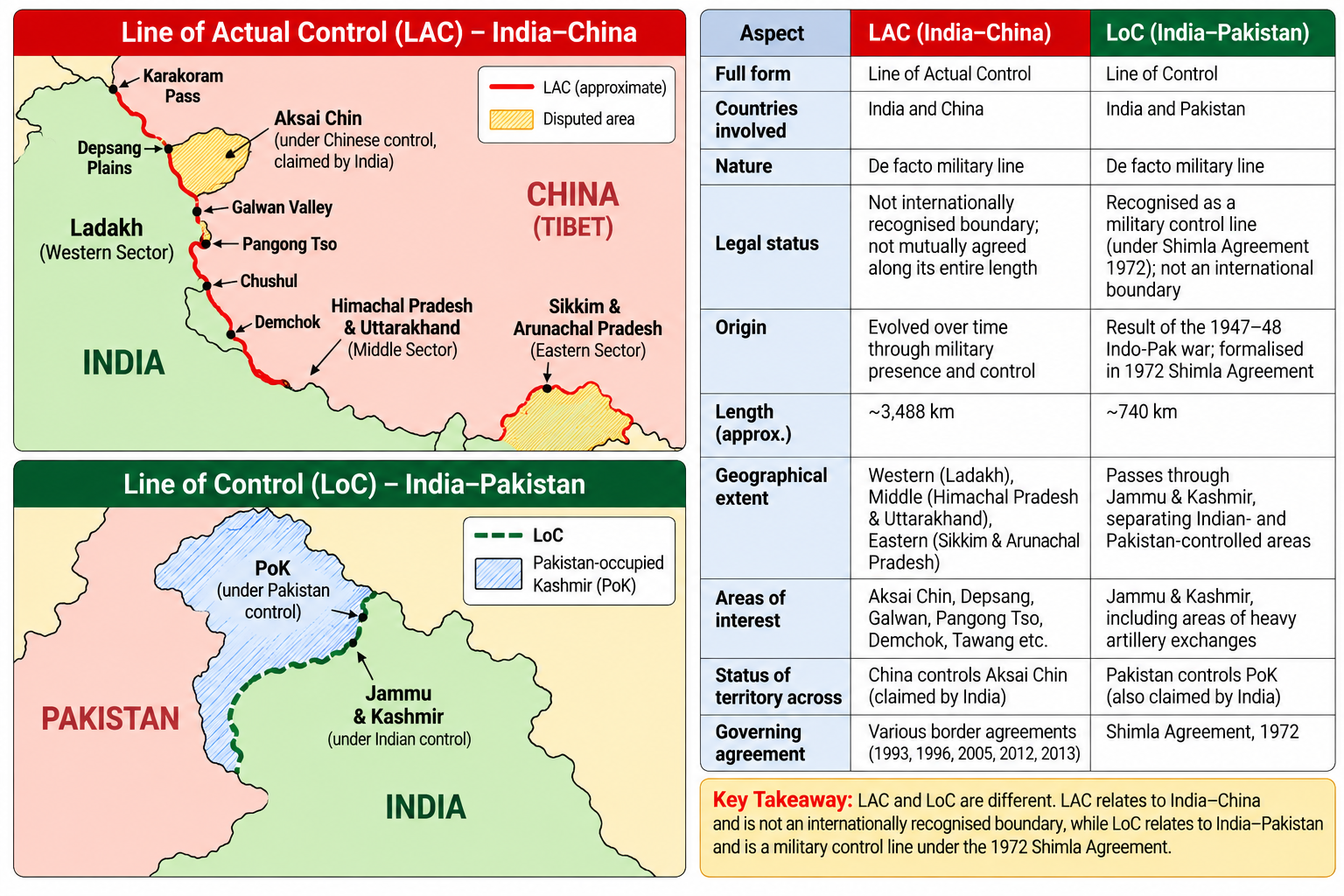
The Line of Actual Control (LAC) is the de facto line separating areas controlled by India and China. It is not an internationally recognised boundary, and the two countries do not have a common perception of its entire alignment. This lack of clarity has historically led to patrol face-offs and military tensions.
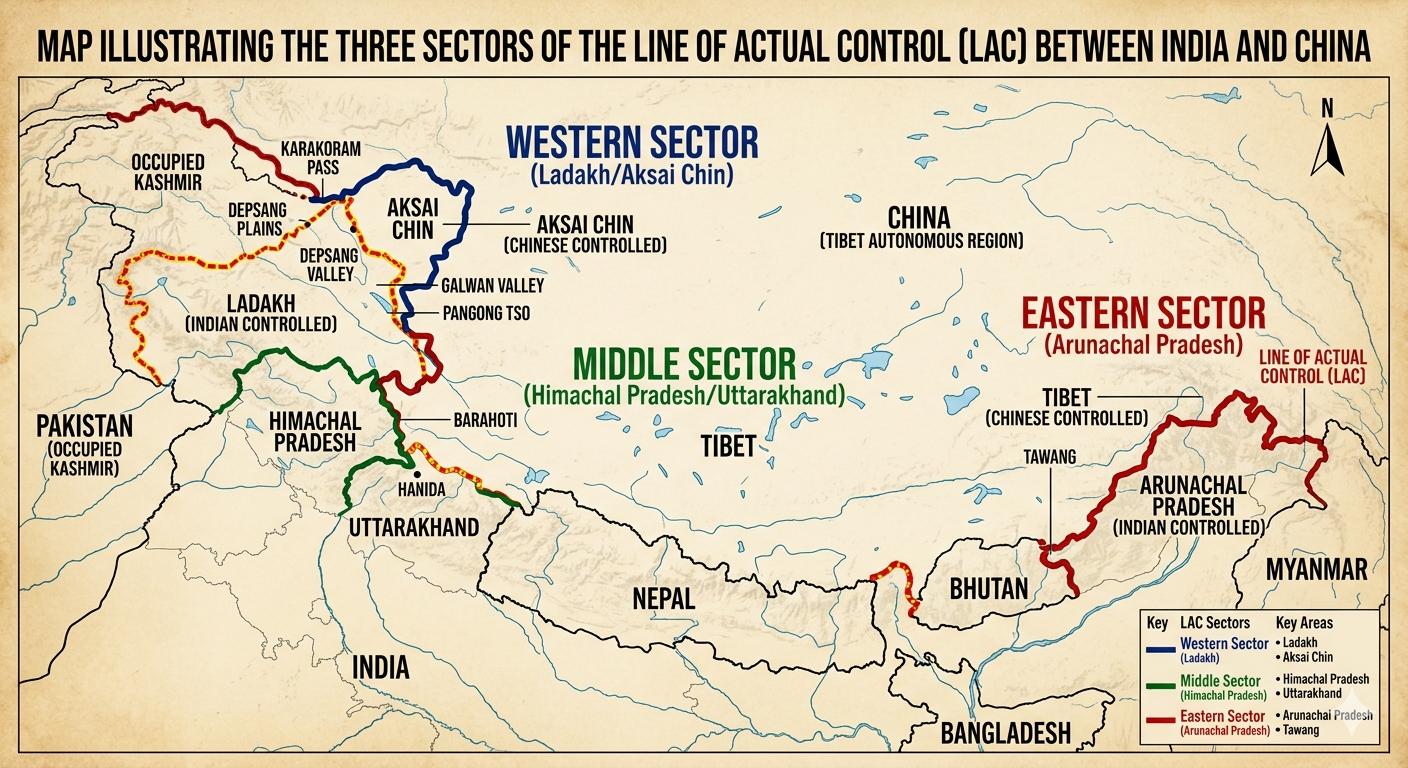
The India-China border is generally discussed in three sectors—Western, Middle and Eastern. For Prelims, it is important to remember the geography of each sector and the major strategic locations associated with it.
The Western Sector covers the India-China boundary in Ladakh. It is the most strategically sensitive sector and includes the disputed Aksai Chin region.
Important geographical locations include:
- Aksai Chin
- Karakoram Pass
- Depsang Plains
- Galwan Valley
- Pangong Tso
- Gogra–Hot Springs
- Demchok
- Chushul
- Kongka La
Aksai Chin is controlled by China but claimed by India. Its strategic importance partly arises from its location between Xinjiang and Tibet.
The 2020 military crisis was concentrated largely in this sector. The 2024 agreement on patrolling arrangements in Depsang and Demchok subsequently enabled disengagement from the remaining 2020 friction points.
- Middle Sector — Himachal Pradesh and Uttarakhand
The Middle Sector lies along the Indian states of Himachal Pradesh and Uttarakhand and the Chinese side of Tibet.
It is generally considered the least contentious sector of the India-China boundary, although differences exist regarding the precise alignment of the LAC in certain locations, including the Barahoti area.
- Eastern Sector — Sikkim and Arunachal Pradesh
The Eastern Sector covers Sikkim and Arunachal Pradesh.
A major geographical and historical reference point here is the McMahon Line, associated with the 1914 Simla Convention. India regards the McMahon Line as the basis of its boundary in the eastern sector, while China does not accept it and claims Arunachal Pradesh as part of what it calls southern Tibet.
Important locations include:
- Tawang
- Bum La
- Nathu La
- Se La
- Arunachal Pradesh
Why is the LAC Disputed?
The fundamental problem is the absence of a mutually agreed and fully delineated LAC. India and China have different perceptions of the alignment in several areas. Consequently, a patrol that one side considers to be within its territory may be viewed by the other side as a transgression. This creates the cycle of patrol → face-off → military mobilisation → diplomatic negotiations.
LAC, LoC and International Boundary
The LAC relates to India-China, whereas the Line of Control (LoC) relates to India-Pakistan. Neither term should automatically be equated with an internationally settled boundary. The LAC is particularly important because the India-China boundary dispute remains unresolved.
Important Agreements
India and China have developed several mechanisms to maintain peace despite the unresolved boundary. The 1993 Agreement focused on maintaining peace and tranquillity along the LAC, while the 1996 Agreement introduced military confidence-building measures. The 2005 Agreement established political parameters and guiding principles for settling the boundary question. The 2012 WMCC created a mechanism for consultation and coordination on border affairs, followed by the 2013 Border Defence Cooperation Agreement.
These agreements are important because they manage the disputed frontier but do not constitute a final boundary settlement.
2020 LAC Crisis
The 2020 crisis in Eastern Ladakh significantly altered India-China relations. Major areas involved included Galwan Valley, Pangong Tso, Gogra-Hot Springs and Depsang. The Galwan clash in June 2020 resulted in fatalities on both sides and led to prolonged military deployments and negotiations.
2024 Development
On 21 October 2024, India and China reached an agreement on patrolling arrangements in Depsang and Demchok. This facilitated disengagement from the remaining 2020 friction points. However, it is important for Prelims to remember:
Disengagement does not mean de-escalation, and de-escalation does not mean final boundary settlement.
Strategic Significance
The LAC is important not only for territorial security but also for Himalayan geopolitics, infrastructure development, border connectivity and India''s relations with China. The difficult terrain and high altitude make roads, bridges, tunnels, airfields and surveillance systems strategically important.
uture Course of Action / Way Forward
First, India should maintain peace and stability along the LAC. Military preparedness and credible deterrence are necessary to prevent unilateral changes to the status quo. At the same time, sustained diplomatic and military-level communication should reduce the risk of accidental escalation.
Second, the two sides should strengthen border-management mechanisms. Regular meetings of the WMCC, Special Representatives and military commanders, along with reliable hotlines and established protocols for face-offs, can help prevent local incidents from developing into wider crises.
Third, India should continue developing border infrastructure. All-weather roads, bridges, tunnels, communication networks and surveillance systems are essential for faster mobilisation and better connectivity. Development of border villages should accompany security infrastructure so that border populations become active participants in frontier development.
Fourth, the focus should gradually move from disengagement to de-escalation and de-induction. Withdrawal from immediate friction points is only the first step. Long-term stability requires reducing excessive forward military deployments while retaining adequate defensive preparedness.
Fifth, both countries should work towards greater clarity of the LAC. Clarification and confirmation of the LAC, wherever feasible, can reduce overlapping perceptions and therefore minimise recurring patrol confrontations. This should remain separate from, but complementary to, negotiations on the final boundary settlement.
Sixth, India should maintain a balanced diplomatic approach. The border issue should be managed through direct India-China dialogue while India simultaneously strengthens its strategic partnerships and regional connectivity. Economic engagement with China should also be calibrated with national-security considerations.
Conclusion
The LAC is not merely a disputed line on the map; it is a test of India''s ability to combine military preparedness with diplomatic maturity. The immediate objective should be peace, stability and prevention of further confrontation, while the long-term goal should remain clarification and eventual settlement of the boundary.
The way forward lies in “deterrence without escalation, dialogue without complacency, and development without neglecting security.” A stable LAC, supported by strong border infrastructure, effective communication and sustained negotiations, is essential for a mature and predictable India-China relationship.