Managing Climate Uncertainty in the Age of El Niño
Managing the El Niño Threat
Introduction
El Niño is no longer merely a periodic climatic phenomenon; in an era of climate change, its consequences are becoming increasingly complex and disruptive. The warming of the central and eastern tropical Pacific Ocean alters global atmospheric circulation, with significant consequences for rainfall, temperature, agriculture, water security and the economy. For India, the phenomenon is particularly important because of its potential to disrupt the southwest monsoon.
The challenge, therefore, is not to prevent El Niño—which is a natural climate phenomenon—but to reduce India''s vulnerability to its consequences through better prediction, preparedness and climate-resilient development.
Understanding El Niño
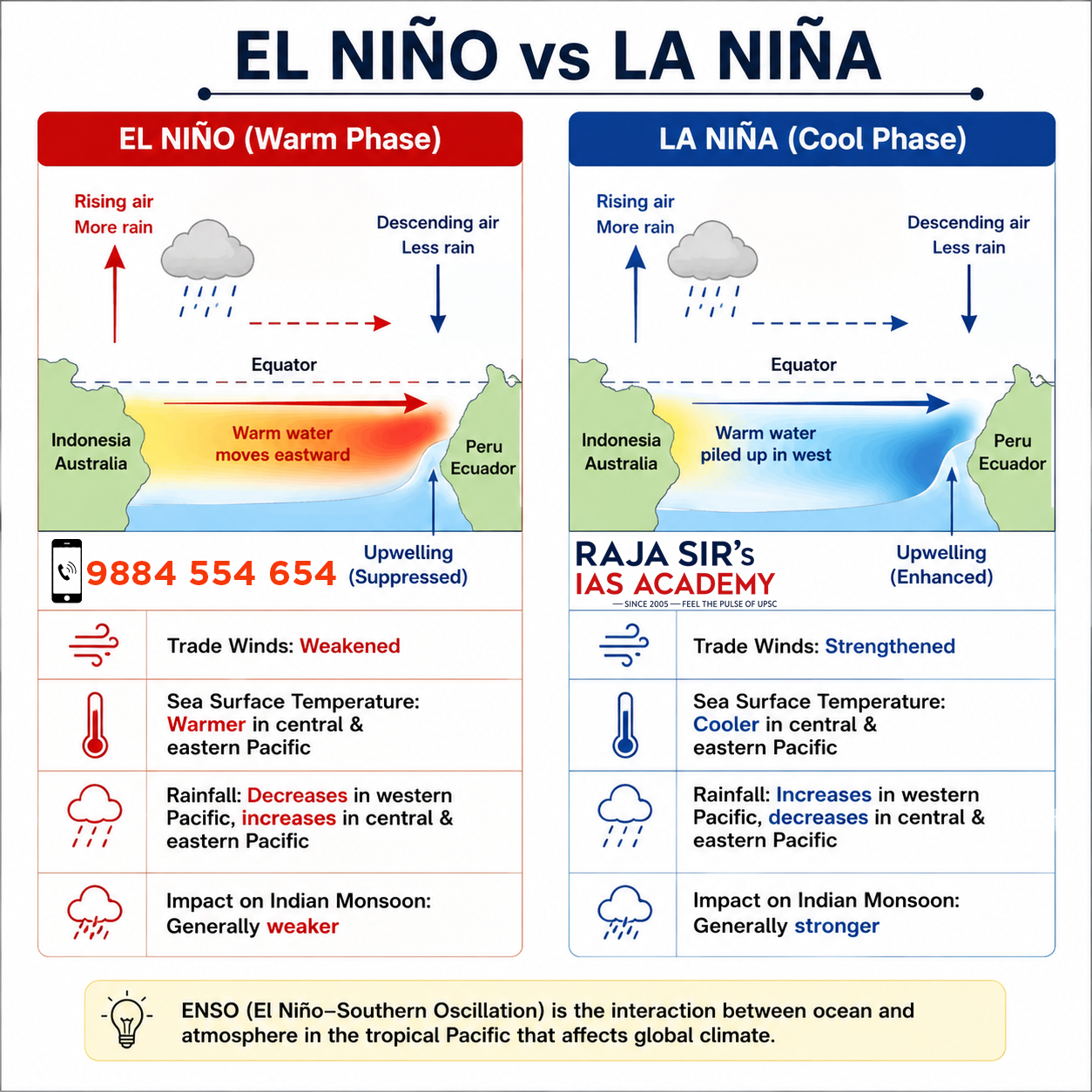
El Niño represents the warm phase of the El Niño-Southern Oscillation (ENSO). It occurs when sea-surface temperatures in the central and eastern tropical Pacific become unusually warm, accompanied by changes in atmospheric circulation and weakened trade winds.
Under normal conditions, trade winds push warm surface waters towards the western Pacific, while cooler waters upwell along the eastern Pacific coast. During El Niño, weakened trade winds disturb this circulation, resulting in warming of the eastern and central Pacific.
This ocean-atmosphere interaction has global consequences because it influences the Walker Circulation, precipitation patterns, temperature and atmospheric pressure across different regions.
Why is El Niño a Concern for India?
India''s southwest monsoon is particularly sensitive to ENSO conditions. El Niño is generally associated with a weakening of the Indian monsoon, although the relationship is not deterministic.
A weaker monsoon can trigger a chain of consequences:
El Niño → Monsoon variability → Agricultural stress → Food-price pressures → Rural income losses → Wider economic consequences
The risks are particularly significant for rain-fed agriculture, which remains highly dependent on monsoon rainfall.
However, it is important to avoid treating every deficient monsoon as an automatic consequence of El Niño. The Indian monsoon is influenced by several interacting factors, including the Indian Ocean Dipole (IOD), Madden-Julian Oscillation (MJO), snow cover, land-sea temperature contrasts and regional ocean conditions.
The Emerging Challenge: Climate Change
Climate change adds another layer of uncertainty.
A warmer atmosphere can hold more moisture, potentially intensifying extreme rainfall when conditions are favourable. At the same time, prolonged dry periods and heatwaves can become more damaging.
Thus, the policy challenge is shifting from simply asking:
Will El Niño occur?
to a more important question:
How vulnerable is India to the weather extremes associated with El Niño?
Recent research has also raised concerns regarding changes in the behaviour and persistence of ENSO events under a warming climate. Multi-year El Niño and La Niña events could create prolonged disruptions to rainfall, agriculture and ecosystems.
Limitations of Prediction
Modern climate models have significantly improved our ability to forecast ENSO. However, prediction becomes more difficult when climatic signals are weak or when multiple atmospheric and oceanic phenomena interact.
For India, this means that seasonal forecasts should not be treated as precise predictions. Instead, they should function as risk-management tools.
India therefore needs to move from a forecast-centric approach to a forecast-to-action framework, where climate information directly informs agricultural planning, reservoir management, disaster preparedness and public-health measures.
What Should India Do?
- Strengthen Climate Forecasting
The forecasting capabilities of the India Meteorological Department (IMD) and research institutions should be continuously strengthened through better ocean observations, high-resolution models, artificial intelligence and improved regional forecasting.
- Build Climate-Resilient Agriculture
Farmers should have access to:
- Drought-resistant and short-duration crop varieties
- Crop diversification
- Micro-irrigation
- Weather-based advisories
- Crop insurance
- Improved water-use efficiency
Agricultural policy should increasingly focus on resilience rather than merely increasing production.
- Improve Water Management
El Niño-related rainfall uncertainty makes water security crucial.
India needs:
- Scientific reservoir management
- Groundwater recharge
- Watershed development
- Rainwater harvesting
- Efficient irrigation
- Reuse of treated wastewater
Water management must shift from crisis response to anticipatory planning.
- Strengthen Social Protection
Climate shocks disproportionately affect small farmers, agricultural labourers and vulnerable households.
Targeted social protection, food-stock management, employment support and effective price monitoring can prevent a climatic shock from becoming a livelihood crisis.
- Use Climate Information at the Local Level
National-level forecasts are not sufficient for highly diverse climatic regions.
India should strengthen district-level and village-level climate advisories so that farmers, local governments and disaster-management authorities can take timely decisions.
Way Forward
India cannot control the occurrence of El Niño, but it can control the extent of damage caused by it.
The long-term strategy should combine better forecasting, resilient agriculture, efficient water management, diversified livelihoods and stronger disaster preparedness.
At the same time, climate adaptation cannot substitute for mitigation. Reducing greenhouse-gas emissions remains essential because climate change can amplify the risks associated with natural climate variability.
Conclusion
El Niño is a reminder that climate risks do not respect administrative boundaries or sectoral divisions. Its effects can travel from the Pacific Ocean to India''s farms, food markets, reservoirs and household incomes.
Therefore, India''s objective should not be to predict every climatic shock perfectly, but to build a society capable of absorbing, adapting to and recovering from climatic uncertainty.
The real measure of climate resilience is not the absence of climate shocks, but the ability to ensure that a climatic shock does not become a developmental crisis.
ENSO and Walker Circulation
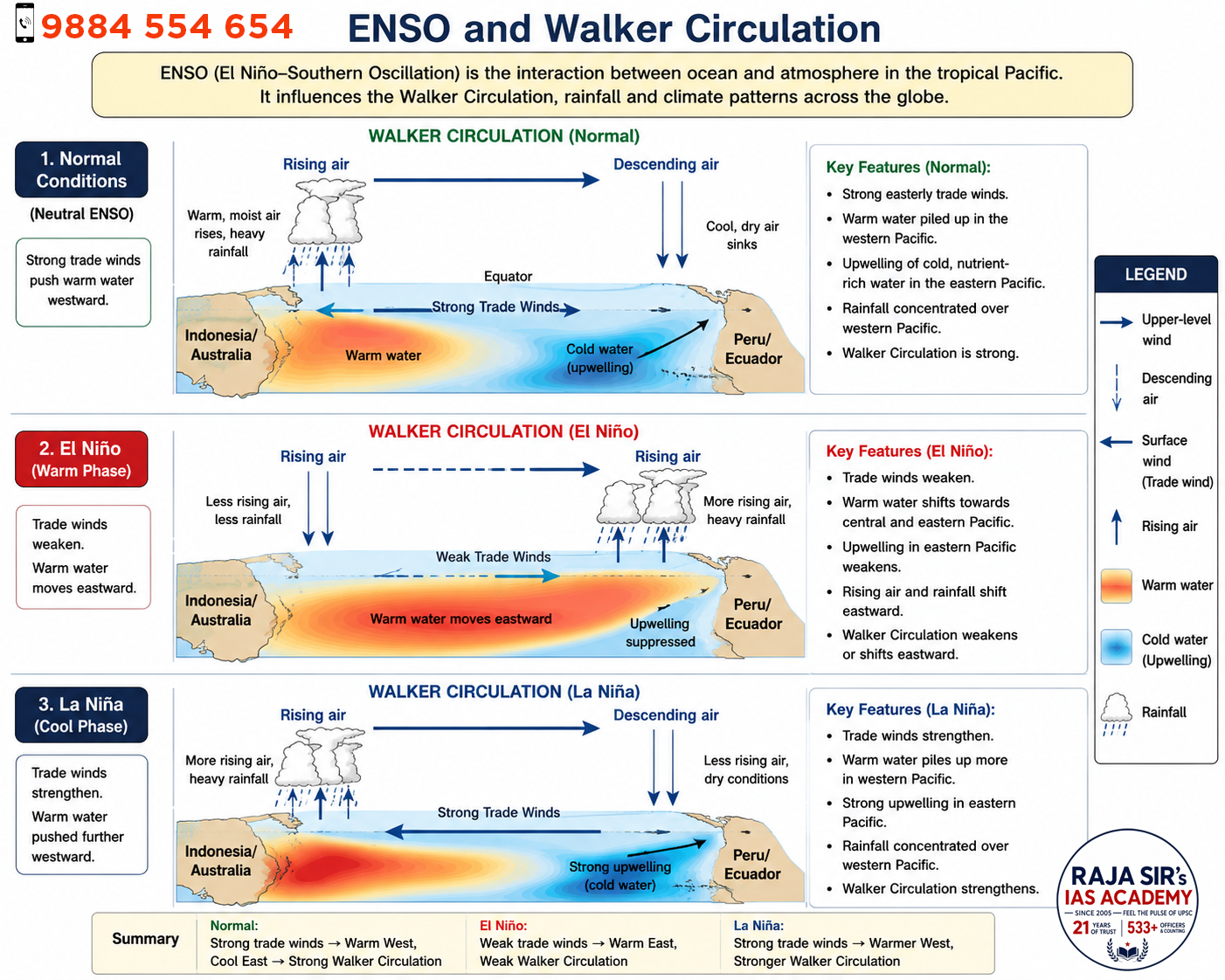
Under normal conditions, the tropical Pacific Ocean is characterised by strong easterly trade winds that blow from the eastern Pacific towards the western Pacific. These winds push warm surface waters towards Indonesia and Australia, causing warm water to accumulate in the western Pacific. The warm waters promote strong evaporation, leading to the rising of warm, moist air and heavy rainfall over the western Pacific. Meanwhile, along the coast of Peru and Ecuador in the eastern Pacific, cold, nutrient-rich water rises from the deeper ocean through upwelling, resulting in relatively cooler and drier conditions.
This east–west movement of air forms the Walker Circulation. Air rises over the warm western Pacific, moves eastward at higher levels of the atmosphere, descends over the cooler eastern Pacific and then returns westward near the surface as trade winds. Thus, the Walker Circulation represents a large-scale east–west atmospheric circulation over the tropical Pacific, closely linked with ocean temperatures and trade winds.
During El Niño, the trade winds weaken, allowing the warm surface water accumulated in the western Pacific to move eastward towards the central and eastern Pacific. This reduces the normal upwelling of cold, nutrient-rich water along the South American coast. Consequently, the central and eastern Pacific becomes unusually warm. The region of rising air and heavy rainfall also shifts eastward, while rainfall may decrease over the western Pacific. Therefore, El Niño is associated with a weakening or eastward displacement of the Walker Circulation.
During La Niña, the opposite process occurs. The trade winds become stronger and push even more warm surface water towards the western Pacific. At the same time, upwelling of cold, nutrient-rich water in the eastern Pacific becomes stronger, causing the central and eastern Pacific to become unusually cool. Rising air and rainfall become more concentrated over the western Pacific, while the eastern Pacific experiences stronger descending air. Consequently, the Walker Circulation becomes stronger.
Thus, ENSO represents the coupled interaction between ocean temperatures and atmospheric circulation in the tropical Pacific. El Niño is characterised by warming of the central and eastern Pacific and a weakening of the Walker Circulation, whereas La Niña is characterised by cooling of the same region and strengthening of the Walker Circulation. These changes in the Pacific Ocean–atmosphere system can influence rainfall, temperature and extreme weather patterns across the world, including the Indian monsoon.
|
Feature |
El Niño |
La Niña |
|
Meaning |
Warming of central & eastern tropical Pacific Ocean |
Cooling of central & eastern tropical Pacific Ocean |
|
Trade Winds |
Weaken |
Strengthen |
|
Upwelling off Peru |
Weakens |
Strengthens |
|
Walker Circulation |
Weakens |
Strengthens |
|
Pacific Rainfall |
Shifts towards central/eastern Pacific |
Concentrates more towards western Pacific |
|
India Monsoon |
Generally weaker / deficient |
Generally stronger / above normal |
|
India Temperature |
Can contribute to higher temperatures |
Can favour relatively cooler conditions in some seasons |
|
Australia & Indonesia |
Often drier |
Often wetter |
|
Peru & Ecuador |
Often wetter |
Often drier |
|
Global Temperature |
Tends to increase global temperatures |
Tends to lower global temperatures |
|
Fisheries near Peru |
Often negatively affected due to reduced nutrient-rich upwelling |
Generally favoured by stronger upwelling |
El Niño = Warm Pacific → Weak Trade Winds → Weak Upwelling → Generally weaker Indian Monsoon
La Niña = Cold Pacific → Strong Trade Winds → Strong Upwelling → Generally stronger Indian Monsoon