|
Citizenship in India-US
GS Paper II – Polity | Election Reforms | Democracy
Why in News?
US electoral rules concerning voter identification and citizenship verification have been compared with India''s electoral-roll verification process, particularly the Special Intensive Revision (SIR).
What it is?
The two countries have fundamentally different electoral architectures:
- USA : Decentralised election administration.
- India : Election Commission of India has constitutional superintendence over elections.
Aim
- Ensure electoral integrity while maintaining universal and accessible participation.
Significance
- Electoral Integrity : Accurate electoral rolls are essential for credible elections.
- Citizenship Verification : Raises questions about how eligibility should be established.
- Democratic Inclusion : Excessive documentation requirements can potentially exclude legitimate voters.
Challenges
- Documentation Gap : Poor and marginalised citizens may lack required documents.
- Administrative Burden : Verification can become complex.
- Inclusion–Integrity Balance : Electoral purity must not come at the cost of legitimate voter participation.
Way Forward
- Accessible Verification : Use multiple reliable forms of identification.
- Due Process : Provide notice and appeal mechanisms before deletion from electoral rolls.
- Technology with Safeguards : Use digital verification while protecting privacy.
- Independent Oversight ; Ensure transparent electoral-roll revision.
|
|
Degree without job
GS Paper II – Education | Social Justice | Employment
Why in News?
NITI Aayog''s report “Reimagining Skilling for Viksit Bharat@2047” highlighted a major gap between education, skills and employment, estimating 8.7 crore Indians aged 15–29 as NEET youth. (NEET = Not in Education, Employment or Training)
Aim
Shift India''s skilling system from training numbers to employment outcomes.
Significance
- Demographic Dividend : Youth skills determine whether India''s demographic advantage becomes an economic advantage.
- Employability : Addresses mismatch between degrees and labour-market requirements.
- Human Capital : Better skills improve productivity and earnings.
Impact
- NEET Reduction : Early vocational exposure can improve school-to-work transition.
- Industry Alignment : Apprenticeships and work-integrated education can improve employability.
- Future Workforce : Green industries, EVs and emerging sectors can receive better-trained workers.
Challenges
- Skill–Job Mismatch : Formal degrees do not always translate into employability.
- Financial Barriers : Poor households may not afford additional skilling.
- Uneven Apprenticeships : Opportunities remain fragmented across sectors and regions.
- Quality of Training : Training numbers alone do not guarantee employment.
Way Forward
- School-Level Skilling :Introduce employability and entrepreneurship skills from Class 6.
- Kaushal Tracks : Provide vocational specialisation from Class 9.
- Apprenticeships : Expand industry-linked apprenticeship opportunities.
- Earn While Learning : Provide flexible education and training models.
- Outcome-Based Evaluation : Measure success through employment and earnings, not enrolment numbers.
|
|
Eyes at sea
GS Paper II – International Relations GS Paper III – Internal Security Maritime Security
Why in News?
A tanker was reportedly boarded by six armed persons, who took control of the vessel and diverted it towards Somalia. The incident was reported by the United Kingdom Maritime Trade Operations (UKMTO).
What it is?
UKMTO is a British Royal Navysponsored maritimesecurity organisation that acts as a communication bridge between commercial vessels and military forces in the region.
Aim
- Early reporting of maritime security incidents.
- Coordinate responses to distress calls.
- Provide warnings and advisories to commercial shipping.
- Improve maritime domain awareness.
Significance
- Maritime Security : Helps protect merchant vessels from piracy, armed attacks and other maritime threats.
- Global Trade : Supports security of major shipping routes linking the Indian Ocean, Red Sea and Persian Gulf.
- Military–Commercial Coordination : Provides a direct communication channel between ship masters and military forces.
- Regional Security : Important for security in the West Asia–Indian Ocean maritime region.
Impact
- Faster Response : Incident reporting enables quicker coordination during emergencies.
- Better Maritime Awareness : Regular reports from ships help security agencies monitor developments at sea.
- Safer Shipping ; Warnings and advisories allow vessels to take precautionary measures.
Challenges
- Maritime Crime : Piracy, armed boarding and other transnational crimes remain difficult to control.
- Vast Operational Area : The reporting area covers nearly 2.5 million sq. miles of ocean.
- Multiple Security Actors :Effective response requires coordination among navies, coast guards, shipping companies and coastal states.
Way Forward
- RealTime Information Sharing : Strengthen maritime informationsharing mechanisms.
- Joint Surveillance : Improve coordination among regional maritimesecurity agencies.
- Vessel Preparedness : Encourage merchant ships to follow reporting and security protocols.
- Regional Cooperation : Strengthen cooperation among Indian Ocean and West Asian countries.
|
Feature
|
UKMTO
|
|
Full form
|
United Kingdom Maritime Trade Operations
|
|
Sponsored by
|
British Royal Navy
|
|
Established
|
2001
|
|
Original office
|
Dubai
|
|
Present location
|
Portsmouth, UK
|
|
Primary role
|
Commercial vessel–military coordination
|
|
Reporting mechanism
|
Voluntary Reporting Scheme (VRS)
|
|
Area
|
Voluntary Reporting Area (VRA)
|
|
Approx. area
|
2.5 million sq. miles
|
|
Key regions
|
Red Sea, Arabian Sea, NW Indian Ocean, Gulf of Aden, Gulf of Oman, Persian Gulf
|
|
Reporting
|
Entry, daily transit and exit/port reports
|
|
Communications
|
Warnings, Advisories, Reports, Maritime Information Exchange Meeting records
|
|
|
Fueling Friendship
GS Paper II – International Relations | India–Mauritius Relations | Energy Security
Why in News?
India and Mauritius signed a longterm fuel supply agreement under which Indian Oil Corporation will supply Mauritius with petrol, diesel and aviation turbine fuel (ATF).
Aim
- Ensure reliable fuel supply to Mauritius.
- Strengthen India–Mauritius economic cooperation.
- Deepen India''s strategic engagement in the Indian Ocean.
Significance
- Energy Security : Provides Mauritius with a more assured source of petroleum products.
- Indian Ocean Strategy : Strengthens India''s partnership with a strategically located island nation.
- Economic Diplomacy : Expands bilateral cooperation into the energy sector.
- Regional Connectivity : Reinforces India''s role as a reliable partner in the Indian Ocean region.
Impact
- Supply Stability : Reduces uncertainty in Mauritius''s fuel procurement.
- Strategic Presence : Deepens India''s engagement in the western Indian Ocean.
- Energy Diplomacy : Demonstrates how energy partnerships can support wider foreign policy objectives.
Challenges
- Import Dependence : Mauritius remains highly dependent on imported petroleum products.
- Global Price Volatility : International crude price fluctuations can affect fuel costs.
- Energy Transition : Petroleum cooperation must eventually be complemented by clean energy alternatives.
Way Forward
- Renewable Energy Cooperation : Expand collaboration in solar, wind and other renewable technologies.
- Green Energy : Explore cooperation in green hydrogen, biofuels and energy efficiency.
- Strategic Reserves : Improve fuel storage and supplychain resilience.
- Technology & Investment : Encourage Indian investment in Mauritius''s wider energy infrastructure.
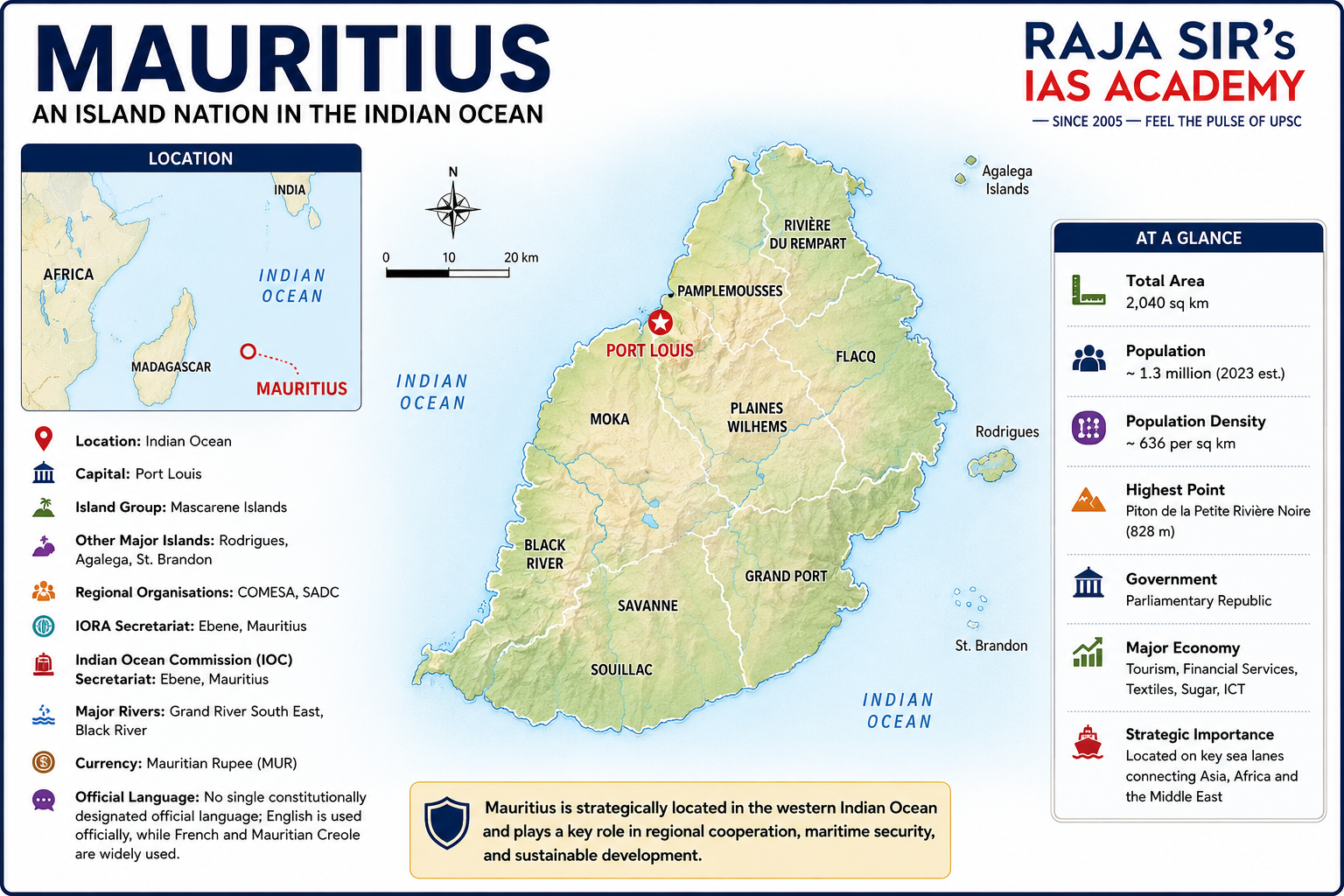
About
- Location: Indian Ocean
- Capital: Port Louis
- Island group: Mascarene Islands
- Other major islands: Rodrigues, Agalega, St. Brandon
- Regional organisations: COMESA, SADC
- IORA: Headquarters/Secretariat at Ebene, Mauritius
- Indian Ocean Commission (IOC): Secretariat at Ebene, Mauritius
- Major rivers: Grand River South East, Black River
- Currency: Mauritian Rupee
- Official language: No single constitutionally designated official language; English is used officially, while French and Mauritian Creole are widely used.
|
|
High altitude survivor
GS Paper I – Geography Environment & Ecology
Why in News?
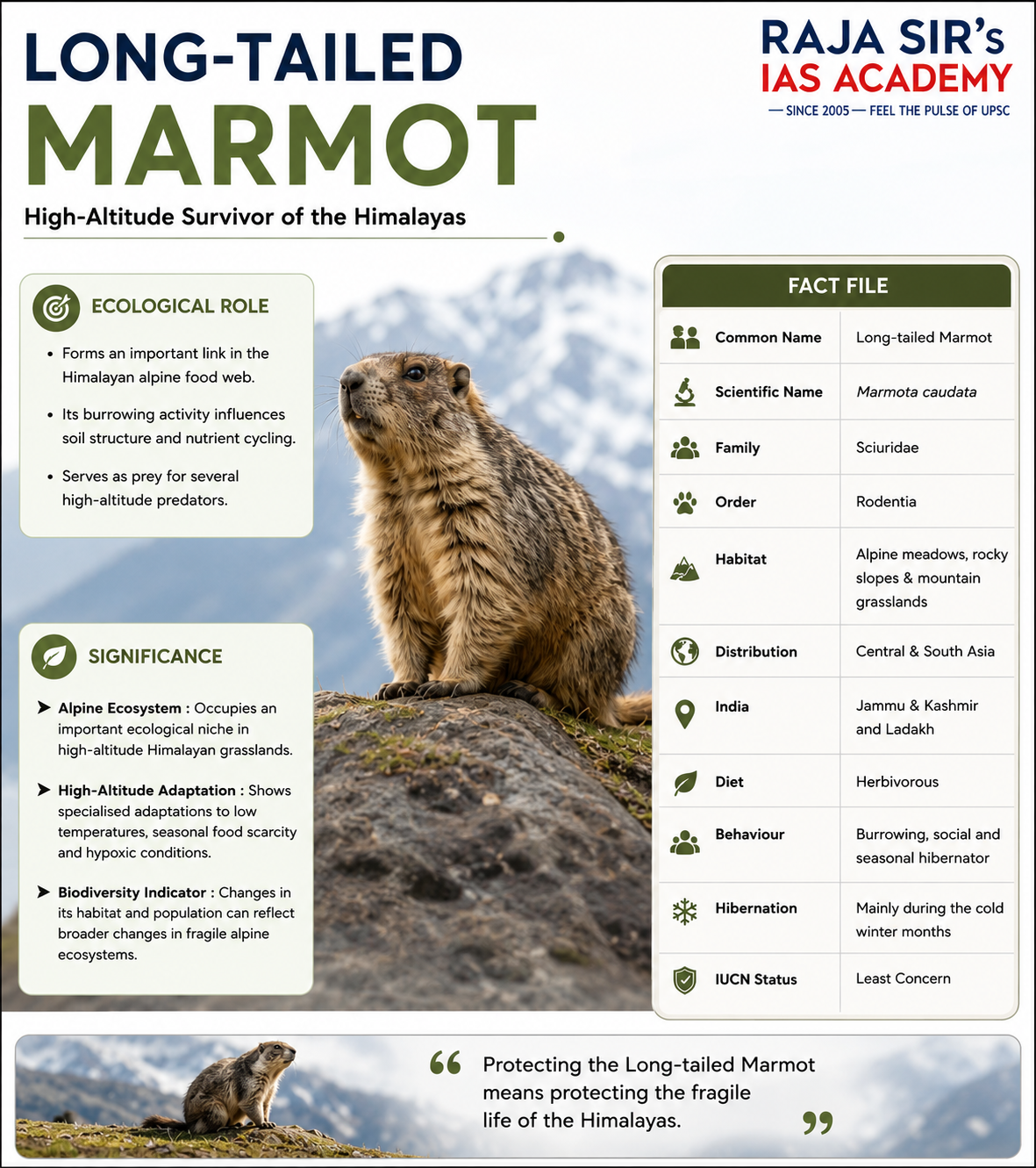
The Amarnath Yatra brings large numbers of pilgrims into the fragile Himalayan landscape, drawing attention to wildlife such as the Longtailed Marmot, a characteristic highaltitude mammal of the region.
Ecological Role
- Forms an important link in the Himalayan alpine food web.
- Its burrowing activity can influence soil structure and nutrient cycling.
- Serves as prey for several highaltitude predators.
Significance
- Alpine Ecosystem : Occupies an important ecological niche in highaltitude Himalayan grasslands.
- HighAltitude Adaptation : Shows specialised adaptations to low temperatures, seasonal food scarcity and hypoxic conditions.
- Biodiversity Indicator : Changes in its habitat and population can reflect broader changes in fragile alpine ecosystems.
Threats
- Tourism & Pilgrimage Pressure : Heavy human movement can cause habitat disturbance and behavioural stress.
- Artificial Feeding : Feeding by tourists can alter natural foraging behaviour and increase dependence on humans.
- Climate Change : Changes in temperature, snow cover and alpine vegetation can affect its food availability, hibernation and habitat suitability.
Way Forward
- Responsible Tourism : Prohibit feeding, chasing or approaching wild animals.
- Awareness : Educate pilgrims and tourists about the sensitivity of alpine wildlife.
- EcosystemBased Management : Integrate wildlife protection, waste management and carryingcapacity assessment into pilgrimage planning.
|
Feature
|
Fact
|
|
Common name
|
Long-tailed Marmot
|
|
Scientific name
|
Marmota caudata
|
|
Family
|
Sciuridae
|
|
Order
|
Rodentia
|
|
Habitat
|
Alpine meadows, rocky slopes & mountain grasslands
|
|
Distribution
|
Central & South Asia
|
|
India
|
Jammu & Kashmir and Ladakh
|
|
Diet
|
Herbivorous
|
|
Behaviour
|
Burrowing, social and seasonal hibernator
|
|
Hibernation
|
Mainly during the cold winter months
|
|
IUCN status
|
Least Concern
|
|
|
Micro camera- Macro threat
GS Paper III – Science & Technology Internal Security
Why in News?
An endoscopic camera was allegedly used to covertly access and copy an examination paper in a Chhattisgarh university paper-leak case, highlighting how compact medical-imaging technologies can be repurposed for non-medical activities.
What it is?
- An endoscopic camera is a miniature imaging system designed to capture visuals from narrow, enclosed or difficult-to-access spaces.
- In modern endoscopes, chip-on-tip technology places the image sensor at or near the tip of the instrument, allowing compact and flexible imaging.
Significance
- Medical Technology : Enables doctors to directly visualise internal structures without conventional open surgery.
- Minimally Invasive Procedures : Smaller access points can reduce tissue damage, recovery time and surgical trauma.
- Technological Convergence : Demonstrates how advances in miniaturised sensors, optics and electronics have expanded medical imaging capabilities.
Security Implications
- Covert Surveillance : Extremely small imaging devices can potentially be concealed and used for unauthorised recording.
- Examination Security : Traditional physical security measures must account for increasingly sophisticated miniature technologies.
- Dual-Use Technology : A technology developed for a legitimate purpose can potentially be repurposed for malicious or unlawful activities.
Challenges
- Technology Misuse : Miniaturisation makes sophisticated imaging equipment easier to conceal.
- Detection Difficulties : Conventional frisking and visual inspection may not always detect miniature electronic devices.
- Institutional Preparedness : Examination authorities may lack awareness of emerging technological methods of cheating.
Way Forward
- Layered Examination Security : Combine secure question-paper handling, controlled access, surveillance and technology-based screening.
- Technology Awareness : Regularly update examination-security protocols to account for emerging devices.
- Controlled Access : Maintain strict chain-of-custody procedures for confidential examination material.
|
Endoscope
|
Major Area Examined
|
|
Cystoscope
|
Urinary bladder / urinary tract
|
|
Laryngoscope
|
Larynx
|
|
Gastroscope
|
Stomach and upper gastrointestinal tract
|
|
Laparoscope
|
Abdominal/pelvic cavity
|
|
Arthroscope
|
Joints
|
|
Duodenoscope
|
Duodenum
|
|
|
Missile KN-30
GS Paper II – International Relations | GS Paper III – Defence & Security
Why in News?
Ukraine''s defence intelligence has reportedly alleged that Russia received North Korean KN-30 ballistic missiles, highlighting the expanding military relationship between Russia and North Korea amid the Russia–Ukraine conflict.
What it is ?
- The KN-30 is a Western designation associated with North Korea''s Hwasong-11C / Hwasong-11Da family of short-range ballistic missiles (SRBMs).
- It is designed as a mobile, ground-launched ballistic-missile system and uses solid propellant, enabling relatively rapid launch preparation.
Significance
- Russia–North Korea Military Cooperation : The reported transfer would indicate deepening defence cooperation and military-technology links between the two countries.
- Solid-Fuel Technology : Solid-fuel missiles generally offer shorter preparation time and easier storage and deployment compared with liquid-fuel systems.
- Missile Proliferation : Transfer of ballistic missiles across borders raises concerns regarding the spread of missile capabilities and associated technologies.
- Indo-Pacific Security : Greater North Korean missile cooperation with external powers could complicate the strategic environment in East Asia.
Impact
- Russia''s Strike Capability : If confirmed, the transfer could supplement Russia''s inventory of battlefield ballistic missiles.
- North Korea''s Military Partnerships : Military cooperation can provide Pyongyang with opportunities for combat experience, technology access and diplomatic leverage.
- Global Security : Such transfers challenge existing efforts to restrict the proliferation of ballistic-missile capabilities.
Challenges
- Missile Proliferation : Cross-border transfers make monitoring and controlling missile technologies more difficult.
- Verification : Intelligence assessments regarding specific missile transfers can be difficult to independently verify.
- Sanctions Enforcement : Preventing prohibited military transfers requires effective monitoring of shipping, financial networks and supply chains.
Way Forward
- Strengthen Export Controls : Improve monitoring of components and technologies relevant to ballistic-missile development.
- International Monitoring : Enhance intelligence-sharing and mechanisms for detecting illicit military transfers.
- Diplomatic Engagement : Use multilateral forums to address missile proliferation and emerging military-technology networks.
|
Feature
|
KN-30
|
|
Western designation
|
KN-30
|
|
Associated North Korean designation
|
Hwasong-11C / Hwasong-11Da
|
|
Category
|
Short-Range Ballistic Missile (SRBM)
|
|
Propulsion
|
Solid fuel
|
|
Launch
|
Mobile, ground-based launcher
|
|
Nature
|
Ballistic missile
|
|
|
Nature’s helical blueprint
GS Paper III – Science & Technology Environment Biomimicry
Why in News?
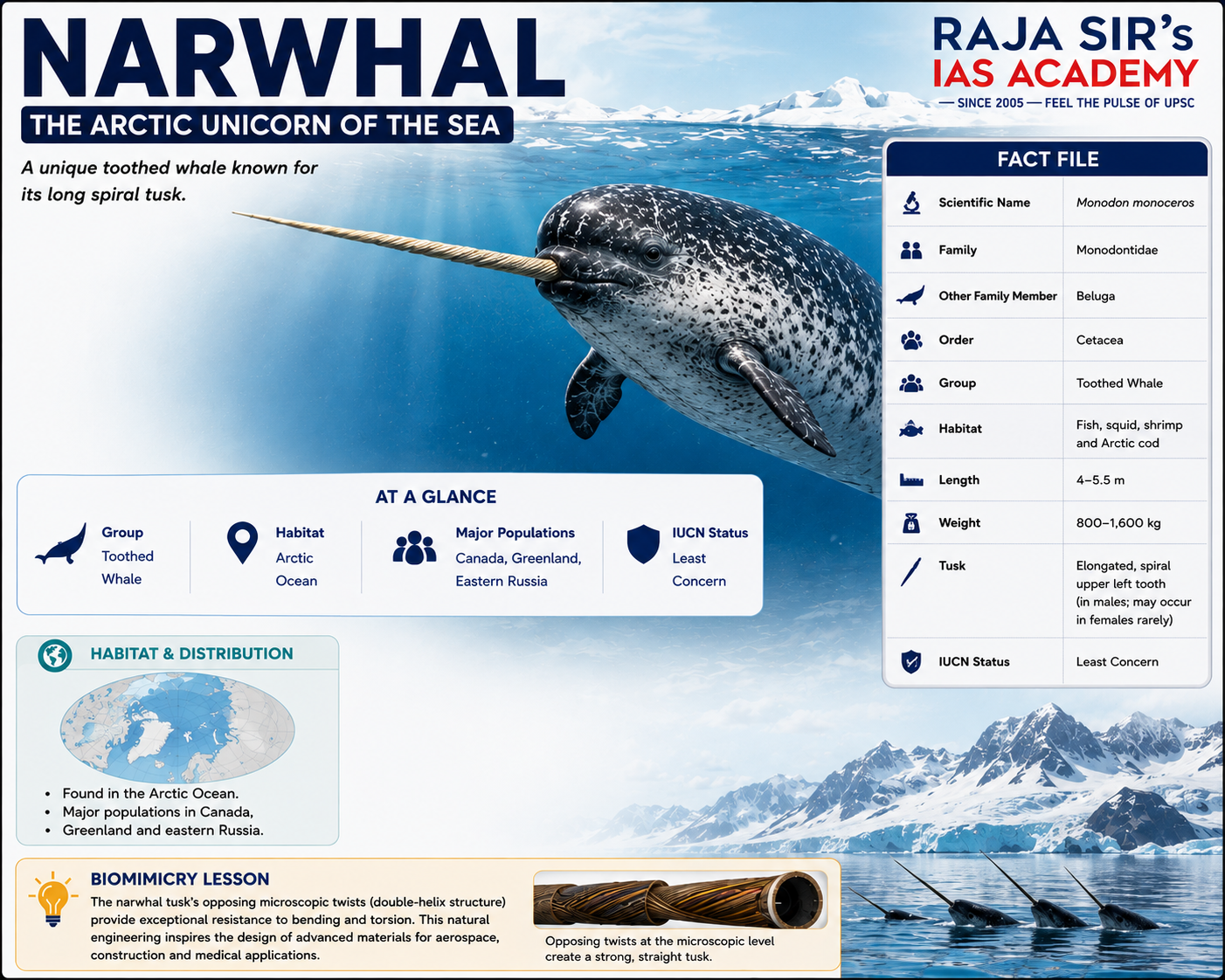
A study published in Nature Communications examined how opposing microscopic twists within the narwhal’s tusk contribute to its straight and mechanically stable structure.
Significance
- Biomimicry : structural designs can inspire new humanmade materials.
- Material Science : Provides insights into how biological materials withstand bending and torsional forces.
- Evolutionary Adaptation : Demonstrates specialised structural adaptation in Arctic marine mammals.
Impact
- Advanced Materials : Could inspire the development of lightweight and resilient materials.
- Engineering Innovation : Helical structural principles may contribute to future engineering designs.
- Medical Applications : Biological material architecture may provide ideas for designing stronger biomaterials.
Challenges
- Biological Complexity : Replicating naturally evolved microscopic structures is technically difficult.
- Manufacturing Cost : Bioinspired materials may require sophisticated manufacturing processes.
- ScaleUp : Laboratory discoveries may not easily translate into commercially viable technologies.
Way Forward
- Biomimetic Research : Translate biological structural principles into engineered materials.
- Advanced Imaging : Use highresolution 3D imaging to study biological materials.
- Practical Applications : Explore potential uses in aerospace, construction and medical devices.
|
Feature
|
Narwhal
|
|
Scientific name
|
Monodon monoceros
|
|
Family
|
Monodontidae
|
|
Other family member
|
Beluga
|
|
Group
|
Toothed whale
|
|
Habitat
|
Arctic Ocean
|
|
Major populations
|
Canada, Greenland, eastern Russia
|
|
Tusk
|
Elongated tooth
|
|
IUCN status
|
Least Concern
|
Notes:
- Narwhal is NOT a fish. It is a marine mammal and toothed whale.
- Tusk is NOT a horn. It is a modified/elongated tooth.
- Family: Monodontidae . Includes narwhal + beluga.
|
|
Strabismus
GS Paper II – Health Human Development
Why in News?
A recent global systematic review estimated that horizontal strabismus affects about 1.81% of the global population, equivalent to nearly 138.5 million people, highlighting the significant burden of eyealignment disorders.
What it is ?
Strabismus, commonly known as squint, is a condition in which the two eyes are not properly aligned and therefore do not look at the same point simultaneously.
Significance
- Child Health : Normal eye alignment is important for the development of binocular vision during childhood.
- Prevention of Amblyopia : Persistent misalignment may cause the brain to suppress images from one eye, leading to amblyopia (“lazy eye”).
- Quality of Life : Depending on the type and age of onset, strabismus may cause double vision, visual discomfort and difficulties with depth perception.
Impact
- Vision Development : Untreated childhood strabismus can interfere with normal visual development.
- Social & Psychological Wellbeing : Visible eye misalignment may affect selfconfidence, social interaction and quality of life.
- Healthcare Burden : Delayed diagnosis can increase the complexity of treatment and the risk of permanent visual impairment.
Challenges
- Late Detection : Strabismus may go unnoticed, particularly when the deviation is intermittent.
- Unequal Access : Paediatric ophthalmology and specialised eyecare services are not uniformly available.
- Lack of Awareness : Parents may mistakenly assume that childhood squint will resolve automatically.
Way Forward
- Early Screening : Strengthen childhood and schoolbased vision screening.
- Timely Intervention : Depending on the cause, treatment may include corrective glasses, patching/amblyopia therapy, vision therapy in selected cases, or surgery.
- Public Awareness : Parents should seek professional eye examination when abnormal eye alignment is persistent or recurrent.
|
Term
|
Meaning
|
|
Strabismus
|
Misalignment of the eyes
|
|
Esotropia
|
Inward deviation of an eye
|
|
Exotropia
|
Outward deviation of an eye
|
|
Amblyopia
|
Reduced vision caused by abnormal visual development
|
|
Binocular vision
|
Ability of both eyes to work together to produce a single integrated visual perception
|
|
Horizontal strabismus
|
Strabismus involving inward or outward deviation
|
|
|
Toxic Legacy
GS Paper III – Environment | Pollution | Public Health
Why in News?
Decades of improper industrial-waste disposal have resulted in groundwater contamination by hexavalent chromium [Cr(VI)] in parts of Uttar Pradesh, highlighting the long-term consequences of hazardous industrial pollution.
Short Explain
- Chromium is a naturally occurring metallic element that exists in several oxidation states.
- Cr(VI) → highly toxic and carcinogenic; can contaminate groundwater through industrial activities.
- Cr(III) → generally much less toxic and is an essential trace nutrient in some biological contexts.
Significance
- Public Health : Long-term exposure to Cr(VI), particularly through contaminated water, can cause serious health effects, including increased cancer risk.
- Groundwater Security : Demonstrates how industrial pollution can threaten aquifers that serve as important sources of drinking and irrigation water.
- Environmental Governance : Highlights the importance of hazardous-waste management, industrial compliance and groundwater monitoring.
Impact
- Health Burden : Communities dependent on contaminated groundwater may face prolonged exposure.
- Agricultural Impact : Contaminated groundwater used for irrigation can introduce pollutants into soil and agricultural ecosystems.
- Persistence of Legacy Pollution : Industrial contamination can remain in groundwater and soil for years or decades, even after the original source is removed.
Challenges
- Difficult Aquifer Remediation : Groundwater contamination is difficult to detect, contain and clean because pollutants can migrate through subsurface formations.
- Legacy Industrial Waste : Historical contamination may persist long after industrial operations have ceased.
- Continuous Monitoring : Requires regular testing of groundwater quality, contaminant concentration and exposure pathways.
Way Forward
- Polluter Pays Principle : Industries responsible for contamination should bear the cost of environmental restoration and remediation.
- Scientific Mapping : Identify contaminated aquifers, pollution sources and vulnerable populations through hydrogeological mapping.
- Safe Drinking Water : Provide affected communities with alternative safe-water sources until contamination is addressed.
- Remediation Technologies : Select site-specific technologies such as pump-and-treat, permeable reactive barriers and in-situ reduction where technically suitable.
- Stronger Hazardous-Waste Management : Ensure safe treatment, storage and disposal of industrial waste to prevent future contamination.
|
Feature
|
Cr(III)
|
Cr(VI)
|
|
Oxidation state
|
+3
|
+6
|
|
Common compounds
|
Cr₂O₃, CrCl₃
|
Chromate, Dichromate
|
|
Relative toxicity
|
Lower
|
Very high
|
|
Carcinogenicity
|
Much lower concern
|
Carcinogenic
|
|
Environmental concern
|
Comparatively lower
|
Major concern
|
|
Groundwater mobility
|
Generally lower
|
Higher
|
|
Oxidising nature
|
Lower
|
Strong oxidising agent
|
| |
|
|
|
|
Transshipment Friction
GS Paper II – International Relations | GS III – Economy | International Trade
Why in News?
The US accused India and several other countries of helping Chinese exporters evade US tariffs through transshipment, triggering another phase of US–India trade tensions.
What it is?
- Transshipment refers to routing goods through a third country before reaching the final destination.
- The US allegation is that Chinese goods may undergo limited processing, repackaging or relabelling before being exported onward.
Aim of US Policy
- Prevent tariff evasion and protect domestic industries from goods entering through alternative routes.
Significance for India
- Trade Relations : Adds another point of friction to India–US economic relations.
- Manufacturing : India increasingly imports Chinese intermediate goods and components for domestic manufacturing.
- Global Value Chains : Shows the complexity of modern supply chains.
Impact
- Higher Costs : Additional US tariffs could increase costs for Indian exporters.
- Export Competitiveness : Indian manufacturing could become less competitive.
- Chinese Inputs : Restrictions could disrupt India''s access to intermediate components.
Challenges
- Trade Protectionism : Rising tariffs can fragment global trade.
- ·Supply-Chain Dependence : Indian manufacturing remains dependent on some Chinese inputs.
- ·Strategic Autonomy : India must reduce excessive dependence without disrupting production.
Way Forward
- ·Supply-Chain Diversification : Develop alternative sources of critical components.
- ·Rules-Based Trade : Resolve disputes through transparent trade mechanisms.
- ·Domestic Manufacturing : Increase domestic value addition and component production.
- ·Diplomatic Engagement : Negotiate tariff and market-access issues through bilateral channels.
|