|
AI and Cyber Threats in India
GS-3: Cyber Security
Why in News?
AI is increasingly being used to automate reconnaissance, phishing, malware generation, vulnerability discovery and cyber espionage.
This is shifting cyber warfare from human-speed to machine-speed operations.
What is AI-enabled Cyber Threat?
AI can be integrated across the cyber kill chain to:
- Identify targets.
- Generate personalised phishing.
- Create/mutate malware.
- Discover vulnerabilities.
- Generate deepfakes.
- Automate attacks through AI agents.
Aim of Attackers
- Scale attacks at low cost.
- Bypass conventional cybersecurity systems.
- Target critical infrastructure.
- Conduct espionage and information warfare.
Significance
- Critical Infrastructure Risk : Power grids, banking, defence, nuclear facilities and telecom networks become vulnerable.
- Democratisation of Cyber Offence : Advanced capabilities previously requiring expert teams can increasingly be automated.
- Deepfake Threat : Synthetic voice/video can facilitate fraud, misinformation and social engineering.
- Industrial Control Systems : AI-enabled attacks can affect OT/ICS systems controlling physical infrastructure.
Way Forward
- AI for AI : Deploy AI-based threat detection and automated response.
- Zero Trust : Continuous authentication rather than perimeter-based security.
- Critical Infrastructure Protection : Air-gapping wherever feasible.
- Human-in-the-loop : AI should assist—not completely replace—security decision-making.
CERT-In
- CERT-In = Indian Computer Emergency Response Team
- A CERT is a specialised team that monitors, detects, analyses and responds to cybersecurity incidents such as malware attacks, data breaches, phishing and ransomware.
- Functions under the Ministry of Electronics and Information Technology (MeitY).
- It is the national agency for responding to computer security incidents under the Information Technology Act, 2000.
|
|
Balancing Foreign-Fund Regulation with Civil-Society Space
GS-2 | Governance | NGOs | Internal Security
Why in News?
The Foreign Contribution (Regulation) Amendment Bill, 2026 has been referred to a Joint Parliamentary Committee (JPC).
The FCRA Amendment Rules, 2026 also seek to strengthen compliance, transparency and accountability in the regulation of foreign contributions.
Aim
- Improve Transparency & Accountability : Strengthen monitoring of foreign contributions received and utilised by NGOs and other registered organisations.
- Address Asset-Management Gap : Provides a legal framework for dealing with assets created or acquired through foreign contributions after cessation of FCRA registration.
Key Provisions
- Designated Authority : Provides for a Designated Authority to deal with assets associated with foreign-funded organisations after cessation of registration.
- Provisional Custody : Assets may be placed under provisional custody after the organisation''s FCRA registration ceases, preventing their unauthorised transfer or disposal.
- Permanent Vesting : Under specified circumstances, such assets may vest permanently with the government.
- Appeal Mechanism : Provides affected organisations with a mechanism to challenge decisions relating to custody or vesting of assets.
- Automatic Cessation : FCRA registration may automatically cease in specified circumstances, reducing ambiguity over the legal status of organisations.
- Reduced Maximum Imprisonment : The proposed changes seek to reduce the maximum imprisonment for certain FCRA-related offences.
Significance
- National Security : Stronger monitoring can help prevent foreign funds from being diverted towards activities contrary to national security or public interest.
- Transparency : Improved tracking of foreign contributions and associated assets can reduce financial opacity and misuse.
- Accountability : A defined framework for asset management after cessation of registration reduces legal uncertainty.
- Regulatory Certainty : Clear procedures for custody, vesting and appeals can make enforcement more predictable.
Concerns
- Excessive Executive Discretion : Broad administrative powers may create concerns regarding arbitrary or disproportionate action.
- NGO Autonomy : Excessive regulation could affect the ability of legitimate civil-society organisations to operate independently.
- Due Process : Decisions affecting registration and property should follow notice, hearing and reasoned decision-making.
- Property Rights : Permanent vesting of assets raises questions regarding ownership and constitutional protection of property.
- Chilling Effect on Civil Society : Excessive compliance burdens may discourage legitimate organisations from receiving foreign support or undertaking socially beneficial activities.
Way Forward
- Prior Notice: Give organisations adequate notice before adverse action.
- Right to Hearing: Ensure affected entities can present their case.
- Reasoned Orders: Authorities should clearly explain the basis for decisions.
- Judicial Review: Maintain effective avenues for independent judicial scrutiny.
- Independent Grievance Mechanism: Provide a neutral mechanism for resolving disputes.
- Targeted Scrutiny: Focus intensive monitoring on high-risk organisations and transactions rather than imposing identical burdens on all NGOs.
|
|
Bringing Retail Investors into Debt Markets
GS-3 | Economy & Financial Markets
Why in News?
SEBI proposed norms governing advertisements by Online Bond Platform Providers (OBPPs) to ensure greater transparency and prevent misleading promotion of bond investments.
What is OBPP?
- Online Bond Platform Providers (OBPPs) are SEBI-regulated online platforms that facilitate retail investors'' access to listed debt securities and other eligible bonds.
- They make the bond market more accessible by providing information and digital access to investment opportunities.
Benefits
- Retail Access to Bond Markets : Enables individual investors to participate more easily in the corporate bond and debt-securities market.
- Better Investment Comparison : Platforms allow investors to compare bonds based on:
1. Yield: Potential return from the investment.
2. Credit Rating: Indicative assessment of the issuer''s creditworthiness.
3. Maturity: Period until repayment of principal.
4. Cash Flow: Timing and amount of interest/principal payments.
Significance
- Financial Inclusion : Expands access to investment avenues beyond traditional bank deposits and equity markets.
- Increased Retail Participation : Digital platforms can lower entry barriers and encourage greater retail participation in debt markets.
- Deepening Corporate Bond Market : A broader investor base can improve liquidity, capital mobilisation and diversification in India''s corporate bond market.
- Greater Transparency : Standardised disclosure and advertising norms can help investors make better-informed investment decisions and reduce the risk of misleading claims.
|
|
Building India’s Complete Solar Manufacturing Chain
GS-3 | S&T | Renewable Energy
Why in News?
India is considering a dedicated subsidy framework to develop 30 GW domestic polysilicon manufacturing capacity by 2030.
Solar PV Manufacturing Chain
Polysilicon → Ingots → Wafers → Solar Cells → Solar Modules
Polysilicon
- Polysilicon is high-purity silicon produced from silicon-containing raw materials. It is the starting material for most crystalline-silicon solar panels.
- Role: Provides the silicon needed to convert sunlight into electricity.
Ingots
- Polysilicon is melted and formed into large blocks or cylindrical crystals called ingots.
- Monocrystalline: Single crystal structure → higher efficiency.
- Multicrystalline: Multiple crystal structures → generally lower efficiency.
- Role: Provides the crystalline structure from which wafers are made.
Wafers
- Ingots are sliced into very thin wafers using specialised cutting equipment.
- Role: Acts as the physical semiconductor substrate on which the solar cell is manufactured.
Solar Cells
- Wafers undergo processes such as doping, surface treatment and metallisation to create a photovoltaic cell.
- When sunlight falls on the cell, it generates direct current (DC) electricity through the photovoltaic effect.
- Role: Converts solar energy → electrical energy.
Solar Modules
- Multiple solar cells are interconnected, encapsulated and protected with glass and a backsheet/frame to form a solar module (solar panel).
- Role: Provides a durable, deployable unit for generating electricity.
Significance
- Reduces Import Dependence: Domestic solar manufacturing reduces India’s reliance on imported polysilicon, wafers, cells and modules.
- Strengthens Manufacturing: Builds capabilities across the entire solar PV value chain, while supporting the wider semiconductor ecosystem.
- Enhances Supply-Chain Resilience: Diversifies sourcing and reduces vulnerability to global price shocks, trade restrictions and geopolitical disruptions.
- Supports Atmanirbhar Bharat: Promotes domestic production, technology development, investment and employment, strengthening India’s self-reliance in clean-energy manufacturing.
|
|
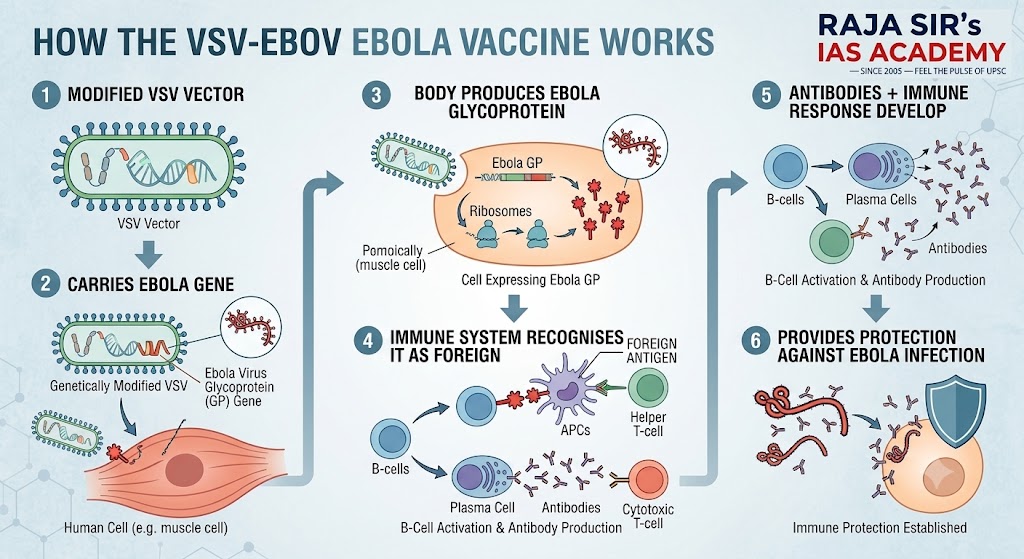
Ervebo Ebola Vaccine
What is Ervebo?
Ervebo is a vaccine used to protect against Ebola virus disease, particularly disease caused by Zaire ebolavirus.
What is rVSV-ZEBOV?
- rVSV-ZEBOV is the scientific name of the vaccine.
- rVSV = recombinant Vesicular Stomatitis Virus.
- ZEBOV = Zaire Ebola virus.
Why use VSV?
- VSV is used as a viral vector because it can deliver the Ebola glycoprotein antigen effectively while being modified so that the vaccine does not cause Ebola disease.
What is the Ebola Glycoprotein?
- The glycoprotein (GP) is a protein on the surface of the Ebola virus that helps the virus attach to and enter host cells. The vaccine uses this protein to train the immune system.
Single Dose
- Ervebo is administered as a single-dose vaccine, which is particularly useful during Ebola outbreaks because rapid vaccination of at-risk populations is important.
|
|
Exercise Udara Shakti 2026
GS-3 | Defence
Why in News?
The Indian Air Force (IAF) participated in Exercise Udara Shakti 2026 with the Royal Malaysian Air Force (RMAF) in Malaysia.
Aim
- Enhance air combat capability: Improves pilots’ ability to operate in complex combat scenarios.
- Improve tactical interoperability: Enables both air forces to coordinate and operate effectively together.
- Joint mission planning: Promotes coordinated planning and execution of air operations.
- Strengthen operational readiness: Helps forces prepare for real-time and high-intensity air operations.
Key Features
- Dissimilar Air Combat Training: Fighters with different capabilities train against each other to improve combat tactics.
- Fighter Manoeuvres: Enhances pilot skills in offensive and defensive aerial manoeuvres.
- Air-to-Air Refuelling: Builds capability for extended-range and long-duration air operations.
- Subject Matter Expert Exchanges: Facilitates sharing of expertise, operational experience and best practices.
- Strategic Airlift Cooperation: Improves coordination in long-range movement of personnel and equipment.
Significance for India
- Strengthens Act East Policy: Expands India’s defence engagement with Southeast Asian countries.
- Deepens India–Malaysia Defence Relations: Builds mutual trust and operational cooperation.
- Enhances ASEAN Interoperability: Improves India’s ability to work with regional partners during security operations.
- Supports Indo-Pacific Security: Contributes to a free, open, inclusive and rules-based Indo-Pacific through greater defence cooperation
India–Malaysia Defence Exercises:
- Udara Shakti → Air Force
- Harimau Shakti → Army
- Samudra Laksamana → Navy
|
|
Expanding Animal–Human Health Frontier
GS-3 | Environment & Health
Why in News?
Australia reported H5N1 infection in a dead long-nosed fur seal at Beachport, South Australia, indicating the continuing geographical spread of highly pathogenic avian influenza.
What is H5N1?
- H5N1 is a subtype of Influenza A virus that primarily causes avian influenza.
- H5 → Hemagglutinin: Viral surface protein involved in attachment and entry into host cells.
- N1 → Neuraminidase: Viral surface protein involved in the release of newly formed virus particles.
- Highly Pathogenic Avian Influenza (HPAI): Refers to strains that can cause severe disease and high mortality, particularly in poultry.
Significance
- Primarily Affects Birds : H5N1 mainly circulates among wild birds and domestic poultry and can cause severe outbreaks.
- mammalian Spillover : The virus can cross the species barrier and infect mammals, including marine mammals.
- Zoonotic Concern : Repeated infections in mammals create opportunities for viral adaptation, raising concerns about potential changes in host range and human health risks.
- One Health Relevance : H5N1 demonstrates the interconnectedness of animal health, human health and ecosystems, requiring coordinated surveillance.
|
|
Harnessing India’s Water Bodies for Solar Power
GS-3: Renewable Energy
Why in News?
- Union Cabinet approved Pradhan Mantri Surya Sarovar Yojana (PM-SSY).
- Outlay: ₹5,070 crore.
- Target: 5,000 MW Floating Solar PV + 10,000 MWh Battery Energy Storage Systems by 2030-31.
About
- Scheme : Pradhan Mantri Surya Sarovar Yojana (PM-SSY)
- Ministry : Ministry of New and Renewable Energy (MNRE)
- Launch Year : 2025
What is Floating Solar?
- Solar PV panels mounted on buoyant platforms over reservoirs, dams, lakes and water bodies.
- Electricity is transmitted to shore through underwater cables.
- India has estimated technical potential of around 102 GWp.
Aim
- Expand renewable energy without additional land acquisition.
- Reduce water evaporation.
- Integrate solar generation with hydropower and storage.
Significance
- Land-use efficiency : Avoids competition with agriculture, forests and settlements.
- Water conservation : Panel coverage reduces solar radiation reaching water → potentially lowers evaporation.
- Higher efficiency : Water''s cooling effect can improve panel performance.
- Hydro-Solar Synergy : Reservoirs of hydropower projects already have transmission infrastructure.
Challenges
- High Capital & Anchoring Costs : Floating solar requires specialised floaters, mooring systems, anchors and underwater cables, making initial investment higher than conventional ground-mounted solar..
- Reservoir Water-Level Fluctuations : Hydropower reservoirs experience significant changes in water levels. This can create additional stress on mooring and anchoring systems and requires flexible designs that can move safely with changing water levels.
- Strong Winds & Waves : Wind, waves and sudden weather events can exert substantial forces on floating platforms. Poorly designed mooring systems may lead to platform displacement, structural damage or cable failure.
- Corrosion & Moisture Degradation : Continuous exposure to water, humidity and sunlight can accelerate corrosion of metallic components and degradation of electrical equipment.
- Aquatic Ecosystem & Fisheries Concerns : Large floating solar arrays can alter light penetration, water temperature, dissolved oxygen and aquatic habitats.
Way Forward
- Mandatory Bathymetric & Hydrological Assessment : Before installation, detailed assessment of reservoir depth, bed profile, water-level variation, currents, wind conditions and wave characteristics should be undertaken.
- Climate-Resilient Anchoring Systems : Anchoring and mooring systems should be designed to withstand extreme winds, storms, waves and changing reservoir levels.
- Domestic Manufacturing of Floaters & Components : Promoting indigenous production of floaters, anchors, mooring equipment, inverters and cables can reduce import dependence, lower costs and create a domestic floating-solar supply chain.
- Single-Window Reservoir Clearance : A single-window approval mechanism can coordinate water, irrigation, environment and power authorities. This would reduce procedural delays and improve ease of doing business.
|
|
INS Mangrol – Anti-Submarine Warfare Shallow Water Craft
GS-3 | Defence Technology
Why in News?
The Indian Navy received INS Mangrol, the third Mahe-class Anti-Submarine Warfare Shallow Water Craft (ASW-SWC).
Aim
- Detect and neutralise submarines: Designed to counter underwater threats in shallow maritime environments.
- Shallow Coastal Waters: Operates effectively close to the Indian coastline.
- Littoral Zones: Specially suited for confined and relatively shallow waters.
- Maritime Approaches: Helps protect India’s coastal and strategic maritime areas.
Key Features
- Indigenous Construction: Built by Cochin Shipyard Limited (CSL), strengthening domestic warship production.
- High Indigenous Content: Over 80% indigenous content, reflecting defence self-reliance.
- Waterjet Propulsion: Provides high manoeuvrability and is suitable for shallow-water operations.
- Lightweight Torpedoes: Used to engage and neutralise underwater targets.
- Indigenous ASW Rockets: Enhance the vessel’s submarine-hunting capability.
- Advanced Shallow-Water Sonars: Detect and track submarines in complex underwater environments.
Significance
- Maritime Security : Strengthens India’s anti-submarine warfare (ASW) capability against underwater threats.
- Defence Indigenisation : Promotes domestic defence manufacturing and advances Aatmanirbhar Bharat.
- Littoral Warfare : Provides specialised capability in shallow and confined waters, where larger warships may face operational constraints.
About
- Class: Mahe-class
- Type: Anti-Submarine Warfare Shallow Water Craft (ASW-SWC)
- Builder: Cochin Shipyard Limited
- Indigenous Content: >80%
- Propulsion: Waterjet
- Named after: Mangrol, Gujarat
|
|
Judicial Entry Recast
GS-2 | Polity & Governance | Judiciary
Why in News?
The Supreme Court, in Bhumika Trust v. Union of India (21 August 2026), modified its 2025 decision that had restored the requirement of three years of legal practice for direct recruitment as Civil Judge (Junior Division). The Court retained the principle that practical exposure is important, but held that such experience need not come entirely from three years of conventional Bar practice.
Background
- In May 2025, the Supreme Court restored the requirement of three years of practice at the Bar for entry-level judicial service.
- The rationale was that judges should have practical exposure to court proceedings and the functioning of the legal system before joining the judiciary.
The Court has now adopted a hybrid model combining:
- Actual legal practice
- Judicial Academy training
- Supervised Law Clerkship
Thus, the emphasis shifts from “three years of Bar practice” to “practical judicial exposure through multiple channels.
New Framework
Transitional Period — Till 31 March 2027
- Candidates covered by recruitment notifications issued between 20 May 2025 and 31 March 2027 can apply without completing the three-year practice requirement.
- Selected candidates will initially be appointed as Trainee Judicial Officers.
One-Year Judicial Academy Training
- Trainees undergo one year of intensive training at the concerned State Judicial Academy.
This provides structured exposure to:
- Court procedures
- Judicial reasoning
- Evidence and trial processes
- Case management
- Judicial ethics
One-Year Structured Law Clerkship
After academy training:
- 6 months : Under Principal District Judge / District & Sessions Judge / Higher Judicial Service member
- 6 months : Under a sitting High Court judge
For recruitment notifications issued on or after 1 April 2027
Eligibility
- Candidate must have at least one year of actual legal practice before appearing for the Civil Judge (Junior Division) examination.
- The practice must be certified and verifiable, including evidence of participation in effective court proceedings.
Positive Implications
- Balances Fresh Talent & Experience : Allows young law graduates to enter judicial service earlier while still ensuring practical exposure.
- Structured Training : Instead of relying entirely on experience acquired informally at the Bar, candidates receive systematic judicial training.
- Reduces Hardship for Graduates : The abrupt restoration of the three-year requirement had affected graduates who had planned their careers under the earlier system. The transitional arrangement addresses this hardship.
- Better Judicial Preparedness : Supervised clerkship provides practical exposure to case management, judicial reasoning and courtroom functioning before independent adjudication.
- Wider Talent Pool: A shorter pre-recruitment practice requirement may make judicial service more attractive to young lawyers and law graduates.
Negative Implications
- Quality of Practical Experience : One year of Bar practice may not provide the same breadth of experience as three years of courtroom exposure.
- Training Quality Differences : Judicial Academies across States may differ in infrastructure, faculty and training standards.
- Increased Institutional Burden : High Courts, District Courts and Judicial Academies will need additional capacity to supervise and evaluate trainees.
- Risk of Formalistic Clerkship : If clerkship becomes merely a procedural requirement rather than meaningful courtroom exposure, its intended benefit may be diluted.
- Verification Challenges : Ensuring that claimed Bar practice represents genuine and effective participation in judicial proceedings could be administratively challenging.
Constitutional Framework
Article 233 — District Judges
- Deals with appointment, posting and promotion of District Judges.
- Appointment is made by the Governor in consultation with the High Court.
Article 234 — Other Judicial Service
- Deals with recruitment of persons other than District Judges to the judicial service of a State.
- Recruitment is made according to rules framed by the Governor after consultation with the State Public Service Commission and High Court.
Article 235 — Control of Subordinate Judiciary
- Vests control over district courts and courts subordinate thereto in the concerned High Court.
|
|
National Animal Disease Control Programme (NADCP)
GS-3 | Agriculture & Animal Husbandry
Why in News?
The National Animal Disease Control Programme (NADCP) has contributed to reducing outbreaks of Foot-and-Mouth Disease (FMD) and Brucellosis among livestock.
Aim
- Control FMD and Brucellosis: Reduce disease prevalence through systematic vaccination and surveillance.
- FMD Eradication: India aims to eradicate FMD by 2030.
Key Features
- 100% Centrally Funded: Implemented as a Central Sector Scheme, with the Centre bearing the full financial cost.
- FMD Vaccination: Livestock are vaccinated twice a year to build and maintain immunity.
- Brucellosis Vaccination: Primarily targets female bovine calves to prevent reproductive losses and disease transmission.
Impact
- Reduces Livestock Disease: Lowers the incidence and spread of major livestock diseases.
- Improves Milk Productivity: Healthier cattle and buffaloes contribute to better and more consistent milk production.
- Reduces Economic Losses: Prevents losses arising from mortality, reduced productivity, abortion and infertility.
- Improves Livestock Trade: Better disease control enhances the quality and marketability of livestock and animal products.
- Supports Farmer Income: Reduced disease-related losses and improved productivity strengthen livestock-based livelihoods.
Foot-and-Mouth Disease (FMD)
- Type: Viral disease affecting cloven-hoofed animals such as cattle, buffalo, sheep, goats and pigs. Transmission: Highly contagious and spreads rapidly among susceptible livestock.
- Indian Serotypes: O, A and Asia-1.
- Economic Impact: Reduces milk and meat productivity and can restrict livestock trade.
Brucellosis
- Type: Bacterial zoonotic disease.
- Causative agent in cattle/buffalo: Brucella abortus.
- Major Impact: Causes abortion, infertility and reproductive disorders in livestock.
- Human Health: Has zoonotic significance and can be transmitted from infected animals to humans.
|
|
Shielding Farmers from Price Crashes
GS-3 | Agriculture
Why in News?
The Government highlighted PM-AASHA as an important mechanism for strengthening MSP-linked income protection for farmers.
Aim
- Ensure remunerative prices: Provides farmers protection against sharp declines in market prices.
- Protect against price crashes: Reduces the risk of farmers being forced to sell produce below remunerative levels.
- Stabilise agricultural prices: Balances farmer interests with consumer affordability.
Components
- Price Support Scheme (PSS) : Physical procurement at MSP is undertaken when market prices fall below MSP. Covers pulses, oilseeds and copra.
- Price Deficiency Payment Scheme (PDPS) : Farmers receive the difference between the MSP and the market price for eligible produce. No physical procurement of the commodity is required.
- Price Stabilization Fund (PSF) : Creates and maintains buffer stocks of selected commodities. Used to moderate excessive price fluctuations and protect consumers from sharp price rises.
- Market Intervention Scheme (MIS) : Used for perishable agricultural and horticultural commodities when there is a significant price fall. Helps prevent distress sales during periods of market glut.
Significance
- Farmer Income Security : Provides a safety mechanism against volatile agricultural prices and distress sales.
- Crop Diversification : Better price support for pulses and oilseeds can encourage farmers to move beyond cereal-centric cultivation.
- Consumer Price Stability : Buffer stocks and market interventions can help moderate sudden price spikes.
- Reduces Distress Sales : Price-support mechanisms give farmers greater bargaining power when market prices decline sharply.
Challenges
- Uneven Procurement : Procurement operations vary considerably across states and commodities, limiting the reach of MSP protection.
- Storage Constraints : Inadequate warehousing and storage infrastructure can restrict large-scale procurement and buffer stocking.
- Fiscal Burden : Procurement, storage, transportation and price-support operations impose significant costs on the government.
- MSP Implementation Gap : Announcement of MSP does not automatically ensure actual procurement or remunerative market prices for every farmer.
Way Forward
- Expand Procurement Infrastructure : Strengthen local procurement centres, warehouses and logistics networks to improve access.
- Strengthen FPOs : Farmer Producer Organisations can aggregate produce, improve bargaining power and facilitate collective marketing.
- Improve Market Intelligence : Better price forecasting, production estimates and market information systems can enable timely government Intervention.
- Promote Warehouse-Based Sales & e-NAM : Warehouse-based marketing allows farmers to store produce and avoid distress sales, while e-NAM can improve market access and price discovery.
|
|
Singhbhum’s Ancient Biosignatures
GS-1 | Geography & Geology | GS-3 | Science & Technology
Why in News?
Evidence suggesting microbial life around 3.5 billion years agohas been identified in rocks of the Singhbhum Cratonin eastern India.
Key Facts
- Location — Bhitardari (Jharkhand)
- The evidence was identified at Bhitardari, within the Singhbhum Craton.
Singhbhum Craton
- An ancient geological block covering parts of Jharkhand and Odisha.
- It contains some of India''s oldest preserved rocks, making it important for studying early Earth history.
Carbon-Bearing Chert
- Chertis a hard, fine-grained sedimentary rock rich in silica.
- Carbon-bearing structures preserved within the chert provide potential evidence of ancient biological activity.
Zircon Dating
- Zircon mineralsare highly resistant and can preserve geological age information.
- Dating of associated zircon supports an age of approximately 3.5 billion years.
Carbon Isotope Signatures
- variations in the ratios of carbon isotopescan indicate biological processes.
- The observed signatures are consistent with ancient microbial activity.
|
|
Taking Future Skills Beyond Metros
GS-3 | Skill Development
Why in News?
NSDC and Cultus Education, with support from Amazon Web Services (AWS), launched a nationwide programme to build cloud and AI skills among learners.
Aim
- Bridge the digital skills gap: Expands access to cloud and AI training, particularly in Tier-2 and Tier-3 cities.
- Create industry-ready talent: Provides practical skills aligned with the requirements of the technology industry.
Significance
- Democratises Technology Careers: Enables students from smaller cities to access high-demand cloud and AI opportunities.
- Reduces Regional Digital Divide: Extends advanced technology training beyond major metropolitan centres.
- Supports Digital Economy: Creates a skilled workforce for India’s expanding AI and cloud ecosystem.
- Improves Employability: Combines training, certification, practical projects and employer interaction.
Challenges
- Digital Infrastructure Gaps: Poor connectivity and limited access to devices can restrict participation.
- Quality of Online Learning: Online training may not provide adequate hands-on technical exposure.
- Certification–Employment Mismatch: Certificates alone may not guarantee jobs without practical and industry-relevant skills.
- Continuous Upskilling: Rapid technological change requires workers to regularly update their skills.
|
Aspect
|
Key Fact
|
|
Nodal Organisation
|
National Skill Development Corporation (NSDC)
|
|
Ministry
|
Ministry of Skill Development & Entrepreneurship (MSDE)
|
|
Technology Partner
|
Amazon Web Services (AWS)
|
|
Target
|
Tier-2 & Tier-3 cities
|
|
Focus
|
Cloud + AI skills
|
|