|
Central Bureau of Narcotics (CBN)
GS Paper III – Internal Security
Why in News?
The Central Bureau of Narcotics (CBN) has intensified action against illicit narcotics trafficking and diversion.
Institutional Framework
CBN → Department of Revenue → Ministry of Finance
It is the principal agency associated with the control and supervision of licit opium cultivation in India.
Major Functions
- Licit Opium Cultivation : Regulates and supervises legally permitted opium poppy cultivation.
- Prevention of Diversion : Works to prevent legally produced opium and controlled substances from entering illicit channels.
- Narcotics Enforcement : Takes action against illicit trafficking and related violations under applicable narcotics laws.
Why Important for India?
India's location between major drug-producing and drug-consuming regions makes it vulnerable to narcotics trafficking.
Major Challenges
- Cross-border trafficking: Porous and extensive borders facilitate illicit movement.
- Synthetic drugs: Increasing complexity of synthetic narcotics.
- Dark-web trafficking: Online platforms can facilitate clandestine drug networks.
- Money laundering: Drug profits may enter the formal financial system.
- Diversion: Controlled substances can be diverted from legitimate supply chains.
Way Forward
- Intelligence Sharing: Strengthen real-time information exchange among enforcement agencies.
- Technology & Surveillance: Use AI, drones and digital tools to detect trafficking networks.
- Border Management: Improve border surveillance and prevent cross-border drug movement.
- Financial Investigation: Track and disrupt drug money laundering and illicit financial flows.
|
Feature
|
Central Bureau of Narcotics (CBN)
|
Narcotics Control Bureau (NCB)
|
|
Ministry
|
Ministry of Finance
|
Ministry of Home Affairs
|
|
Department
|
Department of Revenue
|
—
|
|
Core role
|
Regulation of licit opium cultivation and prevention of diversion
|
Combating illicit drug trafficking and coordinating enforcement
|
|
Focus
|
Legal/regulated narcotic production
|
Illegal narcotics trafficking
|
|
Opium cultivation
|
Major responsibility
|
Not its primary role
|
|
Enforcement
|
Enforces provisions relating to regulated narcotic activities
|
Coordinates and supports anti-drug enforcement
|
|
Established
|
Earlier narcotics-control institution
|
1986
|
|
Key law
|
NDPS Act, 1985 and related rules
|
NDPS Act, 1985
|
|
|
Datura
GS Paper III – Environment | Biodiversity
Why in News?
Concerns regarding the online availability/mislabeling of Datura, a poisonous plant, highlight issues of toxicology, food safety and ecommerce regulation.
|
Feature Datura
|
|
Family Solanaceae
|
|
Type Flowering plant
|
|
Important alkaloids Atropine, Scopolamine
|
|
Alkaloid class Tropane alkaloids
|
|
Nature Highly poisonous
|
|
Habitat Often grows in disturbed areas
|
|
Risk Accidental ingestion/misidentification
|
Scientific Importance
- Datura contains anticholinergic tropane alkaloids, particularly atropine and scopolamine, which can cause severe poisoning when consumed improperly.
- Atropine: Can increase heart rate and reduce secretions; medically used in certain situations.
- Scopolamine: Mainly affects the brain and is used medically, including for motion sickness.
Ecological Significance
- Can grow in disturbed habitats, wastelands and along roadsides.
- Illustrates how some plant species can thrive in humanmodified environments.
Public Health Concern
Online mislabelling or sale as an edible/herbal product can increase the risk of exposure.
Way Forward
- Monitor online sale of toxic plant products.
- Ensure clear and accurate labelling.
- Strengthen foodsafety enforcement.
- Create awareness about poisonous plants.
- Improve identification and reporting of plant poisoning cases.
|
|
e-Shram Portal Completes Five Years
GS Paper II – Governance | Social Justice | Welfare Schemes
Why in News?
The e-Shram portal, launched in August 2021, has completed five years of operation.
Background
India's workforce has historically been dominated by the unorganised sector, comprising workers who often lack formal employment contracts and adequate social-security coverage.
Core Objective
- Create a centralised database of unorganised workers.
- Provide workers with a Universal Account Number (UAN).
- Facilitate access to government welfare schemes.
- Improve portability of benefits for migrant workers.
- Enable better policy formulation using worker-level data.
Why is it important?
The major problem with welfare delivery is not always the absence of schemes, but identification and last-mile delivery.
e-Shram attempts to solve this through:
Worker identification → Database creation → Scheme convergence → Benefit delivery
Significance
- Social-security inclusion : It helps bring informal workers into the formal welfare architecture.
- Migrant worker portability : A worker migrating from one State to another can potentially remain within a common welfare database.
- Scheme convergence : Different welfare programmes can be linked to a common beneficiary database.
- Better policymaking : Data can help governments understand the occupational and geographical distribution of informal workers.
Challenges
- Digital Divide: Limited internet access and digital literacy hinder registration.
- Outdated Information: Worker details may become incorrect due to migration or job changes.
- Worker Mobility: Frequent movement makes it difficult to track and update worker records.
- Lack of Awareness: Many workers are unaware of e-Shram registration and its benefits.
- Data Privacy: Large-scale worker data creates risks of data leaks and cyberattacks.
- Benefit Delivery Gap: Registration alone does not ensure access to welfare schemes.
Way Forward
- Regular Database Updation: Periodically verify and update worker details.
- State Integration: Link e-Shram with State-level worker databases for better coverage.
- Multilingual Registration: Provide local-language and assisted registration facilities.
- Privacy Safeguards: Strengthen data protection, encryption and cybersecurity.
- Scheme Convergence: Integrate e-Shram with more social-security and welfare schemes.
- Grievance Redressal: Establish quick and accessible mechanisms to resolve worker complaints.
|
|
GENESIS EIR 3.0
GS Paper III – Science & Technology | Economy
Why in News?
MeitY launched GENESIS Entrepreneur-in-Residence (EIR) 3.0 to support technology entrepreneurs and strengthen innovation ecosystems beyond major cities.
Objective
- Promote technology innovation.
- Encourage entrepreneurship and startups.
- Support early-stage technology entrepreneurs.
- Strengthen innovation ecosystems in Tier-II and Tier-III cities.
Why Tier-II & Tier-III Cities?
Startup activity is often concentrated in major metropolitan centres.
Decentralising innovation
- Local Employment: Creates opportunities locally.
- Regional Talent: Utilises skilled youth outside metros.
- Balanced Growth: Reduces geographical concentration.
- Grassroots Innovation: Encourages solutions to local problems.
Challenges
- Limited Venture Capital: Difficulty accessing early-stage funding.
- Weak Incubation: Fewer quality incubators and mentors.
- Skill Gaps: Shortage of specialised technical and managerial skills.
- Market Access: Difficulty connecting startups with customers and markets.
- Industry-Academia Disconnect: Limited conversion of research into commercial products.
Way Forward
- Incubation: Provide startups with workspace, technical support and mentoring to develop ideas.
- Finance: Improve access to seed funding, grants and venture capital.
- Mentoring: Connect entrepreneurs with industry experts and experienced founders.
- Prototype: Help convert ideas into working and testable products.
- Market: Provide market linkages, government procurement and industry partnerships.
- Scale: Help successful startups expand through larger investments, technology and wider markets.
|
|
Guggal
GS Paper III – Environment | Biodiversity
Why in News?
Guggal, a native dryland species, is being used for ecological restoration of community grazing commons in Gujarat.
Ecological Context
Gujarat has large arid and semi-arid ecosystems and community grazing lands (commons).
These face:
- Land degradation
- Overgrazing
- Invasive species
- Vegetation loss
Ecological Significance
Native Guggal-based restoration can:
- Improve ecosystem resilience
- Support local biodiversity
- Restore degraded grazing commons
- Support local communities and traditional livelihoods
- Reduce dependence on unsuitable exotic species
|
|
Hijab & Essential Religious Practices Doctrine
GS Paper II – Indian Polity | Fundamental Rights
Why in News?
Judicial observations on whether wearing the hijab qualifies as an Essential Religious Practice (ERP) have revived the debate over Article 25 and the limits of judicial scrutiny of religious practices.
Constitutional Framework
- Article 25 : Guarantees freedom of conscience and the right to profess, practice and propagate religion.
- Not absolute — subject to: Public order , Morality, Health.
Essential Religious Practices (ERP) Doctrine
- A judge-made doctrine used to determine which religious practices receive constitutional protection.
- Key question: Is the practice essential to the religion, or merely associated with it?
- Courts have historically examined religious texts, traditions and practices to make this determination.
Core Constitutional Tension
Religious Freedom ↔ Equality ↔ Individual Autonomy ↔ Institutional Discipline
Why Controversial?
- Critics: Courts should not decide theological questions or determine what is essential to a religion.
- Supporters: Constitutional courts must determine whether claimed religious practices are protected by Fundamental Rights.
Broader Significance
- Secularism: Balancing state neutrality with religious freedom.
- Equality: Preventing discriminatory practices.
- Constitutional Morality: Giving primacy to constitutional values.
- Individual Dignity: Protecting personal choice and autonomy.
- Institutional Autonomy: Allowing reasonable rules in educational/work institutions.
Way Forward
- Protect genuine religious freedom while respecting constitutional limits.
- Minimise theological adjudication where possible.
- Balance religious claims with equality and dignity.
- Permit reasonable, proportionate institutional regulations.
- Apply constitutional principles consistently, irrespective of the religion involved.
|
|
Jago – AI-Powered Tribal Welfare Assistant
GS Paper II – Tribal Affairs | E-Governance | AI
Why in News?
The Ministry of Tribal Affairs launched Jago, an AI-based conversational assistant to improve awareness and access to tribal welfare schemes.
Eligible beneficiaries may remain excluded because they lack information about:
- Available schemes
- Eligibility criteria
- Application process
- Required documents
How AI Helps
Citizen Query → AI Assistance → Scheme Information → Application Guidance
Significance
- Accessibility: Makes scheme information easier to obtain.
- Information Gap: Helps beneficiaries understand government programmes.
- Last-Mile Governance: Connects schemes with intended beneficiaries.
- Multilingual Support: Can facilitate interaction in local languages.
- Awareness: Improves knowledge about eligibility and application procedures.
Challenges
- Digital Divide: Limited access to devices and internet.
- Language Barriers: Tribal languages may not be adequately supported.
- Algorithmic Errors: Incorrect AI responses may misguide beneficiaries.
- Data Privacy: Personal information requires strong protection.
- Human Oversight: AI cannot fully replace human officials.
Way Forward
- AI as an Assistant, Not a Replacement
- Combine AI support with human help desks and grievance redressal.
- Ensure privacy, accuracy and transparency.
- Expand multilingual and voice-based access.
- Conduct regular monitoring and auditing of AI responses.
|
|
Nepal Flash Floods
GS I – Geography|GS III –Disaster management
Why in News?
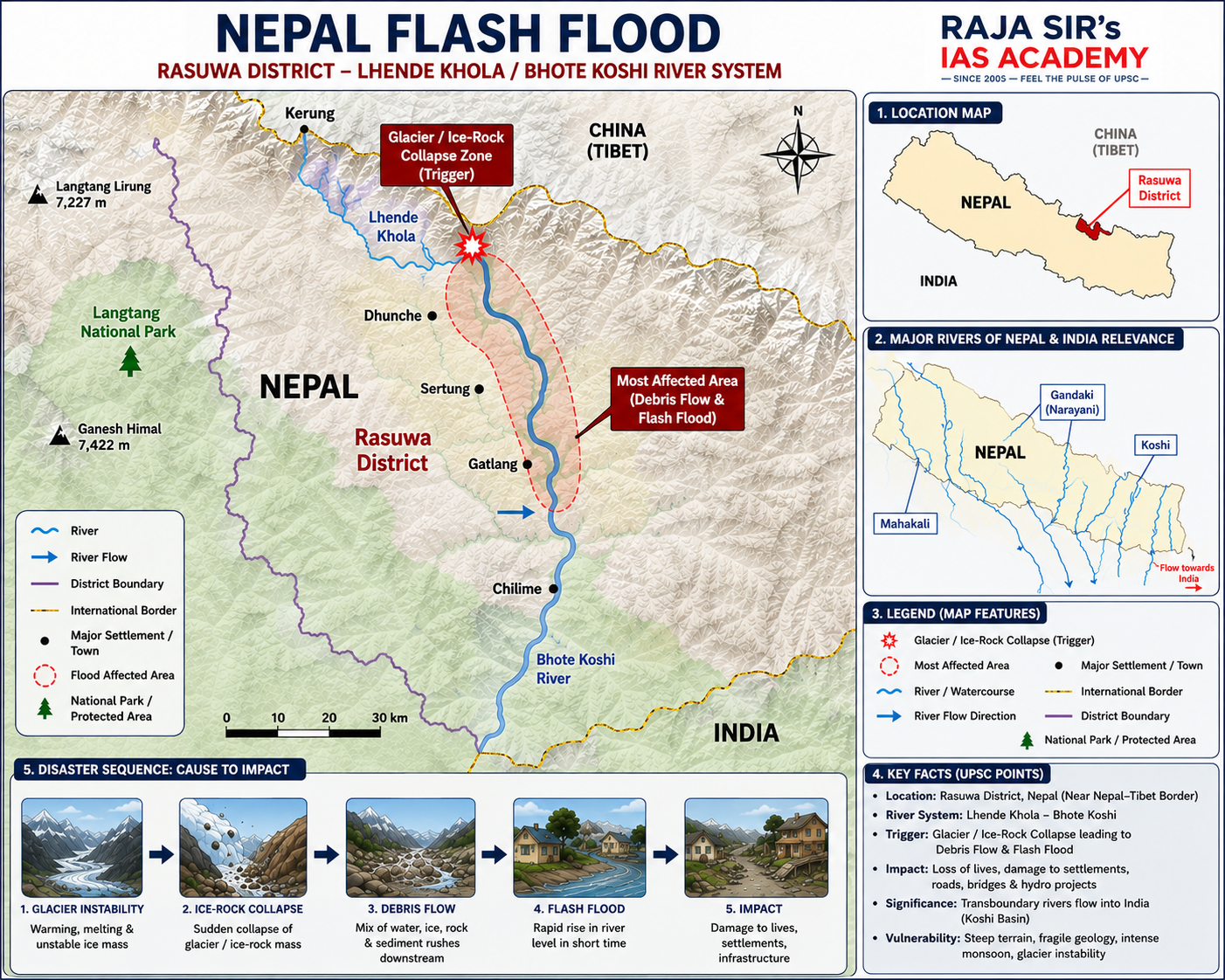
On 26 August 2026, a catastrophic flash flood struck Nepal’s Rasuwa district near the Nepal–Tibet border.. The event affected the Lhende Khola–Bhote Koshi river system and caused extensive damage to settlements and infrastructure.
What is a Flash Flood?
A flash flood is a rapid rise of water in rivers, streams or low-lying areas, generally occurring within a short period after intense rainfall or a sudden release of water.
Major triggers
- Cloudburst/extreme rainfall
- Glacial Lake Outburst Flood (GLOF)
- Glacier collapse
- Landslide-dammed lake failure
- Sudden snow/ice avalanche
- Dam or reservoir failure
What Happened in Nepal?
- The disaster occurred in the steep Himalayan terrain of Rasuwa district.
- A major ice-rock avalanche/glacial collapse entered the river system, producing a sudden surge of water and debris. Reports indicate that river levels rose dramatically within a very short period, destroying roads, bridges, settlements and other infrastructure.
Why is Nepal Highly Vulnerable?
- Nepal lies almost entirely within the Himalayan mountain system, with steep slopes, fragile geology and intense monsoon rainfall.
Fragile Himalayan geology
The Himalayas are:
- Young fold mountains
- Tectonically active
- Characterised by unstable slopes
- Vulnerable to landslides and rockfalls
Steep topography : Water moves rapidly down narrow mountain valleys.
Therefore: Steep slope + confined valley + sudden water release = high flood velocity
Monsoon rainfall
Nepal receives intense rainfall during the June–September southwest monsoon.
|
Feature
|
GLOF
|
Glacier Collapse
|
Flash Flood
|
|
Meaning
|
Sudden release of water from glacial lake
|
Collapse of glacier/ice-rock mass
|
Rapid flooding
|
|
Main trigger
|
Failure of moraine/ice dam
|
Glacier destabilisation
|
Rainfall or sudden water release
|
|
Water source
|
Glacial lake
|
Glacier/river system
|
Rain/river/sudden release
|
|
Nature
|
Specific hazard
|
Specific triggering event
|
Broader flood phenomenon
|
|
Example relevance
|
Himalayan regions
|
Nepal 2026 event
|
Final manifestation
|
Nepal and India share several transboundary river systems.
Important rivers include:
- Koshi
- Gandaki/Narayani
- Karnali
- Mahakali
Infrastructure Vulnerability
- Roads → Landslides & debris flows: Mud, rocks and floodwater can block or wash away roads, cutting off villages.
- Bridges → Scouring: Fast-flowing floodwater can erode the soil around bridge foundations, weakening or damaging bridges.
- Hydropower → Sedimentation & flood damage: Mud and stones carried by floods can fill reservoirs and damage power equipment.
- Transmission lines → Landslide & flood damage: Floods and landslides can damage electricity towers and interrupt power supply.
- Tourism → Risk to trekkers & pilgrims: Floods can damage trekking routes, roads and hotels, putting tourists at risk.
- Border infrastructure → Connectivity & trade: Damage to roads and bridges can disrupt movement of people and goods across border areas.
Major Challenges
- Limited warning time : A glacier collapse can occur suddenly, leaving extremely little time for evacuation.
Difficult terrain : Mountainous terrain makes
- Road access difficult
- Helicopter operations challenging
- Communication unreliable
- Rescue operations slow
- Fragmented monitoring
Cryosphere, rainfall, river discharge and seismic information need to be monitored together.
Transboundary nature
- The source and downstream impacts can involve Nepal, China and India, requiring international coordination.
Infrastructure concentration
- Roads, hydropower projects and settlements are often concentrated along narrow valleys.
Way Forward
Strengthen Early Warning Systems
- Develop integrated monitoring of: Glaciers, Glacial lakes, River discharge, Rainfall, Landslides, Seismic activity
- Use: Satellite + GIS + remote sensing + ground sensors + AI-based forecasting
Transboundary Data Sharing
- India, Nepal and China should strengthen: Real-time rainfall data sharing, River-level information, Glacier monitoring, Flood alerts, Emergency communication
Hazard Zonation
- Prepare detailed maps identifying: GLOF-prone zones, Landslide-prone slopes, Flash-flood corridors, Debris-flow zones, Glacier-collapse risk zones.
|
|
Ribociclib
GS Paper II – Health | Social Justice | Governance
Why in News?
Ribociclib has drawn attention to the high cost of advanced cancer treatment and the challenge of balancing pharmaceutical innovation with affordability.
What is Ribociclib?
- Anti-cancer drug belonging to the CDK4/6 inhibitor class.
- Used mainly for certain HR-positive, HER2-negative breast cancers.
- Mechanism: Inhibits CDK4 and CDK6 → slows cancer-cell progression through the cell cycle.
Why are Cancer Medicines Expensive?
- High R&D Costs : Drug discovery, clinical trials and regulatory processes require large investments.
- Patent : Patent protection can limit competition during the protection period.
- Advanced Technology : Targeted therapies often involve sophisticated research and manufacturing.
- Long-Term Treatment : Prolonged treatment increases cumulative expenditure.
Why Important for India?
India faces a dual challenge: Pharmaceutical Innovation and Affordable Healthcare
Policy Measures
- Price Regulation: NPPA regulates prices under the applicable framework.
- Generic Competition: Competition can reduce medicine prices when legally feasible.
- Public Procurement: Bulk procurement can lower costs.
- Health Insurance: Provides financial protection.
- Public Cancer Centres: Expand affordable treatment infrastructure.
- Domestic R&D: Promote innovative medicines, biosimilars and diagnostics.
Way Forward
- Prevention → Early Detection → Affordable Treatment
- Strengthen cancer screening.
- Expand health insurance and public healthcare.
- Promote generic/biosimilar competition.
- Strengthen domestic pharmaceutical R&D.
- Use Health Technology Assessment (HTA) for evidence-based healthcare spending.
|