AUGUST 7,2026 CURRENT AFFAIRS
|
Agni-4 Missile Test GS III – Defence Technology Why in News? India successfully test-fired the Agni-4 ballistic missile, demonstrating operational readiness and validating critical systems. Type: Nuclear-capable ballistic missile. Range: Approximately 4,000 km. Propulsion: Solid-fuel. Strategic command: Associated with India''s Strategic Forces Command (SFC). Agni Missile Family
|
||||||||||||||||||||||||
|
Bhawana Kanth – Fighter Combat Leader GS I Why in News? Squadron Leader Bhawana Kanth became India’s first woman Fighter Combat Leader (FCL). She earned the FCL qualification at TACDE, Gwalior, one of the IAF’s premier institutions for advanced air-combat tactics. About
Significance
|
||||||||||||||||||||||||
|
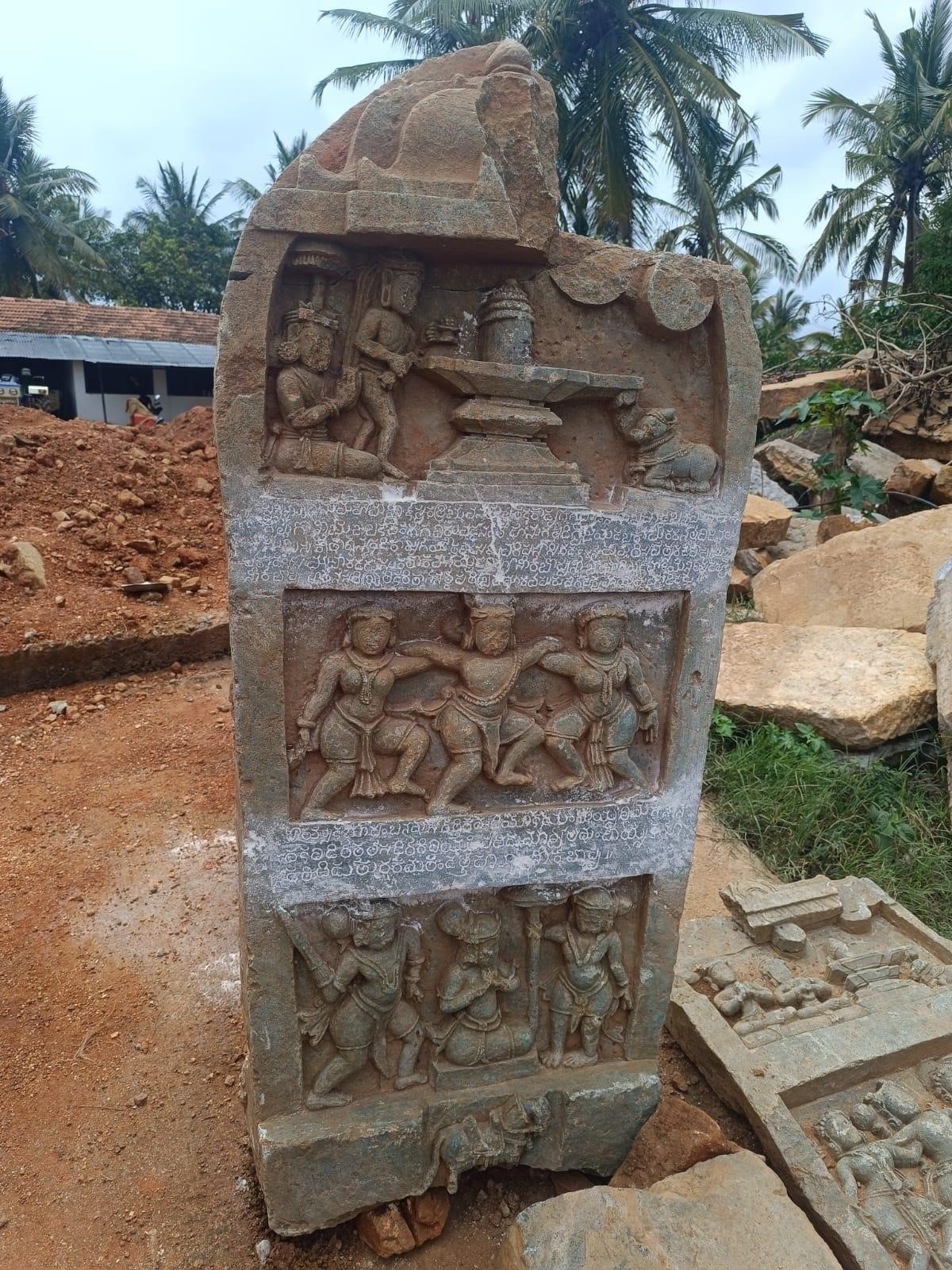
Hero Stone GS I Art and culture Why in News ? 12th-century hero stone found in Neeragunda village, Arsikere taluk, Karnataka. Its Kannada inscription fixes Hoysala king Vishnuvardhana''s death to 11 December 1141. ABOUT
Three-tier design:
· Inscription scripts: Old Kannada, Vatteluttu — recording hero''s name, battle details, king''s name, and date. · Apex symbol: Sun and Moon (Achandrarkam) — symbolizing eternal fame. · Special types: Gograhana (protecting cattle), Turugol (recovering stolen livestock), Penbuyyal (protecting village women). Impact · Settles a long-standing scholarly dispute on Vishnuvardhana''s exact death date, refining Hoysala dynastic chronology. · Reaffirms epigraphy''s value as a primary historical source, over literary dating. Significance · Reveals the Garuda tradition - royal guards'' ritual self-sacrifice after the king''s death — offering insight into Hoysala feudal loyalty and court culture. · Source of information on social customs, warfare traditions, and local administration, not just royal chronicles. · Highlights the role of community-driven discovery (found during temple restoration work). Way Forward · Systematic documentation and digitization of hero stones across Karnataka, Tamil Nadu, Andhra Pradesh, and Maharashtra before they are lost to neglect or construction. · Involve ASI/state archaeology departments for in-situ protection; raise public awareness on reporting such finds.
|
||||||||||||||||||||||||
|
India–US Trade Relations GS II International relations Why in News? The Parliamentary Standing Committee on Commerce presented a report on India–US trade relations amid tariff and non-tariff trade concerns. Mission 500: · Target of USD 500 billion bilateral trade by 2030. · To be pursued through a Bilateral Trade Agreement (BTA). Major Challenges · Tariff uncertainty : Frequent changes in US tariffs create uncertainty for Indian exporters. · Non-Tariff Barriers (NTBs) : SPS standards. Certification requirements.Customs procedures. · MSME vulnerability :Limited access to finance. Compliance difficulties.Market concentration Excessive dependence on the US market. · Low value addition : Weak R&D and technology adoption. · High logistics costs : Reduce export competitiveness. Recommendations : Conclude Bilateral Trade Agreement. · Strengthen: PLI Scheme, Manufacturing, Logistics infrastructure,Export infrastructure · Improve MSME access to: Export finance. Quality certification. Global Value Chains. Significance India–US trade cooperation is moving beyond conventional merchandise trade towards technology, supply chains, clean energy and strategic sectors. |
||||||||||||||||||||||||
|
Money bills GS II Polity Why in News · Supreme Court (Number of Judges) Amendment Bill, 2026 (34→38 judges incl. CJI) passed as a Money Bill. · Reignited debate on using this route to limit Rajya Sabha scrutiny. Constitutional Provisions Article 110(1) -Defines Money Bill; must deal exclusively with: · Imposition/abolition/remission/regulation of tax · Regulation of government borrowing · Custody/withdrawal of money from Consolidated Fund of India (CFI) / Contingency Fund · Appropriation of money from CFI · Declaring expenditure "charged" on CFI · Receipt, custody, audit of government accounts · Incidental matters — Article 110(1)(g) (the controversial clause)
Article 110(3) - Decision on whether a Bill is a Money Bill rests finally with the Speaker of Lok Sabha. Article 109 - Special procedure: · Can be introduced only in Lok Sabha · Requires prior recommendation of the President · Rajya Sabha must return it within 14 days · Rajya Sabha can only recommend, not reject/amend · Lok Sabha may accept/reject RS recommendations · No joint sitting provision (unlike ordinary Bills under Art. 108) Impact · Weakens Rajya Sabha''s role as a revising chamber; tilts bicameral balance toward Lok Sabha/executive. · Fuels repeated litigation - Aadhaar Act (2016), PMLA amendments, Tribunals Reforms all challenged on this ground. · Sets a precedent risk - even a largely administrative Bill (SC judges'' strength) getting Money Bill status widens scope for future misuse. Significance · Justice D.Y. Chandrachud''s Aadhaar dissent (2018) — called passing non-financial laws as Money Bills a "fraud on the Constitution." · A 7-judge Constitution Bench is pending to lay down definitive benchmarks for Money Bill certification — a potential landmark on separation of powers. Way Forward · Await SC''s objective criteria for what qualifies as "incidental" under Art. 110(1)(g). · Reasoned Speaker certification to aid judicial reviewability without diluting Art. 110(3) finality. · Restrict the Money Bill route strictly to genuinely financial legislation. |
||||||||||||||||||||||||
|
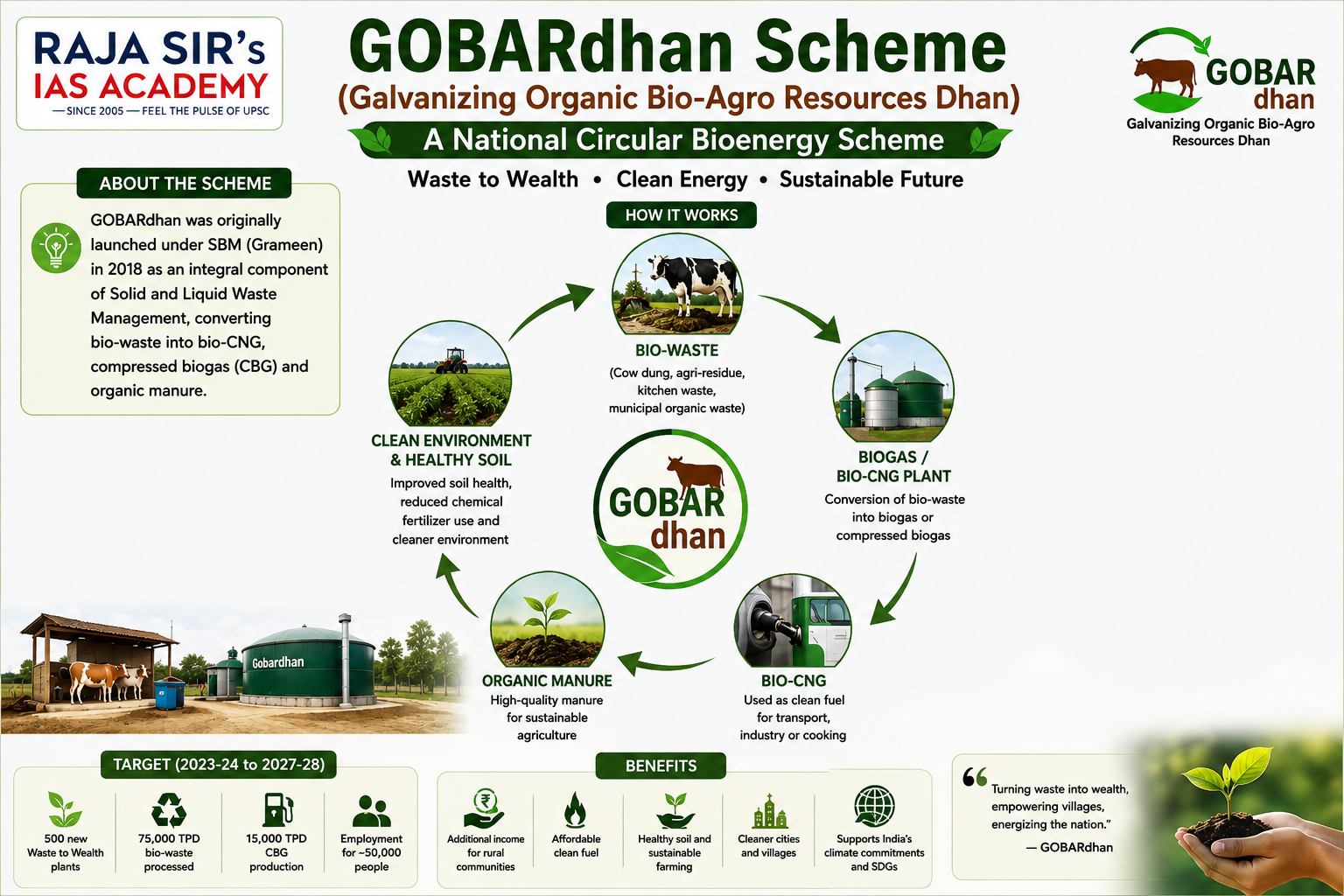
National Circular Bioenergy Scheme GS III Environment Why in News? The Union Cabinet approved the GOBARdhan (Galvanizing Organic Bio-Agro Resources Dhan) Scheme as a national circular bioenergy programme. · Original launch: 2018 under Swachh Bharat Mission– Grameen (SBM-G). · Focus: Conversion of organic/bio-waste into biogas and Compressed Biogas (CBG). · Nodal Ministry: Ministry of Petroleum & Natural Gas. · Outlay: ₹23,731 crore. · Implementation: FY 2026-27 to 2035-36. Objective: · Nearly 10-fold increase in domestic CBG production. · Attract private investment. · Promote circular bio economy. · Convert agricultural/organic waste into energy. Six Growth Engines Assured CBG Off take . CBG procurement by City Gas Distribution (CGD) entities. Blending obligations:
· Stable CBG Pricing : Administered price: ₹2,110/MMBTU. 10-year government-backed revenue assurance. · Capital Assistance : Up to ₹2 crore/tonne/day for eligible CBG projects. · Pipeline Infrastructure : Cluster-based and standalone connectivity. Reduces evacuation costs and improves market access. Credit Guarantee : Up to 85% loan guarantee for MSME-based CBG projects. CBG Ecosystem Challenge Fund : Feedstock assessment. Aggregation infrastructure. Technology adoption at district level. Significance / Impact · Reduces organic/agricultural waste. · Reduces dependence on imported fossil fuels. · Supports energy security. · Creates rural employment and additional farmer income. · Promotes circular economy. · Can reduce methane emissions from unmanaged organic waste.
|
||||||||||||||||||||||||
|
National Handloom Day GS I Why in News? India observed the 12th National Handloom Day on 7 August 2026. Commemorates the launch of the Swadeshi Movement in 1905. Swadeshi Movement promoted: Indigenous production, Boycott of foreign goods., Economic self-reliance. Government Initiatives : · NHDP: Supports weavers with infrastructure, skills and market access. · Small Cluster Development Programme: Provides basic facilities and support to small handloom clusters. · Mega Cluster Development Programme: Provides large-scale infrastructure and modernization support to major clusters. · Handloom Marketing Assistance: Helps weavers promote and sell their products in wider markets. · Weaver MUDRA Scheme: Provides easy and affordable loans to handloom weavers. · Handloom Mark: Identifies and certifies genuine handloom products. · India Handloom Brand: Promotes quality Indian handloom products under a common brand. · GI Protection: Protects region-specific handloom products from misuse and imitation. · GeM / Indiahandmade Portal: Enables online sale and procurement of handloom products. Insurance schemes such as: · PMJJBY (Pradhan Mantri Jeevan Jyoti Bima Yojana): Provides low-cost life insurance cover to eligible subscribers. · PMSBY (Pradhan Mantri Suraksha Bima Yojana): Provides low-cost accident insurance cover for accidental death or disability. Union Budget 2026-27 Initiatives
Challenges · Powerloom imitation. · Counterfeiting. · Low and unequal incomes. · High raw-material costs. · Limited access to affordable credit. · Low productivity. · Dependence on intermediaries. · Weak direct market access. |
||||||||||||||||||||||||
|
RBI – 17 NBFCs in Upper Layer GS III Economy Why in News? The RBI identified 17 large NBFCs under the Upper Layer (NBFC-UL) of its Scale-Based Regulation framework. Scale- Based Regulation - 4 Layers
Base Layer Includes: Smaller non-deposit-taking NBFCs, P2P lending platforms, Account Aggregators, Non-Operative Financial Holding Companies. Middle Layer : All deposit-taking NBFCs, irrespective of asset size, Non-deposit-taking NBFCs with assets of ₹1,000 crore and above, Housing Finance Companies, Infrastructure Finance Companies, Infrastructure Debt Fund NBFCs, Core Investment Companies. Upper Layer : NBFCs identified annually by RBI.Generally includes NBFCs with significant systemic importance, Mandatory listing within 3 years of identification, Enhanced regulatory requirements apply for at least 5 years. Top Layer :Normally intended to remain empty,Used when an NBFC in the Upper Layer develops substantial systemic risk. Significance The framework aims to: Risk → Systemic Importance → Regulation It prevents large NBFCs from becoming sources of systemic financial instability. |
||||||||||||||||||||||||
|
Sarvottan jeevan raksha padak GS III Internal ssecurity Why in News ? Conferred on 12 rat-hole miners involved in the Silkyara Tunnel rescue operation (Uttarkashi) by the Union Minister for Road Transport & Highways. About · Highest tier of the 3-tier Jeevan Raksha Padak series (Sarvottam > Uttam > Jeevan Raksha Padak). · Administered by the Ministry of Home Affairs (MHA). · Instituted in 1961, as an offshoot of the Ashoka Chakra series. · Awarded for exceptional bravery in saving human life under extreme personal risk. · Open to all citizens; Armed Forces/CAPF/Police eligible only if the act is beyond routine duty. · Reward: medal + miniature replica + certificate + ₹2 lakh monetary grant. · Posthumous conferment allowed. · Final approval by the President of India. Impact · Brings formal state recognition to informal/unregulated workers (rat-hole miners) whose expertise is otherwise legally grey. · Sets a public precedent — informal skill validated as nationally significant during disaster response, recalling the 2023 Silkyara/Uttarkashi tunnel collapse rescue. Significance · Reinforces that civilian courage cuts across profession and class. · Strengthens India''s civilian gallantry architecture, distinct from military honours (Ashoka Chakra series). Way Forward · Push for formal skill certification and safety protocols for rat-hole miners, given the practice''s legally ambiguous status. · Wider public awareness of the Jeevan Raksha Padak series to encourage nominations of unsung civilian rescuers.
|
||||||||||||||||||||||||
|
SATPURA–MELGHAT TIGER CORRIDOR GS III Environment Why in News ? SC-NBWL gave in-principle clearance to a Central Railway third-line project requiring 200+ hectares of forest land inside this corridor. About · Connects Satpura Tiger Reserve (Madhya Pradesh) with Melghat Tiger Reserve (Maharashtra). · Area: approximately 7,325 sq km. · MP districts: Betul, Narmadapuram. · Maharashtra district: Amravati. · Protected areas connected (MP): Satpura National Park, Bori Sanctuary, Pachmarhi Sanctuary. · Protected areas connected (Maharashtra): Gugamal National Park, Wan, Narnala, Ambabarwa Sanctuaries. · Key species: Tiger, Leopard, Sloth Bear, Striped Hyena, endangered Forest Owlet. · Tribal population: ~54%, mainly Korku and Gond tribes. · Threats: railway line expansion (Jujharpur-Chichonda section), road expansion, habitat fragmentation, human-wildlife conflict. Impact · Risk of habitat fragmentation → genetic isolation/inbreeding of tiger populations. · Displaces conflict pressure onto tribal (Korku, Gond) farmland/settlements. · Reflects the recurring infrastructure vs. conservation trade-off. Significance · A critical link in the wider Central Indian Tiger Landscape — also connects to Satpura-Pench and Melghat-Bor corridors — affecting tiger metapopulation viability regionally. · Home to the endangered Forest Owlet, adding cascading biodiversity stakes beyond tigers. Way Forward · Mandatory mitigation structures — wildlife under/overpasses, speed limits — as implemented on NH-44 through Pench-Kanha. · Cumulative impact assessment of all linear infrastructure (rail + roads) rather than piecemeal, project-by-project clearances. · Strengthen tribal-inclusive, community-based conservation and real-time wildlife telemetry monitoring.
|