|
Akash Air Defence Missile System
GS Paper III – Defence Technology
Why in News?
India has expanded exports of the indigenous Akash air-defence system to countries in Central Asia, including Tajikistan and Turkmenistan.
About Akash
- Developed by DRDO under the Integrated Guided Missile Development Programme (IGMDP).
- A short-range Surface-to-Air Missile (SAM) system designed to counter airborne threats.
- IAF induction: 2014.
- Indian Army induction: 2015.
- Approximate operational range: 4.5–25 km.
Key Technology
|
Component
|
Key Feature
|
Role
|
|
Rajendra Radar
|
3D Passive Electronically Scanned Array (PESA) radar
|
Target detection, tracking and engagement support
|
|
Akash Prime
|
Active RF seeker
|
Improves target acquisition and engagement capability
|
|
Akash-NG
|
Canisterised, compact design
|
Longer range and faster reaction capability
|
|
|
Balancing Accuracy with Universal Franchise
GS Paper II – Polity
Why in News?
The Special Intensive Revision (SIR) of electoral rolls has raised concerns over balancing accurate electoral rolls with universal adult suffrage, particularly where extensive verification or deletion may inadvertently exclude eligible voters.
Aim
- Remove dead, duplicate and shifted electors.
- Identify and eliminate ineligible entries.
- Update electoral rolls through housetohouse verification.
- Improve the accuracy, integrity and credibility of electoral rolls.
Core Issue: Electoral Integrity vs Electoral Inclusion
- A credible electoral roll is essential for “one person, one vote” and free and fair elections.
- However, wrongful deletion of an eligible elector can directly affect the constitutional principle of universal adult suffrage.
Who is Particularly Vulnerable?
- Internal migrants who frequently change residence.
- Poor and homeless populations lacking stable documentation.
- Women, particularly those who relocate after marriage.
- Marginalised communities with weaker access to official records.
- Citizens facing difficulties in producing historical documentary evidence.
Constitutional & Legal Basis
- Article 324: Vests the superintendence, direction and control of elections in the Election Commission of India (ECI).
- Article 326: Provides for elections to Lok Sabha and State Legislative Assemblies on the basis of adult suffrage.
- Representation of the People Act, 1950: Provides the statutory framework for electoral rolls.
- Section 21, RPA, 1950: Provides for preparation and revision of electoral rolls.
- Registration of Electors Rules, 1960: Provides the procedural framework for registration and revision.
Positive Impact
- Electoral accuracy: Removes duplicate, deceased and otherwise ineligible entries.
- Administrative efficiency: Helps election authorities maintain updated rolls.
- Electoral integrity: Strengthens confidence in the voter list.
- Better targeting of verification: Identifies discrepancies requiring correction.
Negative Impact
- Wrongful deletion: Genuine voters may be excluded.
- Documentation barrier: Citizens without easily available records may face difficulty.
- Migrant exclusion: Frequent movement can make electoral registration difficult.
- Administrative errors: Errors during field verification may translate into loss of voting rights.
- Digital divide: Technology dependent verification can disproportionately affect vulnerable groups.
Way Forward
- Notice before deletion: Provide an opportunity to respond before removing an elector.
- Provisional deletion lists: Publish proposed deletions and allow objections.
- Door to door verification: Strengthen human verification rather than relying exclusively on databases.
- Accessible appeals: Ensure simple, time bound correction and restoration mechanisms.
- Migrant friendly registration: Explore mechanisms that facilitate electoral registration for internal migrants.
|
|
Bringing Thermal Intelligence to Earth Observation
GS Paper III – Space Technology | Remote Sensing
Why in News?
Ahmedabad-based Satleo Labs launched TAPAS-1, described as India’s first commercial private thermal-imaging payload, aboard Space X’s Falcon 9 through a rideshare mission.
What is TAPAS-1?
- TAPAS stands for Thermal Access Platform for Analytics & Solutions.
- It is a 1.5-kg modular CubeSat payload designed for thermal infrared imaging and Earth-observation applications.
NOTES
- Technology: Thermal Infrared Imaging (TIR) — detects heat emitted by Earth’s surface
- Orbit: Sun-synchronous Low Earth Orbit (SSO-LEO)
- Altitude: ~500 km
- Planned mission life: 3 years
- Launch vehicle: SpaceX Falcon 9
- Launch mode: Rideshare mission
Thermal Infrared Imaging (TIR)
- Meaning: A remote-sensing technique that detects thermal radiation (heat) emitted by objects or Earth’s surface.
- Principle: Objects emit infrared radiation depending on their temperature.
- Unlike optical imaging: Optical: Detects reflected sunlight. TIR: Detects emitted heat.
|
|
Buxa Tiger Reserve
GS Paper III – Environment
Why in News?
A tigress was translocated from Bihar’s Valmiki Tiger Reserve to Buxa Tiger Reserve (BTR), West Bengal, as part of efforts to restore and strengthen the tiger population in Buxa.
About Buxa Tiger Reserve
- Located in the Dooars region of northern West Bengal.
- Area: 760.87 sq km.
- Declared India''s 15th Tiger Reserve in 1983.
- Buxa National Park: Declared in 1997.
- Elevation ranges up to about 1,750 m.
- Known for rich orchid diversity and varied flora and fauna.
Landscape Significance
|
Protected Area / Landscape
|
Location
|
Key Point
|
|
Buxa Tiger Reserve
|
West Bengal
|
Eastern Himalayan foothills; important tiger/elephant habitat
|
|
Phipsoo Wildlife Sanctuary
|
Bhutan
|
North of Buxa; transboundary ecological connectivity
|
|
Jaldapara National Park
|
West Bengal
|
South-west of Buxa; famous for one-horned rhinoceros
|
|
Ripu Reserve Forest
|
Assam
|
East of Buxa; important elephant/tiger landscape
|
|
Manas Tiger Reserve
|
Assam
|
Connected with Bhutan''s Royal Manas National Park; UNESCO World Heritage Site
|
|
Terai–Duar landscape
|
India–Bhutan
|
Important transboundary wildlife corridor
|
|
|
Compressed Biogas (CBG)
GS Paper III – Environment
Why in News?
A TERI study has indicated that blending 20% CBG with CNG could potentially make CNG carbonneutral over its life cycle, highlighting CBG''s role in India''s cleanenergy transition.
What is CBG?
- Compressed Biogas (CBG) is purified biogas containing more than 90% methane, which is compressed for use as a renewable gaseous fuel. It can be produced from organic waste and biomass.
- Major feedstock: Agricultural residue, cattle dung, press mud, municipal organic waste and other biomass.
Why is CBG Important?
Waste to Energy
- Converts agricultural and municipal organic waste into a useful fuel.
- Helps address problems of stubble burning and unmanaged organic waste.
Methane Mitigation
- Capturing biogas prevents methane from being directly released into the atmosphere.
- Thus, CBG can provide dual benefits of waste management and climate mitigation.
Energy Security
- Provides a renewable alternative to fossil based natural gas.
- Can reduce dependence on imported natural gas in the long term.
Rural Economy
- Creates an additional revenue stream from agricultural residues and cattle dung.
- Supports decentralised rural energy systems and local employment.
Government Initiatives
GOBARdhan
Promotes conversion of organic/biodegradable waste into biogas, CBG and biofertilisers.
CBG Blending Obligation
- 3% → 2026–27
- 4% → 2027–28
- 5% → From 2028–29
|
|
Electronics Component Manufacturing Scheme (ECMS)
GS Paper III – Indian Economy
Why in News?
The Electronics Component Manufacturing Scheme (ECMS) seeks to develop a robust domestic ecosystem for electronics components and integrate Indian firms with Global Value Chains (GVCs).
Key Features
- Ministry: Ministry of Electronics and Information Technology (MeitY).
- Notified: April 2025.
- Tenure: 6 years, with an additional 1-year gestation period.
- Provides turnover-linked, capex-linked or hybrid incentives.
- Focuses on manufacturing of critical electronics components and sub-assemblies.
|
|
Independent Institutions in Democracy
GS Paper II – Polity & Governance
Why in News?
Recent Supreme Court judgments concerning the functioning of the Election Commission of India have renewed debate over the autonomy of constitutional institutions.
Important institutions include:
- ECI
- CAG
- UPSC
- Finance Commission
- Judiciary
|
Body
|
Article
|
Appointment
|
Tenure
|
Removal
|
Core Function
|
|
ECI
|
324
|
President
|
6 yrs / 65 yrs*
|
CEC: SC Judge-like; EC: President on CEC recommendation
|
Conduct elections
|
|
CAG
|
148
|
President
|
6 yrs / 65 yrs
|
SC Judge-like
|
Audit public finances
|
|
UPSC
|
315
|
President
|
6 yrs / 65 yrs
|
President; SC inquiry for misbehaviour
|
Civil-service recruitment
|
|
Finance Commission
|
280
|
President
|
5 years
|
President, as per law
|
Fiscal devolution
|
|
Supreme Court
|
124
|
President
|
Till 65 yrs
|
President after Parliament''s special-majority address
|
Justice & judicial review
|
|
|
India’s Transition Towards Electric Mobility
GS Paper III – Environment
Why in News?
The PM E-DRIVE Scheme, launched in September 2024, is facilitating EV adoption, charging infrastructure and deployment of e-buses. As per recent updates, 26.59 lakh EVs have been sold and around 14,000 e-buses allocated under the scheme.
About PM E-DRIVE
- Ministry: Ministry of Heavy Industries.
- Type: Central Sector Scheme.
- Implementation period: September 2024 – 31 March 2028.
- Objective: Accelerate EV adoption and create an enabling ecosystem for clean mobility and domestic EV manufacturing.
- Supports e-2Ws, e-3Ws, e-ambulances, e-trucks and e-buses, along with charging infrastructure.
- IFCI acts as the Project Management Agency.
Significance
- Decarbonisation: Reduces dependence on fossil fuels and supports lower transport-sector emissions.
- Energy Security: Reduces petroleum import dependence.
- Manufacturing: Supports domestic production of EVs, batteries and components.
- Infrastructure: Promotes development of charging infrastructure.
- Public Transport: Accelerates electrification of high-use transport such as buses.
|
Aspect
|
IFCI
|
|
Full Form
|
Industrial Finance Corporation of India
|
|
Established
|
1948
|
|
Nature
|
Statutory financial institution originally
|
|
Purpose
|
Long-term finance to industrial sector
|
|
Major Role
|
Industrial development & infrastructure financing
|
|
Current Status
|
IFCI Ltd. – Government-owned NBFC
|
|
Ministry
|
Ministry of Finance
|
|
Key Feature
|
One of India’s earliest development financial institutions
|
|
Prelims Point
|
First development financial institution established in India
|
|
|
Jawahar Dweep
GS Paper I – Geography | GS III – Infrastructure | Environment
Why in News?
Jawahar Dweep Marine Oil Terminal, Mumbai, was declared India’s first plastic-free oil terminal during the Swachhata Abhiyan 2026.
About Jawahar Dweep
- Located in Mumbai Harbour, in the Arabian Sea.
- Historically known as Butcher Island.
- Located approximately 8.25 km from the Gateway of India.
- An important component of Mumbai’s crude-oil handling infrastructure.
- Connected to Wadala through subsea pipelines for oil transportation.
|
Oil Terminal
|
Location
|
Coast / Water Body
|
Key Significance
|
|
Jawahar Dweep
|
Mumbai, Maharashtra
|
Arabian Sea
|
Marine oil terminal; crude-oil handling
|
|
Vadinar Oil Terminal
|
Gujarat
|
Gulf of Kutch
|
Major crude-oil import and handling hub
|
|
Sikka Oil Terminal
|
Gujarat
|
Gulf of Kutch
|
Crude oil and petroleum-product handling
|
|
Deendayal Port oil terminals
|
Kandla, Gujarat
|
Gulf of Kutch
|
Crude oil and petroleum-product handling
|
|
Paradip Oil Terminal
|
Odisha
|
Bay of Bengal
|
Crude oil and petroleum-product handling
|
|
Visakhapatnam Oil Terminal
|
Andhra Pradesh
|
Bay of Bengal
|
Crude oil and petroleum-product handling
|
|
Kamarajar Port oil terminals
|
Ennore, Tamil Nadu
|
Bay of Bengal
|
Petroleum and energy cargo handling
|
|
Cochin Oil Terminal
|
Kerala
|
Arabian Sea
|
Petroleum-product and crude-oil logistics
|
|
Swachhata Abhiyan
|
Swachh Bharat Mission (SBM)
|
|
A cleanliness campaign/drive
|
A flagship Government of India mission
|
|
Focuses on cleanliness activities in specific institutions, offices, public spaces or sectors
|
Comprehensive focus on sanitation, cleanliness and waste management
|
|
Can be conducted periodically by ministries/departments/organisations
|
Launched on 2 October 2014
|
|
Activities include cleanliness drives, waste removal, plastic reduction and awareness
|
Includes ODF, toilet construction, solid & liquid waste management, behavioural change etc.
|
|
Campaign-oriented
|
Mission/programme-oriented
|
|
May operate within the broader Swachh Bharat framework
|
Implemented through structured government programmes and targets
|
|
|
Przewalski’s Horse
GS Paper III – Environment
Why in News?
The birth of two foals at a reintroduction sanctuary in Kazakhstan marks progress in efforts to restore Przewalski’s horse to its native Central Asian steppe habitat.
About the Species
- Scientific name: Equus ferus przewalskii
- Common name: Przewalski’s horse / Takhi
- Native to the steppes of Central Asia, particularly Mongolia and surrounding regions.
- Often described as the last surviving wild horse.
- Unlike feral domestic horses, it has not descended from a domesticated population that subsequently became wild.
Why is it Important?
Conservation Success
- The species became extinct in the wild during the 20th century.
- Captive breeding and coordinated conservation programmes enabled its subsequent reintroduction into the wild.
Reintroduction as a Conservation Tool
- Kazakhstan, Mongolia and China are among the areas involved in restoring populations.
- Demonstrates how captive breeding, genetic management, habitat restoration , reintroduction can recover threatened species.
Grassland Ecosystem
- As a large herbivore, it contributes to grassland ecological processes, including grazing dynamics and nutrient cycling.
Conservation Status
- IUCN: Endangered
- CITES: Appendix I
- Wild status: Previously extinct in the wild; reintroduced populations now occur in parts of its historical range.

|
|
Quantum-Secure Communication
GS Paper III – Science & Technology
Why in News?
India has established a 1,000-km quantum-secure communication network using indigenous technology under the National Quantum Mission (NQM).
What is Quantum-Secure Communication?
- It uses quantum technologies, particularly Quantum Key Distribution (QKD), to secure the exchange of encryption keys.
- In QKD, the quantum state of particles such as photons is used to generate and share cryptographic keys.
Key principle:
- Any attempt to measure or intercept an unknown quantum state can disturb it, enabling the communicating parties to detect eavesdropping.
- QKD does not itself encrypt the message; it enables secure distribution of encryption keys.
Significance
- Cybersecurity: Strengthens protection against sophisticated cyberattacks.
- Strategic communication: Secures sensitive government and military communication.
- Critical infrastructure: Can protect banking, energy, telecom and other strategic networks.
- Quantum threat preparedness: Helps address the future threat posed by powerful quantum computers to conventional cryptography.
- Technological sovereignty: Indigenous quantum communication capabilities reduce dependence on foreign technologies.
National Quantum Mission
|
Parameter
|
Details
|
|
Approved
|
2023
|
|
Implementation
|
2023–24 to 2030–31
|
|
Nodal Department
|
Department of Science & Technology (DST)
|
|
Focus
|
Developing India’s quantum technology ecosystem
|
|
Thematic Hubs
|
4
|
|
|
Rebate of State and Central Taxes and Levies (RoSCTL)
GS Paper III – Economy
Why in News?
The RoSCTL scheme has been extended up to 31 December 2026 at the existing rates, providing continued support to India''s apparel and made-up textile exports.
What is RoSCTL?
- RoSCTL is an export remission scheme that reimburses embedded State and Central taxes, duties and levies that are not otherwise refunded to exporters.
- It aims to ensure that un refunded domestic taxes do not get embedded in the cost of exported textile products, thereby improving export competitiveness.
Key Features
- Focuses on apparel and made-ups.
- Benefits are provided through transferable electronic duty-credit scrips.
- Claims are processed by CBIC.
- Helps offset the tax burden embedded in exported products.
Coverage
|
Term
|
Meaning
|
|
HS Code
|
International system for classifying traded products
|
|
Chapter 61
|
Knitted/crocheted apparel – T-shirts, sweaters, etc.
|
|
Chapter 62
|
Non-knitted/woven apparel – shirts, trousers, suits, etc.
|
|
Chapter 63
|
Other made-up textile articles – bed linen, curtains, blankets, etc.
|
Significance
Export Competitiveness
- Reduces the embedded tax burden on textile exports.
- Helps Indian exporters compete in international markets.
WTO-Compatible Export Support
- Follows a remission-of-taxes approach, rather than providing an export subsidy linked to export performance.
Employment & MSMEs
- Supports the labour-intensive apparel and textile sector, which has significant employment and MSME linkages.
|
Feature
|
RoSCTL
|
RoDTEP
|
|
Full Form
|
Rebate of State and Central Taxes and Levies
|
Remission of Duties and Taxes on Exported Products
|
|
Main Focus
|
Apparel & made-ups
|
Wider range of exports
|
|
Ministry
|
Ministry of Textiles
|
Ministry of Commerce & Industry
|
|
HS Chapters
|
61, 62 & 63
|
Broader eligible products
|
|
Purpose
|
Rebate embedded State + Central taxes/levies
|
Remit unrefunded duties/taxes/levies
|
|
Benefit
|
Duty-credit scrip
|
Transferable e-scrip
|
|
Key Sector
|
Textile/apparel exports
|
Multiple export sectors
|
|
|
Russia’s Strategic Outpost in the Baltic
GS Paper II – International Relations
Why in News?
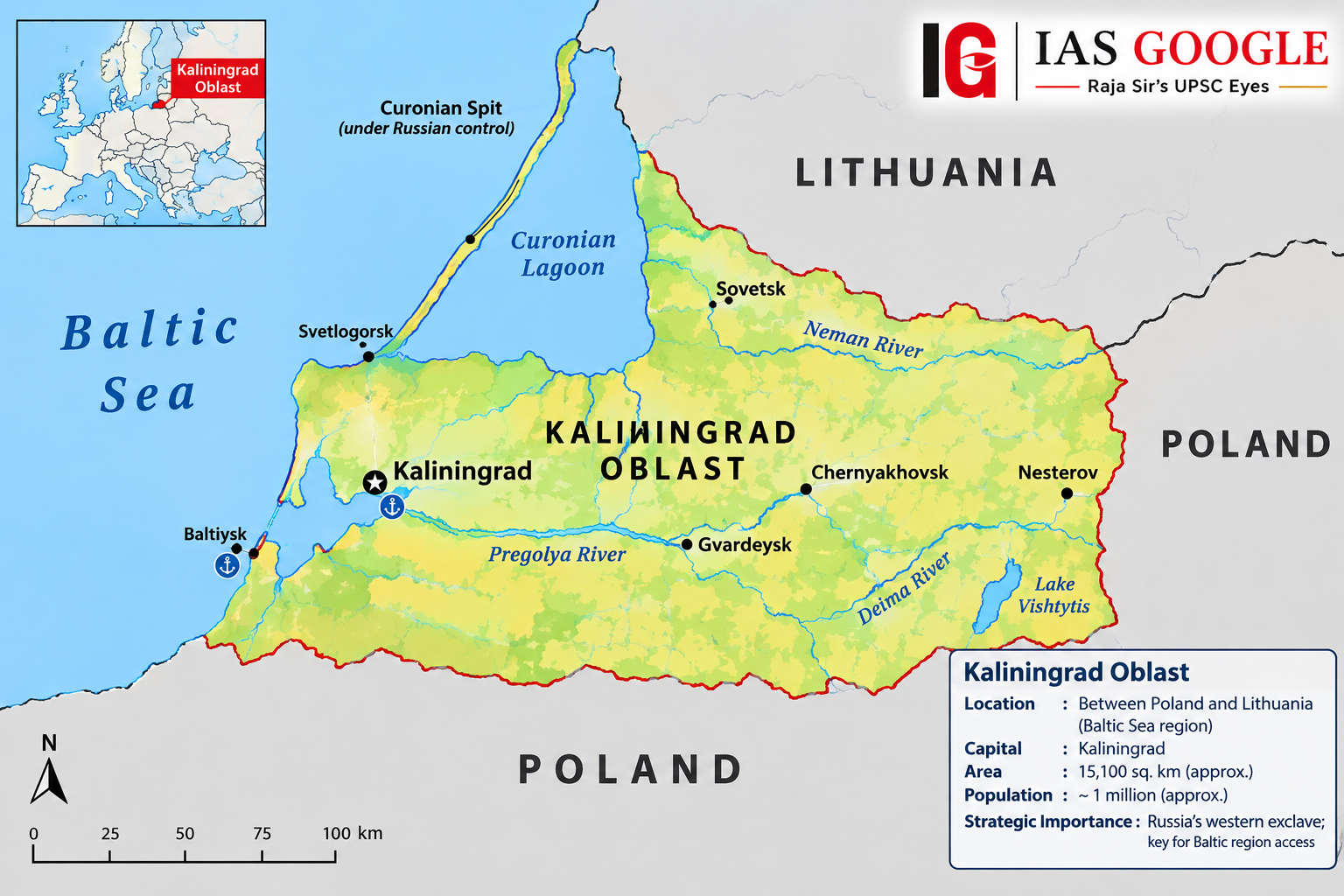
Russia has warned against attempts to isolate or cut off Kaliningrad, highlighting the enclave''s strategic importance amid tensions between Russia and NATO in the Baltic region.
What is Kaliningrad?
- Kaliningrad is a Russian exclave located on the Baltic Sea.
- It is geographically separated from mainland Russia.
- It lies between Poland and Lithuania, both NATO members.
- Formerly known as Königsberg, it was historically part of Prussia/Germany.
- It became part of the Soviet Union after World War II and subsequently Russia.
- Following the dissolution of the Soviet Union in 1991, Kaliningrad became separated from mainland Russia, making it a Russian exclave.
Strategic Significance
- Russian Military Presence : Kaliningrad hosts Russia''s Baltic Fleet and military infrastructure.Its location provides Russia with a strategic position on the Baltic Sea.
- NATO–Russia Geopolitics : Kaliningrad is surrounded by NATO territory, making it a sensitive point in European security architecture.Its geographical position gives it significance for Russia''s access and military posture in the Baltic region.
- Suwałki Gap : The Suwałki Gap is a narrow land corridor between Poland and Lithuania.
- It connects NATO''s Baltic members with the rest of NATO territory while lying between Kaliningrad and Belarus.
Exclave vs Enclave
- Exclave: A territory politically belonging to a country but geographically separated from its main territory.
- Enclave: A territory completely surrounded by another country''s territory.
- Kaliningrad = Russian exclave, NOT an enclave.
|
|
The Hidden Pollution Threat Beneath Landfills
GS Paper III – Environment
Why in News?
Detection of hazardous substances, including cadmium, in groundwater near Delhi''s Ghazipur landfill has highlighted the risks posed by landfill leachate and inadequate management of municipal solid waste.
What is Leachate?
- Leachate is a contaminated liquid generated when rainwater or other liquids percolate through solid waste, extracting dissolved and suspended pollutants.
- Its composition depends on the type of waste, landfill age, moisture and decomposition conditions.
Why is Leachate a Concern?
Groundwater Contamination
- Unlined or poorly managed landfills can allow leachate to infiltrate into soil and groundwater.
- Heavy metals such as cadmium, lead and chromium can persist and accumulate.
Water Pollution
- High BOD and COD can reduce dissolved oxygen when leachate reaches water bodies.
- Organic pollutants, ammonia and other contaminants can affect aquatic ecosystems.
Soil Degradation
- Alters soil chemistry and can introduce toxic substances into the soil-water system.
Public Health Risk
- Contaminated groundwater can create long-term exposure risks through drinking water and food chains.
|
Feature
|
Young Leachate
|
Mature Leachate
|
|
Landfill stage
|
Early decomposition
|
Later decomposition
|
|
Organic matter
|
High
|
Relatively low
|
|
Biodegradability
|
High
|
Low
|
|
BOD/COD
|
Generally high
|
Generally lower
|
|
Ammoniacal N
|
Relatively low
|
Higher
|
|
Recalcitrant compounds
|
Low
|
High
|
|
Treatment
|
Relatively easier biologically
|
More difficult
|
|