|
1991 India–Pakistan Advance Notice Agreement: Preventing Accidental Escalation
GS II – International Relations
Why in News?
- India invoked the 1991 India–Pakistan Advance Notice Agreement following a collision involving a Pakistani naval vessel and an Indian Navy warship in the North Arabian Sea.
- The agreement provides confidence-building measures aimed at reducing the risk of miscalculation and accidental escalation.
Key Provisions
- Signed: 6 April 1991.
- Parties: India and Pakistan.
- Military Exercises: Provides for advance notification of major military exercises.
- Army Exercises: 90 days advance notice for major exercises at the Army level.
- Corps-level Exercises: 60 days advance notice.
- Naval & Air Exercises: 15 days advance notice.
- Article 10: Naval vessels and submarines are required to maintain a minimum separation of 3 nautical miles in international waters.
Impact
- Risk Reduction: Helps reduce the possibility of accidental military confrontation.
- Strategic Stability: Provides communication and transparency mechanisms between India and Pakistan.
- Maritime Safety: The naval provisions are particularly relevant in preventing dangerous encounters at sea.
- Confidence Building: Serves as a bilateral confidence-building measure (CBM) even amid broader bilateral tensions.
- Crisis Management: Demonstrates the importance of established agreements during unexpected military incidents.
Way Forward
- Strict Compliance: Both sides should consistently adhere to agreed notification and separation requirements.
- Communication Channels: Strengthen direct military-to-military communication mechanisms.
- Maritime Coordination: Improve protocols for avoiding unintended encounters between naval vessels.
- Transparency: Maintain timely information-sharing regarding military exercises and movements.
- CBM Strengthening: Preserve existing bilateral confidence-building measures as safeguards against accidental escalation.
|
|
Asymmetric Federalism: Balancing Unity with Regional Diversity
GS II – Polity & Governance
Why in News?
- The Union Ministry of Home Affairs (MHA) has proposed a framework under a new Article 371K for Ladakh.
- It emerged from discussions with the Leh Apex Body (LAB) and Kargil Democratic Alliance (KDA) on demands for greater local representation and protection of Ladakh''s identity.
Key Features
- Directly Elected Body: A Union Territory-level body would be elected through universal adult franchise.
- Legislative Powers: The body is proposed to have powers over matters such as land, culture, language, forests, environment and natural resources.
- Protection of Local Interests: Intended to safeguard Ladakh''s land, cultural identity and indigenous interests.
- Sui Generis Model: It would create a customised constitutional arrangement specifically for Ladakh rather than simply extending an existing model.
- Different from Sixth Schedule: The proposal is being discussed as an alternative framework rather than directly bringing Ladakh under the Sixth Schedule.
- Different from Statehood: It does not amount to granting full statehood to Ladakh.
Why Important?
- Asymmetric Federalism: Shows how the Constitution can accommodate region-specific political, cultural and developmental needs through differentiated governance arrangements.
- Local Representation:Could provide Ladakh''s population with a greater role in decisions affecting land, resources and culture.
- Centre–UT Relations:Raises questions about the appropriate balance between local democratic institutions and the powers of the Lieutenant Governor/Union Government.
|
|
Census Towns: Capturing India’s Emerging Urbanisation
GS I – Geography | Urbanisation
Why in News?
The Ministry of Housing and Urban Affairs (MoHUA) has highlighted that the existing criteria for Census Towns may not fully reflect India''s changing patterns of urbanisation.
What is a Census Town?
A settlement is classified as a Census Town when it satisfies all three criteria:
- Population: At least 5,000.
- Occupational Structure: At least 75% of the male main working population engaged in non-agricultural activities.
- Population Density: At least 400 persons per km².
Significance
- Urban Identification: Helps identify settlements that are demographically urban even though they may remain administratively rural.
- Urban–Rural Distinction: Complements Statutory Towns, which are declared urban areas under a legal/administrative framework.
- Urbanisation Planning: Helps policymakers understand the spread of urban characteristics beyond officially notified municipalities.
- Changing Urban Landscape: Existing criteria have remained substantially unchanged since 1981, raising questions about their suitability for contemporary Urbanisation patterns.
|
|
Central Board of Film Certification (CBFC): Regulating Film Exhibition in India
GS II – Polity & Governance
Why in News?
The Government has reconstituted the Central Board of Film Certification (CBFC).
Key Facts
- Nature: Statutory body.
- Legal Basis: Cinematograph Act, 1952.
- Ministry: Ministry of Information and Broadcasting.
- Headquarters: Mumbai, Maharashtra.
- Function: Examines films intended for public exhibition in India and grants certification under the applicable law.
Regional Offices: 9 regional offices.
- Mumbai – Maharashtra
- Kolkata – West Bengal
- Chennai – Tamil Nadu
- Bengaluru – Karnataka
- Hyderabad – Telangana
- Thiruvananthapuram – Kerala
- New Delhi – Delhi
- Cuttack – Odisha
- Guwahati – Assam
Significance
- Film Certification: Ensures films intended for public exhibition are certified under the legal framework.
- Regulatory Role: Acts as the statutory authority for film certification rather than functioning as a general film-censorship department.
- Regional Reach: Regional offices facilitate certification across different parts of India.
|
CBFC – Films
|
OTT Platforms
|
|
Films for public theatrical exhibition require certification.
|
OTT content generally does not require prior CBFC certification.
|
|
Governed primarily by the Cinematograph Act, 1952.
|
Governed through the IT Rules, 2021, including the Code of Ethics for digital media.
|
|
Prior certification is required before theatrical release.
|
Uses classification, content descriptors and age-based access controls.
|
|
CBFC can prescribe cuts/modifications as permitted by law.
|
Regulation relies more on platform-level compliance and grievance redressal.
|
|
Stronger role for the State before public exhibition.
|
Greater emphasis on self-regulation and due diligence.
|
Major Issues
- Regulatory Asymmetry: Similar audiovisual content can face different regulatory requirements depending on whether it is released theatrically or digitally.
- Censorship Concerns: Pre-certification of films but comparatively lighter prior regulation of OTT content raises questions about consistency and proportionality.
- Content Classification: OTT platforms face challenges in effectively implementing age ratings and parental controls, particularly for minors.
- Jurisdictional Complexity: Digital platforms may operate across borders, making enforcement and accountability more difficult.
- Freedom of Expression: Regulation must balance Article 19(1)(a) with legitimate restrictions under Article 19(2).
- Evolving Technology: Traditional cinema-centric regulation may not fully address streaming, user-generated content and rapidly changing digital platforms.
Way Forward
- Platform-Neutral Principles: Similar principles should apply to comparable audiovisual content irrespective of the medium, while recognising differences between theatrical and digital distribution.
- Strengthen Age Classification: Improve standardised ratings, content descriptors and parental controls.
- Independent Grievance Redressal: Ensure complaints are resolved through a transparent and time-bound mechanism.
- Proportionate Regulation: Prefer classification and access controls over unnecessary prior censorship wherever adequate.
- Clear Legal Framework: Clearly define the respective roles of CBFC, government authorities and OTT platforms.
- Digital Literacy: Promote awareness among parents and users regarding content ratings and parental-control tools.
|
|
Cheetah: India’s Reintroduction and Conservation Effort
GS III – Environment & Biodiversity
Why in News?
India’s cheetah population under Project Cheetah has increased to 52, including cubs born in India.
Key Facts
- Scientific Name: Acinonyx jubatus
- Family: Felidae
- IUCN Status: Vulnerable
- Asiatic Cheetah: Critically Endangered
- CITES: Appendix I
- Special Feature: Fastest land animal.
- Habitat: Grasslands, savannahs and semi-arid open landscapes.
- India’s Project Cheetah: Reintroduction programme centred on Kuno National Park, with additional cheetahs at Gandhi Sagar Wildlife Sanctuary.
|
|
CoBRA: CRPF’s Jungle Warfare and Counter-Insurgency Force
GS –III – Internal Security
Why in News?
Sanjukta Parasor became the first woman officer to head the CRPF''s CoBRA unit.
Key Facts
- Full Form: Commando Battalion for Resolute Action (CoBRA).
- Part of: Central Reserve Police Force (CRPF).Established: 2008.
- Ministry: Ministry of Home Affairs.
- Nature: Specialised commando force of the CRPF.
Specialisation
- Jungle Warfare: Trained for operations in difficult forest terrain.
- Counter-Insurgency: Conducts operations against armed insurgent groups.
- Left-Wing Extremism: Specially deployed for operations in LWE-affected areas.
- Special Operations: Undertakes intelligence-based and high-risk operations in challenging terrain.
|
|
Dadasaheb Phalke Award: India’s Highest Cinematic Honour
GS I – Art & Culture
Why in News?
Veteran actor Anant Nag has been named the recipient of the Dadasaheb Phalke Award for 2024.
Key Facts
- Instituted: 1969.
- First Recipient: Devika Rani.
- Presented: Annually as part of the National Film Awards.
- Named After: D. G. Phalke, regarded as a pioneer of Indian cinema.
- Raja Harishchandra (1913): D. G. Phalke’s landmark film and India''s first full-length Indian feature film.
- Award Components: Swarna Kamal, shawl and cash prize.
- Anant Nag: Becomes the second Kannada actor, after Dr Rajkumar, to receive the honour.
|
|
Djibouti: Strategic Gateway to the Red Sea
GS I – Geography | GS II – International Relations
Why in News?
Djibouti joined the Artemis Accords, becoming the 72nd signatory, according to the supplied source.
Key Facts
- Location: Horn of Africa.
- Capital: Djibouti City.
Neighbouring Countries:
- Eritrea – North
- Ethiopia – West and Southwest
- Somalia – South
Geographical Significance
- Bab-el-Mandeb Strait: Djibouti lies near this strategically important maritime chokepoint connecting the Red Sea with the Gulf of Aden.
- Red Sea: Located to the northeast.
- Gulf of Aden: Lies to the southeast.
- Gulf of Tadjoura: Major gulf along Djibouti''s coastline.
- Lake Assal: Highly saline lake and one of the lowest points in Africa.
- Rift Geology: Located near the meeting point of the Red Sea, Gulf of Aden and East African Rift systems.
Why is Djibouti Strategically Important?
- Maritime Chokepoint: Its proximity to Bab-el-Mandeb makes it important for global shipping between the Indian Ocean and Mediterranean via the Suez Canal.
- Geopolitical Location: Situated between Africa and the Arabian Peninsula, giving it importance in Red Sea geopolitics.
- Military Presence: Its strategic location has attracted foreign military bases and security cooperation.
- Regional Connectivity: Provides an important maritime outlet for landlocked Ethiopia.
|
|
EPFO Wage Ceiling: Expanding Formal Social Security
GS III- Economy | Social Security
Why in News?
The EPFO mandatory coverage wage ceiling has been increased from ₹15,000 to ₹25,000 per month.
Coverage wage ceiling means the maximum monthly wage limit used to determine whether an employee is mandatorily covered under a particular social-security scheme.
Aim
- Expand Coverage: Bring more workers into the formal social-security system.
- Social Protection: Extend statutory provident-fund, pension and insurance benefits to a larger workforce.
- Formalisation: Encourage wider participation in formal employment and social-security schemes.
Significance
- Wider Coverage: Expected to bring more than 51 lakh additional employees under EPFO coverage.
- Retirement Security: Expands access to Employees'' Provident Fund (EPF).
- Pension Protection: Provides wider access to the Employees'' Pension Scheme (EPS).
- Insurance: Extends coverage under the Employees'' Deposit Linked Insurance Scheme (EDLI).
- Inclusive Growth: Strengthens social protection for workers in the organised sector.
About EPFO
- Established: 1952.
- Nature: Statutory social-security organisation.
- Administrative Ministry: Ministry of Labour and Employment.
- Core Role: Administers provident-fund, pension and insurance-related social-security schemes for covered employees.
|
|
Global Gender Gap Index 2026: Measuring Gender Parity
GS I – Society | GS II – Social Justice
Why in News?
The World Economic Forum (WEF) released the Global Gender Gap Report 2026.
The 2026 edition marks the 20th anniversary of the index.
Key Facts
- Published by: World Economic Forum.
- Launched: 2006.
- 2026 Edition: 20th anniversary edition.
- India’s Rank: 131st out of 145 countries.
- India’s Overall Parity Score: 64.5%.
- Global Gender Gap: 69.2% of the global gender gap has been closed.
Four Dimensions
- Economic Participation and Opportunity – Women''s participation in the workforce, income and advancement opportunities.
- Educational Attainment – Gender differences in access to and attainment of education.
- Health and Survival – Gender differences in health outcomes and survival.
- Political Empowerment – Representation and participation of women in political decision-making.
Significance
- Gender Equality: Provides a framework to assess disparities between women and men.
- Policy Benchmarking: Enables countries to track progress across different dimensions.
- International Comparison: Helps identify areas requiring greater policy attention.
- Long-term Tracking: Since 2006, the index provides a basis for monitoring changes in gender parity.
|
|
Hazard Perception Test: From Driving Skills to Hazard Awareness
GS II – Governance
Why in News?
Kerala is set to introduce a mandatory computer-based Hazard Perception Test (HPT) for driving-licence applicants from December 2026.
The test aims to assess not just vehicle-handling skills but also the ability to identify and anticipate road hazards.
Aim
- Hazard Awareness: Assess whether applicants can identify potential dangers on the road.
- Anticipatory Driving: Test the ability to anticipate hazards before they become critical.
- Better Licensing: Move beyond testing traffic-rule knowledge and basic vehicle control.
Key Features
- 10 Video Simulations: Candidates are shown 10 one-minute traffic videos.
- Multiple Hazards: Each simulation contains multiple potential hazards.
- Candidate Response: Applicants must respond when they identify an emerging hazard.
- Qualifying Score: A minimum score of 60/100 is required.
|
|
India Electric Mobility Index: Tracking India’s EV Transition
GS III – Environment, Technology & Infrastructure
Why in News?
NITI Aayog, in collaboration with WRI India, released the second edition of the India Electric Mobility Index (IEMI).
Aim
- Measure Progress: Assess state and UT-level progress in electric mobility.
- Identify Gaps: Highlight policy, infrastructure and implementation bottlenecks.
- Evidence-based Policy: Support data-driven EV policymaking at the subnational level.
Three Themes
- Transport Electrification Progress – 50%: Measures the extent of EV adoption and electrification of transport.
- Charging Infrastructure Readiness – 30%: Assesses the availability and preparedness of charging infrastructure.
- EV Research & Innovation – 20%: Examines progress in research, innovation and the broader EV ecosystem.
Significance
- State-level Benchmarking: Enables comparison of electric-mobility progress across States and UTs.
- Policy Improvement: Helps identify gaps in EV policies and implementation.
- Infrastructure Planning: Highlights charging-infrastructure requirements.
- Decarbonisation: Supports the transition towards cleaner and lower-carbon transport.
- Innovation: Encourages investment in EV-related research and technology.
Key Data
- EV Sales Share: Increased from around 0.5% of vehicle sales in 2018 to 8.25% in 2025–26.
- Charging Infrastructure: Public charging stations exceeded 29,000 by June 2025.
Challenges
- Charging Gaps: Uneven distribution of charging infrastructure across regions.
- Battery Ecosystem: Need for stronger domestic battery manufacturing and recycling.
- Grid Readiness: Large-scale EV adoption requires adequate electricity distribution infrastructure.
- State-level Variation: Differences in policies, infrastructure and implementation capacity can create uneven EV adoption.
Way Forward
- Charging Network: Expand reliable and interoperable public charging infrastructure.
- Battery Ecosystem: Promote domestic battery manufacturing, second-life applications and recycling.
- Public Transport: Accelerate electrification of buses and other mass-transit systems.
- State Policies: Strengthen implementation of state-level EV policies.
- Innovation: Support R&D in batteries, charging technology and alternative mobility solutions.
|
|
Net Zero Portal & NAPCC Dashboard: Digital Climate Governance
GS III – Environment & Climate Change
Why in News?
The Ministry of Environment, Forest and Climate Change (MoEFCC) launched the Net Zero Portal and NAPCC Dashboard to strengthen climate-action monitoring and transparency.
Net Zero Portal
- Purpose: Digital platform for voluntary registration and disclosure of Net Zero commitments by Indian entities.
- Coverage: Tracks information related to emissions, targets and progress.
- Significance: Promotes greater transparency and accountability in India''s net-zero transition.
NAPCC Dashboard
- Purpose: Tracks implementation of India''s National Missions under the National Action Plan on Climate Change (NAPCC).
- Monitoring: Enables systematic assessment of progress across climate-related missions.
- Coordination: Supports inter-ministerial coordination and evidence-based climate governance.
Significance
- Transparency: Improves visibility of climate commitments and progress.
- Accountability: Encourages entities and government programmes to track measurable outcomes.
- Data-driven Governance: Facilitates evidence-based climate policy and monitoring.
- Institutional Coordination: Strengthens coordination among ministries implementing climate missions.
|
|
Pakistan–China Boundary Joint Commission: Sovereignty and Strategic Competition
GS II – International Relations
Why in News?
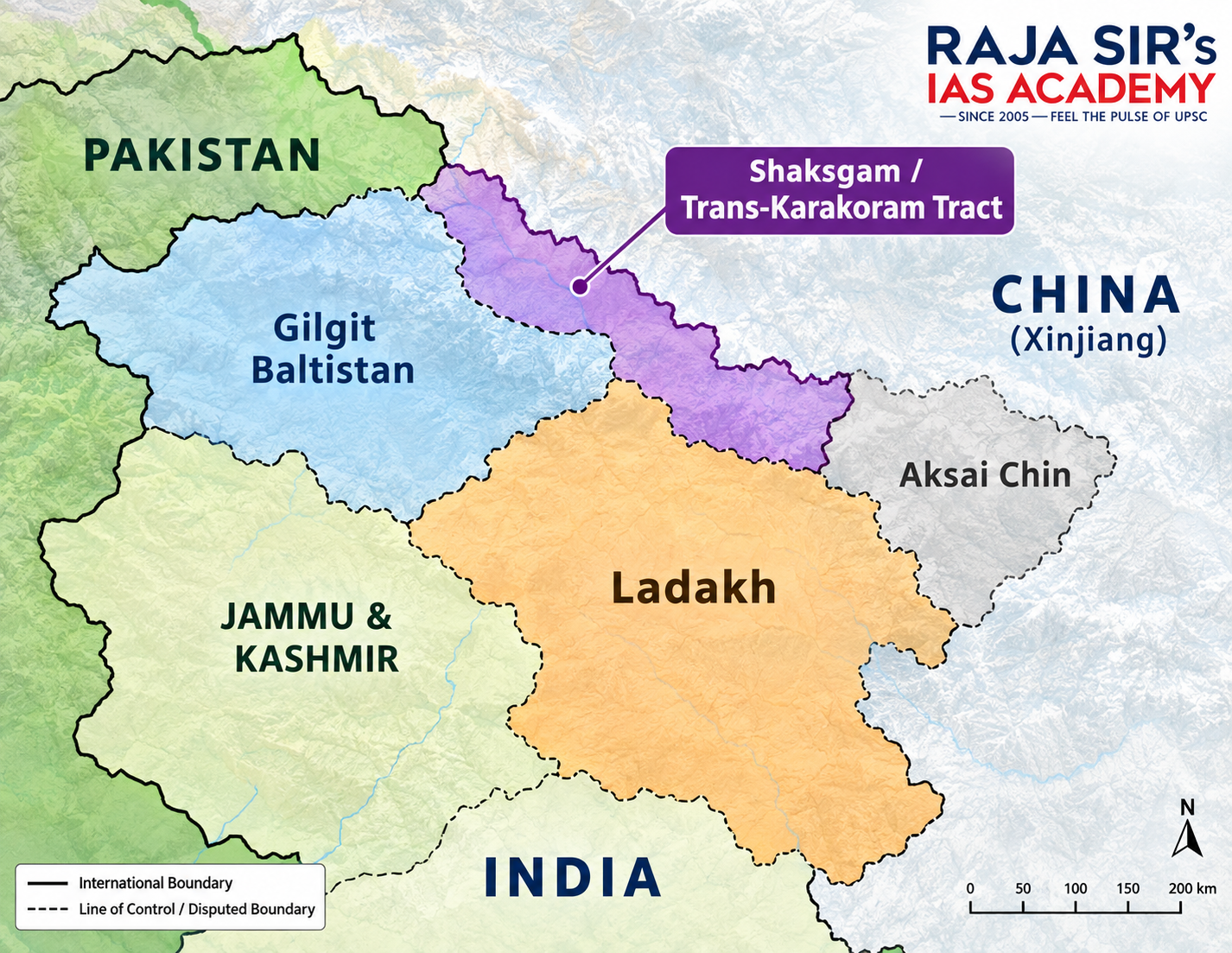
India rejected the operationalisation of the Pakistan–China Boundary Joint Commission, reiterating its position regarding territories under Pakistan’s occupation.
The issue is linked to the 1963 Sino-Pakistan Boundary Agreement, particularly the Shaksgam/Trans-Karakoram Tract.
Key Facts
- 1963 Agreement: China and Pakistan concluded a boundary agreement concerning the area adjoining Xinjiang and Pakistan-occupied territories.
- Shaksgam Tract: The agreement is particularly associated with the Shaksgam Valley/Trans-Karakoram Tract.
- India’s Position: India does not recognise the agreement as legally valid with respect to territory it claims as its own.
- Strategic Location: The region lies in the wider Karakoram area, close to Ladakh and Xinjiang.
Causes
- 1963 Sino-Pakistan Agreement: Pakistan and China negotiated a boundary arrangement involving territory claimed by India.
- China–Pakistan Strategic Convergence: Growing cooperation in security, infrastructure and connectivity has strengthened bilateral coordination.
- Karakoram’s Strategic Location: The region connects important strategic spaces involving Xinjiang, Pakistan-occupied territories and the Karakoram.
- CPEC: The China–Pakistan Economic Corridor has increased the strategic significance of areas under Pakistan''s control.
- India–China Boundary Dispute: The unresolved India–China boundary question adds to India''s concerns regarding developments in the region.
- India–Pakistan Territorial Dispute: India''s claims over territories under Pakistan''s control make any Pakistan–China arrangement concerning such areas particularly sensitive.
Impact
- Security Concerns: Greater China–Pakistan coordination can add complexity to India''s security environment.
- Two-Front Challenge: Developments involving both countries complicate India''s strategic planning along its northern and western fronts.
- Territorial Claims: Reinforces India''s concerns over third-party agreements involving territories claimed by India.
- Connectivity Implications: China–Pakistan infrastructure and connectivity projects in the region have strategic implications for India.
- Diplomatic Strain: May further complicate India''s bilateral relations with China and Pakistan.
- Karakoram Significance: Enhances the strategic importance of the Karakoram–Ladakh region for India''s border management.
Way Forward
- Diplomatic Assertion: Consistently communicate India''s territorial and legal position through diplomatic channels.
- Border Infrastructure: Strengthen connectivity, surveillance, logistics and infrastructure in strategically important border areas.
- Strategic Preparedness: Maintain capabilities to manage simultaneous security pressures on the northern and western fronts.
- Dialogue with China: Continue diplomatic and military communication mechanisms to prevent escalation.
- International Outreach: Present India''s position through credible historical and legal documentation.
- Regional Connectivity: Develop alternative connectivity and economic partnerships that advance India''s strategic interests.
|
|
Sohar Port: India’s Strategic Gateway to Oman
GS II – International Relations
Why in News?
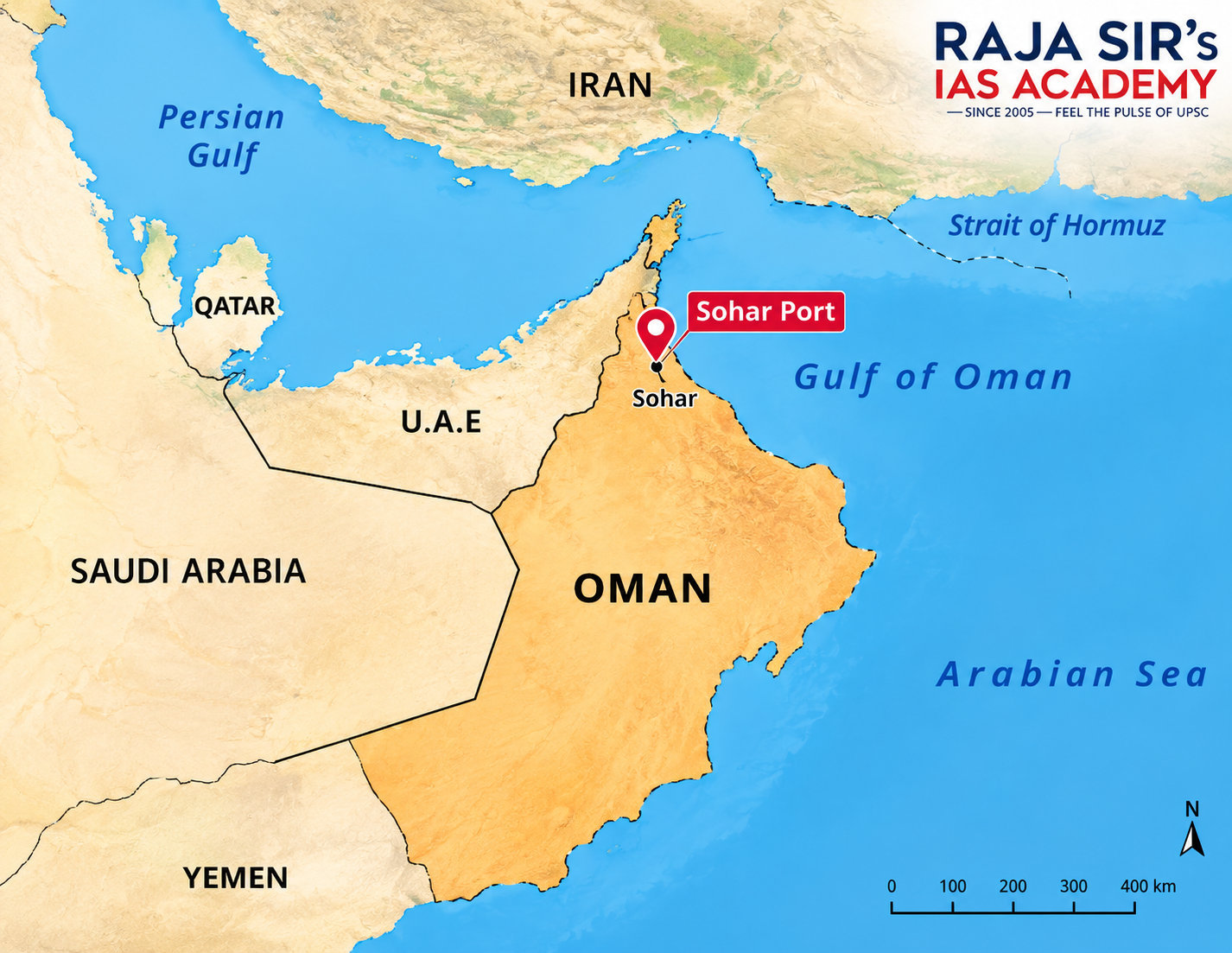
Oman has invited greater Indian investment in Sohar Port, highlighting its growing importance in India–Oman economic and maritime cooperation.
Key Facts
- Location: Northern Oman.
- Water Body: Gulf of Oman.Strategic
- Location: Located outside the Strait of Hormuz, providing an alternative maritime access point.
- Capital of Oman: Muscat.
- Major Mountain Range: Al Hajar Mountains.
- Drainage: Oman is characterised largely by seasonal wadis rather than major perennial rivers.
Strategic Significance
- Maritime Connectivity: Provides access to the Gulf of Oman without directly passing through the Strait of Hormuz.
- Trade: Supports Oman''s role as a regional logistics and industrial hub.
- India–Oman Relations: Greater Indian investment can strengthen bilateral trade and maritime cooperation.
- Strategic Geography: Its location is relevant to India''s wider interests in the Arabian Sea–Gulf region.
|