|
A Maritime Space at the Heart of Northeast Asian Geopolitics
GS II International Relations
Why in News?
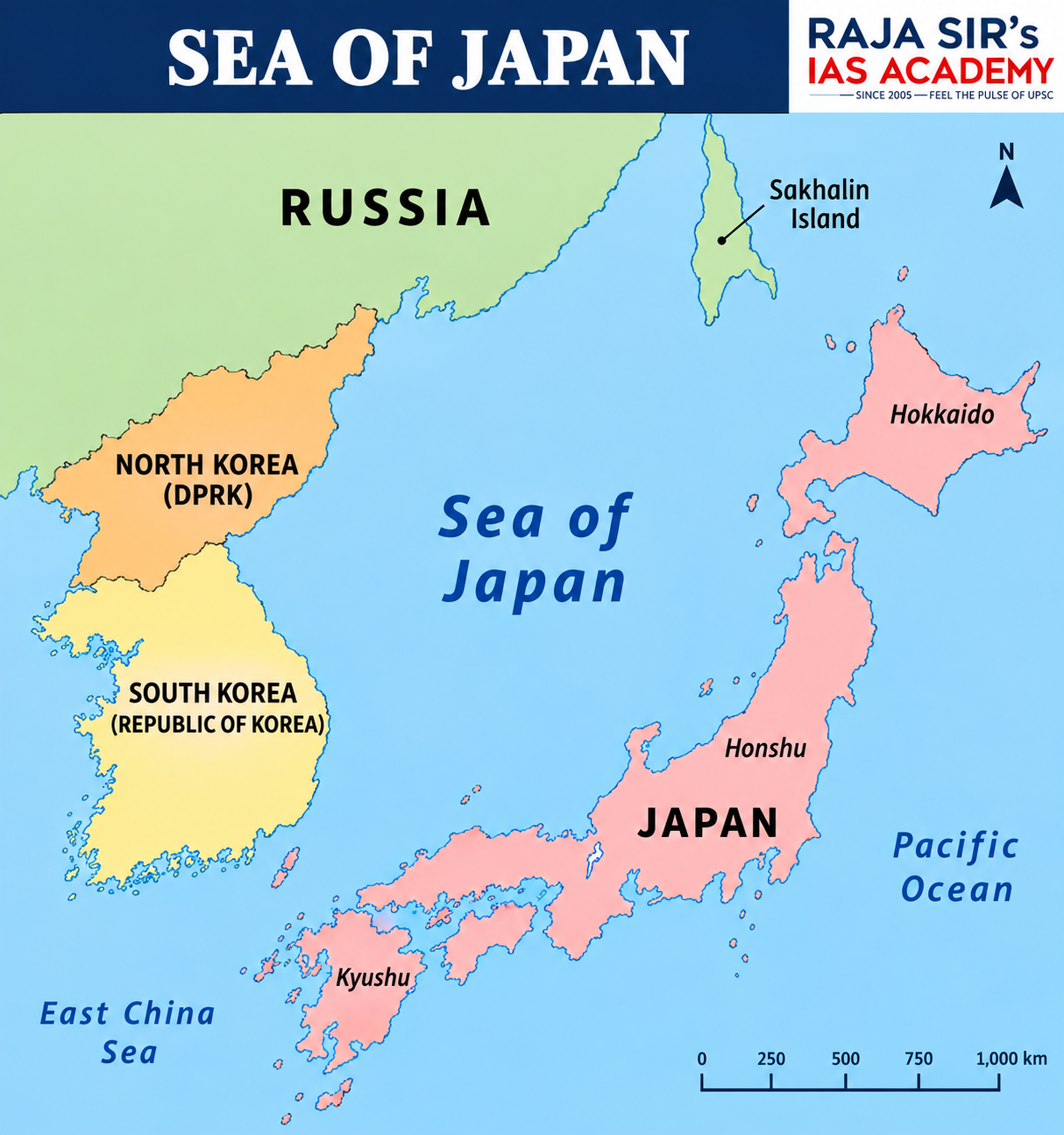
Recent military activity by North Korea occurred in waters of the East Sea, internationally widely known as the Sea of Japan.
Significance
- Strategic Location: Forms an important maritime space in Northeast Asia, connecting the Korean Peninsula, Japan and the Russian Far East.
- Security: Relevant to the strategic interactions among North Korea, South Korea, Japan and Russia.
- Maritime Trade: Supports regional shipping and economic activity.
- Fisheries: Important fishing grounds and marine resources support coastal economies.
- Geopolitics: Its location makes it significant for monitoring missile tests, naval activity and regional military movements.
About
- Location: Marginal sea of the western Pacific Ocean.
- Boundaries: Located between the Korean Peninsula, Japanese archipelago and Russian Far East.
- Countries bordering it: North Korea, South Korea, Japan and Russia.
Major connecting straits:
- Tsushima (Korea) Strait – connects with the East China Sea.
- Tsugaru Strait – connects with the Pacific Ocean.
- La Pérouse (Soya) Strait – connects with the Sea of Okhotsk.
- Tatar Strait – connects towards the Sea of Okhotsk.
- Major Current: Tsushima Current, a warm branch of the Kuroshio system, enters through the Korea/Tsushima Strait.
- Terminology: “East Sea” is the name used by South Korea; “Sea of Japan” is the internationally predominant English name.
|
|
Authenticating the Beneficiary: LPG Subsidy Delivery vs Exclusion Risks
Why in News?
Biometric authentication is proposed to become mandatory from 1 October 2026 for consumers seeking subsidised/regulated LPG refills.
Aim
- Eliminate duplicate and ghost beneficiaries.
- Prevent diversion of subsidised domestic LPG to commercial users.
- Improve targeting and delivery of LPG subsidies.
Core Issue
- The central challenge is to improve beneficiary authentication and subsidy targeting without creating exclusion for genuine consumers.
- Biometric authentication can strengthen identification, but authentication failure due to poor connectivity, biometric mismatch or lack of digital access can affect vulnerable beneficiaries.
Significance
- Fiscal Governance: Can reduce subsidy leakage and improve efficiency of public expenditure.
- Targeting: Helps ensure benefits reach the intended beneficiary.
- Digital Governance: Expands technology-based authentication in welfare delivery.
- Transparency: Makes beneficiary identification more traceable.
- Subsidy Management: Can help distinguish genuine domestic consumption from unauthorised diversion.
|
|
Europe''s Offshore Energy Hub
GS III Environment GS I Geography
Why in News?
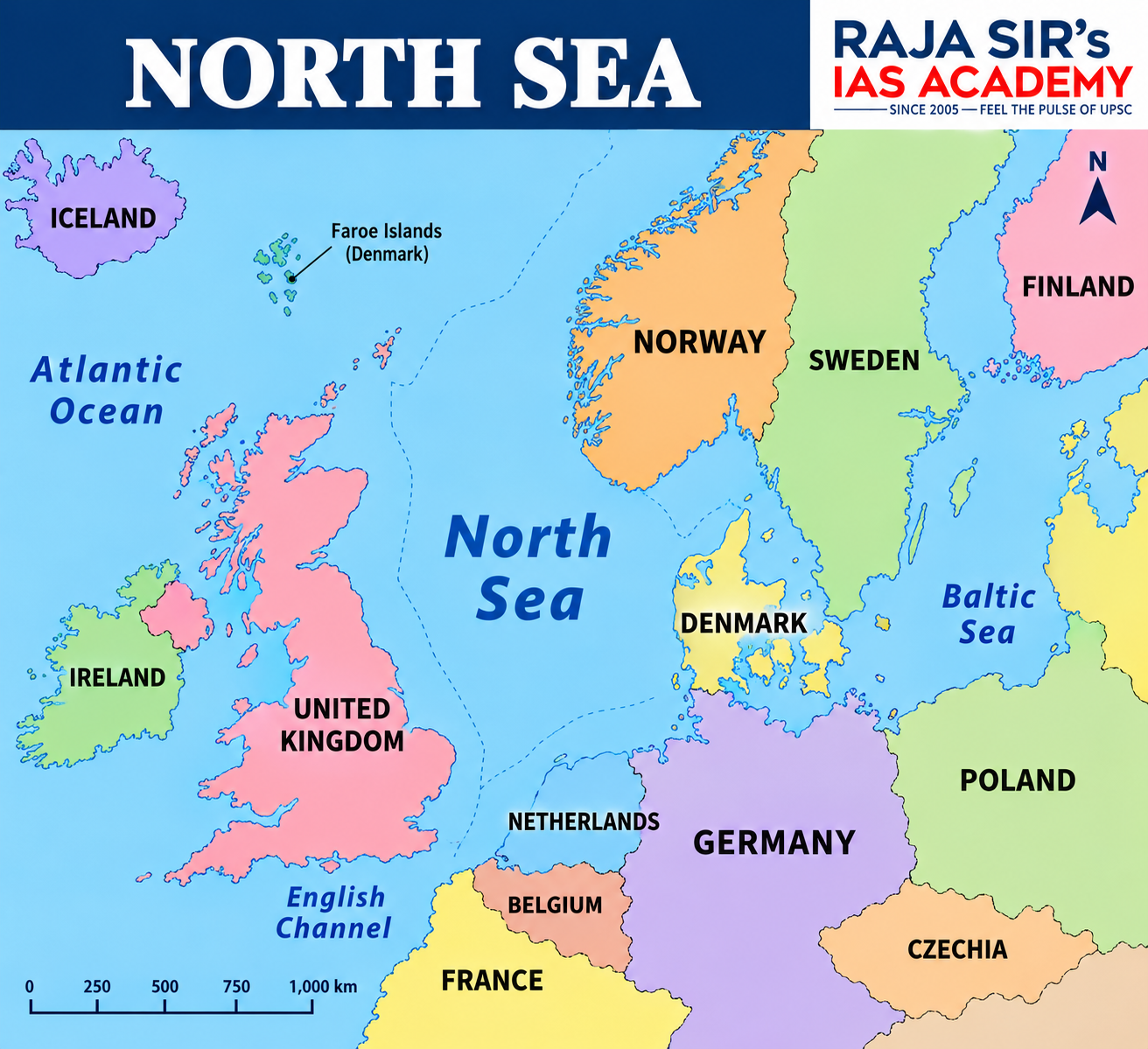
Denmark inaugurated a major offshore Carbon Capture and Storage (CCS) project in the North Sea, highlighting the region’s emerging role in Europe’s energy transition.
What is Carbon Capture and Storage (CCS)?
- CCS is a technology that captures CO₂ emissions from industrial processes or power generation and permanently stores them in deep geological formations.
- In offshore CCS, captured CO₂ is transported to offshore sites and injected into suitable sub-seabed geological formations.
Why is the North Sea Important?
- Hydrocarbon legacy: The North Sea has extensive experience in offshore oil and gas operations.
- Suitable geology: Depleted oil and gas reservoirs and saline formations can potentially provide storage capacity for CO₂.
- Existing infrastructure: Pipelines, offshore platforms and technical expertise can support the development of CCS networks.
- Energy transition: The region is increasingly combining offshore wind, CCS and other low-carbon technologies.
Significance
- Industrial decarbonisation: Can help reduce emissions from difficult-to-abate sectors such as cement, steel and chemicals.
- Carbon-management infrastructure: Supports development of cross-border CO₂ transport and storage networks.
- Just transition: Allows existing offshore engineering capabilities to be repurposed for low-carbon activities.
- European climate goals: CCS can complement renewable energy and energy-efficiency measures where direct electrification is difficult.
North Sea
Location
- North Sea is a marginal sea of the Atlantic Ocean.
- Located between Great Britain and continental Europe.
Countries bordering the North Sea
|
Direction
|
Countries
|
|
West
|
United Kingdom
|
|
South
|
France, Belgium, Netherlands
|
|
East
|
Germany, Denmark
|
|
North-East
|
Norway
|
Important Connections
- North Sea ↔ English Channel ↔ Atlantic Ocean in the south-west.
- North Sea ↔ Norwegian Sea ↔ North Atlantic towards the north.
- North Sea ↔ Baltic Sea through the Skagerrak–Kattegat system.
|
|
Foreign Funding, National Security and the Autonomy of Civil Society
GS II Polity and governance
Why in News?
The proposed FCRA Amendment Bill, 2026 seeks to strengthen regulation of foreign-funded organisations, including the treatment of assets created from foreign contributions after FCRA registration ceases.
- Aim
- Prevent foreign contributions from undermining sovereignty, national security, public interest and democratic processes.
- Improve accountability and traceability in the utilisation of foreign funds.
- Prevent misuse or diversion of assets created through foreign contributions.
Core Issue
- The central challenge is to balance national-security oversight and financial accountability with the autonomy and continuity of civil society organisations.
- Excessive restrictions may affect NGOs involved in healthcare, education, humanitarian relief and social development.
- Asset treatment after cessation of registration raises questions of public accountability, property rights and institutional continuity.
Significance
- National Security: Stronger scrutiny can reduce illicit foreign financing and external interference.
- Financial Accountability: Improves traceability of foreign contributions and assets created from them.
- Public Service Delivery: NGOs supplement state capacity in healthcare, education, livelihoods and humanitarian assistance.
- Democratic Governance: Civil society contributes to social accountability and community participation.
- Asset Governance: Clear rules can prevent diversion or misuse of foreign-funded assets.
|
No
|
FCRA Amendment, 2020
|
FCRA Amendment Bill, 2026
|
|
Core focus
|
Receipt and utilisation of foreign contribution
|
Management of funds and assets after FCRA status ceases
|
|
FCRA Account
|
Foreign contribution must be received through an FCRA account in SBI, New Delhi Main Branch
|
No major change to this 2020 framework
|
|
Transfer of funds
|
Inter-organisational transfer of foreign contribution prohibited
|
Not the central focus; focuses on what happens to funds/assets after cessation
|
|
Administrative expenses
|
Ceiling reduced from 50% to 20% of foreign contribution
|
No comparable change proposed
|
|
Cessation of registration
|
Introduced surrender of FCRA certificate
|
Certificate can cease through non-renewal, refusal of renewal or expiry, besides cancellation/surrender
|
|
Foreign-funded assets
|
Provided for vesting of assets in specified circumstances
|
Creates Designated Authority with provisional/permanent vesting, supervision and disposal of foreign-funded and partly foreign-funded assets
|
|
Penalties & investigation
|
Strengthened compliance and identification requirements, including Aadhaar
|
Maximum imprisonment proposed to reduce 5 years → 1 year; prior Central Government approval proposed for initiating investigation
|
|
|
Giant African Snail
GS III Environment & Biodiversity
Why in News?
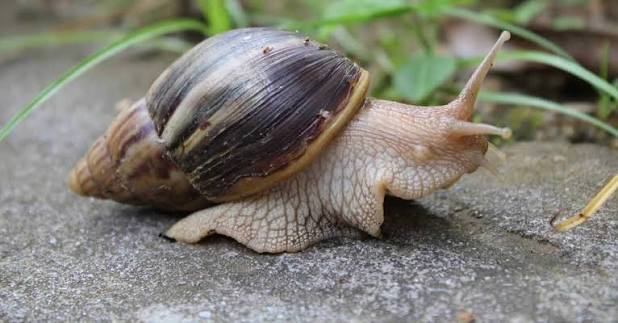
Kerala Agricultural University launched an eradication programme against the Giant African Snail in Idukki.
What is the Giant African Snail?
- Scientific name: Lissachatina fulica
- Common names: Giant African land snail / Giant African snail.
- Origin: East Africa, particularly Kenya and Tanzania.
- It is a terrestrial gastropod mollusc.
- It is among the world''s most invasive land-snail species.
Key Features
- Habitat: Tropical and subtropical environments; thrives in warm and humid conditions.
- Diet: Highly polyphagous — feeds on a wide range of plants.
- Reproduction: Hermaphroditic, with individuals possessing both male and female reproductive organs.
- Can reproduce rapidly and produce large numbers of eggs.
- Its broad diet and high reproductive capacity make population control difficult.
|
|
GIFT City and India''s Rise in Global Financial Services
GS Paper III – Indian Economy
Why in News?
- The 40th edition of the Global Financial Centres Index (GFCI 40) was published on 16 September 2026 by Z/Yen Group in partnership with the China Development Institute (CDI).
- GIFT City–Gujarat was ranked 46th globally, with a rating of 703, compared with 29th in GFCI 39.
- The index evaluates the competitiveness of 117 financial centres, using quantitative indicators and assessments from financial-sector respondents.
What is GFCI?
- The Global Financial Centres Index is a global ranking of financial centres based on their competitiveness and future potential.
- It is published twice a year.
- GFCI 40 used 144 instrumental factors, along with 39,531 assessments from 6,147 respondents.
GIFT City
- GIFT City (Gujarat International Finance Tec-City) is India''s first operational International Financial Services Centre (IFSC).
- It functions as a multi-services SEZ and aims to provide an international financial-services ecosystem in India.
Major activities include:
- Banking
- Capital markets
- Fund management
- Insurance
- Bullion trading
- FinTech
- Aircraft and ship leasing.
Significance
- Global Benchmark: Provides a comparative assessment of financial-centre competitiveness.
- Business Environment: Evaluates factors affecting the ease of conducting financial business.
- Human Capital: Considers availability of skilled professionals and talent.
- Infrastructure: Assesses physical and technological infrastructure supporting financial services.
- Financial Development: Examines the depth and development of the financial sector.
- Reputation: Considers the perception and reputation of financial centres.
- India''s Financial Ambition: Greater recognition can support India''s objective of developing an international financial-services ecosystem.
|
|
Global Water Cycle Under Stress: Groundwater, Glaciers and Freshwater Storage Decline
GS II Governance ; GS I : Geography ; GS III: Environment & Agriculture
Why in News?
- The World Meteorological Organization (WMO) released the State of Global Water Resources 2025 report on 17 September 2026.
- It provides a global assessment of river discharge, groundwater, terrestrial water storage, soil moisture, snow, glaciers and water-related extremes.
What is the Report?
- An annual WMO assessment of the world''s freshwater resources and hydrological variability.
- It combines ground observations, satellite observations and hydrological models.
- The report now draws on data from 68 countries and more than 3,000 stations, showing the expansion of global hydrological monitoring.
Key Findings
River Discharge
- 2025 was one of the driest years for global river discharge in 35 years.
- Around 36% of the global basin area experienced below-normal discharge.
- The past seven years recorded exceptionally few rivers with normal flows, indicating increasing hydrological variability.
Groundwater Stress
- Persistent groundwater deficits during 2022–2025 were reported in parts of the Americas, Europe, Middle East, India, southern Africa and Australia.
- 34% of monitored groundwater stations recorded below-normal to much-below-normal levels in 2025, compared with 25% in 2024.
Terrestrial Water Storage
- Global terrestrial water storage has shown a persistent decline since around 2014–16.
- It includes freshwater stored in groundwater, soil, rivers, lakes, reservoirs, snow and ice.
- This represents depletion of the Earth''s long-term natural water buffers.
Glacier Loss
- Glaciers lost approximately 408 ±132 gigatonnes (Gt) of mass in 2025.
- This is equivalent to approximately 1.1 ±0.4 mm of sea-level rise.
- It was the fourth consecutive year in which every major glaciated region recorded net ice loss
Water-Related Disasters
- Asia and Africa were particularly affected.
- Together, they accounted for at least half of recorded water-related extreme events and more than 80% of associated deaths over the past five years.
India-Specific Findings
Persistent Groundwater Deficit
- India experienced persistent groundwater deficits during 2022–2025, particularly in parts of northwestern India.
- Over-abstraction is identified as an important driver in several affected regions.
Important Paradox
- India illustrates an important distinction between short-term water availability and long-term water security:
- Several major Indian river basins recorded above-normal river discharge in 2025.
- Yet groundwater depletion continued, particularly in north western India.
|
|
Red Sea Insecurity and the Geopolitics of Maritime Chokepoints
GS II International relations
Why in News?
Houthi military activity around Yemen''s Red Sea coast has renewed attention to maritime security around the Bab-el-Mandeb Strait.
What are the Houthis?
- The Houthis, formally known as Ansar Allah, are a political and armed movement originating in northern Yemen.
- They emerged from the Zaydi Shia community and became a major actor in Yemen''s civil conflict.
- The movement controls significant territory in northern and western Yemen, including the capital Sana''a.
Core Issue
- Houthi activity demonstrates how a regional conflict can affect global maritime commerce because of the strategic location of Yemen near the Bab-el-Mandeb.
- The central challenge is to protect freedom of navigation and commercial shipping while preventing maritime confrontation from contributing to wider regional escalation.
Significance
- Strategic Chokepoint: Bab-el-Mandeb connects the Red Sea with the Gulf of Aden.
- Global Trade: It forms part of the maritime route linking the Indian Ocean with the Suez Canal and Mediterranean.
- Energy Security: Disruption can affect the transportation of oil and other energy commodities.
- Regional Security: Houthi activity links Yemen''s internal conflict with wider West Asian geopolitical tensions.
|
|
Strengthening India–Sri Lanka Maritime Interoperability
GS II – International Relations GS III– Internal Security
Why in News?
- The 13th edition of the Sri Lanka–India bilateral naval exercise, SLINEX-26, was conducted at Visakhapatnam from 17–21 September 2026.
- It was conducted under the operational supervision of the Indian Navy''s Eastern Naval Command.
What is SLINEX?
- SLINEX = Sri Lanka–India Naval Exercise.It is an annual bilateral maritime exercise between the Indian Navy and Sri Lanka Navy.
- The exercise was conceptualised in 2005 and has evolved into a platform for maritime cooperation, interoperability and professional exchange.
Participating Ships
India
- INS Kavaratti – indigenous Anti-Submarine Warfare (ASW) Corvette.
- INS Jyoti – Fleet Tanker.
Sri Lanka
- SLNS Sindurala – Offshore Patrol Vessel.
|
Phase
|
Key Activities
|
|
Harbour Phase
|
Professional interactions, Cross-deck visits, Sharing of naval best practices, Subject-matter expert exchanges, Sports and cultural activities
|
|
Sea Phase
|
Tactical manoeuvring, Live surface-firing exercises, Anti-piracy operations, Cross-deck helicopter manoeuvres, Coordinated maritime operations
|
|
|
The Implementation Gap Behind Legal Commitments
GS Paper II – Social Justice | International Organisations
Why in News?
- UN Women and UN DESA released the Gender Snapshot 2026 on 17 September 2026.
- The annual report tracks gender equality across all 17 Sustainable Development Goals (SDGs) using data from more than 100 sources.
|
Indicator
|
Finding
|
|
SDG 5
|
No indicator is currently on track to achieve the 2030 gender-equality targets.
|
|
Gender-equality institutions
|
32% reported erosion of institutional power over the previous two years.
|
|
National parliaments
|
At the current pace, gender parity would take another 63 years.
|
|
Chief Justices
|
Only 31 of 175 Chief Justices globally are women.
|
|
Defence Ministers
|
Nearly 9 in 10 are men.
|
|
Finance Ministers
|
More than 8 in 10 are men.
|
|
Corporate CEOs
|
Women hold only about 6% of CEO positions globally.
|
|
UN Secretary-General
|
No woman has held the position in the UN''s history.
|
Institutional Retreat
- Around one in three gender-equality institutions reported a loss of institutional power.
- Around one in four experienced cuts to their operating budgets.
- Nearly one in ten lost control over their budgets.
- Funding for gender equality reached its lowest level since 2021.
|
Feature
|
UN DESA
|
UN Women
|
|
Full Form
|
United Nations Department of Economic and Social Affairs
|
United Nations Entity for Gender Equality and the Empowerment of Women
|
|
Established
|
1948 as Department of Economic Affairs; became UN DESA in 1955
|
2010
|
|
Operational Since
|
—
|
2011
|
|
Headquarters
|
New York, USA
|
New York, USA
|
|
Nature
|
Department of the UN Secretariat
|
Dedicated UN entity
|
|
Created by
|
—
|
UN General Assembly Resolution 64/289
|
|
Head
|
Under-Secretary-General for Economic and Social Affairs
|
Executive Director
|
|
Primary Focus
|
Economic, social and sustainable-development issues
|
Gender equality and women’s empowerment
|
|
Major Areas
|
Economy, population, statistics, social development, SDGs
|
Gender equality, women''s empowerment, political participation, violence against women
|
|
UPSC Keyword
|
Economy + Society + Population + Statistics + SDGs
|
Gender Equality + Women’s Empowerment
|
|