|
Asymmetric Federalism & the Siliguri Corridor Dilemma
GS Paper II – Federalism | Regional Aspirations | Governance | Internal Security
Why in News?
The Union Home Minister held a stakeholder meeting in Siliguri and announced a high-level committee headed by interlocutor Pankaj Kumar Singh to work towards a Permanent Political Solution (PPS) to the long-standing Gorkha issue.
What is the Gorkha Issue?
The Gorkha issue revolves around demands for:
- Political self-governance.
- Protection of Gorkha/Nepali linguistic and cultural identity.
- Greater administrative autonomy.
- Historically, creation of a separate Gorkhaland State from northern West Bengal.
Aim
The objective is to establish a durable constitutional and administrative arrangement that:
- Addresses regional aspirations.
- Provides meaningful self-governance.
- Protects the interests of different ethnic communities.
- Preserves West Bengal''s territorial integrity.
- Safeguards national-security interests in a strategically sensitive region.
Historical Evolution
- 1988- Darjeeling Gorkha Hill Council (DGHC) established
- 2011- Gorkhaland Territorial Administration (GTA) created
- 2017- Renewed agitation and prolonged shutdown
- October 2025- Pankaj Kumar Singh appointed interlocutor
- 2026- High-level committee announced for PPS
Why is the Demand Persistent?
- Identity: Distinct Gorkha/Nepali linguistic and cultural identity.
- Development deficit: Concerns regarding employment, education, healthcare, tea plantations and infrastructure.
- Limited devolution: Earlier arrangements such as DGHC and GTA lacked adequate legislative and financial autonomy.
- Constitutional aspirations: Demands for stronger constitutional protection and ST status for certain Gorkha communities.
Significance
- Tests Indian federalism: Demonstrates the challenge of accommodating regional aspirations within a federal structure.
- Asymmetric federalism: Raises questions about differentiated autonomy for distinct regions.
- Internal security: Stability is important in a sensitive borderland.
- Strategic importance: The region lies close to the Siliguri Corridor, connecting mainland India with the Northeast.
- Inclusive governance: A negotiated settlement can prevent recurring political unrest.
- Development: Political stability can facilitate investment, tourism and infrastructure development.
Constitutional provisions
- Union Territory: Creation of a UT under Article 3.
- Autonomous State: Article 244A provides a constitutional mechanism for an autonomous State within Assam; extending a similar model elsewhere would raise constitutional questions.
- Sixth Schedule: Possibility of an empowered autonomous council, but extension outside the areas constitutionally covered by the Sixth Schedule would require careful constitutional examination.
- Strengthened Autonomous Administration: Greater legislative, financial and administrative powers to the existing arrangement.
Way Forward
- Consensus-based federalism: Consult all affected communities.
- Real devolution: Transfer genuine legislative, financial and administrative powers rather than merely renaming institutions.
- Protect minority interests: Ensure representation of non-Gorkha communities.
- Development-led settlement: Combine political autonomy with infrastructure, education, healthcare and livelihood measures.
|
|
Chagos-Laccadive Geography & Channel Geopolitics
Why in News?
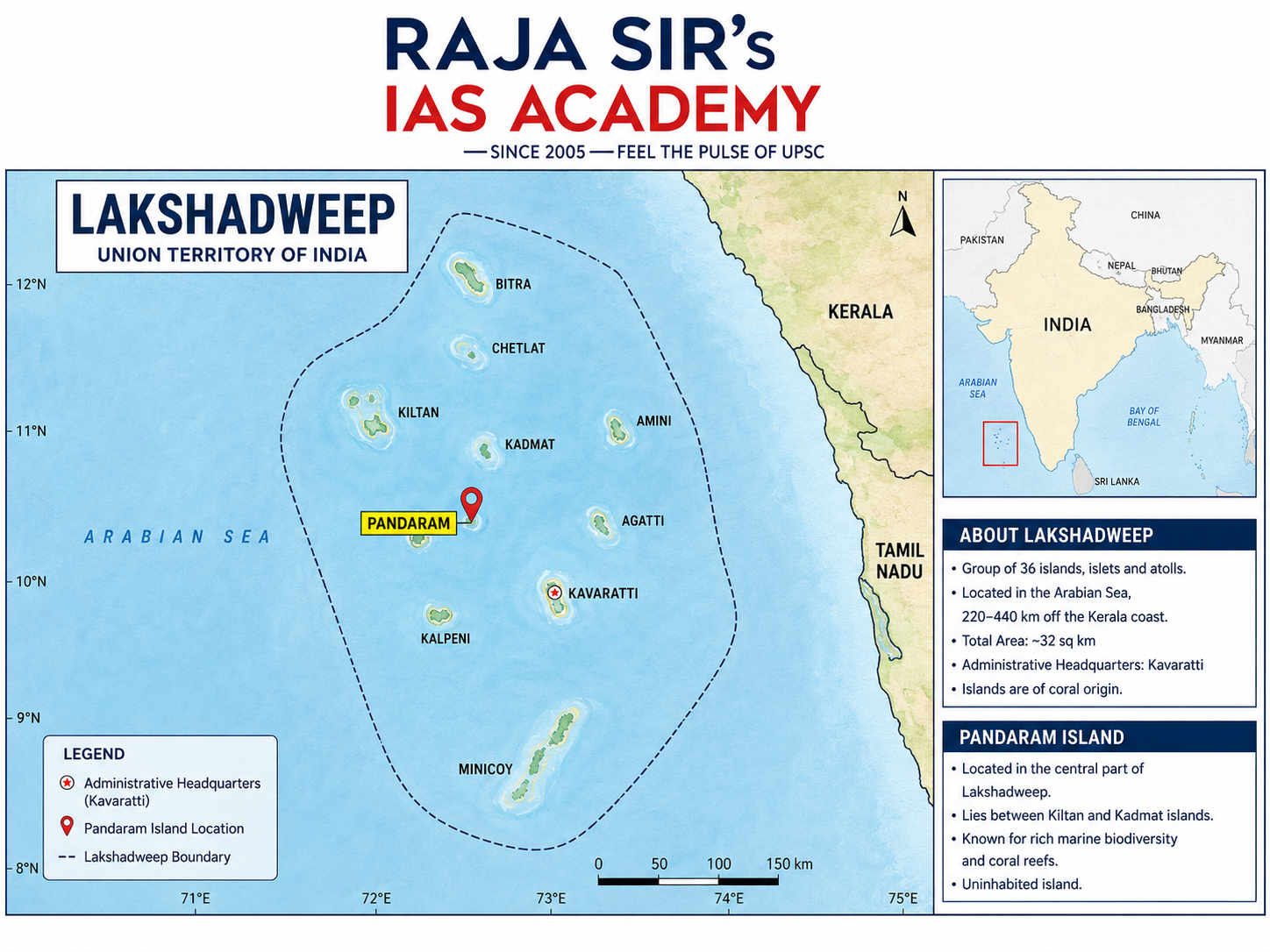
The Kerala High Court addressed a dispute concerning pandaram land in Lakshadweep and held that traditional cowledars possessing such land before the 1965 Regulation were lawful landowners, quashing arbitrary resumption orders.
|
Dimension
|
Spatial & Geographic Facts
|
|
Geological Origin
|
Coral atolls resting on the submerged Chagos-Laccadive Ridge (volcanic hotspot origin)
|
|
Capital
|
Kavaratti (located in the central Laccadive group)
|
|
Only Airport
|
Agatti Island
|
|
Largest Island
|
Andrott (by land area: ~4.90 sq km); Minicoy is the second largest (~4.80 sq km)
|
|
Smallest Inhabited Island
|
Bitra (land area: ~0.10 sq km)
|
|
Bird Sanctuary
|
Pitti Island (Pakshipitti) — an uninhabited coral islet and breeding ground for terns (Wildlife Protection Act, 1972)
|
|
Southernmost Island
|
Minicoy
|
|
Northernmost Island
|
Chetlat
|
|
Easternmost Island
|
Andrott
|
|
Westernmost Island
|
Bitra
|
Crucial Water Channels (North to South)
- 11 Degree North Channel: Divides the Amindivi Group (North) from the Laccadive/Cannanore Group (Central/South).
- 9 degree channel : Separates the main Lakshadweep Archipelago (Kalpeni/Suheli/Kavaratti) from Minicoy Island.
- 8 degree Channel: Separates Minicoy Island (India) from the Maldives Archipelago (Ihavandhippolhu Atoll).
Sub-Group Island Breakdown
- Amindivi Group (North): Amini, Kadmat, Kiltan, Chetlat, Bitra.
- Laccadive Group (Central): Andrott, Kavaratti, Agatti, Kalpeni, Bangaram, Suheli Par.
- Southern Isolated Atoll: Minicoy (Maliku).
Cultural & Linguistic
- Scheduled Tribe Status: Over 94% of the indigenous population is classified as ST.
Languages:
- Jeseri (Dweep Bhasha): A dialect of Malayalam with Arabic/Tamil influences, spoken across the northern and central islands.
- Mahl: A dialect of Divehi (official language of the Maldives), written in the Thaana script, spoken exclusively on Minicoy Island.
- Social System: Traditional matrilineal lineage system (Marumakkathayam) and undivided joint families (Taravad).
The Backstory: How Did It All Begin?
- The Geography: Lakshadweep is a tiny archipelago of 36 coral islands in the Arabian Sea with a total land area of just 32 sq km. Over 94% of the population belongs to indigenous Scheduled Tribes (ST).
- The Royal Era (Arakkal Kingdom): Centuries ago, the rulers of Cannanore declared uncultivated, vacant, or confiscated lands as "Pandaram Land" (which simply meant Crown/Sovereign property).
- The British Era (Cowle System): To turn barren coral sands into productive farms, the British leased these Pandaram lands to local islanders under long-term agrarian contracts called Cowles (tenants were called Cowledars). The deal was simple: Plant coconut palms, care for the land, pay a nominal tax, and your family can keep renewing it.
- 1965 Law: After Independence, the 1965 Land Revenue and Tenancy Regulation conferred formal landowner status to these long-settled Cowledar families.
- The Big Fact: Pandaram land makes up roughly 60% of Lakshadweep''s entire land area.
What Caused the Dispute?
- Eviction Notices: The UT Administration issued notices demanding that islanders vacate Pandaram lands for government tourism and development projects.
- Minimal Compensation: The administration treated residents as temporary occupants, offering compensation only for standing coconut trees, paying nothing for the land itself.
- Repeal of Protective Clauses (2023): The Union Government deleted Section 15A of the 1965 Regulation, removing key tenancy protections for islanders ho had legally purchased or inherited Pandaram plots.
- Bypassing the Tribal Commission: Even though over 94% of islanders are Scheduled Tribes, the administration made these major changes without consulting the National Commission for Scheduled Tribes (NCST) under Article 338A(9).
What Did the Kerala High Court Rule?
- In Fathima Holithithige vs. Union Territory of Lakshadweep, the High Court ruled in favor of the islanders:
- Islanders are Lawful Landowners: Families settled on Pandaram lands before the 1965 Regulation hold full statutory ownership rights.
- No Arbitrary Evictions: The government cannot seize land through executive notices. Any future acquisition must follow the RFCTLARR Act, 2013 (ensuring fair market compensation, Social Impact Assessments, and proper rehabilitation).
- 2023 Amendment Struck Down: Bypassing mandatory consultation with the NCST was ruled unconstitutional.
|
|
Non-GMO Breeding & India''s Niche Agritech Shift
GS Paper III – Agriculture | Biotechnology | Food Processing | Seed Technology
Why in News?
India''s first non-GMO high-expansion popcorn maize hybrid seed was launched at Musunuru in Eluru district, Andhra Pradesh.
What is it?
- It is an indigenously developed hybrid maize seed designed specifically for popcorn production.
- High expansion means the kernels produce a larger volume of popped corn relative to the quantity of raw kernels.
Aim
- Reduce dependence on imported popcorn hybrid technology.
- Strengthen India''s indigenous seed ecosystem.
- Increase farmers'' returns through specialised crops.
- Develop farm-to-processing value chains.
- Promote self-reliance in agricultural inputs and technology.
Significance
- Agriculture : Encourages crop diversification towards high-value niche crops. Provides farmers access to specialised markets.
- Science & Technology : Demonstrates indigenous plant breeding and hybrid-seed development.Shows how breeding can target specific commercial traits.
- Economy : Supports import substitution.Creates opportunities in processing, packaging and food industries.
- Farmers : Can integrate production with processors and organised markets. Greater value addition can improve farm-level returns.
Way Forward
- Expand indigenous R&D in specialised crop varieties.
- Strengthen farmer–processor–retailer linkages.
- Improve seed quality certification and storage infrastructure.
- Develop export-oriented popcorn value chains.
- Promote region-specific, high-value agricultural crops.
Notes
- Hybrid - Produced by crossing selected parental lines to combine desirable traits.
- GMO - Organism whose genetic material has been deliberately altered using genetic engineering.
- Non-GMO hybrid- A hybrid developed through conventional breeding without genetic engineering.
- High-expansion popcorn - Popcorn that produces a greater volume after popping from a given quantity of kernels.
|
|
Pediatric Guardrails for Cold & Cough Formulations
GS Paper II: Health | Pharmaceuticals | Drug Regulation | Public Health
Why in News?
The Union Health Ministry has strengthened regulatory requirements concerning Fixed-Dose Combinations (FDCs) containing chlorpheniramine maleate and phenylephrine, including a warning regarding their use in children below four years of age.
|
Drug
|
Pharmacological role
|
Main function
|
|
Chlorpheniramine maleate
|
First-generation antihistamine
|
Helps relieve symptoms such as sneezing and runny nose
|
|
Phenylephrine
|
Sympathomimetic decongestant
|
Helps reduce nasal congestion through vasoconstriction
|
What is an FDC?
Fixed-Dose Combination (FDC) is a pharmaceutical formulation containing two or more active pharmaceutical ingredients in a fixed proportion within a single dosage form.
Why is the regulatory move important?
- Paediatric Safety : Young children can be particularly vulnerable to medication-related adverse effects and dosing errors.
- Rational Drug Use : Combination medicines should be used only when the individual ingredients are clinically justified.
- Prevention of Medication Errors : Multiple ingredients increase the possibility of accidental duplication when different medicines contain overlapping components.
|
|
Silvopastoral Adaptation & Indigenous Cryobanking
GS Paper III – Agriculture | Animal Husbandry | Biodiversity & Genetic Resources
Why in News?
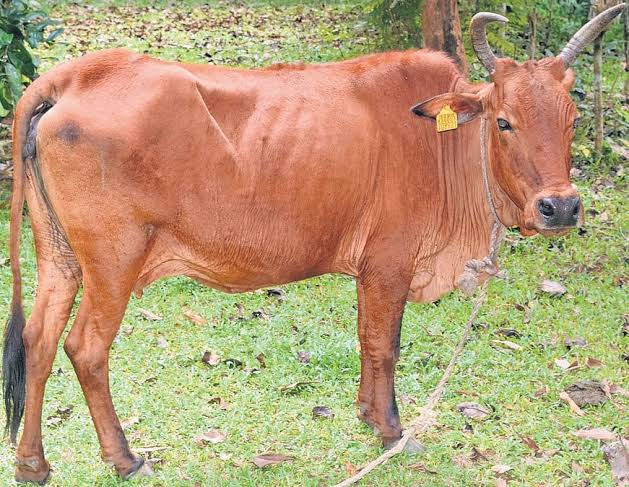
- The ICAR–National Bureau of Animal Genetic Resources (NBAGR) has officially registered Periyar Kullan (Periyar cattle) as an indigenous cattle breed.
- It becomes Kerala’s second nationally recognised indigenous cattle breed(2026), after Vechur (1996)
What is Periyar Kullan?
- An indigenous cattle breed of Kerala.
- Associated with the Periyar region and central Kerala.
- Known for its adaptation to local environmental conditions.
- Traditionally maintained under low-input and semi-feral/silvopastoral systems.
Significance
- Genetic Resource Conservation : Adds to India''s recognised animal genetic resources. Helps preserve locally adapted cattle genetics.
- Climate & Environment : Indigenous breeds can possess traits suited to local climate, feed availability and disease pressures.
- Rural Livelihoods : Potentially useful for small and marginal farmers.
- Scientific Importance : Formal breed recognition enables systematic documentation, conservation and breeding programmes.
Way Forward
- Establish dedicated breed conservation programmes.
- Provide scientific breeding and veterinary support.
- Maintain genetic purity through controlled breeding.
- Avoid indiscriminate cross-breeding that may erode unique genetic traits.
- Develop sustainable local dairy and livestock models.
National Bureau of Animal Genetic Resources (NBAGR)
- Parent Organization : Indian Council of Agricultural Research (ICAR), under the Ministry of Agriculture & Farmers Welfare.
- Headquarters : Karnal, Haryana (initially set up in Bangalore in 1984, shifted to Karnal in 1985).
- National Animal Gene Bank: Maintains an ex-situ cryobank for indigenous animal germplasm (deep-frozen semen, embryos, and somatic cells).
Headquarters
- NBPGR (Plants) New Delhi
- NBAGR (Animals) Karnal, Haryana
- NBFGR (Fish) Lucknow, Uttar Pradesh
- NBAIM (Microorganisms) Mau, Uttar Pradesh
- NBAIR (Agricultural Insect Resources) Bengaluru, Karnataka
- NBSS&LUP (Soil Survey & Land Use Planning) Nagpur, Maharashtra
|
State
|
Breed
|
Utility
|
About
|
|
Kerala
|
Vechur
|
Dwarf / Milch
|
World''s smallest cattle breed by height; extremely disease-resistant.
|
| |
Periyar Kullan
|
Dwarf
|
Semi-feral agroforestry grazer from the Periyar river basin; 2nd recognised Kerala breed.
|
| |
Kasaragod Dwarf
|
Dwarf
|
Extremely low-input, heat-tolerant native dwarf cattle.
|
|
Tamil Nadu
|
Kangayam
|
Draught
|
Hardy work breed of Kongu region; extensively used in Jallikattu.
|
| |
Bargur
|
Draught
|
Agile, brown-and-white patched breed native to Bargur hill forests.
|
| |
Umblachery
|
Draught
|
Short-legged draught breed specifically adapted to marshy Cauvery delta paddy fields.
|
| |
Pulikulam
|
Draught / Game
|
High-spirited, aggressive breed maintained in migratory herds for Jallikattu.
|
| |
Alambadi
|
Draught
|
Dark-coated, backward-curving horn breed of Dharmapuri/Cauvery basin.
|
|
Andhra Pradesh
|
Ongole
|
Dual-Purpose
|
Massive, muscular white breed; progenitor of American and Brazilian Nelore/Brahman cattle.
|
| |
Punganur
|
Dwarf / Dual
|
Compact dwarf cattle from Chittoor known for high-fat milk and drought resilience.
|
|
Telangana
|
Poda Thurpu
|
Draught
|
White cattle with brown/black patches adapted to Nallamala forest grazing.
|
|
Karnataka
|
Hallikar
|
Draught
|
Long vertical-horned breed; foundational progenitor of South Indian draught cattle.
|
| |
Amritmahal
|
Draught
|
Historically developed by Mysore rulers as high-speed military draught/transport cattle.
|
| |
Malnad Gidda
|
Dwarf / Dual
|
Agile, miniature breed adapted to heavy rainfall and Western Ghats terrains.
|
| |
Deoni
|
Dual-Purpose
|
Black-and-white spotted breed of Bidar/Marathwada; related to Gir ancestry.
|
| |
Krishna Valley
|
Dual-Purpose
|
Heavy-bodied breed used for ploughing deep black cotton soils along the Krishna River.
|
| |
Khillari
|
Draught
|
Rapid, endurance-oriented draught cattle of North Karnataka and Maharashtra border.
|
|
|
The Ayur-Maternal Bridge
GS Paper II – Health | Maternal & Child Health | AYUSH | Traditional Knowledge
Why in News?
The All India Institute of Ayurveda (AIIA), New Delhi launched the Garbhini Mitra six-month course for the 2026–27 academic session. The programme aims to create trained non-clinical support personnel for maternal wellness and appropriate referral.
Core Objectives & Features
- Antenatal Care (ANC) Tracking: Helps pregnant women and healthcare workers monitor scheduled checkups, ultrasound scans, blood pressure, weight, and blood glucose levels across all trimesters.
- Immunization & Nutrition Reminders: Sends alerts for essential supplements (Iron & Folic Acid, Calcium) and vaccinations (such as Tetanus-Diphtheria / Td boosters).
- High-Risk Pregnancy Identification: Flags warning signs (e.g., severe anemia, preeclampsia, gestational diabetes) early so women can receive timely clinical intervention.
- Dietary & Lifestyle Guidance: Offers culturally tailored nutrition plans, safe exercises, and guidance on trimester-specific body changes.
- Emergency & Delivery Readiness: Provides contact information for nearby Primary Health Centres (PHCs), Community Health Centres (CHCs), 108/102 emergency ambulance services, and birth preparedness checklists.
Core Ayurvedic Pillars:
- Garbhadhana Vidhi (Pre-conceptional health care).
- Garbhini Paricharya (Month-by-month, trimester-specific antenatal regimen).
- Sutika Paricharya (Postnatal maternal recovery and newborn care/Abhyanga).
- Modern Protocols Covered: Basic Life Support (BLS), infection control, bio-medical waste handling, and tracking maternal vital signs (BP, hemoglobin).
- Eligibility & Intake: Minimum qualification of 10+2 (Senior Secondary), minimum age 18 years, capped at small batches (20 students
|
Feature
|
Garbhini Mitra
|
Garbhini-GA2
|
|
What it is
|
A 6-month maternal wellness training course.
|
An AI/machine learning diagnostic algorithm.
|
|
Developed by
|
All India Institute of Ayurveda (AIIA), Ministry of Ayush.
|
IIT Madras and THSTI, under the Department of Biotechnology (DBT).
|
|
Primary Focus
|
Training frontline caregivers in Ayurvedic prenatal/postnatal care, nutrition, and yoga.
|
Accurately calculating fetal gestational age (GA) during 2nd & 3rd trimesters.
|
|
Core Function
|
Delivers supportive lifestyle, dietetics, newborn massage, and emotional care for pregnant women.
|
Replaces Western ultrasound formulas (e.g., Hadlock) with an India-specific growth model to reduce age estimation errors.
|
|
Key Users
|
Certified healthcare assistants, doulas, and community wellness workers.
|
Obstetricians, radiologists, and sonographers.
|
|
|
The Blue Helmet Shield
GS Paper II – International Relations | UN Peacekeeping | Conflict Resolution
Why in News?
India condemned an attack on UNMISS peacekeepers near Pajut in Jonglei State, South Sudan, in which an Ethiopian peacekeeper was killed. The incident highlights the risks faced by UN peacekeepers operating in conflict-affected regions.
What is UNMISS?
UNMISS (United Nations Mission in South Sudan) is a UN peacekeeping mission established in 2011, following South Sudan''s independence.
|
Dimension
|
Fact
|
|
Establishment
|
Created on 9 July 2011 via UNSC Resolution 1996, coinciding with South Sudan''s declaration of independence.
|
|
Headquarters
|
Juba, South Sudan.
|
|
Legal Basis
|
Operates with a robust mandate under Chapter VII of the UN Charter (authorized to use force in defence of the mandate and protection of civilians).
|
UNMISS works to:
- Protect civilians.
- Support peace and stability.
- Facilitate humanitarian assistance.
- Monitor and report human rights violations.
- Support implementation of the Revitalized Agreement on the Resolution of the Conflict in South Sudan (R-ARCSS).
Significance
- Peace & Security : Helps protect civilians in a fragile and conflict-affected state.
- Humanitarian : Facilitates humanitarian access and assistance to vulnerable populations.
- UN Peacekeeping : Demonstrates the role of UN peacekeeping in post-conflict and fragile states.
India and UNMISS
- India’s Role & High-Yield Connections Top Troop Contributor (TCC): India is the largest troop-contributing country to UNMISS, deploying over 1,700 military personnel (INDBATT) alongside police, medical units, and engineers.
- Leadership: Senior Indian military officers have served as the Force Commander (e.g., Lt. Gen. Mohan Subramanian).
- Gender Inclusivity: Major Suman Gawani was conferred the UN Military Gender Advocate of the Year Award (2019) for her work integrating gender perspectives while serving with
- UNMISS.Civic Action: Indian peacekeepers run veterinary and medical camps, construct critical road corridors, and protect internally displaced persons (IDPs) across volatile states like Jonglei, Upper Nile, and Unity.
|
|
Wildland–Urban Interface & Sendai Mitigation Models
GS Paper III – Disaster Management | Environment | Climate Change
Why in News?
- The Hawk Fire in western Nevada, USA, spread rapidly across Peavine Peak, prompting a state of emergency in Washoe County.
- The incident highlights the growing challenge of managing wildfires where settlements are located close to fire-prone natural landscapes.
What is the Wildland–Urban Interface?
- Wildland–Urban Interface (WUI) is the zone where human settlements meet, border or intermingle with wildland vegetation.
Major Drivers of Wildfire Risk
- Dry vegetation - provides readily available fuel.
- Strong winds - accelerate fire spread and carry embers.
- Low humidity - increases vegetation flammability.
- Human ignition - can trigger fires.
- Urban expansion - increases exposure of people and infrastructure.
- Hotter and drier conditions - can increase fire-weather risk.
Before the Fire – Prevention & Preparedness
- Hazard Mapping: Identify fire-prone and vulnerable WUI areas for better planning.
- Fuel Management: Remove or reduce dry vegetation and combustible material.
- Fire-Resistant Construction: Use fire-resistant materials and maintain safe spaces around buildings.
- Early Warning: Use satellites, sensors and monitoring systems for early detection.
- Community Preparedness: Conduct awareness programmes, drills and evacuation planning.
During the Fire – Response
- Rapid Detection: Quickly identify the fire’s location and direction of spread.
- Evacuation: Move people from threatened areas to safe zones.
- Fire Suppression: Deploy firefighting teams and appropriate suppression measures.
- Protect Critical Infrastructure: Safeguard hospitals, power, water, transport and communication systems.
After the Fire – Recovery
- Damage Assessment: Assess losses to people, infrastructure and ecosystems.
- Ecological Restoration: Support natural regeneration and restore damaged habitats.
- Erosion Control: Stabilise exposed soil and prevent post-fire erosion.
- Community Rehabilitation: Restore housing, livelihoods and essential services.
Way Forward
- Fire-resilient WUI planning: Integrate wildfire risk into land-use and building planning.
- Advanced Early Warning: Strengthen satellite, drone and sensor-based detection.
- Scientific Fuel Management: Manage vegetation without harming ecosystems.
- Prescribed Burning: Use controlled fire where ecologically appropriate to reduce excess fuel.
|