|
A Regional Bloc with Wider Geopolitical Linkages
GS II International Relations
Why in News?
The four Visegrád countries recently supported India’s bid for permanent membership of the UN Security Council at the first V4+India Foreign Ministers’ Meeting, held on the sidelines of the 81st UN General Assembly in New York.
What is the Visegrád Group?
- The Visegrád Group (V4) is a regional cooperation platform of four Central European countries.
- It was established in 1991 in the Hungarian city of Visegrád.
- It promotes cooperation in political, economic, security, cultural and other areas.
|
Country
|
Capital
|
|
Poland
|
Warsaw
|
|
Hungary
|
Budapest
|
|
Czechia
|
Prague
|
|
Slovakia
|
Bratislava
|
|
|
Advancing Socio-Economic Empowerment of Scheduled Castes
GS II Governance
Why in News?
The Ministry of Social Justice and Empowerment reported that over ₹11,186 crore has been released under the three components of PM-AJAY. 16,022 villages have been declared Adarsh Grams, while the Grant-in-Aid component has benefited 34.61 lakh people.
Pradhan Mantri Anusuchit Jaati Abhyuday Yojana
- Ministry: Ministry of Social Justice & Empowerment
- Target Group: Scheduled Castes (SCs)
- Implemented since: 2021–22 as a merger of three erstwhile Centrally Sponsored Schemes
Objectives
- Reduce poverty among SC communities through employment, skill development and income-generating activities.
- Improve infrastructure and basic services in SC-dominated villages.
- Promote education and literacy through hostels and residential facilities.
Three Major Components
|
Component
|
Focus
|
|
Adarsh Gram
|
Development of SC-dominated villages through infrastructure and basic services
|
|
Grants-in-Aid
|
State/District-level projects for livelihoods, skill development, infrastructure and socio-economic development
|
|
Hostels
|
Construction of hostels in eligible schools and higher educational institutions for SC students
|
|
Earlier Scheme
|
Broad Focus
|
|
Pradhan Mantri Adarsh Gram Yojana (PMAGY)
|
Development of SC-dominated villages
|
|
Special Central Assistance to SC Sub Plan (SCA to SCSP)
|
Socio-economic development of SCs
|
|
Babu Jagjivan Ram Chhatrawas Yojana (BJRCY)
|
Hostels for SC students
|
|
|
Climate-Resilient Water Management
GS-III – Environment & Ecology
Why in News?
- The 9th India International Water Week (IIWW) 2026 is being held from 22–26 September 2026 at Bharat Mandapam, New Delhi.
- It is organised by the Ministry of Jal Shakti with the theme “Climate Resilient Water Management.”
|
Feature
|
Details
|
|
Edition
|
9th
|
|
Dates
|
22–26 September 2026
|
|
Venue
|
Bharat Mandapam, New Delhi
|
|
Organiser
|
Ministry of Jal Shakti
|
|
Theme
|
Climate Resilient Water Management
|
|
Origin
|
Conceptualised in 2012 as India Water Week
|
|
Earlier Name
|
India Water Week (IWW)
|
|
Current Name
|
India International Water Week (IIWW)
|
|
Nature
|
International platform for water-policy dialogue, knowledge exchange, innovation and partnerships
|
Key Focus Areas
- Inclusive and equitable water governance
- Optimal use of water resources
- Technology and community participation
- Climate-related water risks
- Innovative financing for water infrastructure
- Sustainable water-resource management
- Water for people and planet
|
|
Dermatophytes: When Climate and Lifestyle Shape Fungal Disease
GS III Health
Why in News?
Dermatophytic fungal infections remain an important public-health concern, particularly in warm, humid and densely populated settings.
What are Dermatophytes?
- Dermatophytes are fungi that utilise keratin, a structural protein present in: Skin, Hair. Nails
- They primarily infect keratinised tissues rather than deeper living tissues.
- Common genera include: Trichophyton, Microsporum, Epidermophyton
- Transmission may also occur through contaminated objects (fomites) such as towels, clothing, footwear and hairbrushes.
Transmission
|
Type
|
Main Source / Reservoir
|
|
Anthropophilic
|
Humans
|
|
Zoophilic
|
Animals
|
|
Geophilic
|
Soil
|
Core Issue
The spread of dermatophytosis is not determined by the pathogen alone. Climate, population density, hygiene practices, urbanisation and lifestyle can collectively create conditions favourable for transmission and persistence.
Significance
- Climate: Warm and humid conditions favour fungal growth and transmission.
- Overcrowding: Close physical contact facilitates person-to-person spread.
- Lifestyle: Occlusive footwear, prolonged sweating and shared facilities can increase exposure.
- Public Health: Recurrent infections can increase treatment requirements and healthcare expenditure.
- One Health Dimension: Zoophilic and geophilic transmission highlights the interaction between humans, animals and the environment.
|
|
Energy Security in the Era of Energy Transition
GS III Environment | GS II International Relations
Why in News?
The G20 Energy Ministers concluded the Energy Abundance Ministerial in Houston, with four broad consensus outcomes covering energy access, infrastructure, water resilience and critical-mineral supply chains.
Four Broad Outcomes
- Energy Access and Clean Cooking : Focus on household energy access and cleaner cooking solutions.
- Infrastructure and Regulatory Efficiency : Improve energy infrastructure and regulatory frameworks to support reliable and affordable energy.
- Water Resilience : Promote water reuse and address the water–energy nexus, particularly in power generation and industry.
- Critical-Mineral Supply Chains : Strengthen secure and resilient supply chains for minerals essential to clean-energy and digital technologies.
Why Important for India?
- Energy Access: Expanding affordable clean cooking remains important for reducing dependence on traditional polluting fuels.
- Critical Minerals: Minerals such as lithium, cobalt, nickel and rare earth elements are important for batteries, renewable-energy technologies, electronics and other strategic sectors.
- Water–Energy Nexus: Power generation and industrial activities require significant quantities of water, making water availability an increasingly important energy-security concern.
|
|
Managing Liquidity Without Changing the Policy Rate
GS III – Indian Economy
Why in News?
The RBI conducted an OMO sale auction of ₹25,000 crore of Government Securities (G-Secs) to absorb durable surplus liquidity from the banking system.
What is OMO?
Open Market Operations (OMO) are the RBI''s purchase or sale of Government Securities in the secondary market to regulate liquidity in the financial system.
How Does It Work?
|
OMO Sale
|
OMO Purchase
|
|
RBI sells G-Secs
|
RBI buys G-Secs
|
|
Banks/investors pay RBI
|
RBI pays banks/investors
|
|
Money moves out of the banking system
|
Money moves into the banking system
|
|
Liquidity decreases
|
Liquidity increases
|
|
Generally contractionary
|
Generally expansionary
|
Why is OMO Important?
- OMO allows the RBI to manage durable/systemic liquidity without necessarily changing the policy repo rate.
- It is therefore an important instrument for maintaining appropriate monetary and financial conditions.
OMO vs Repo
|
Basis
|
OMO
|
Repo
|
|
Primary Purpose
|
Primarily manages durable liquidity
|
Primarily manages short-term liquidity and supports monetary-policy transmission
|
|
Mechanism
|
RBI purchases/sells G-Secs
|
RBI provides collateralised short-term funds against securities
|
|
Impact on Liquidity
|
Can have a more durable impact on systemic liquidity
|
Generally provides temporary liquidity
|
|
Market/Framework
|
Operates through the Government Securities market
|
Operates through the RBI’s liquidity-management framework
|
|
Nature
|
Outright purchase/sale of securities
|
Repurchase agreement with an obligation to reverse the transaction
|
|
Interest Rate
|
No repo rate involved
|
Conducted at the repo rate or applicable auction rate
|
Excess Liquidity Can:
- weaken monetary-policy transmission,
- push money-market rates away from the desired operating framework,
- contribute to demand-side inflationary pressures under certain conditions.
Excessive Liquidity Absorption Can:
- put upward pressure on bond yields,
- increase borrowing costs,
- tighten financial-market conditions.
|
|
National Formulary of India: From Drug Availability to Patient Safety
GS Paper II –Governance
Why in News?
The 7th edition of the National Formulary of India (NFI) was launched along with the Biovigilance Programme of India.
What is NFI?
- The National Formulary of India (NFI) is a guidance document for healthcare professionals that promotes the rational, safe and appropriate use of medicines.
- It is published by the Indian Pharmacopoeia Commission (IPC).
NFI 2026
- 34 chapters
- 20 appendices
- 653 drugs
- 42 fixed-dose combinations
- 30 immunologicals
Aligned with the National List of Essential Medicines (NLEM) and national health programmes.
Biovigilance Programme of India
- Focuses on monitoring adverse events associated with biological products, including those used in transplantation.
- It complements the broader safety-monitoring framework:
|
Programme
|
Broad Focus
|
|
Pharmacovigilance
|
Medicines / Drugs
|
|
Materiovigilance
|
Medical Devices
|
|
Biovigilance
|
Biological products and related safety
|
|
Basis
|
NFI
|
NLEM
|
|
Full Form
|
National Formulary of India
|
National List of Essential Medicines
|
|
Purpose
|
Provides rational prescribing and medicine-use guidance
|
Identifies medicines considered essential for priority healthcare needs
|
|
Focus
|
How medicines should be used
|
Which medicines are essential
|
|
Content
|
Information on drugs, indications, dosage, precautions, interactions, etc.
|
List of essential medicines by therapeutic category
|
|
Prepared by
|
Indian Pharmacopoeia Commission (IPC)
|
Ministry of Health & Family Welfare
|
|
Regulatory Link
|
Primarily a prescribing reference
|
Important for drug policy and price regulation
|
|
Price Control
|
Not directly a price-control list
|
Medicines included in NLEM can be brought under DPCO price regulation
|
|
|
Parbati-II: Hydropower Expansion versus Himalayan Fragility
GS Paper III – Infrastructure | Environment | Disaster Management
Why in News?
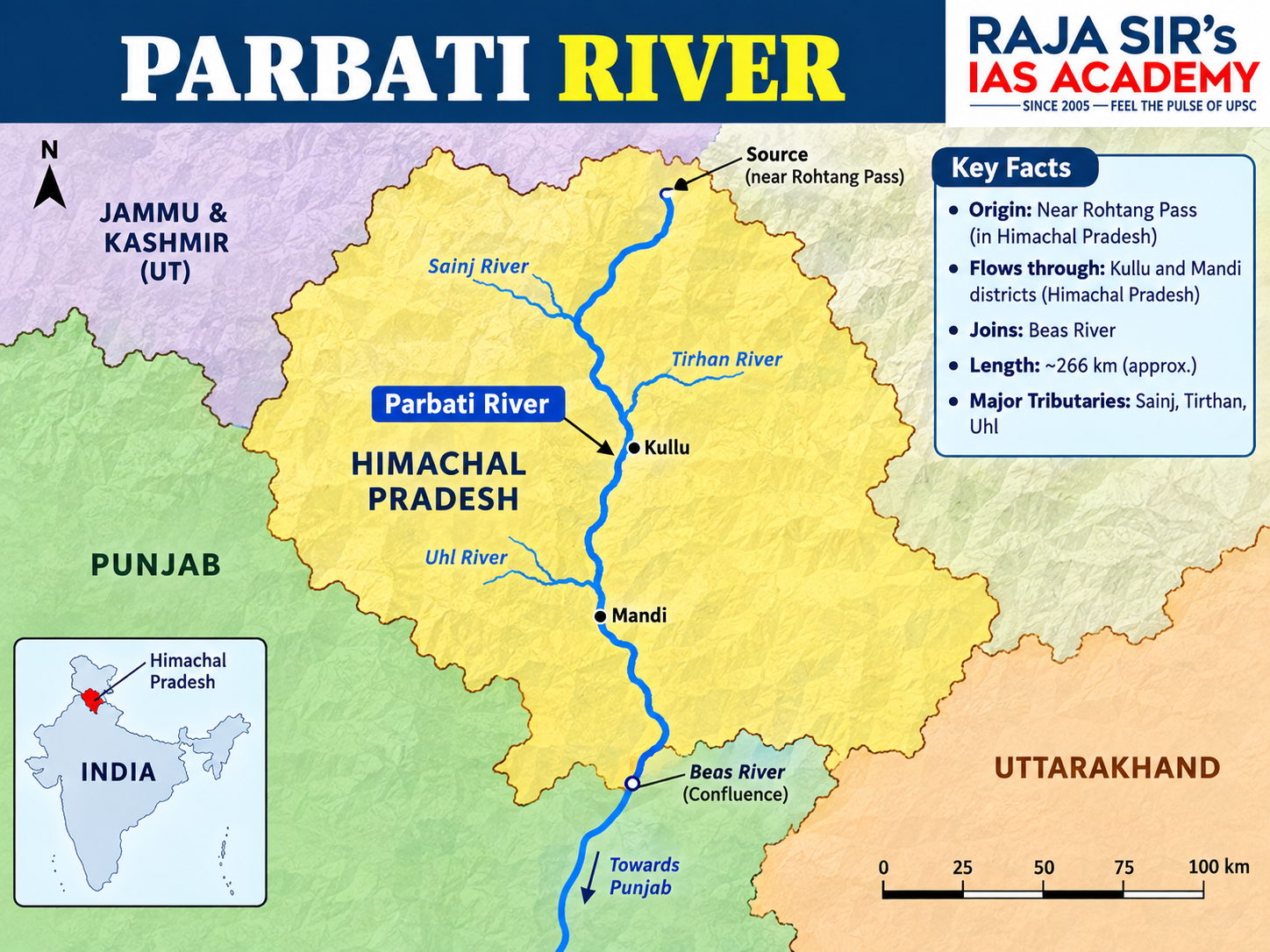
Leakage from the Parbati-II Hydroelectric Project in Himachal Pradesh''s Kullu district affected nearby settlements and agricultural land.
Project Profile
- Location: Kullu, Himachal Pradesh
- River: Parbati
- Tributary of: Beas
- Type: Run-of-the-river
- Capacity: 800 MW
- Dam: 83.7 m concrete gravity dam
- Head Race Tunnel: 31.56 km
- Developer: NHPC
NHPC Limited
- Full Form: NHPC Limited (originally National Hydroelectric Power Corporation)
- Established: 1975
- Ministry: Ministry of Power
- Nature: Central Public Sector Enterprise (CPSE)
- Headquarters: Faridabad, Haryana
- Primary role: Development and operation of hydropower and renewable-energy projects.
Key Challenges
- Geological instability: Young and tectonically active Himalayan terrain is vulnerable to landslides and slope failures.
- Extreme weather: Cloudbursts, intense rainfall, floods and glacial hazards can increase infrastructure risks.
- Tunnel uncertainty: Long tunnels can encounter unforeseen geological conditions, groundwater pressure and seepage.
- Downstream impacts: Altered flow regimes can affect aquatic ecosystems, sediment movement and local livelihoods.
- Cumulative risk: Multiple dams, tunnels, roads and transmission infrastructure can produce impacts greater than those assessed project-by-project.
- Human vulnerability: Settlements and agricultural land located downstream or near project infrastructure can face heightened exposure.
|
|
Pilibhit Tiger Reserve: Terai Ecology and Transboundary Conservation
GS III Environment
Why in News?
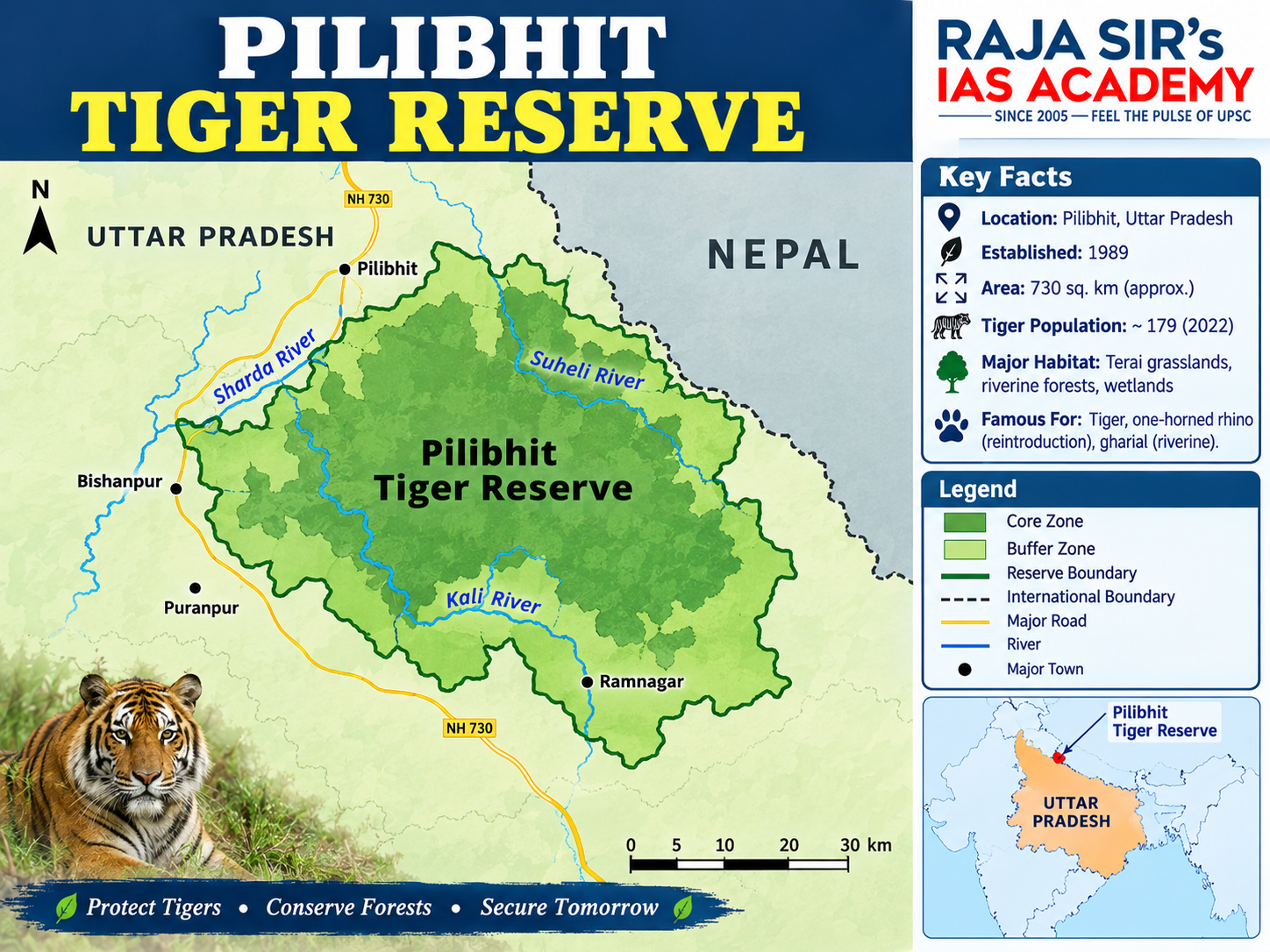
Tourism access to the Pilibhit Tiger Reserve has been extended, allowing visitors to access the reserve for a longer period.
Location
- Located in Uttar Pradesh, primarily across Pilibhit and Lakhimpur Kheri districts.
- Forms part of the Terai Arc Landscape (TAL).
- Located along the India–Nepal border, making landscape connectivity important for wildlife conservation.
Ecological Significance
- Important habitat for tigers and other Terai fauna.
- Characterised by Sal-dominated forests, grasslands and wetlands.
Supports species such as:
|
Species
|
Scientific Name
|
IUCN Status
|
Key Information
|
|
Tiger
|
Panthera tigris
|
Endangered (EN)
|
Apex predator; found across parts of Asia; India has the world''s largest wild tiger population
|
|
Swamp Deer
|
Rucervus duvaucelii
|
Vulnerable (VU)
|
Also called Barasingha; associated with grasslands and wetlands; Kanha is an important habitat
|
|
Hog Deer
|
Axis porcinus
|
Endangered (EN)
|
Small deer associated with grasslands and floodplains; found in parts of South and Southeast Asia
|
|
Leopard
|
Panthera pardus
|
Vulnerable (VU)
|
Highly adaptable big cat; occurs in forests, grasslands and human-dominated landscapes
|
|
Bengal Florican
|
Houbaropsis bengalensis
|
Critically Endangered (CR)
|
Rare grassland bird; found mainly in Terai grasslands and Brahmaputra floodplains
|
Hydrological Importance
- The reserve forms part of an important Terai river and wetland system.
- It is associated with rivers and streams including the Sharda, Mala and Khannot.
- The Gomti River originates in the Pilibhit region, making the landscape significant from a watershed perspective.
|
|
Reformed Multilateralism: Creating Space Between Polarisation and Fragmentation
GS II International relations
Why in News?
The Partners for Multilateralism (P4M) summit was held on the sidelines of the UN General Assembly in September 2026. It brings together countries seeking flexible cooperation across geopolitical divisions and supporting reforms in multilateral institutions.
What is P4M?
- Partners for Multilateralism (P4M) is a flexible, network-based platform that seeks to strengthen multilateral cooperation and promote reforms in global institutions.
- It is not intended to function as a rigid geopolitical bloc. Instead, it promotes cooperation among countries on common global issues while supporting the existing multilateral system.
|
Area
|
Focus
|
|
Multilateral Reform
|
Make global institutions more effective, representative and inclusive
|
|
International Law
|
Uphold the UN Charter, sovereign equality and peaceful settlement of disputes
|
|
Global Challenges
|
Cooperation on climate change, AI, global health and sustainable development
|
|
Economic Cooperation
|
Resilient supply chains and reform of the international financial architecture
|
|
Peace & Security
|
Strengthen international cooperation and conflict prevention
|
Why is it Important for India?
- Global South Representation: Provides an additional platform to advocate greater representation of developing countries.
- UNSC Reform: Supports India''s broader demand for reform of the UN Security Council and more representative global governance.
- Global Financial Reform: Creates space to push for reforms in international financial institutions.
- Strategic Autonomy: Allows India to engage with different countries through issue-based coalitions rather than fixed geopolitical alignments.
- Rules-Based Order: Supports India''s interest in a predictable international system based on international law and multilateral institutions.
|
Old Model
|
Emerging Model
|
|
Rigid geopolitical blocs
|
Flexible coalitions
|
|
Alliance-driven cooperation
|
Issue-based cooperation
|
|
Fixed partners
|
Variable partnerships
|
|
Geopolitical polarisation
|
Pragmatic multilateralism
|
|
Alignment around power blocs
|
Cooperation based on shared interests
|
|
Example: Cold War-era bloc politics
|
Example: P4M-type flexible cooperation
|
|
|
Scrub Typhus: The Neglected Vector-Borne Disease Beyond Mosquitoes
Why in News?
A recent death in Tamil Nadu has brought attention to scrub typhus, an important but often under-recognised febrile illness.
What is Scrub Typhus?
- Scrub typhus is a bacterial infection caused by Orientia tsutsugamushi.
- It is transmitted through the bite of infected larval mites called chiggers.
- It is associated with vegetated, scrub and rural environments, particularly where humans come into contact with mite habitats.
Symptoms
- Fever
- Headache
- Muscle/body pain
- Rash
- Enlarged lymph nodes
- Eschar: a dark, scab-like lesion that may develop at the site of the mite bite.
Severe disease may cause:
- Acute respiratory distress syndrome (ARDS)
- Shock
- Meningitis
- Kidney failure
- Multi-organ complications.
|
Aspect
|
Details
|
|
Causative agent
|
Orientia tsutsugamushi
|
|
Vector
|
Chigger (larval mite)
|
|
Reservoir
|
Small mammals, particularly rodents, are important hosts
|
|
Habitat
|
Vegetation, scrubland and areas with mite populations
|
|
Geographical region
|
Mainly Asia-Pacific, including India
|
|
Incubation
|
Usually around 6–21 days
|
Treatment
|
Feature
|
Doxycycline
|
Azithromycin
|
|
Drug class
|
Tetracycline antibiotic
|
Macrolide antibiotic
|
|
Role in scrub typhus
|
Commonly used first-line treatment
|
Important alternative treatment
|
|
Particularly useful
|
Standard treatment in many patients
|
Useful when doxycycline is unsuitable, including pregnancy/children in appropriate clinical settings
|
|
Target
|
Orientia tsutsugamushi
|
Orientia tsutsugamushi
|
|
Disease
|
Causative Organism
|
Vector
|
|
Scrub Typhus
|
Orientia tsutsugamushi
|
Chiggers (larval mites)
|
|
Epidemic Typhus
|
Rickettsia prowazekii
|
Body lice
|
|
Murine Typhus
|
Rickettsia typhi
|
Fleas
|
|