



 Latest News
APRIL 06, 2026 Current Affairs
Gujarat Passes Uniform Civil Code (UCC) Bill, 2026
- Gujarat Legislative Assembly passed the Uniform Civil Code (UCC) Bill, 2026, making it the second Indian state after Uttarakhand to enact a UCC.
- Coverage: The code replaces diverse religious statutes with a standardised civil framework for marriage, divorce, and inheritance.
- Gender Parity: It mandates that sons and daughters hold identical legal rights regarding the inheritance of all property.
- Registration Deadline: All marriages must be officially registered within 60 days, and live-in relationships within 30 days.
- Monogamous Mandate: The legislation strictly prohibits polygamy and bigamy, enforcing a one-spouse rule across all faith groups.
- Judicial Exclusivity: All separations must be processed through civil courts, effectively abolishing all forms of out-of-court or customary divorce.
- Tribal Exemption: The state’s Scheduled Tribes are exempted from the code’s application to protect their specific customary identities.
About Uniform Civil Code (UCC)
- Constitutional Mandate: Article 44 of the Directive Principles of State Policy (DPSP) places a non-justiciable directive on the State to secure a uniform civil code nationwide.
- Rights Conflict: UCC seeks to resolve the conflict between Article 25 (Religious Freedom) and Article 14 (Equality before Law) through uniform civil procedures.
- Judicial Consistency: Courts have consistently endorsed a UCC from Shah Bano (1985) to recent 2026 rulings as central to secular national identity.
- First State: Uttarakhand became the first state to pass its own UCC legislation in 2024.
Right to be Considered for Promotion
- The Punjab & Haryana High Court has reaffirmed that government employees have a fundamental right to be considered for promotion.
- Constitutional Basis: The right is derived from Articles 14 & 16(1) ensuring equality and equal opportunity in public employment.
- There is no fundamental right to actual promotion, only a right to be evaluated.
Kulwant Singh Case
- A junior engineer was excluded from a DPC due to a misinterpretation of eligibility rules, denying him consideration for promotion.
- The P&H High Court held this as a violation of his fundamental right to be considered for promotion.
- The Court ordered notional retrospective promotion and mandated regular DPC meetings.
Key Supreme Court Principles
- In Ajit Singh vs State of Punjab (1999), the SC recognised the right to be considered for promotion.
- In Bihar State Electricity Board vs Dharamdeo Das (2024), the court reaffirmed that consideration does not mean guaranteed promotion.
- Departmental Promotion Committees are official panels that assess eligible employees for promotion based on merit, seniority, and service rules.
Challenges in Implementation of the Right to be Considered for Promotion
- Administrative Delays: Irregular DPC meetings prevent the timely consideration of eligible employees.
- Procedural Lapses: Errors in interpreting eligibility or in record-keeping lead to wrongful exclusion from promotion processes.
- Bureaucratic Inefficiency: Lack of coordination & accountability within departments delays decision-making.
- Arbitrary Decisions: Discretionary or biased actions by authorities can undermine fair consideration.
- Lack of Monitoring Mechanisms: Absence of strict oversight systems allows violations of the right.
Strengthening of the Right to be Considered for Promotion
- Regular DPCs: Time-bound & periodic Departmental Promotion Committee meetings to avoid delays.
- Transparent Systems: Use digital tracking and clear eligibility criteria to minimise errors and arbitrariness.
- Monitoring: Strengthen oversight mechanisms and fix responsibility for administrative lapses.
- Grievance Redressal: Establish efficient grievance mechanisms for timely correction of violations.
Parliament Passed Andhra Pradesh Reorganisation (Amendment) Bill, 2026
- Parliament passed the Andhra Pradesh Reorganisation (Amendment) Bill, 2026, to designate Amaravati as the sole and permanent capital of Andhra Pradesh.
- Amendment: It replaces placeholder text in Section 5(2) of the Andhra Pradesh Reorganisation Act, 2014, with “Amaravati shall be the capital.”
- Historical Precedent: This marks the first instance where Parliament has enacted a law explicitly naming a specific city as a state capital.
- Retrospective Effect: The amendment is deemed effective from 2 June 2024, ensuring continuity after Hyderabad ceased to be the joint capital.
- Joint Capital: Hyderabad served as the common capital of Andhra Pradesh and Telangana from June 2, 2014, to June 2, 2024.
- Policy Override: The Bill nullifies the earlier “three-capital” model proposing Visakhapatnam as executive, Kurnool as judicial, and Amaravati as legislative capital.
India and Azerbaijan Initiate Diplomatic Reset
- India and Azerbaijan initiated a diplomatic reset following years of strained relations triggered by Operation Sindoor.
- Condemnation: Azerbaijan condemned India’s military action in Operation Sindoor as part of the “Three Brothers” alliance with Turkey and Pakistan.
- Armenia Factor: Relations were further complicated by India’s deepening defence ties with Armenia, Azerbaijan’s adversary.
Overview of India-Azerbaijan Relations
- Trade: India is currently Azerbaijan’s seventh-largest trading partner, with bilateral trade reaching a peak of $1.88 billion in 2022.
- Trade Skew: Historically, the balance of trade is heavily skewed in favour of Azerbaijan due to India’s significant imports of crude oil.
- Key Export: Basmati rice, pharmaceuticals, machinery, and electronics.
- Key Import: Crude oil accounts for roughly 98% of total imports.
- Strategic Role: Azerbaijan serves as India’s gateway to the South Caucasus and a key node in the International North-South Transport Corridor (INSTC).
- OVL Stakes: ONGC Videsh Ltd (OVL) holds a ~2.9% stake in the ACG oil fields and a ~3.1% stake in the Baku-Tbilisi-Ceyhan (BTC) pipeline.
- Strategic Divergence: Azerbaijan’s “Three Brothers” alliance with Pakistan and Turkey, and India’s defence ties with Armenia.
- Historical Link: 18th-century Ateshgah Fire Temple near Baku features stone inscriptions in Devanagari and Gurmukhi.
USA Imposes Tariff on Imported Patented Drugs and Active Ingredients
- President Trump invoked Section 232 of the Trade Expansion Act to impose a 100% ad valorem duty on imported patented drugs and active ingredients.
- National Security: The administration cited dependence on foreign-made patented drugs (53%) and active ingredients (85%) as a threat to the U.S. supply chain.
- Compliance Timeline: Large firms have 120 days (until July 31, 2026) and smaller firms 180 days to reach compliance agreements before full tariffs apply.
- Pricing Safe-Harbour: Companies can secure a 0% tariff until 2029 by entering Most Favoured Nation pricing deals and committing to onshore production.
- Generic Exemption: Non-patented generic medicines and biosimilars remain exempt, though the Secretary of Commerce will reassess this status within one year.
- Medical Carve-outs: Orphan drugs and cell therapies are excluded to prevent shortages of critical speciality treatments.
- Indian Insulation: 90% of India’s shipments to the U.S. are low-cost generics, which are excluded from this tariff.
| Ad valorem duty is an import tax calculated as a fixed percentage of a product’s total assessed value. |
NATO (North Atlantic Treaty Organization)
- U.S. President Donald Trump described NATO as a paper tiger and stated that withdrawing U.S. membership is now beyond reconsideration.
About NATO (North Atlantic Treaty Organization):
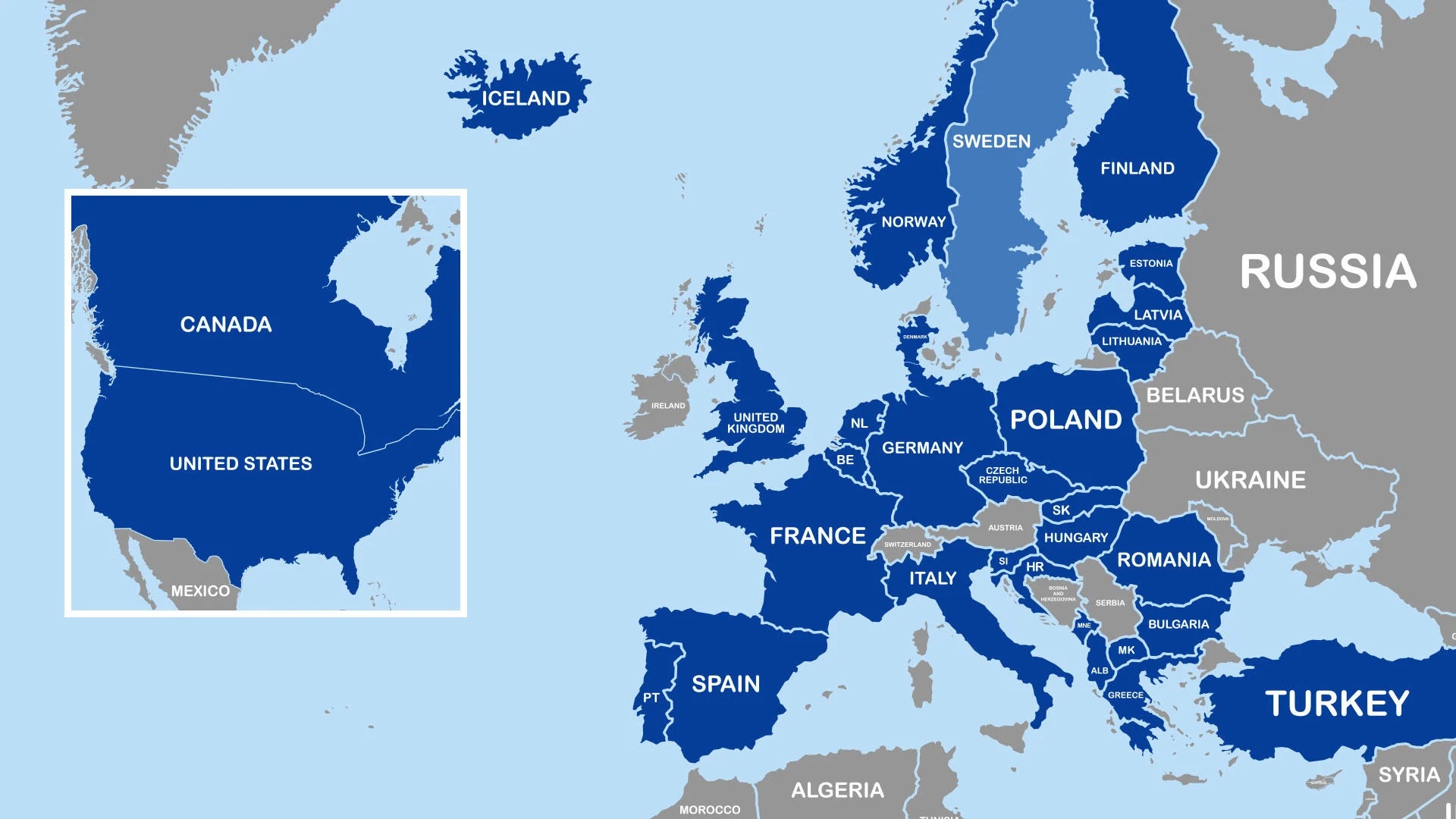
- NATO is a 32-nation intergovernmental military alliance based on the North Atlantic Treaty. it serves as a system of collective defense where its independent member states agree to mutual defense in response to an attack by any external party.
Established In:
- Date: April 4, 1949.
- Headquarters: Brussels, Belgium.
Background:
- NATO was created in the aftermath of World War II to provide security against the perceived threat posed by the Soviet Union.
- As pro-Soviet Communist regimes were installed across Eastern Europe and China, the U.S., Canada, and 10 Western European nations sought a unified front to prevent further Soviet expansion.
- Following the collapse of the USSR, the alliance expanded to include many former Eastern Bloc countries.
Aim:
- The primary aim is defined in Article 5, which states that an attack against one member is considered an attack against all.
- To promote democratic values and enable members to consult and cooperate on issues related to defense and security.
- To provide a deterrent against potential aggressors through a unified command structure.
Members:
- Currently, there are 32 member countries.
- Founding Members: Include the U.S., UK, France, Canada, and Italy.
- Recent Additions: Following Russia’s 2022 invasion of Ukraine, Finland (2023) and Sweden (2024) joined the alliance, significantly shifting the security landscape of Northern Europe.
Key Functions:
- Command Structure: While NATO has no independent army, members contribute personnel and resources to a unified command called SHAPE (Supreme Headquarters Allied Powers Europe), usually led by a U.S. 4-star General.
- Joint Operations: Historically, NATO has conducted missions in the Balkans (1990s), and Afghanistan (2001).
- Nuclear Umbrella: The U.S. provides a nuclear deterrent for European allies who do not possess their own nuclear weapons.
- Defense Spending: Members are expected to contribute to the alliance’s budget; at the 2025 Hague Summit, members agreed to raise spending to 5% of their GDP by 2035.
Significance:
- NATO has been the backbone of the Western security architecture for over 75 years, ensuring stability in Europe.
- It remains the primary counterweight to Russian influence in Eurasia.
- The alliance has traditionally been the vehicle through which the U.S. projects power and maintains its nuclear umbrella over the Western world.
The United Arab Emirates (UAE)
- The UAE has officially backed Bahrain’s call for the UN Security Council to intervene in the Strait of Hormuz crisis, labeling the near-blockage of the waterway a direct threat to global stability.
About The United Arab Emirates (UAE):
- The UAE is a federation of seven emirates (Abu Dhabi, Dubai, Sharjah, Ajman, Umm Al Quwain, Ras Al Khaimah, and Fujairah) located in the southeast of the Arabian Peninsula. Established in 1971, it has transformed from a quiet desert region into a global hub for finance, tourism, and energy.
Location and Borders:
- Region: Middle East/West Asia.
- Capital: Abu Dhabi (The largest and wealthiest of the seven emirates).
Bordering Nations:
- Saudi Arabia: To the west and south.
- Oman: To the east and northeast.
- Coastline: It has a long coastline along the Persian Gulf (North) and a shorter coast along the Gulf of Oman (East).
Key Geological Features:
- Desert Landscape: Over 80% of the UAE’s land is part of the Rub’ al Khali (Empty Quarter), characterized by rolling sand dunes and arid plains.
- Al Hajar Mountains: Located in the east, these rugged mountains separate the coastal plain from the interior desert and provide a cooler climate and seasonal water run-off.
- Sabkha (Salt Flats): Extensive coastal salt flats, particularly in the western regions of Abu Dhabi, formed by the evaporation of seawater.
- Coral Reefs and Islands: The UAE possesses numerous offshore islands and a complex marine ecosystem in the Persian Gulf, vital for biodiversity.
- Hydrocarbon Deposits: Geologically, the UAE sits atop some of the world’s largest oil and gas reserves, primarily concentrated in the Emirate of Abu Dhabi.
Significance:
- The UAE is a key member of OPEC and a top global exporter of oil. Its proximity to the Strait of Hormuz makes its economic stability inseparable from maritime security.
- With ports like Jebel Ali and airports in Dubai and Abu Dhabi, it serves as a critical bridge between Europe, Asia, and Africa.
- The UAE is a leader in the Global South and the Arab world, often mediating regional conflicts and hosting major international summits
Major Indian Ports Handled over 915 MT of Cargo in FY2025-26
- Major ports handled a record 915.17 million tonnes (MT) of cargo in FY2025-26, exceeding the 904 MT target with a 7.06% year-on-year increase.
- Top Performers: Deendayal Port (Gujarat) led major ports with 160.11 MT, followed by Paradip Port (Odisha) and JNPA (Maharashtra).
- Growth Leader: Mormugao Port (Goa) recorded the highest growth rate among major ports at 15.91%.
- Efficiency Metrics: Average vessel turnaround at major ports improved to 48.86 hours. JNPA led the container segment at 23.82 hours.
- Cargo Handled: Non-Major Ports handled an estimated 739 MT, bringing India’s total cargo volume to over 1,654 MT.
- Capacity Expansion: India’s total port capacity reached 2,762 MTPA, comprising 1,617 MTPA at Major Ports and 1,145 MTPA at Non-Major Ports.
- Maritime Amrit Kaal Vision 2047 aims to raise India’s total port capacity to 10,000 MTPA by 2047, quadrupling the current level.
Strategic Growth Drivers of Indian Port Sector
- Digital Integration: NLP-Marine (National Logistics Portal) and the Sagar-Setu app slashed gate-in times by digitising all port-led documentation.
- Connectivity Focus: PM Gatishakti National Master Plan integrated 101 port-connectivity projects, removing chronic last-mile bottlenecks for hinterland cargo flow.
- Regulatory Autonomy: Major Port Authorities Act granted port boards greater autonomy over land leasing and asset monetisation decisions.
- Logistics Efficiency: Direct Port Delivery (DPD) bypassed traditional inland container depots, saving shippers up to ₹5,000 per container.
- Infrastructure Privatisation: PPP models for 100% berth mechanisation at major hubs reduced bulk handling losses and improved loading speeds.
- Performance Incentives: Sagar Aankalan guidelines pushed major ports toward global benchmarks, achieving record daily berth productivity.
Challenges in India’s Maritime Sector
- Modal Imbalance: Road handles 60% of hinterland cargo despite rail being six times more economical, inflating overall port logistics costs.
- Draft Limitations: Shallow 14-metre channels at major ports divert 75% of India’s transhipment cargo to foreign hubs like Colombo or Singapore.
- Turnaround Gap: The average vessel turnaround of 48 hours remains four times slower than leading global benchmarks.
- Fleet Dependency: Inadequate domestic ship ownership drains $75 billion annually in freight payments to foreign-flagged vessels.
- Evacuation Logjam: Unfinished rail-linked projects under PM Gatishakti National Master Plan leave 25% of planned port-to-hinterland infrastructure incomplete.
Govt. Initiatives for India’s Port Sector
- Fleet Modernisation: Green Tug Transition Programme (GTTP) replaces diesel harbour tugs with hybrid-electric models, targeting 50% green tug coverage by 2030.
- Fund Outlay: Maritime Development Fund (MDF) provides ₹25,000 crore in low-cost, long-term financing for domestic shipbuilding and port-led industrialisation.
- Operational Standardisation: One Nation-One Port (ONOP) standardises operational and data protocols to eliminate procedural variations for global shipping lines.
- Tourism Expansion: Cruise Bharat Mission expands international sea cruise terminals from 2 to 10 to double passenger traffic to 1 million by 2029.
- Sustainable Bunkering: Harit Sagar Guidelines and the National Green Hydrogen Mission construct green hydrogen and ammonia bunkers at major ports to supply sustainable fuel.
Plastic Waste Management (Amendment) Rules, 2026
- Government has notified the amendment to the Plastic Waste Management Rules, 2016.
- Objective: The amendment aims to promote a circular economy by mandating recycled plastic use, strengthening compliance, improving transparency, and reducing plastic pollution.
Key Provisions of the Plastic Waste Management (Amendment) Rules, 2026
- Recycling Targets: The amendment mandates progressively increasing recycled plastic content in packaging, especially for rigid plastics (30% to 60% by 2028–29).
- Mandatory Recycled Content: Producers must use recycled plastic in packaging, making circularity legally binding.
- Carry-Forward of Targets: Companies can carry forward unmet recycling targets for up to three years, instead of strict annual compliance.
- Tradable Plastic Certificates: The amendment formalises a tradable certificate system, allowing companies to purchase credits from those exceeding targets.
- End-of-Life Disposal: The rules allow burning and other end-of-life disposal methods such as waste-to-energy, co-processing, and waste-to-oil conversion.
- Category-Based Classification: Plastics are classified into rigid (easy to recycle), flexible, and multi-layered (hardest to recycle) with separate compliance targets.
Plastic Waste Management Rules, 2016
- Legal Basis: Notified under the Environment (Protection) Act, 1986, providing statutory backing for plastic waste regulation in India.
- Objective: To minimise plastic waste generation, promote recycling and reuse, and ensure environmentally sound disposal of plastic waste.
- Extended Producer Responsibility: Introduces EPR, making producers, importers, and brand owners responsible for the collection and management of plastic waste.
- Waste Segregation: Mandates segregation of waste at source & establishment of collection systems.
- Single-Use Plastics Ban: The 2022 Amendment to the rules prohibited identified single-use plastic.
- Role of Local Bodies: Urban and rural local bodies are responsible for segregation, collection, processing, and disposal of plastic waste.
India Commissions Nuclear-Powered Submarine INS Aridaman
- Indian Navy commissioned the indigenous, nuclear-powered ballistic missile submarine INS Aridaman and the stealth frigate INS Taragiri at Visakhapatnam.
- INS Taragiri is the fourth stealth guided-missile frigate of the Nilgiri-class under Project 17A, built with over 75% indigenous content.
About INS Aridaman
- INS Aridaman (or INS Aridhaman) is India’s 3rd indigenous Ship Submersible Ballistic Nuclear (SSBN).
- It is an upgraded version of the Arihant-class submarine, succeeding INS Arihant and INS Arighaat.
- The submarine was built at the Ship Building Centre (SBC) in Visakhapatnam as part of the Advanced Technology Vessel (ATV) programme.
- ATV Project began in the 1980s to develop India’s indigenous SSBN fleet, with technical assistance from Russia, and is managed by DRDO, the Department of Atomic Energy (DAE), and the Indian Navy.
- Displacement: It has a larger hull displacing ~7,000 tonnes, allowing heavier payloads and longer underwater endurance.
- Propulsion: Uses an upgraded 83 MW pressurised compact light-water reactor (CLWR), allowing quiet operation, better stealth, and survivability.
- Armament: 8 Vertical Launch System (VLS), double the capacity of its predecessors; can carry 24 K-15 (~750 km range) or 8 K-4 (~3,500 km range) ballistic missiles.
Significance for India
- Nuclear Triad: Induction completes India’s Nuclear Triad, allowing nuclear weapon delivery from land, air, and sea.
- Second Strike Capability: Enables a sustained underwater presence for retaliation, supporting India’s “No First Use” (NFU) doctrine.
- Deterrence: Extended missile range and payload capacity strengthen India’s deterrence in the Indian Ocean Region and the Indo-Pacific.
- Global Status: India joins a select group of nations with a fully operational nuclear triad, including the USA, Russia, and China.
India’s Three Nuclear-Powered Submarines
| Submarine | Displacement | Armament | Significance |
| INS Arihant (2016) | ~6,000 tonnes 4 VLS; | 12 K-15 or 4 K-4 | First indigenous SSBN |
| INS Arighaat (2024) | ~6,000 tonnes 4 VLS; | 12 K-15 or 4 K-4 | Enhanced survivability and stealth |
| INS Aridaman (2026) | ~7,000 tonnes 8 VLS; | 8 K-4 or 24 K-15 | Doubles missile capacity |
About Nuclear Submarines
- Nuclear submarines use pressurised water reactors, allowing long endurance without surfacing, unlike diesel-electric subs that rely on batteries.
Primary Classifications:
- SSBNs carry nuclear-tipped ballistic missiles, designed for stealth deployment to ensure a nuclear deterrence capability.
- Ship Submersible Nuclear (SSN) are fast-attack submarines carrying torpedoes and cruise missiles, for anti-submarine and carrier protection roles.
- Ship Submersible Guided Missile Nuclear (SSGN) carry large cruise missiles, enabling precision land-attack missions from underwater platforms.
Multi-Hazard Early Warning Decision Support System (MHEW-DSS)
- Context (PIB): Multi-Hazard Early Warning Decision Support System (MHEW-DSS) under the Ministry of Earth Sciences (MoES) represents a transformation in India’s approach to weather forecasting.
- It is an integrated digital platform delivering real-time, impact-based weather alerts across India.
- Developer: India Meteorological Department (IMD) built it under the Mission Mausam to modernise weather forecasting infrastructure.
- Data Integration: It integrates satellites, radars, and weather station datasets into a single WebGIS-based platform to generate colour-coded warnings.
- Impact Modelling: Advanced algorithms convert weather data into sector-specific risks for agriculture, health, transport, and energy systems.
- Hyper Granularity: It delivers forecasts for over 1.5 lakh pin codes and 6.2 lakh villages via the Mausamgram portal.
- Dissemination: The dashboard uses Common Alerting Protocol (CAP) to send real-time alerts via SMS, WhatsApp, and Mausam App.
Significance of MHEW-DSS
- Automation: MHEW-DSS automates over 90% of data processing and quality checks, reducing manual intervention and forecast delays.
- Time Efficiency: Streamlined workflows have cut forecast preparation time from 6 hours to 3 hours.
- Precision: The system uses improved numerical models to increase forecast accuracy by 30% and extend lead times to 7 days.
- Regional Coordination: It facilitates data sharing with 12 nations, serving as a centralised hub for North Indian Ocean and Asia Pacific weather safety.
United Nations Interim Force in Lebanon (UNIFIL)
- India condemned the killing of three Indonesian peacekeepers deployed under the United Nations Interim Force in Lebanon (UNIFIL).
- United Nations Security Council (UNSC) created UNIFIL in 1978 to oversee the withdrawal of Israeli forces from southern Lebanon and to restore peace.
- Core Mandate: Under UNSC Resolution 1701, UNIFIL monitors ceasefire, patrols the Blue Line, and ensures humanitarian access for civilians.
- India’s Role: India is the fourth-largest contributor of troops to UNIFIL.
- Timeline: UNSC has extended its mandate for the final time, aiming for withdrawal by the end of 2026.
- Blue Line is a UN-established temporary boundary between Lebanon and Israel, created in 2000 to verify the withdrawal of Israeli Forces.
FAO Food Price Index
- The FAO Food Price Index (FFPI) increased by 2.4% in March, driven by rising energy costs amid escalating Middle East conflict.
- FAO: Food and Agriculture Organisation, headquartered in Rome, is a UN agency founded in 1945 to combat hunger and promote sustainable agriculture.
- FFPI measures monthly international export price changes of key food commodities, reflecting food security and inflation trends.
- Methodology: It uses a trade-weighted Laspeyres formula, combining export prices of 24 basic food commodities with the base period set as 2014–2016.
- Composition: The index has five sub-indices — Cereals, Vegetable Oils, Dairy, Meat, and Sugar, weighted by their importance in global export trade.
Project Chetak
- Border Roads Organisation (BRO) marked the 47th Raising Day of Project Chetak in Bikaner, Rajasthan.
- Project Chetak manages, develops, and maintains over 4,000 km of roads and 214 km of Ditch-cum-Bund for defence infrastructure.
- It is one of the largest BRO projects, stretching across Rajasthan, Punjab, and northern Gujarat along India’s western border.
- Key Infrastructure: The permanent Kasowal Bridge (484 m) over Ravi River in Punjab offers all-weather connectivity to the region.
- Strategic Roads: Over 300 km of desert roads are being upgraded to National Highway standards, including double lanes, to handle heavier traffic.
- Significance: It provides logistical support to the Armed Forces through feeder roads to the International Border, while strengthening regional development and tourism.
- BRO, established in 1960, is India’s leading executive agency for constructing and maintaining strategic roads in remote border areas. It operates under the Ministry of Defence.
Calcium Carbide
- Hyderabad police and municipal authorities have begun inspections on the use of calcium carbide for artificial mango ripening.
- Calcium carbide is a greyish-black industrial chemical used in welding but exploited as a cheap, quick artificial fruit-ripening agent.
- Ripening Mechanism: It reacts with moisture to release acetylene gas, which imitates ethylene, the natural fruit-ripening hormone.
- Health Hazards: Commercial-grade calcium carbide contains arsenic and phosphorus, causing vomiting, ulcers, neurological disorders, and increased cancer risk.
- Regulation: India prohibits its use for fruit ripening under the Food Safety and Standards (Prohibition and Restriction on Sales) Regulations, 2011.
- Alternatives: FSSAI allows ethylene gas up to 100 ppm; Ethephon 39% Soluble Liquid (SL) is also approved, providing more uniform and natural ripening than carbide.
- Food Safety and Standards Authority of India (FSSAI), established under the Food Safety and Standards Act, 2006, is the top food regulator, operating under the Ministry of Health & Family Welfare.
Stagflation
- The ongoing conflict between the US-Israel and Iran in April 2026 has triggered a pernicious energy supply and price shock, leading to fears of a return to 1970s-style stagflation.
About Stagflation:
- Stagflation is a rare and challenging economic condition characterized by the simultaneous occurrence of stagnant economic growth (or recession), high unemployment, and high inflation.
- The term, coined by British politician Iain Macleod, describes the worst of both worlds, where prices rise rapidly even as the economy shrinks or stalls.
How It Occurs?
- Stagflation typically arises from a negative supply shock.
- In a normal economy, prices and quantity move along a curve. However, during a shock (like a war or pandemic), the entire supply curve shifts to the left.
- This shift means that at the same price level, producers can only supply a smaller quantity of goods (Q1 instead of Q0) due to higher input costs or broken logistics.
- The result is a new equilibrium where the price is higher (P1), but the actual output/growth is lower.
Factors Impacting Stagflation:
- Energy Supply Disruptions: Sudden stoppages in oil or gas (e.g., closure of the Strait of Hormuz) create sudden stops in industrial activity.
- Input Cost Surges: Rapid increases in the price of raw materials, petrochemical feedstocks, and fertilizers (crucial for modern Indian agriculture).
- Supply Chain Breakages: Wars and geopolitical tensions that physically block trade routes rather than just increasing the price of transit.
- Monetary Policy Lag: When central banks are slow to react or have already exhausted their ammunition (low interest rates) before the shock hits.
Features of Stagflation:
- Low/Negative GDP Growth: As seen in 1974, when the US and UK saw growth rates of -0.5% and -1.7% respectively.
- Double-Digit Inflation: Concurrent with low growth, consumer price inflation often exceeds 10% (reaching as high as 24.2% in the UK in 1975).
- High Unemployment: Stagnant growth leads to business closures (especially MSMEs) and job losses.
- Ineffectiveness of Traditional Tools: Normal textbook fixes for inflation usually worsen stagnation, and vice-versa.
Methods to Control Stagflation:
- Supply-Side Reforms: Since stagflation is a supply-side problem, the primary solution is restoring broken supply chains and increasing production capacity.
- Energy Diversification: Shifting away from volatile fossil fuels toward renewables or electric cooking/transport to insulate the economy from oil shocks.
- Targeted Fiscal Support: Providing specific relief to vulnerable sectors (like MSMEs or farmers) rather than broad-based stimulus which could fuel further inflation.
- Balanced Interest Rate Hikes: Central banks must carefully raise rates to anchor inflation expectations without choking what little growth remains in the economy.
Tar Balls Management Rules, 2026
- The Ministry of Environment, Forest, and Climate Change has released the draft Tar Balls Management Rules, 2026, to protect India’s coastline from oil spills.
About Tar Balls:
- Tar balls are small, dark, sticky, or hardened blobs of weathered crude oil found floating on the ocean surface or washed ashore on beaches. They are essentially the remnants of oil that has undergone physical and chemical changes due to environmental exposure.
Chemical Composition:
Hydrocarbons: Primarily heavy, high-molecular-weight compounds like paraffins and aromatics.
Asphaltenes: These provide the characteristic black color and sticky texture.
Impurities: They often trap sand, shells, seaweed, and microplastics as they roll along the ocean floor or beach.
Sulfur and Metals: Trace amounts of nickel and vanadium are often present, depending on the source of the crude oil.
How They Are Formed?
The formation of tar balls is a result of a process called weathering:
Oil Release: It begins with an oil spill from ships, offshore platforms, or natural oil seeps on the ocean floor.
Evaporation & Dissolution: Lighter components of the oil evaporate into the air or dissolve in water.
Emulsification: The remaining heavy oil mixes with seawater to form a thick, mousse-like emulsion.
Fragmentation: Wind and waves break this thick oil into smaller pieces.
Solidification: As the lighter fractions continue to leave, the residue hardens into sticky, dense spheres (tar balls) that are carried by currents to the shore.
Key Features:
Persistence: They are highly resistant to environmental degradation and can remain in the marine environment for a long time.
Size Variability: They can range from the size of a coin to that of a basketball.
Seasonal Presence: In India, they are most prominent on the western coast (Gujarat to Goa) between April and September due to south-westerly winds and currents.
Sticky Texture: When fresh, they are soft and tacky, but they can become hard and crusty over time as they incorporate sand and debris.
Implications:
- Seabirds, fish, and sea turtles often mistake tar balls for food. Ingestion can lead to internal poisoning, while external coating can impair a bird’s ability to fly or swim.
- They can smother coral reefs and seagrass beds, disrupting local marine habitats.
- Accumulation on beaches reduces the aesthetic value of coastal destinations, impacting the tourism industry in states like Goa.
The Indian Crested Porcupine
- Kashmir’s red gold (Saffron) is under severe threat as the Indian crested porcupine has begun devouring saffron corms (underground bulbs) in the Pampore highlands.
About The Indian Crested Porcupine:
- The Indian crested porcupine (Hystrix indica) is a large, nocturnal rodent belonging to the Old World porcupine family. It is characterized by its coat of sharp quills, which serve as a highly effective defense mechanism against predators. In Kashmir, it has recently emerged as a significant agricultural pest, specifically targeting the roots and bulbs of high-value crops.
Habitat:
- Geographic Range: Found throughout Southern Asia and the Middle East, including India, Pakistan, and Iran.
- Ecological Preference: They are highly adaptable and live in various habitats, including rocky hillsides, scrublands, forests, and increasingly, cultivated agricultural highlands (like the karewa uplands of Pampore).
- Nesting: They are expert burrowers, creating extensive underground tunnel systems or using natural caves and rock crevices for shelter.
- IUCN Status: Least Concern (LC) Globally, the species is widespread and not currently threatened with extinction.
Key Characteristics:
- Defense Mechanism: Its body is covered in multiple layers of quills; the longest quills are located on the neck and shoulder, forming a crest.
- Nocturnal Behavior: They are active primarily at night, making it difficult for farmers to monitor or deter them during their peak foraging hours.
- Diet: They are herbivorous, feeding on fruits, grains, and roots. Their powerful incisors allow them to dig deep and hollow out corms and tubers.
- Size: They are the largest rodents in India, weighing between 11 kg and 18 kg.
- Reproduction: They have a high survival rate in areas where natural predators like leopards are declining.
About Saffron:
- Saffron is the world’s most expensive spice by weight, derived from the dried, vivid crimson stigmas (thread-like structures) of the Crocus sativus flower, commonly known as the saffron crocus. Each flower produces only three stigmas, which must be hand-harvested and dried to produce the spice used in cooking, medicine, and dyes.
Region and Cultivation:
Saffron requires a very specific climate—cool, dry summers and cold, snowy winters—to thrive.
- Global Leaders: Iran is the largest producer, accounting for roughly 90% of global supply. Other major producers include Spain, Greece, and Afghanistan.
- Indian Context: In India, saffron is primarily grown in the Kashmir Valley, specifically in the Pampore highlands (Pulwama district), often referred to as the Saffron Bowl of Kashmir.
- Soil Type: It grows best in Karewa soil—lacustrine (lake-derived) deposits consisting of silt, sand, and clay, which are unique to the Kashmir valley and provide excellent drainage.
Key Features:
- The Corm: Unlike many plants grown from seeds, saffron grows from corms, which are underground, bulb-like stems. These corms are perennial and are the target of pests like the Indian crested porcupine.
- Labor Intensive: It takes approximately 150,000 to 175,000 flowers to produce just one kilogram of dry saffron. Because the flowers bloom for only a few weeks in autumn and must be picked at dawn, the labor costs are immense.
Chemical Profile:
- Crocin: Responsible for the intense orange-yellow color.
- Picrocrocin: Gives saffron its distinct, slightly bitter taste.
- Safranal: Provides the characteristic hay-like or metallic aroma.
- GI Tag Status: Kashmir Saffron has been granted a Geographical Indication (GI) tag, which protects its identity and prevents the sale of adulterated or cheaper Iranian saffron under the Kashmiri name.
- Grade and Quality: It is graded based on the length of the red part of the stigma. Mongra (Kashmiri) or Sargol (Iranian) represents the highest grade, consisting only of the deep red tips without the yellow style.
Babu Jagjivan Ram
- The nation paid rich tributes to Babu Jagjivan Ram on his 119th birth anniversary. Dignitaries, including former President Ram Nath Kovind and former Lok Sabha Speaker Meira Kumar, gathered at Samta Sthal (his memorial) in New Delhi to honor his legacy.
About Babu Jagjivan Ram:
Popularly known as Babuji, Jagjivan Ram was a towering national leader, a veteran freedom fighter, and an unwavering crusader for social justice. He holds the record for being a Union Cabinet Minister for 35 years—the longest tenure in Indian history—and served as the Deputy Prime Minister of India.
Early Life:
- Birth: Born on April 5, 1908, in Chandwa (Bihar) to a Dalit family.
- Education: Despite facing severe caste-based discrimination, he excelled academically. He attended Banaras Hindu University (BHU) and later Calcutta University, where he organized students against social inequalities.
- Social Awakening: In 1935, he was instrumental in foundation of the All India Depressed Classes League, an organization dedicated to attaining equality for untouchables.
Key Contribution to Indian Freedom Movement:
- Civil Disobedience: He was actively involved in the Quit India Movement (1942) and was imprisoned by the British for his participation.
- Organizational Role: He served as a bridge between the Dalit community and the Indian National Congress, ensuring that the struggle for independence was also a struggle for social reform.
- Interim Government: In 1946, he became the youngest minister in Jawaharlal Nehru’s interim government, handling the Labour portfolio.
Key Contributions to Post-Independent India
- Green Revolution: As the Minister for Food and Agriculture (1967–1970), he is credited with successfully steering the Green Revolution, making India self-sufficient in food grains.
- 1971 War: As the Defence Minister during the 1971 Indo-Pak war, his leadership was pivotal in India’s victory and the subsequent birth of Bangladesh.
- Labour Reforms: He introduced several landmark legislations for workers’ rights, including the Minimum Wages Act and the Employees’ State Insurance (ESI) scheme.
Last Days:
- In 1977, he resigned from the Congress and formed the Congress for Democracy, eventually joining the Janata Party alliance.
- He served as Deputy Prime Minister from January 1979 to July 1979.
- He remained an active parliamentarian until his passing on July 6, 1986.
POSTED ON 06-04-2026 BY ADMIN
Next previous  General Studies
Political Science and International Relations
Some Reference Essays
List of previous year essay topics (1997-2019)

IAS GOOGLE is googled by the team of Raja Sir’s Cracking IAS Academy. Sources include The Hindu, Indian Express, pib.nic.in, Down To Earth, Economic Times, Vigyan Prasar, AIR and the like. IAS GOOGLE has been prepared in pace with emerging UPSC Trends.