




 Latest News
Baglihar Hydropower Project Temporarily Halted
- Operations at the 450 MW Stage-I of the Baglihar Hydropower Project were recently suspended after flooding affected the project site on the Chenab River in Jammu & Kashmir.The incident has raised concerns about the vulnerability of hydropower infrastructure to extreme weather and river flow fluctuations.
Background and Context
- The Chenab River basin is prone to heavy rainfall, glacial melt, and flash floods, particularly during monsoon and extreme weather events. Hydropower projects located in Himalayan river systems face increasing climate variability risks.
- The temporary shutdown of a major generating unit highlights the need for improved flood management, dam safety protocols, and climate-resilient infrastructure planning.
About the Baglihar Hydropower Project
- The Baglihar Hydropower Project is a 900 MW run-of-the-river power project located on the Chenab River in Ramban district of Jammu and Kashmir.
Key Features
- Type: Run-of-the-river hydroelectric project.
- Total Installed Capacity: 900 MW.
- Structure: Concrete gravity dam.
Stages:
- Stage I – 450 MW.
- Stage II – 450 MW.
- The project is a major contributor to northern India’s power supply and plays a role in regional energy security.
Key Facts About the Chenab River
- Position in Indus Basin
- The Chenab is the largest of the five tributaries of the Indus River.
- It is one of the western rivers governed under the Indus Waters Treaty framework.
- Course
- Origin: Formed by the confluence of the Chandra and Bhaga streams in Lahaul and Spiti district of Himachal Pradesh.
- In upper reaches, it is known as Chandrabhaga.
- Flows through Himachal Pradesh and Jammu & Kashmir.
- Enters Pakistan after crossing the Line of Control.
- Joins the Sutlej after receiving waters from the Jhelum near Trimmu (in Pakistan).
- The Chenab valley is a structural trough formed between the Great Himalayan and Pir Panjal ranges.
- Major Tributaries
Left Bank Tributaries:
- Niru
- Tawi
- Neeru
- Liddrari
Right Bank Tributaries:
- Ans
- Bhut Nalla
- Bichleri
- Kalnai
- Marusudar
- Miyar Nalla
Major Dams on the Chenab
- Salal (rockfill dam)
- Aalal (concrete dam)
- Baglihar
- Dul
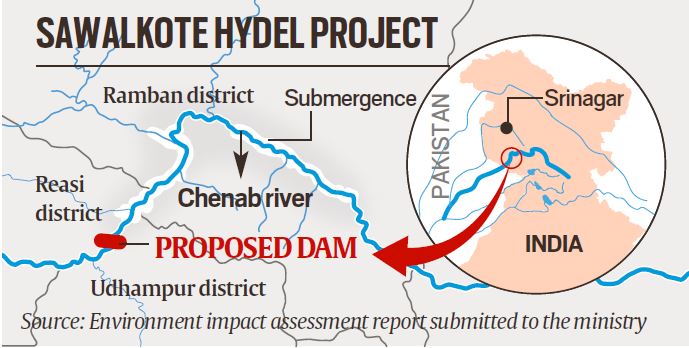
Significance of the Baglihar Project
- Energy Security
- Contributes significantly to the northern grid.
- Supports peak power demand.
- Strategic Importance
- Located on a western river under the Indus Waters Treaty.
- Infrastructure development on Chenab has geopolitical significance.
- Flood Management
- Although primarily a run-of-the-river project, dam infrastructure helps moderate river flows to some extent.
Challenges Highlighted by Recent Flooding
- Increased frequency of extreme rainfall events.
- Siltation and debris flow affecting turbines.
- Structural vulnerability in Himalayan hydropower projects.
- Climate change-induced hydrological unpredictability.
Temporary suspension of operations underscores the need for:
- Improved dam safety audits.
- Real-time flood forecasting systems.
- Strengthened early warning mechanisms.
- Climate-resilient infrastructure design.
Broader Implications
- Infrastructure Resilience: Hydropower projects in fragile Himalayan terrain must integrate disaster risk reduction measures.
- Environmental Concerns: Run-of-the-river projects, though less storage-intensive, remain vulnerable to flash floods and glacial lake outburst floods (GLOFs).
- Policy Perspective: The incident highlights the importance of balancing renewable energy expansion with ecological sensitivity and safety planning.
What lies ahead?
- The International Hydropower Association (IHA) promotes a combination of water, wind, and sun to achieve sustainable energy goals.
- Ghana and Kenya are successfully moving from high reliance on hydropower towards a more “robust portfolio of technologies”.
- There’s significant potential in placing floating solar panels on reservoirs in hydropower plants, it is already explored by countries like China and Brazil.
- There is a need to move away from mega dams toward medium-scale plants, it can help mitigate climate risks associated with overdependence on large infrastructure projects.
POSTED ON 26-02-2026 BY ADMIN
Next previous  General Studies
Political Science and International Relations
Some Reference Essays
List of previous year essay topics (1997-2019)

IAS GOOGLE is googled by the team of Raja Sir’s Cracking IAS Academy. Sources include The Hindu, Indian Express, pib.nic.in, Down To Earth, Economic Times, Vigyan Prasar, AIR and the like. IAS GOOGLE has been prepared in pace with emerging UPSC Trends.