




 Latest News
India AI Impact Summit 2026: New Delhi Declaration
- India wrapped up the India AI Impact Summit 2026 on February 21, with its organisers describing it as the world’s “largest and most historic” AI summit. The AI Impact Summit 2026 marked the first time an AI summit was held in the Global South.The summit achieved significant diplomatic heft and positioned New Delhi as a convening power in global AI governance discussions, producing a declaration with broader country participation than any previous summit in the series. Therefore, it is crucial to understand not only the key highlights of the summit but also artificial intelligence and India’s efforts in this field.
- Today, artificial intelligence (AI) has become a buzzword. India has also launched an AI mission and promised to make heavy investments in an indigenous AI language model.
What is Artificial Intelligence?
- Artificial Intelligence is the ability of machines, especially computers, to perform tasks that typically require human intelligence. These tasks include things like understanding language, recognising patterns, solving problems, and making decisions. Essentially, AI enables machines to think and learn from experience, just like humans do, but often at a much faster pace with access to vast amounts of data.
- Breakthroughs in computational power and big data accelerated AI’s capabilities in image and speech recognition, natural language processing, and autonomous systems. Today, AI continues to evolve, integrating into various industries, driving innovation, and transforming everyday life.
AI can be classified into two types:
- Artificial Narrow Intelligence (ANI) also known as weak AI and Artificial General Intelligence (AGI) also referred to as strong AI. ANI is designed for specific tasks and excels within a narrow domain. Examples include virtual assistants like Siri, recommendation systems on platforms like Netflix, and image recognition software. ANI systems are highly specialised and cannot transfer their expertise to unrelated tasks.
- AGI aims to replicate human cognitive abilities, enabling it to perform any intellectual task a human can do. AGI would possess general reasoning skills, understand context, and adapt to new situations across various domains. It would be capable of autonomous learning and problem-solving without requiring task-specific programming.
What are the key takeaways of the India AI Impact Summit 2026?
- The AI Impact Summit 2026 marked the first time the AI Summit was held in the Global South, following previous events in Seoul and Paris. The theme of the summit was Sarvajana hitaya, Sarvajana sukhaya — welfare for all, happiness for all.
- The three main goals of the AI Impact Summit 2026 were:
- leveraging AI to empower people and promote innovation.
- Projecting India as the service provider for AI for the whole world
- Democratising access to compute, datasets, and algorithms.
Global AI Governance
Four summits, four years — tracking the evolution of global AI priorities
- From Safety to Solutions: How the AI Summit Agenda Has Shifted
- Bletchley Park, UK- AI Safety Summit Nov 2023
- Focus: Risk & Safety. 28 countries signed the Bletchley Declaration, identifying catastrophic AI risks and laying the groundwork for global safety standards.
- Seoul AI Summit Seoul- May 2024- South Korea
- Focus: Innovation & Inclusivity. Safety remained on the table, but discussions expanded to AI''s economic potential and the need for equitable global access.
- Paris AI Action Summit Paris, France Feb 2025
- Focus: Implementation & Economy. PM Modi co-chaired. Emphasis shifted to practical deployment and economic opportunity, with safety concerns largely set aside.
- India-AI Impact Summit (First time in Global South)- New Delhi, India- Feb 16–20, 2026
- Focus: People, Planet, Progress. India centres the conversation on on-ground, local solutions — pitching actionable AI for the Global South over binding regulations.
- It comprised seven working groups, termed ‘chakras’, that covered topics such as: ‘Resilience, Innovation, and Efficiency,’ ‘Human Capital,’ ‘Safe & Trusted AI’, ‘Science’, ‘Democratising AI Resources’, ‘Inclusion for Social Empowerment’, and ‘AI for Social Good & Economic Development’.
The key takeaways of the summit are:
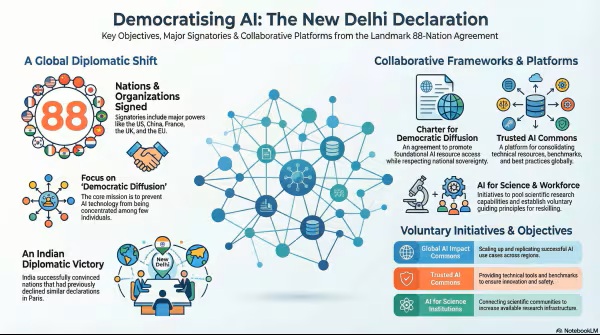
(i) New Delhi Declaration on AI Impact: The key outcome document of the five-day India AI Impact Summit, the New Delhi Declaration on AI Impact, so far have been signed by 88 countries and international organisations, including the United States, China, France, Australia and the UK. Through the declaration, India has maintained the focus on its key pitch ahead of the AI Summit — “democratising” AI, while respecting the sovereignty of countries.
— The declaration sets a number of voluntary frameworks and platforms that countries have said they will participate in, to share AI resources, use cases, and expertise, among other things.
(ii) ‘MANAV’ vision: During the summit, PM Modi unveiled India’s AI vision ‘MANAV’, which encompasses moral and ethical systems, accountable governance, and national sovereignty. He outlined a nuanced approach to AI not as an autonomous force driven solely by data and algorithms, but as an extension of human aspirations, ethics, and dignity.
MANAV stands:
- M– moral and ethical systems: AI should be based on ethical guidance.
- A– accountable governance means transparent rules, robust oversight;
- N– national sovereignty means whose data, his right.
- A– accessible and inclusive means AI should be a multiplier, not a monopoly.
- V– valid and legitimate means AI should be lawful and verifiable”.
(iii) India-America Connect Initiative: At the summit, Google CEO Sundar Pichai announced a new initiative called the India-America Connect Initiative. The initiative aims to increase AI connectivity between India, the US and multiple locations across the Southern Hemisphere, delivering new sub-scale cable routes.
- The project will establish a new international subsea gateway in Visakhapatnam; three new subsea paths connecting India to Singapore, South Africa and Australia; and four strategic fiber-optic routes to boost network connectivity between the US, India and multiple locations across the Southern Hemisphere. This builds on Google’s ongoing subsea cable projects across the Pacific and Africa, it said in a press release.
(iv) Prime Minister Modi has outlined three key suggestions for the ethical and responsible use of artificial intelligence.
- First, Modi called for a global trusted data framework that respects data sovereignty.
- Second, he stressed transparency in AI systems, advocating for what he described as a “glass box” approach. “We need a glass box approach instead of a black box, where safety rules can be viewed and verified,” he said, adding that this would strengthen accountability and ethical business practices.
- Third, referring to the “paperclip problem” often cited in AI research, Modi warned about unchecked machine objectives. “If a machine is given the goal of simply making paperclips, it will continue to do so, even at the cost of devouring all the world’s resources. Therefore, AI requires clear human values and guidance,” he said.
(v) Qualcomm Technologies has announced a strategic collaboration with the Anusandhan National Research Foundation to strengthen India’s research ecosystem in science, engineering and next-generation technologies. The focus areas include AI systems, advanced wireless technologies and next-generation computing.
(vi) Adobe has announced free access to Acrobat, Firefly AI, and over 20 Creative Cloud apps for students in 15,000 schools and 500 colleges under the government’s Content Creator Labs initiative. This initiative was announced in the Union Budget 2026 to boost the orange economy in India.
(vii) Gnani.ai has announced the launch of Vachana STT, a foundational, enterprise-grade Indic speech recognition model trained on over 1 million hours of real-world voice data spanning 1,056 domains. Vachana STT is the first model released under Inya VoiceOS, a sovereign AI model stack being built as part of the India AI Mission.
What steps has India taken to promote and integrate AI?
- From time to time, the government has introduced various initiatives to promote and integrate AI across sectors. In the Union Budget 2026–27, ₹1,000 crore was allocated to the IndiaAI Mission (FY26–27) to continue support for domestic AI R&D and compute infrastructure. To further encourage long-term investments, Budget also proposed a tax holiday until 2047 for foreign companies providing cloud services globally using data centre infrastructure based in India. The long-term policy framework for data centres up to 2047 positions India among the leading global destinations for AI and cloud infrastructure.
- IndiaAI Mission: The IndiaAI Mission seeks to create a comprehensive ecosystem that encourages AI innovation by democratising computing access, improving data quality, developing indigenous AI capabilities, attracting top AI talent, facilitating industry collaboration, providing startup risk capital, ensuring socially impactful AI projects, and promoting ethical AI — This mission promotes the responsible and inclusive growth of India’s AI ecosystem through the following seven pillars:
- IndiaAI Compute Capacity
- IndiaAI Innovation Centre
- IndiaAI Datasets platform (AIKosh)
- IndiaAI Application development initiative
- IndiaAI Future skills
- IndiaAI Startup Financing
- Safe and Trusted AI
- — Launched in 2024, the mission has made strong progress in expanding the country’s computing infrastructure. From an initial target of 10,000 Graphics Processing Units (GPUs), India has now achieved 38,000 GPUs, providing affordable access to world-class AI resources.
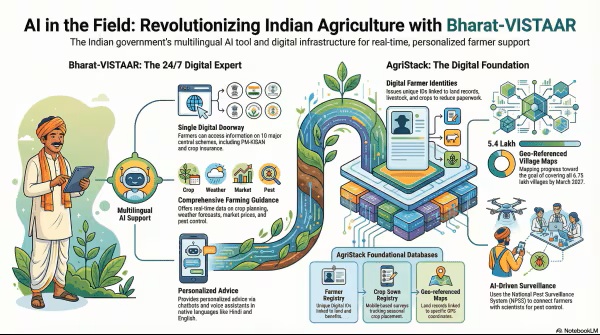
- Bharat-VISTAAR: Union Agriculture Minister Shivraj Singh Chouhan launched the Bharat-VISTAAR (Virtually Integrated System to Access Agricultural Resources), an AI-powered multilingual tool designed to provide farmers with relevant information in Jaipur on Tuesday (February 17).
- — It is an AI-powered multilingual tool that provides information to farmers in their native language through mobile or a simple phone call. The tool offers guidance on crop planning, agricultural practices, pests, weather forecasts, markets, scheme information, eligibility, applications, and grievances. It serves as a single “digital doorway” for farmers to access required information. BharatVistaar will be available 24 hours a day as a ‘digital agriculture expert’.
- Adi Vaani: The Ministry of Tribal Affairs in September last year rolled out the beta version of ‘Adi Vaani’, an AI-based translation tool that will serve as a foundation for large language models dedicated to tribal languages. Made using AI and efforts of academicians and educators proficient in tribal languages, the app will translate Hindi and English to tribal languages and vice-versa, and also aims to help digitize and preserve these languages.
- BharatGen: It is a pioneering generative AI effort that aims to transform public service delivery and increase citizen involvement by establishing a set of basic models in language, speech, and computer vision.
- — BharatGen will provide generative AI models and applications as a public utility, focusing on India’s socio-cultural and linguistic diversity. It aims to address India’s greater concerns, such as social fairness, cultural preservation, and linguistic variety, while also guaranteeing that generative AI reaches all sectors of society.
- — BharatGen connects with Atmanirbhar Bharat’s goal by developing foundational AI models exclusively for India. It will support both text and speech, ensuring coverage of India’s unique linguistic environment.
- BHASHINI: Launched in July 2022 under the National Language Technology Mission, BHASHINI is an AI-based language translation tool designed to facilitate real-time translation of Indian languages to establish a National Public Digital Platform for languages and increase the amount of content available in Indian languages.
- — It aims to provide translation services in 22 scheduled Indian languages to break through linguistic barriers and enable people to access digital services smoothly. The BHASHINI project is designed to integrate technological advancements in governance with multiple language integration, fostering national integration and creating a more inclusive society by adopting artificial intelligence tools.
- SabhaSaar: On the occasion of Independence Day last year, an AI-powered tool named ‘SabhaSaar’ was rolled out in Tripura and thereafter made available to other states. ‘SabhaSaar’ leverages the power of AI to generate structured minutes of meetings from gram sabha videos and audio recordings.
- — It will bring uniformity in minutes of the gram sabha meetings across the country. Panchayat officials can use their e-GramSwaraj login credentials to upload video/audio recordings on ‘SabhaSaar’.
- — ‘SabhaSaar’ is built on Bhashini. The tool generates a transcription from a video or audio, translates it into a chosen output language, and prepares a summary. It enables transcription in all major Indian languages like Hindi, Bengali, Tamil, Telugu, Marathi and Gujarati, in addition to English.
- Chitralekha: It is an open source platform for video subtitling across various Indic languages, using ML model support. It offers support for multiple input sources, transcription generation process and voice over.
What challenges and concerns are associated with the rapid growth of AI?
- In recent years, AI has become an integral part of human lives and is increasingly shaping our daily interactions with the world. However, there are some concerns associated with it.
- Power consumption and grid stress
- AI operates through a complex interdependence between software, hardware and energy. It requires large data centers that operate continuously to train, deploy, and update AI models in real time. These data centers are intensely energy dependent and demand uninterrupted, high-quality electricity to ensure reliability and speed.
- Even routine AI-driven services rely on constant data processing that places sustained pressure on electricity grids. Hence, the growth of AI is also increasing the global energy demand exponentially. According to the International Energy Agency (IEA), globally, data centre electricity consumption has grown by 12 per cent per year since 2017 and will rise to around 945 TWH by 2030.
- Thus, one of the foremost challenges is grid stress. Data centres consume electricity continuously and at a high load, which places disproportionate strain on local energy distribution. With India’s installed data capacity expected to reach 2.5 GW by 2027, grid strain is expected to intensify.
- Water guzzler
- Another challenge relates to AI infrastructure, which—particularly for training and deploying large generative AI models—requires massive amounts of water to cool hardware. Estimates suggest that AI-related infrastructure worldwide may soon consume up to 6 times the annual water use of Denmark, a country with a population of around six million. This is a serious concern in a world where nearly a quarter of the global population still lacks access to clean water and adequate sanitation.
- Policy and institutional gaps
- Policy and institutional gaps are also matter of concern. Despite the rapid expansion of data centres, India lacks a comprehensive national data centre policy. The Draft Centre Policy 2020 was announced by the Ministry of Electronics and Information Technology, but it was not formally adopted or implemented. Presently, data centres are largely operated under state-level policies, which remain fragmented and are largely focused on investment incentives rather than systematic sustainability.
- Regulatory works in Silos
- Additionally, in the context of land use, water governance, and environmental safeguards, ministries and different tiers of government often lack coordination, working in silos. Again, India still appears to have a major regulatory gap for data centres. There are no compulsory energy efficiency rules, and most sustainability standards are voluntary, followed mainly by large companies. There is also no clear policy or financial support for green data centres making clean power storage and sustainable cooling costly.
- Inexperience in technicality and less Institutional capacity
- State utilities and regulators often lack the technical expertise to assess the long-term implications of large digital loads, especially when combined with smart grids and algorithmic management systems. Data governance and energy governance are treated separately, even though digital infrastructure increasingly depends on algorithmic control of electricity flows.
What’s the way forward?
- To address the above mentioned challenges and concerns, India would need an integrated AI-energy policy framework that recognises data centres as strategic energy consumers and not merely commercial consumers. Their requirements need to be incorporated into long-term power planning, grid design, and demand management strategies. For this, strong coordination between different ministries, along with the alignment of policies, would be crucial.
- “Governments should focus on regulating for potentially catastrophic issues of AI and be lenient on lesser important issues until we have more clarity.” OpenAI CEO Sam Altman told on the question of what governments should and shouldn’t regulate
- Equally important is the clean energy transition. Nuclear power, including SMRs, can provide stable, low-carbon baseload electricity for data centres and AI systems. At the same time, greater use of treated wastewater for cooling can help reduce pressure on freshwater resources.
- This can be complemented with policy support for green standards and financing. Mandatory energy-efficiency rules, water use limits, and emissions reporting can help manage resource use, while incentives for renewable power, storage, efficient cooling and low-carbon construction can help smaller players adopt sustainable practices. If India aligns AI growth with clean energy and institutional reforms, it can build a digital economy that is competitive, resilient and environmentally sustainable.
Conclusion
- The India AI Impact Summit 2026 concluded with the adoption of forward-looking commitments and strategic partnerships that advance a shared global vision for responsible, inclusive and development-oriented Artificial Intelligence. The outcomes of the Summit reflect a broad international consensus to harness AI for economic growth, social empowerment and sustainable development, while ensuring resilience, equity and democratic access to emerging technologies.
POSTED ON 22-02-2026 BY ADMIN
Next previous  General Studies
Political Science and International Relations
Some Reference Essays
List of previous year essay topics (1997-2019)

IAS GOOGLE is googled by the team of Raja Sir’s Cracking IAS Academy. Sources include The Hindu, Indian Express, pib.nic.in, Down To Earth, Economic Times, Vigyan Prasar, AIR and the like. IAS GOOGLE has been prepared in pace with emerging UPSC Trends.