



 Latest News
Surge in Silver Prices
- Silver prices rose over 160% in 2025, despite sharp interim corrections; December alone saw >30% gains amid global trade tensions.Over the full year, silver prices surged by more than 160%, significantly outperforming gold and most other asset classes
- While global trade tensions and US Federal Reserve rate cuts supported precious metals broadly, silver’s rally was driven by distinct industrial, supply-side, and speculative factors, making it fundamentally different from gold’s traditional safe-haven rise.
Background: Silver and the Global Commodities Landscape
- Silver (Ag) is a transition metal with atomic number 47, known for its highest electrical and thermal conductivity, which makes it widely used in electronics, solar cells, and jewellery.
- Historically, silver has occupied a hybrid position in the global economy—part precious metal, part industrial input. Unlike gold, which is primarily held as a store of value, silver’s demand is deeply embedded in manufacturing, energy transition technologies, electronics, and healthcare.
- Over the past decade, structural changes such as the rise of renewable energy, electric vehicles, and advanced electronics have steadily increased silver’s industrial relevance. By 2025, these long-term trends converged with geopolitical disruptions and financial speculation, triggering an extraordinary price rally.
Broader Commodity Trend
- Copper Rally: Copper crossed $12,000 per tonne in 2025 due to tariff fears, supply shortages, and energy transition demand, mirroring silver’s price dynamics.
- Real Asset Shift: Investors increasingly moved towards hard assets like metals and bitcoin amid geopolitical risks, fiscal stress, and weakening confidence in US financial assets.
Key Drivers of Silver Price Surge
- Industrial Demand: Silver is critical for solar panels, batteries, EVs and electronics; the clean energy push sharply raised demand. E.g., solar PV alone uses ~15–20% of global silver demand.
- Critical Mineral Tag: The US added silver to its Critical Minerals List, linking it to Section 232 tariff reviews and government financing priorities.
- Geopolitical Risks: China’s rare metals export restrictions (2026–27) raised fears of supply disruption.
- Stockpiling Effect: US inventories hit 531 million ounces (Sept 2025), up 74% YoY (CME), draining availability in global hubs like London.
- ETF-Led Demand: Indian silver ETF inflows touched ₹5,342 crore in Sept 2025, far exceeding gold ETF inflows (₹1,233 crore), forcing fund houses to buy physical silver and tightening supply.
- FOMO Dynamics: Acute physical shortages pushed domestic silver prices 5–12% above global benchmarks, triggering fear of missing out among retail investors and reinforcing speculative buying cycles.
- Dollar Weakness: The US dollar is set to fall ~10% in 2025, encouraging the ‘debasement trade’ into silver, gold, copper, and bitcoin as hedges against currency depreciation.
Why Silver Outperformed Gold?
- Dual Demand Structure: Silver derives value from industrial consumption, investment demand, and jewellery usage, whereas gold is dominated by investment and central bank demand.
- Critical Role in Future Technologies: Silver is indispensable in solar photovoltaic cells, EV batteries, semiconductors, medical equipment, and electronics, sectors that expanded rapidly in 2025.
- Higher Price Elasticity: Because silver markets are smaller and less liquid than gold, marginal changes in demand or supply produce outsized price movements.
- Broader Buyer Base: Industrial firms, ETF investors, retail buyers, and governments simultaneously competed for limited supplies, amplifying price volatility.
Distribution of Silver in World
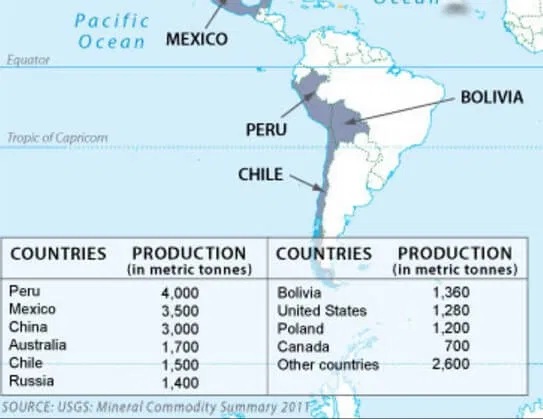
- Major Producers: Mexico is the largest producer, followed by China, Peru, Chile, and Australia; most silver is mined as a by-product of copper, lead, and zinc.
- Resource Concentration: Silver reserves are concentrated in Latin America and Asia-Pacific, closely linked to major base-metal belts like the Andean copper belt.
Distribution of Silver in India
- Limited Reserves: India has no major primary silver mines; domestic availability depends largely on by-product recovery from lead–zinc mining.
- Key Mining Region:
Zawar mines in Udaipur district of Rajasthan is the major producer of silver [smelting of galena ore in Hindustan Zinc Smelter].
The Tundoo Lead Smelter in Dhanbad district of Jharkhand is another major silver producer.
Some silver is produced by Kolar Gold Fields and Hutti gold mines.
The Hindustan Copper Ltd. at Maubhandar smelter in Singhbhum district of Jhakhand obtains silver from copper slimes.
Silver is also produced by Vizag Zinc smelter in Andhra Pradesh from the lead concentrates.
- Import Dependence: India meets a large share of silver demand through imports, primarily from Mexico (largest supplier) and Peru.
POSTED ON 05-01-2026 BY ADMIN
Next previous  General Studies
Political Science and International Relations
Some Reference Essays
List of previous year essay topics (1997-2019)

IAS GOOGLE is googled by the team of Raja Sir’s Cracking IAS Academy. Sources include The Hindu, Indian Express, pib.nic.in, Down To Earth, Economic Times, Vigyan Prasar, AIR and the like. IAS GOOGLE has been prepared in pace with emerging UPSC Trends.