
- The Maoist insurgency in India is gradually losing ground, with key leaders surrendering and many cadres leaving the movement. This reflects India’s steady progress in eliminating Naxalism and strengthening law enforcement efforts in affected regions. Recently, The surrender of Thippiri Tirupathi (alias Devuji), a top-ranking Maoist leader with a ₹1 crore bounty, marks a historic unravelling of the CPI (Maoist) leadership.
- This event, combined with the death of over 500 cadres since 2024, signals the potential endgame for the decades-old insurgency ahead of the government’s March 31 deadline.
Status of Maoism or Left Wing Extremism (LWE) in India:
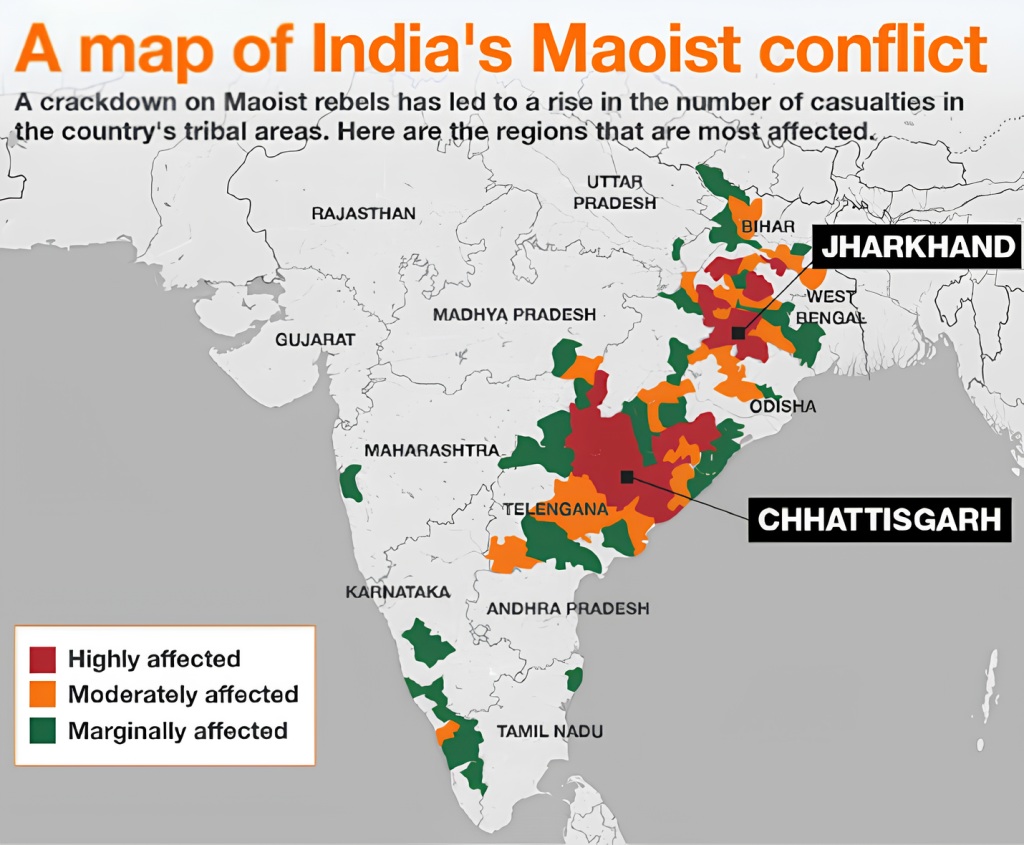
- Shrinking Geographical Spread: LWE, once India''s biggest internal security challenge, spread across the "Red Corridor" from Nepal''s border in the north to Andhra Pradesh in the south, covering parts of Chhattisgarh, Jharkhand, Odisha, Maharashtra, and Andhra Pradesh.
- It is now confined to small pockets in central India, primarily in Chhattisgarh, with a limited presence in Jharkhand, Odisha, and Maharashtra.
- Decline in Violence and Cadre Strength: In 2013, 126 districts reported Naxal violence; by March 2025, this dropped to 18 districts, with only 6 classified as “Most Affected.”
- Left Wing Extremism (LWE) incidents dropped by more than 50% between 2004–14 and 2014–23.
- Maoism in India is in retreat, both territorially and operationally, with the government aiming for a completely Naxal-free Bharat by March 2026.
What is Maoism?
- About: Maoism is a form of communism developed by Mao Tse Tung. It seeks to capture state power through armed insurgency, mass mobilization, and strategic alliances, supported by propaganda and misinformation against state institutions.
- Mao called this process, the ‘Protracted People''s War’, where the emphasis is on ‘military line’ to capture power.
- Naxalism often referred to as Left Wing Extremism (LWE), is an armed movement inspired by Maoist ideology that seeks to overthrow the Indian government through violent rebellion.
- The term Naxalite comes from the 1967 uprising in Naxalbari, West Bengal, led by CPI(M) members. It refers to those advocating armed revolt against the state.
- Maoist Ideology: The central theme of Maoist ideology is the use of violence and armed insurrection as a means to capture State power.
- Indian Maoists: The largest and the most violent Maoist formation in India is the Communist Party of India (Maoist) formed in 2004.
- The CPI (Maoist) and its front organizations were banned under the Unlawful Activities (Prevention) Act, 1967.
- Front Organizations are the off-shoots of the parent Maoist party, which professes a separate existence to escape legal liability.
|
Operation Demolishment
Key Features:
Significance:
|
What is India’s Strategy to Eliminate Left Wing Extremism (LWE)?
Policy Framework: To address the LWE menace holistically, India approved a National Policy and Action Plan in 2015.
- It envisages a multi-pronged strategy involving security related measures, development interventions, ensuring rights and entitlements of local communities etc.
- The policy is complemented by the operational strategy ‘SAMADHAN’, together aiming to achieve a Naxal-free Bharat and transform Red Zones into Growth Corridors by March 2026.
Security Measures:
- Deployment of Forces & Joint Operations: Central Armed Police Forces (CAPFs), India Reserve Battalions, and Joint Task Forces carry out intelligence-led operations, including major offensives like Operation Black Forest (Operation Kagar).
- Scheme of Fortified Police stations: Construction of Fortified Police Stations, security camps and night landing helipads to strengthen operational readiness.
- Security Related Expenditure (SRE) Scheme: Supports training, operations, community policing, ex-gratia payments, and rehabilitation of surrendered cadres.
- Financial & Intelligence Control: National Investigation Agency (NIA) and Enforcement Directorate target Maoist funding to cut off financial resources.
Development Initiatives:
- Road Connectivity (RRP-I & RCPLWE): Expands road networks to improve access for both security and development purposes.
- Telecom Connectivity: Mobile Connectivity Projects and 4G expansion aim to connect all LWE-affected areas by December 2025.
- Financial Inclusion: Bank branches, ATMs, post offices, and Banking Correspondents operationalized to provide services in remote areas.
- Skill Development & Education: Industrial Training Institutes (ITIs), Skill Development Centres, and Eklavya Model Residential Schools strengthen human capital in tribal areas.
- Special Infrastructure Scheme (SIS) & Special Central Assistance (SCA): Funds for district-level facilities, police infrastructure, and essential public services.
- Dharti Aaba Janjatiya Gram Utkarsh Abhiyan (2024 launch): Focus on personal amenities, improving road, mobile, and financial connectivity in over 15,000 villages.
Empowerment & Public Engagement
- Civic Action Programme (CAP): Provides financial support for CAPFs to engage in welfare activities, fostering trust between security forces and communities.
- Media Plan: This scheme is being implemented as a sub-scheme under the Umbrella Scheme ''Modernization of Police Forces''.
- It includes activities such as Tribal Youth Exchange Programs, radio jingles, documentaries, pamphlets, and other outreach materials, all aimed at countering Maoist propaganda through awareness campaigns.
- Rehabilitation of Cadres: Surrendered Maoists are provided education, vocational training, and financial aid to reintegrate them into society.
Challenges Encountered
Mnemonic: “INSURGENT”
- I – Insufficient State Reach: Limited reach of the state in remote and forested areas reduces the ability to monitor and counter insurgent activities effectively.
- N – Neglect / Lack of Development: Chronic neglect, lack of basic infrastructure, and minimal economic opportunities in affected areas create fertile ground for insurgent influence.
- S – Socio-economic Grievances: Widespread poverty, unemployment, and social inequalities drive marginalized communities to support Maoist ideology as a path to better resources and rights.
- U – Unstable Governance: Weak administration, local corruption, and lack of accountability allow LWE groups to operate with impunity.
- R – Remote / Difficult Terrain: Dense forests, hilly terrains, and inaccessible regions in the Red Corridor make surveillance and security operations challenging.
- G – Guerrilla Tactics & Mobilization: Highly mobile Maoist units use guerrilla warfare, ambushes, and infiltration of villages to sustain operations and evade capture.
- E – External Support: Some Maoist groups receive logistical, financial, or ideological backing from external sources, strengthening their capacity.
- N – Narratives / Propaganda: Maoists exploit local grievances through media, pamphlets, and word-of-mouth to recruit youth and maintain ideological influence.
- T – Tribal / Community Influence: Support from local and tribal communities, often driven by shared grievances or coercion, helps Maoists sustain their presence in rural areas.
What Measures can India Further Adopt for Naxal-Free Bharat?
Mnemonic: “REINFORCE”
- R – Revitalize Local Governance: Empower panchayats in tribal and remote areas to ensure faster grievance redressal, reducing the appeal of extremist ideologies.
- E – Employment & Livelihoods: Create sustainable rural jobs through vocational training, entrepreneurship programs, and community-driven initiatives to integrate tribal youth into the formal economy and reduce dependence on illegal activities.
- I – Infrastructure Development: Improve connectivity, electricity, telecom, and access to healthcare in LWE-affected regions to break isolation and integrate remote areas into the national economy.
- N – Nurture Culture: Strengthen democratic values while preserving local culture, art, and languages to counter extremist narratives.
- F – Focus on Social Justice & Land Reforms: Implement the Forest Rights Act stringently, redistribute land, and ensure the rights of marginalized communities to address historical grievances that fuel discontent.
- O – Organize Community Policing & Trust-building: Adopt SMART policing and civic action initiatives to foster trust between security forces and local populations, making extremist infiltration more difficult.
- R – Rehabilitate & Counter Extremism: Launch awareness campaigns against Maoist propaganda and support rehabilitation programs to reintegrate affected individuals while empowering communities with peaceful avenues for redressal.
- C – Cooperatives & Economic Empowerment: Promote rural cooperatives in agriculture, handicrafts, and forest products, providing micro-loans and market access to build self-sustaining local economies.
- E – Enforcement & Border Security; Strengthen cross-border security, monitor arms and fund flows, and coordinate intelligence to disrupt Maoist logistics and prevent regrouping.
Conclusion
India’s multi-pronged strategy combining security, development, and rights-based empowerment has sharply weakened LWE, shrinking affected areas and restoring governance. While lone-wolf attacks may persist, the era of organized Maoist insurgency in India is effectively reaching its twilight. The challenge now lies in ensuring that development reaches the last mile to prevent any future resurgence of extremism.Sustained political will and public participation have brought the country closer to a Naxal-free India.