
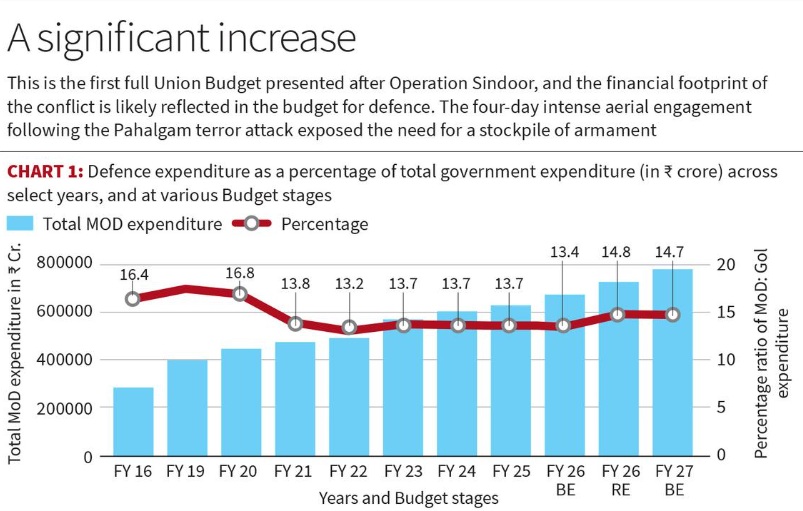
- The government announced a historic 15.2% hike in the total defence budget for FY2026-27, primarily to address tactical gaps exposed by the recent Operation Sindoor conflict.
- The allocation aims to strengthen India’s “security-development-self-reliance” balance amid rising geopolitical tensions.
Increased Capital Spending for the Defence Sector:
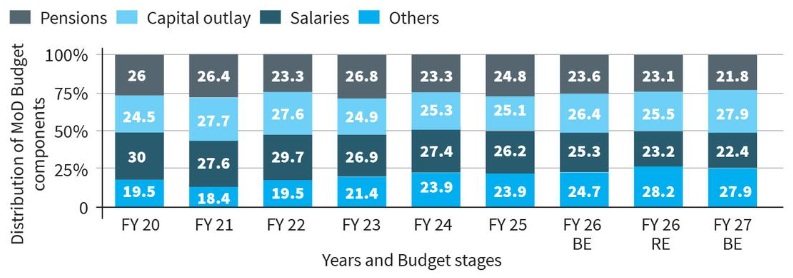
- Capital spending (or capital outlay) is the portion of the budget dedicated to modernization and the acquisition of new assets such as advanced weapons, fighter jets, ships, and submarines.
- For FY2026-27, capital outlay has surged by 8% to reach ₹2,19,306 crore, marking a strategic pivot from manpower costs to technology-intensive capability building.
Important Budget Announcements:
- Record Total Allocation: A total of ₹7.85 lakh crore was granted to the Ministry of Defence, the highest among all ministries.
- Modernization Surge: Capital outlay for new acquisitions rose by nearly 22%, totaling ₹2.19 lakh crore.
- Domestic Procurement Target: 75% of the capital acquisition budget—amounting to ₹1.39 lakh crore—is reserved for domestic industry.
- Border Infrastructure Hike: Allocation for the Border Roads Organisation (BRO) increased to ₹7,394 crore for strategic tunnels and bridges.
- R&D Expansion: Budget for DRDO rose to ₹29,100 crore to foster indigenous innovation in next-gen technology.
- Customs Duty Waivers: Basic customs duty was waived on raw materials for aircraft manufacturing to boost the domestic MRO (Maintenance, Repair, and Overhaul) sector.
Need for Increasing the Defence Budget:
- Replenishment of War Reserves: Essential for replacing stocks depleted during active military engagements.
- E.g. High capital outlay is needed to replenish ammunition and precision-guided munitions used during Operation Sindoor in May 2025.
- Countering Two-Front Threats: Necessary to address simultaneous security challenges from adversarial neighbors.
- E.g. Modernizing air power and ground forces is critical to maintain deterrence along the Line of Actual Control (LAC) against China.
- Maritime Security in IOR: Strengthening undersea and surface capabilities to monitor the Indian Ocean Region (IOR).
- E.g. Funding supports the Project 75(I) stealth submarine deal to counter growing foreign naval presence in Indian waters.
- Technological Superiority: Investing in “sunrise” sectors like AI, cyber, and unmanned systems for future warfare.
- E.g. A 51% increase in the Agnipath scheme allocation reflects a push toward a leaner, tech-savvy force.
- Border Connectivity: Ensuring rapid troop mobilization through all-weather infrastructure in forward areas.
- E.g. Increased BRO funding will expedite strategic projects like high-altitude tunnels to ensure year-round connectivity to the borders.
Issues Associated with the Defence Sector:
- Structural Imbalance: High manpower costs (salaries/pensions) continue to eat into the modernization fund.
- E.g. Defence pensions alone cost ₹1.71 lakh crore in FY27, nearly rivaling the entire capital acquisition budget.
- Absorption Capacity: Domestic industries often struggle to execute large-scale contracts within strict timelines.
- E.g. Fragmented planning and delayed trials have historically led to under-utilization of allocated capital funds.
- Import Dependency: Critical sub-systems and high-end tech like aero-engines are still largely imported.
- E.g. The IAF’s 114 MRFA project remains dependent on foreign original equipment manufacturers (OEMs) for combat jet designs.
- Execution and Delivery Delays: Long gestation periods for indigenous platforms can lead to operational gaps.
- E.g. The Project 75(I) submarine acquisition has faced years of delays, leaving the Navy with a shrinking underwater fleet.
- Budget as % of GDP: Despite absolute increases, spending remains below the recommended 2.5–3% of GDP.
- E.g. The FY27 budget stands at approximately 1.99% of GDP, which experts argue may be insufficient for a full-scale two-front threat.
Way Ahead:
- Institutionalizing Emergency Procurement: Transform fast-track mechanisms used during crises into standard procedures for critical tech.
- Theaterisation and Jointness: Surge funding for “Joint Staff” to enhance inter-service coordination and resource sharing.
- Focus on IP-led Design: Shift from transactional manufacturing to owning Intellectual Property (IP) for at least 50% of contracts.
- Developing Export Hubs: Leverage the domestic base to target ₹35,000 crore in annual exports by 2027 via modular designs.
- Nurturing MSME Ecosystem: Integrate hundreds of Indian MSMEs into the global supply chain for high-end spares and sensors.
Conclusion:
- The FY2026-27 defence budget acts as a stabilization measure that prioritizes immediate tactical readiness and long-term strategic autonomy. By earmarking 75% of acquisitions for domestic players, India is decisively moving toward becoming a self-reliant global defence hub. However, the success of this record outlay will depend on the industry’s ability to deliver advanced technology at the speed of operational relevance.