
- The Union Budget 2026-27 has accelerated India’s infrastructure vision by announcing the Integrated East Coast Industrial Corridor with a key node at Durgapur and allocating ₹3,000 crore to the NICDIT for ongoing projects.
Industrial Corridors of India:
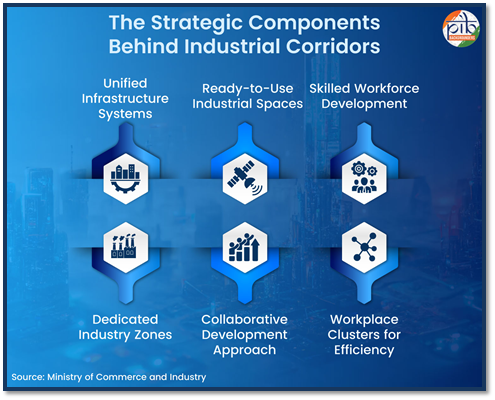
- Industrial corridors are linear development zones designed as planned economic belts. They integrate world-class infrastructure—including high-speed rail, expressways, ports, and smart cities—to connect major economic hubs.
- These corridors aim to lower logistics costs and foster an environment where industries can operate with plug-and-play facilities and walk-to-work ecosystems.
Data & Stats on Industrial Corridors:
- Network Scope: India is developing 11 Industrial Corridors under the National Industrial Corridor Development Programme (NICDP).
- Current Progress: 4 projects are completed (Phase-I cities) and 4 projects are nearing completion.
- Investment: Phase-I projects alone have attracted ₹2.02 lakh crore in investments across sectors like EVs, renewables, and pharma.
- New Projects: 12 additional projects were recently approved with a total cost of ₹28,602 crore, aiming to create nearly 1 million direct jobs.
- Budget 2026-27: ₹3,000 crore allocated to NICDIT to accelerate implementation.
Major Industrial Corridors of India:
- Delhi–Mumbai Industrial Corridor (DMIC)
- Flagship Status: India’s premier corridor, featuring world-class Smart Cities like Dholera (India’s first semiconductor city) and Shendra-Bidkin.
- Logistics Power: Anchored by the Western Dedicated Freight Corridor (WDFC), ensuring rapid transit between the political and financial capitals.
- Strategic Verticals: Leading the charge in Electric Vehicles (EVs), high-end electronics, and renewable energy manufacturing.
- Chennai–Bengaluru Industrial Corridor (CBIC)
- Manufacturing Powerhouse: Links the high-tech ecosystem of Bengaluru with the Detroit of Asia (Chennai).
- Key Nodes: Major developments at Tumakuru (Karnataka) and Krishnapatnam (Andhra Pradesh) are nearing completion.
- Industrial Focus: Dominates in automobiles, precision engineering, and consumer electronics.
- Amritsar–Kolkata Industrial Corridor (AKIC)
- Eastern Link: Aligned with the Eastern Dedicated Freight Corridor (EDFC), spanning the vast Indo-Gangetic plains.
- Cluster Model: Utilizes Integrated Manufacturing Clusters (IMCs) to revitalize the industrial heartland of North and East India.
- Sector Focus: Primarily targets agro-processing, heavy engineering, and steel-based manufacturing.
- Vizag–Chennai Industrial Corridor (VCIC)
- Maritime Connectivity: India’s first coastal corridor, acting as a critical component of the East Coast Economic Corridor (ECEC).
- Blue Economy: Prioritizes port-led industrialization, creating a seamless link between manufacturing zones and global shipping routes.
- Core Industries: Strategic focus on petrochemicals, export-oriented textiles, and logistics.
- Bengaluru–Mumbai Industrial Corridor (BMIC)
- Western-Southern Synergy: Bridging the gap between the industrial powerhouses of Maharashtra and the tech-driven Karnataka.
- Regional Growth: Key nodes at Dharwad and Satara act as magnets for high-tech manufacturing.
- Economic Goal: Aims to decongest existing metros by creating self-sustaining industrial townships along the route.
- Extension of CBIC to Kochi via Coimbatore (ECKC)
- Peninsular Connectivity: Extends the reach of southern industrial belts to the Kochi Port.
- Key Nodes: Significant projects in Palakkad (Kerala) and Dharmapuri-Salem (Tamil Nadu).
- Traditional Strengths: Strengthens global value chains in textiles, food processing, and specialized engineering.
- Hyderabad–Nagpur Industrial Corridor (HNIC)
- Central Expansion: Aims to unlock the industrial potential of Central India by connecting two major urban centers.
- Anchor Project: The Zaheerabad node in Telangana is a focal point for massive industrial investment.
- Growth Drivers: Focused on the automotive supply chain and heavy engineering equipment.
- Hyderabad–Warangal Industrial Corridor (HWIC)
- State-Led Growth: A specialized initiative to decentralize industry within Telangana.
- Diversification: Encourages a shift from traditional sectors toward diverse, high-value manufacturing clusters.
- Regional Impact: Designed to boost rural economies by providing high-quality industrial infrastructure in tier-II regions.
- Hyderabad–Bengaluru Industrial Corridor (HBIC)
- Tech Corridor: Connects India’s two largest technology hubs, facilitating a Knowledge Economy corridor.
- Specialized Node: The Orvakal industrial area is being developed as a premier destination for high-tech sectors.
- Strategic Sectors: High emphasis on Aerospace, Defence, and advanced semiconductor assembly.
- Odisha Economic Corridor (OEC)
- Resource and Port Model: Capitalizes on Odisha’s immense mineral wealth and its strategic ports at Paradip and Dhamra.
- Maritime Integration: Strengthens India’s presence in the Bay of Bengal maritime trade route.
- Primary Industries: Heavily oriented toward steel, aluminum, and downstream mineral-based industries.
- Delhi–Nagpur Industrial Corridor (DNIC)
- Logistics Gateway: A planned corridor aimed at improving North-South connectivity through the center of India.
- Balanced Development: Explicitly designed to reduce regional development imbalances by industrializing the hinterlands.
- Future Vision: Focuses on becoming a hub for national-level logistics and warehousing due to its central location.
Significance:
- Global Competitiveness: Provides plug-and-play infrastructure (ready-to-use land and utilities) that allows businesses to start operations immediately, making India a global manufacturing destination.
- Logistics Efficiency: By integrating with the PM GatiShakti framework and Dedicated Freight Corridors (DFCs), these zones drastically reduce the time and cost of moving goods to ports.
- Sustainable Urbanization: Promotes Low-Carbon Cities (LCCs) with transit-oriented development, renewable energy integration, and vast green spaces.
- Socio-Economic Growth: Acts as a catalyst for regional development, providing high-quality employment in traditionally less-industrialized hinterlands.
Conclusion:
- The development of 11 Industrial Corridors marks a shift from isolated industrial zones to integrated, multi-modal manufacturing ecosystems. With new budget support and the Durgapur node, India is strengthening infrastructure to compete globally. These corridors will be key drivers of Viksit Bharat @ 2047, boosting growth and exports.