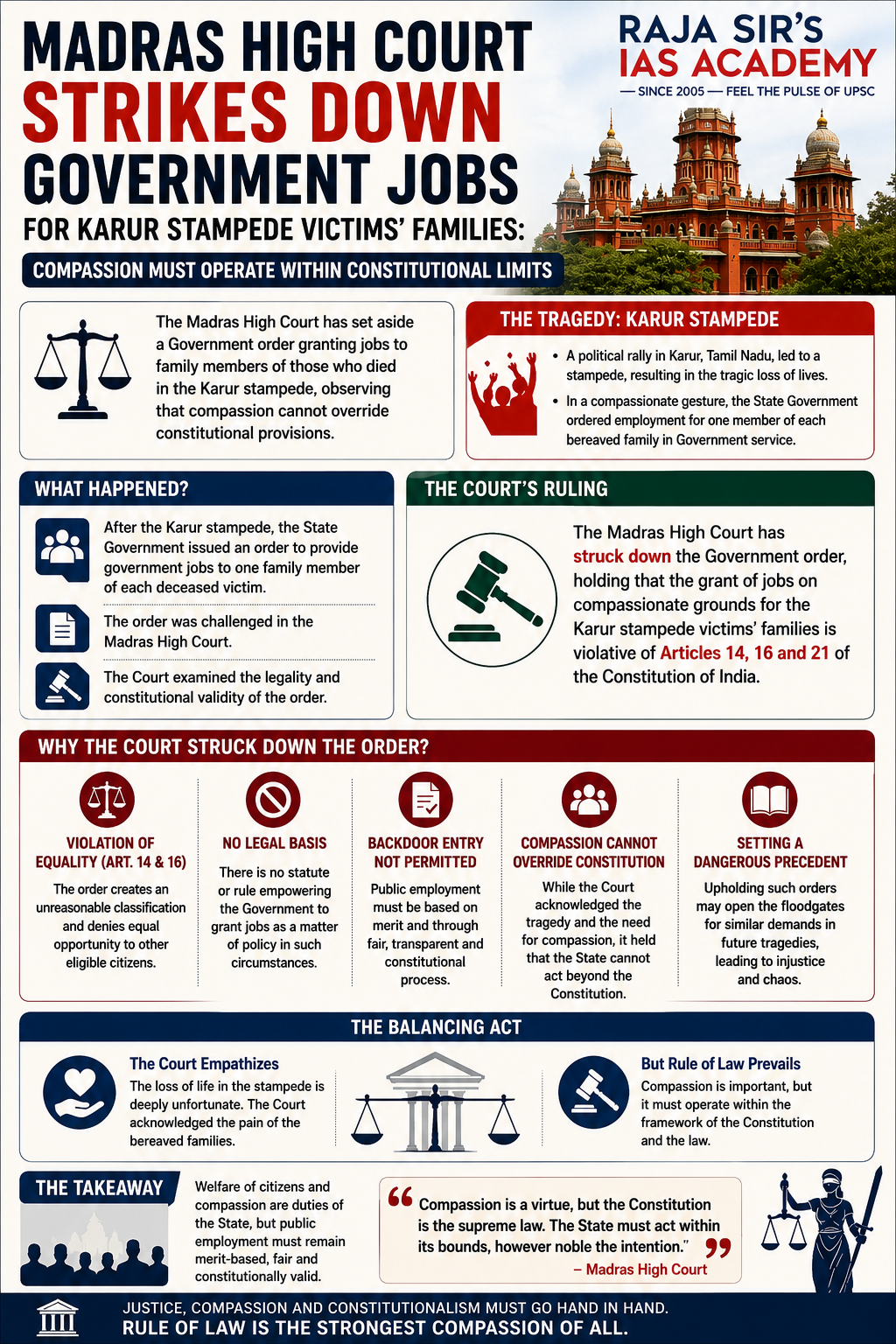
Compassion Must Operate Within Constitutional Limits
The Madurai Bench of the Madras High Court has struck down the Tamil Nadu government''s decision to provide government employment on compassionate grounds to the family members of those who died in the Karur stampede of September 27, 2025. The tragedy occurred during a political rally of the Tamilaga Vettri Kazhagam (TVK), resulting in the death of 41 people and injuries to over 60 others.
Following the formation of the TVK-led government, the State announced government jobs for the affected families as a rehabilitation measure. However, the decision was challenged before the Madras High Court. On July 27, 2026, a Division Bench comprising Justice C.V. Karthikeyan and Justice R. Sakthivel struck down the policy, holding that it violated the constitutional principles governing public employment.
The Case Before the Court
The principal case was Theeran Thirumurugan @ Thirumurugan v. The Chief Secretary (WP(MD) No. 19539 of 2026).
The petitioners contended that compassionate appointment cannot be converted into a general compensation mechanism for victims of accidents or public tragedies. Such appointments are traditionally intended to provide immediate financial relief to the dependants of government employees who die while in service. Creating a separate category of appointments for the Karur victims, they argued, would undermine equality and equal opportunity in public employment.
High Court''s Verdict
The High Court set aside the Government Orders granting employment, holding that the State''s executive power cannot be exercised in a manner inconsistent with Articles 14 and 16 of the Constitution.
Article 14: Equality Before Law
Article 14 guarantees equality before the law and equal protection of the laws. Any special benefit granted by the State must satisfy the test of reasonable classification and cannot be arbitrary.
Article 16: Equality of Opportunity in Public Employment
Article 16 guarantees equal opportunity for all citizens in matters of public employment. Government jobs are constitutional opportunities and public resources that must ordinarily be filled through established recruitment procedures.
The Court held that granting government jobs solely on humanitarian grounds to one category of victims violated these constitutional guarantees.
Public Employment Is Not a Form of Compensation
A significant principle emerging from the judgment is the distinction between compensation for a tragedy and appointment to public employment.
The State undoubtedly possesses the authority to provide financial assistance, rehabilitation, and welfare measures to disaster-affected families. However, a government job occupies a different constitutional position. Public employment cannot be distributed as a form of relief or compensation, as it is governed by constitutional principles of equality, fairness, and merit.
The Court observed that thousands of eligible candidates compete for limited government posts. Therefore, executive discretion cannot override the constitutional framework governing recruitment.
Understanding Compassionate Appointment
Compassionate appointment is an exception to the normal rule of recruitment through open competition. Its objective is not to compensate a family for the loss of a loved one but to provide immediate financial relief to the dependants of a government employee who dies while in service.
Thus, the framework is:
- General Rule: Recruitment through open competition.
- Exception: Compassionate appointment under clearly defined statutory or administrative rules.
The Court noted that many eligible dependants of deceased government employees are already awaiting compassionate appointments. Creating a new category outside this framework could unfairly bypass those who are already in the queue.
Limits on Executive Power Under Article 162
The Tamil Nadu government defended its decision by invoking its executive powers under Article 162, arguing that the appointments were an exceptional humanitarian policy response.
The High Court rejected this argument, emphasizing that executive power is not absolute. Even welfare-oriented policies must conform to constitutional limitations and fundamental rights.
The judgment reiterates an important constitutional principle:
Executive power under Article 162 must operate within the framework of Articles 14 and 16.
A policy decision, however well-intentioned, cannot create an arbitrary route into public employment.
The ''Floodgates'' Concern
The Court also expressed concern about the precedent such appointments could create.
If government employment were granted to families affected by one tragedy, similar demands could arise from victims of:
- Firecracker factory explosions
- Industrial accidents
- Major road accidents
- Building collapses
- Other crowd disasters
Accepting such a principle could open the floodgates for claims seeking government jobs after every major tragedy.
Traditionally, victims of disasters receive ex gratia compensation, rehabilitation assistance, healthcare, housing, and educational support rather than automatic government employment.
Comparison with Ex-Servicemen Rejected
The State relied on a 1999 Government Order granting compassionate appointments to the families of deceased ex-servicemen.
The Court rejected this comparison, holding that military personnel who sacrifice their lives in service to the nation constitute a constitutionally distinct category. Therefore, benefits extended to their families cannot be used as a precedent for victims of unrelated public tragedies.
Distinction from the Thoothukudi Police Firing
The Court also distinguished the Karur stampede from the Thoothukudi police firing.
In cases where deaths result directly from State action, different constitutional considerations may arise. Since the Karur incident was not caused by direct State action, the Court found no justification for departing from ordinary constitutional principles governing public recruitment.
Alternative Rehabilitation Measures Suggested
Importantly, the Court did not suggest that the affected families should be denied assistance altogether. Instead, it recommended rehabilitation measures that do not compromise constitutional equality.
Possible alternatives include:
- Technical education
- Vocational and professional training
- Skill development programmes
- Entrepreneurship assistance
- Government-funded livelihood support
- Measures promoting long-term economic self-sufficiency
Such interventions would provide sustainable rehabilitation without distorting the constitutional recruitment process.
Earlier Interim Order
On July 10, 2026, the High Court had permitted the government to distribute appointment orders, but only on a temporary basis and subject to the outcome of the case.
The Court specifically directed that the constitutional validity of the scheme be decided before the beneficiaries received their first salary. Following a detailed examination, the policy was ultimately struck down on July 27, 2026.
Compassion vs. Equality: The Constitutional Dilemma
The judgment highlights the delicate balance between two important constitutional objectives.
On one hand, the welfare state has a responsibility to rehabilitate families who suddenly lose their breadwinners in mass tragedies. On the other hand, millions of citizens compete for limited government jobs through examinations and established recruitment procedures.
The Court held that while compassion justifies generous rehabilitation measures, it does not justify granting special access to public employment outside the constitutional framework.
Constitutional Significance
The judgment reinforces several important constitutional principles:
- Government employment is a public resource and cannot ordinarily be distributed through executive discretion.
- Compassionate appointment is an exception, not an alternative mode of recruitment.
- Welfare policies remain subject to Fundamental Rights. Benevolent intentions do not automatically make government action constitutional.
- Executive power under Article 162 has constitutional limits and remains subject to judicial review.
While Articles 21, 38, 39 and 41 impose a positive obligation on the State to rehabilitate victims, such rehabilitation must be carried out in a manner consistent with Articles 14 and 16. Welfare objectives cannot justify arbitrary access to public employment.
| Constitutional Provision | Relevance in the Case |
|---|---|
| Article 14 | Equality before law; prevents arbitrary State action |
| Article 16 | Equal opportunity in public employment |
| Article 21 | Right to life with dignity; supports rehabilitation |
| Article 38 | Welfare State and social justice |
| Article 39(a) | Adequate means of livelihood |
| Article 41 | Public assistance and right to work within the State's capacity |
| Article 46 | Educational and economic empowerment of vulnerable groups |
| Article 162 | Executive power is subject to constitutional limitations |
Governance Perspective
The judgment also raises broader questions about disaster rehabilitation policy.
Governments frequently announce relief packages after major tragedies, including ex gratia compensation, educational assistance, healthcare, housing, livelihood support, and social security benefits. These measures directly address rehabilitation without affecting constitutional equality in public employment.
The Court''s reasoning suggests that disaster relief policies should be based on uniform criteria, transparency, fiscal sustainability, and constitutional fairness, rather than case-specific executive decisions.
Analytical Point - Article 21
"Article 21 imposes a duty upon the welfare State to rehabilitate victims with dignity, but the means adopted must conform to Articles 14 and 16. Compassion cannot become a constitutional exception to equality in public employment."
Mass Tragedy
      │
      ▼
Article 21
(Right to Life & Dignity)
      │
State must rehabilitate victims
      │
      ▼
Method of Rehabilitation
      │
      ▼
Must satisfy Articles 14 & 16
(Equality & Equal Opportunity)
      │
      ▼
Government jobs cannot be granted
through arbitrary executive discretion
"The welfare character of the State enlarges its responsibility towards victims, but it does not enlarge its power beyond constitutional limitations."
This judgment demonstrates that while the State may adopt generous rehabilitation measures, the methods adopted must respect constitutional guarantees of equality and fairness.
Way Forward
Governments should formulate a comprehensive disaster rehabilitation framework that provides uniform assistance through financial compensation, educational scholarships, livelihood grants, insurance support, skill development, entrepreneurship assistance, and targeted social security benefits.
Where public employment is contemplated, it should be supported by a clear statutory and constitutional framework rather than ad hoc executive discretion. Such an approach would harmonize humanitarian concerns with constitutional equality.
Conclusion
The Madras High Court''s decision in the Karur stampede case extends beyond the immediate concerns of the affected families. It addresses a fundamental constitutional question: Can compassion justify bypassing equality in public employment?
The Court answered in the negative. While the State has a constitutional obligation to rehabilitate victims of tragedies, government employment is governed by Articles 14 and 16 and must remain accessible through fair and constitutionally valid procedures.
The judgment thus reinforces an enduring constitutional principle: Compassion may inspire public policy, but its implementation must always remain within the framework of the Constitution.