
UPSC CSE Mains 2026 Sociology – Paper II
SECTION A
Q1. Answer in about 150 words each. (10 × 5 = 50)
1(a) In what respect is M. N. Srinivas'' study of Indian village society based on structural and functional perspective? Analyse.
1(b) According to you, which social reform had long-lasting impact on a specific section of society? Support your answer with suitable example.
1(c) In the context of women''s movements and laws do you think that matriarchy is the need of the hour? Discuss in detail.
1(d) Discuss the debates on the concepts ‘duty’ and ‘worship’ while understanding religion in India.
1(e) How does the concept ‘secular’ go beyond any religion in plural society like India? Analyse.
Q2
2(a) Indological approach, advocated by G. S. Ghurye, focuses on the study of Indian society through Indian texts. How can Indological approach be useful in the study of other society? Comment in detail. (20 marks)
2(b) Examine how Indian Nationalism was a result of ‘Akhand Bharat/Indian Subcontinent''s socio-cultural and political consciousness’. (20 marks)
2(c) How does A. R. Desai argue that Indian social classes must be studied through the colonial mode of production? Elucidate. (10 marks)
Q3
3(a) Examine the challenges of applying micro-level village studies to macro-level village structure of Indian society. (20 marks)
3(b) Explain the emergence of middle class in agrarian society in India. What have been the socio-structural implications of the emergence of this middle class? (20 marks)
3(c) When land reform was a paradigm shift, then what type of land reforms would you recommend to make India a more equitable society? (10 marks)
Q4
4(a) How does the Constitution of India promote education? Do you think that education can be a major instrument of social change? Clarify. (20 marks)
4(b) Draw the current population pyramid of India. What policy measures would you recommend for population dynamics to achieve sustainability? (20 marks)
4(c) Compare G. S. Ghurye''s and A. R. Desai''s approaches used in understanding Indian society. (10 marks)
SECTION B
Q5. Answer in about 150 words each. (10 × 5 = 50)
5(a) Discuss the challenges faced by the aged people in receiving ‘elder care’.
5(b) Examine the transiting social movements from physical movements to virtual movements in 21st century India.
5(c) Clarify how the family planning programmes have taken a political ‘U-turn’ in present India.
5(d) How do Louis Dumont and André Beteille differ in their approaches in understanding caste system in India? Explain.
5(e) Bring out the debates of ‘insiders’ and ‘outsiders’ approaches in understanding Indian society.
Q6
6(a) Differentiate between protests and movements. Discuss some of those movements which changed the fabric of Indian agrarian society during the colonial period. (20 marks)
6(b) Synchronise the developmental programmes and social change in India, and describe them through visible and lived experiences. (20 marks)
6(c) Why was the category of ‘criminal tribe’ created by law during the colonial period in India? Discuss its implications. (10 marks)
Q7
7(a) Urbanisation in Independent India has been characterized by over-urbanization and rural push. Explain with demographic and sociological dimensions. (20 marks)
7(b) Give a sociological explanation of violence against women in India. What suggestions would you give to mitigate these violences? (20 marks)
7(c) Examine the process of formalisation of informal sector to safeguard the interests of marginalised sections of the society. (10 marks)
Q8
8(a) How has colonial rule transformed Indian society? If Indian society had not undergone colonial rule, then what type of Indian society would have been there? Elaborate. (20 marks)
8(b) How have the women''s movements made the presence of women felt in every moment and increased women''s participation in various fields? Discuss. (20 marks)
8(c) Where would you locate the tribal community in the Varna system of India? Discuss. (10 marks)
SECTION A
Q1(a) In what respect is M. N. Srinivas's study of Indian village society based on structural and functional perspective? Analyse.
- N. Srinivas's village studies, especially Religion and Society among the Coorgs of South India and The Remembered Village, reflect the structural-functional perspective because he viewed village society as an interconnected system of institutions performing functions for social continuity.
Structurally, Srinivas examined caste, family, kinship, religion, village leadership and economic relations as relatively enduring components of rural society. His concept of the dominant caste explained how numerical strength, landownership, education and political power shaped village hierarchy.
Functionally, institutions were analysed in terms of their contribution to social integration, regulation and continuity. For example, caste traditionally organised occupational relations and ritual interaction, while the jajmani system created interdependence among occupational groups.
However, Srinivas moved beyond static functionalism through concepts such as Sanskritisation, Westernisation and secularisation, which captured social mobility and change.
Thus, Srinivas combined Radcliffe-Brown's structural analysis with functional concerns of social integration, while adapting them to India's dynamic and caste-based reality. Contemporary rural transformation through Panchayati Raj, migration and welfare politics shows that village structures continue to evolve beyond the classical functional equilibrium.
Q1(b) According to you, which social reform had a long-lasting impact on a specific section of society? Support your answer with suitable example.
Among Indian social reforms, the struggle against untouchability and caste discrimination, particularly associated with B. R. Ambedkar, has had perhaps the most long-lasting impact on the historically oppressed Dalit communities.
Ambedkar transformed the issue from one of religious reform to social justice and citizenship rights. Movements such as the Mahad Satyagraha challenged exclusion from public resources, while the temple-entry movements questioned ritual hierarchy. His intervention eventually shaped constitutional provisions abolishing untouchability and promoting equality and affirmative action.
The long-term impact can be seen in the emergence of Dalit education, political representation, assertion movements and identity-based mobilisation. Reservation enabled sections of Scheduled Castes to access education and public employment, contributing to the growth of a Dalit middle class.
Yet, the persistence of caste violence and discrimination demonstrates what Ambedkar called the contradiction between political equality and social inequality.
Thus, the anti-caste reform movement produced a lasting transformation by converting a subordinated community into an increasingly organised political and constitutional constituency, though substantive equality remains an unfinished project.
Q1(c) In the context of women's movements and laws, do you think that matriarchy is the need of the hour? Discuss.
Matriarchy, understood as female domination parallel to patriarchy, is not necessarily the solution to gender inequality. The need of the hour is better understood as a transition from patriarchy to gender equality and gender-just institutions.
Women's movements have successfully challenged patriarchal structures through demands for education, property rights, reproductive autonomy, protection from violence and political representation. Laws relating to domestic violence, workplace sexual harassment and inheritance represent attempts to institutionalise gender justice.
However, replacing male dominance with female dominance would merely reverse the hierarchy rather than eliminate it. Feminist sociology emphasises egalitarian gender relations, not domination by either sex.
The experience of relatively matrilineal societies, such as the Khasi, also shows that descent through women does not automatically mean complete political or economic power for women. Therefore, matriliny is different from matriarchy.
Contemporary concerns—including gender-based violence, unequal unpaid care work and underrepresentation—require gender mainstreaming, intersectional feminism and substantive equality.
Hence, India does not need matriarchy as the opposite of patriarchy; it needs a gender-democratic social order based on dignity, autonomy, representation and equal opportunities.
Q1(d) Discuss the debates on the concepts ‘duty’ and ‘worship’ while understanding religion in India.
Religion in India has traditionally been understood through the interconnected concepts of duty (dharma) and worship (puja/bhakti). However, these concepts have generated important sociological debates.
Dharma refers to moral and social duty and historically connected individuals to their stage of life, social position and collective obligations. From a functional perspective, duty contributed to social order and normative integration. However, Ambedkar criticised the traditional interpretation of dharma when it legitimised caste hierarchy and unequal social obligations.
Worship, on the other hand, represents the ritual and devotional dimension of religion. The Bhakti tradition often challenged ritual monopoly by emphasising personal devotion and direct access to the divine. Saints such as Kabir questioned caste and priestly domination.
Thus, Indian religion contains both hierarchical and egalitarian tendencies. Louis Dumont highlighted hierarchy and purity, whereas reformers emphasised equality and individual spiritual agency.
Contemporary debates over temple access, women’s entry into religious spaces and individual freedom demonstrate that religion is continuously negotiated between duty as social obligation and worship as personal faith.
Q1(e) How does the concept ‘secular’ go beyond any religion in a plural society like India? Analyse.
In a plural society like India, secularism goes beyond being merely anti-religious or separating religion completely from the state. It represents a constitutional framework for ensuring equal citizenship across religious identities.
The Indian model is often described as one of principled distance. The state does not establish a theocratic order but may intervene in religious practices when they conflict with constitutional values such as equality, dignity and social justice.
Thus, secularism transcends individual religions through the principles of constitutional morality, fraternity and citizenship. It provides a common public framework within which Hindus, Muslims, Christians, Sikhs and others can coexist.
Unlike a strictly Western model of church-state separation, Indian secularism recognises the social importance of religion while attempting to maintain equal respect and state neutrality.
Contemporary issues involving religious polarisation and identity politics demonstrate the continuing importance of secularism. Its deeper purpose is to move society from religious majoritarianism to civic pluralism.
Therefore, the secular principle is not the rejection of religion but the creation of a political sphere where no religious identity determines the worth or rights of citizenship.
Q2(a) Indological approach, advocated by G. S. Ghurye, focuses on the study of Indian society through Indian texts. How can the Indological approach be useful in the study of other societies? Comment.
The Indological approach, associated with G. S. Ghurye, studies society through its texts, traditions, scriptures, historical records and civilisational categories. For Ghurye, Indian society could not be adequately understood merely through contemporary empirical observation; its institutions had deep historical and cultural roots.
The approach can be useful in studying other societies because every civilisation possesses its own “native archive”. European society can be studied through classical and Christian traditions; Islamic societies through the Quranic tradition, Hadith and jurisprudence; Chinese society through Confucian texts and historical records.
Its major contribution is contextual sociology. Instead of imposing universal Western categories, researchers can understand concepts through indigenous meanings. For example, concepts of family, authority, morality or community may carry different meanings across civilisations.
However, textual approaches have limitations. Texts often represent the views of elites, priests and ruling groups, while marginalised communities may remain invisible. Therefore, Indology should be combined with fieldwork, oral traditions and contemporary empirical research.
Thus, the wider relevance of the Indological approach lies in promoting civilisational sensitivity and indigenous categories, while avoiding cultural essentialism. A balanced sociology should combine texts, history and lived experience.
Q2(b) Examine how Indian Nationalism was a result of ‘Akhand Bharat/Indian Subcontinent's socio-cultural and political consciousness’.
Indian nationalism did not emerge suddenly during the freedom struggle. It developed through the gradual interaction of the subcontinent's civilisational, socio-cultural and political consciousness.
The idea of Akhand Bharat can be understood sociologically as an imagination of civilisational interconnectedness rather than merely a modern political boundary. Pilgrimage networks, sacred geography, trade routes, epics and cultural exchanges created a consciousness of shared space across diverse regions.
Texts, religious traditions and cultural symbols contributed to what may be called cultural integration. At the same time, empires such as the Mauryan and Mughal systems created experiences of large-scale political administration.
Colonialism paradoxically strengthened nationalism. British rule unified territories through railways, modern communication, bureaucracy, law and an all-India market, while simultaneously generating common grievances. According to Benedict Anderson's idea of imagined communities, print capitalism and modern communication helped transform dispersed populations into a national political community.
However, Indian nationalism was never culturally homogeneous. Linguistic, religious, caste and regional diversity required nationalism to develop through the principle of unity in diversity.
Thus, Indian nationalism emerged through the interaction of civilisational memory, colonial modernity and anti-colonial political mobilisation.
Q2(c) How does A. R. Desai argue that Indian social classes must be studied through the colonial mode of production? Elucidate.
- R. Desai adopted a Marxist and historical-materialist approach to understand Indian society. According to him, Indian social classes cannot be understood independently of the colonial mode of production.
Colonialism transformed India's economic structure to serve imperial interests. Land revenue systems such as the Zamindari and Ryotwari systems altered agrarian relations, while colonial policies contributed to commercialisation of agriculture and the growth of intermediaries.
Simultaneously, the decline of traditional handicrafts and the development of modern industries created new classes such as the industrial bourgeoisie and working class.
Thus, classes in colonial India emerged through changing relations to the means of production. Landlords, peasants, moneylenders, capitalists and workers occupied different positions within the colonial economy.
Desai therefore rejected purely cultural explanations of Indian stratification. He linked social structure to economic exploitation, property relations and imperialism.
Hence, for Desai, colonialism was not merely political domination; it was a process that fundamentally reorganised India's class structure and economic relations.
Q3(a) Examine the challenges of applying micro-level village studies to the macro-level village structure of Indian society.
Village studies by scholars such as M. N. Srinivas, S. C. Dube and Andre Beteille provided rich micro-level understanding of Indian rural society. However, generalising these findings to India's macro-level village structure presents several challenges.
First, villages differ enormously in terms of region, caste composition, ecology, land relations and political history. A South Indian village cannot automatically represent a tribal village in Central India or a village in the Gangetic plains.
Second, micro-studies often emphasised the “village as a unit”, whereas villages are deeply connected with markets, cities, migration networks and the state. The criticism of the “book-view versus field-view” also highlights the danger of treating one local reality as universal.
Third, village studies sometimes overemphasised consensus and interdependence, underplaying conflict, class exploitation and gender inequality.
Contemporary rural India is further transformed by urbanisation, digital connectivity, welfare schemes and migration. The village is increasingly part of a wider rural-urban continuum.
Therefore, micro-studies remain valuable for thick description, but macro-level conclusions require comparative research, large-scale data and political-economic analysis. The ideal approach is multi-scalar sociology, linking household, village, region and nation.
Q3(b) Explain the emergence of middle class in agrarian society in India. What have been the socio-structural implications?
The emergence of the rural middle class in India is linked to the transformation of agriculture after Independence, particularly through land reforms, the Green Revolution, market expansion and state-led development.
The Green Revolution created a class of relatively prosperous farmers possessing land, capital, irrigation, technology and access to markets. This process contributed to what scholars describe as the rise of middle peasantry and rich farmers.
This class increasingly invested in education, urban property, businesses and political networks. In many regions, prosperous agrarian castes became important political actors and often overlapped with Srinivas's concept of the dominant caste.
The socio-structural implications were significant. First, rural society became increasingly differentiated between large farmers, middle peasants and landless labourers. Second, prosperous agricultural groups gained political influence through electoral democracy and farmer organisations.
Third, education and migration facilitated the growth of a rural-urban middle class, blurring the traditional boundary between village and city.
However, agrarian distress and mechanisation have also widened inequalities and reduced employment opportunities for landless groups.
Thus, the rural middle class represents both agrarian modernisation and new forms of rural inequality, making Indian society increasingly complex and differentiated.
Q3(c) When land reform was a paradigm shift, then what type of land reforms would you recommend to make India a more equitable society?
Land reforms were a paradigm shift because they challenged the traditional concentration of landownership and attempted to promote social justice. However, incomplete implementation requires a new generation of reforms.
First, India needs effective implementation of land ceiling laws and redistribution of surplus land to the landless.
Second, women's land rights must be strengthened. Feminisation of agriculture without ownership creates economic dependence; joint titles and independent inheritance rights can promote substantive empowerment.
Third, tenancy should be legally recognised and protected, ensuring security for tenant farmers and sharecroppers.
Fourth, modern land reforms should focus on digitisation of land records, transparent titles and protection against fraudulent dispossession.
Fifth, tribal and forest communities require stronger protection of community and individual land rights.
Finally, land reform should be integrated with credit, irrigation, technology and market access, because redistribution without productive resources may not ensure equality.
Thus, contemporary land reform must move from merely redistributing land to redistributing productive capability and economic security.
Q4(a) How does the Constitution of India promote education? Do you think education can be a major instrument of social change?
The Constitution of India treats education as a crucial instrument for achieving equality, citizenship and social justice. The Right to Education reflects the commitment to universal access, while constitutional provisions also protect educational and cultural rights of minorities and disadvantaged groups.
Education can be a major instrument of social change because it promotes social mobility, rationality and modernisation. Srinivas associated education with processes such as Westernisation and social mobility, while Ambedkar viewed education as essential for the emancipation of oppressed communities.
Education challenges traditional barriers of caste and gender by expanding occupational opportunities and creating awareness of constitutional rights. It also contributes to the emergence of a modern middle class.
However, education is not automatically emancipatory. Pierre Bourdieu reminds us that educational institutions can reproduce inequality through unequal access to cultural and economic capital.
Contemporary digital divides further demonstrate unequal educational opportunities.
Therefore, education becomes transformative only when accompanied by equitable access, quality public institutions, inclusion and affirmative action. Properly democratised, education can transform inherited status into achievement-based social mobility.
Q4(b) Draw the current population pyramid of India. What policy measures would you recommend for population dynamics to achieve sustainability?
Broad shape of India's population pyramid
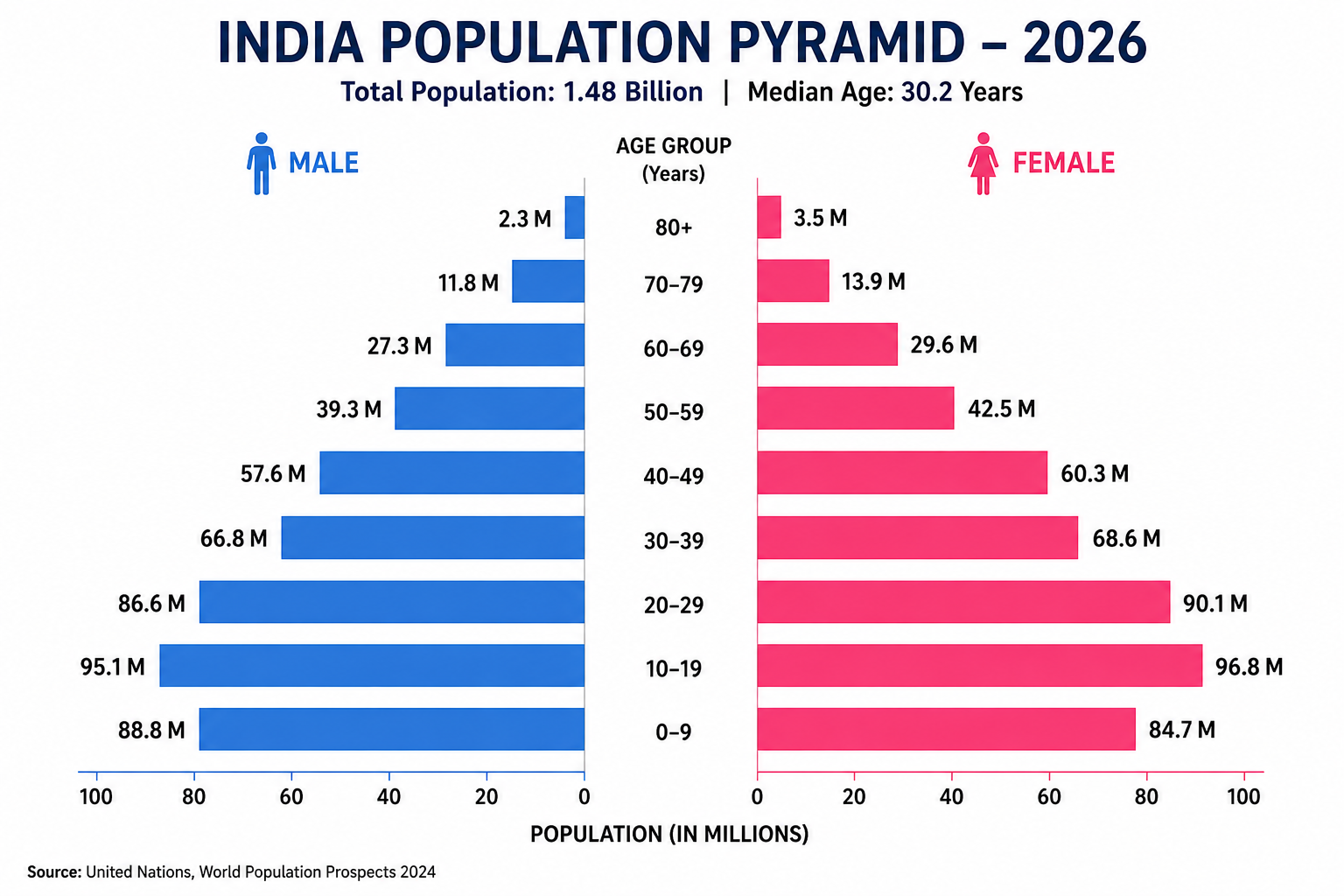
India is moving from a broad-based youthful pyramid towards a more transitional and gradually ageing population structure. This reflects declining fertility, improved life expectancy and demographic transition.
For sustainability, policy should focus on population quality rather than population control.
First, India must invest in the demographic dividend through education, skill development and employment generation.
Second, reproductive healthcare and informed family planning should prioritise choice and rights, rather than coercive population control.
Third, declining fertility requires preparation for population ageing, including pensions, healthcare and elder-care infrastructure.
Fourth, gender equality and female education are essential because they influence fertility, health and labour-force participation.
Finally, sustainable urbanisation must address migration through affordable housing, public transport and employment planning.
Thus, India's demographic strategy should shift from controlling population numbers towards achieving human development, productive employment and intergenerational sustainability.
Q4(c) Compare G. S. Ghurye's and A. R. Desai's approaches used in understanding Indian society.
|
Dimension |
G. S. Ghurye |
A. R. Desai |
|
Main approach |
Indological and historical |
Marxist and historical-materialist |
|
Focus |
Culture, caste, tribes, civilisation |
Class, economy, state and exploitation |
|
Sources |
Texts, scriptures and historical traditions |
Economic relations and historical processes |
|
Caste |
Cultural and civilisational institution |
Linked with material and class relations |
|
Social change |
Cultural interaction and historical evolution |
Contradictions in modes of production |
Ghurye sought to understand Indian society through its civilisational continuity, particularly texts, traditions and institutions. His approach emphasised the historical roots of caste and cultural integration.
Desai, in contrast, argued that society must be understood through material conditions and class relations. Colonialism and capitalism were central to his analysis of Indian nationalism and social classes.
Thus, Ghurye provides a cultural-civilisational lens, while Desai offers a political-economic lens. Together, they demonstrate that Indian society requires both cultural interpretation and structural analysis.
SECTION B
Q5(a) Discuss the challenges faced by aged people in receiving ‘elder care’.
Elder care has emerged as a major sociological challenge due to population ageing, declining joint families, migration and changing family structures.
Traditionally, the joint family provided informal care. However, nuclearisation and migration have produced what may be called the “care deficit”. Elderly persons may experience loneliness, neglect and reduced emotional support.
Economic insecurity is another challenge, particularly for elderly persons without pensions or savings. Healthcare costs increase with age, while access to specialised geriatric care remains uneven.
Gender further complicates elder care. Elderly women are more vulnerable because of longer life expectancy, widowhood and weaker lifetime access to property and employment.
The digitalisation of banking and public services can also produce digital exclusion.
Contemporary elder care therefore requires a combination of family support, community-based care and state welfare. Universal social security, geriatric healthcare, age-friendly infrastructure and protection against elder abuse are essential.
Thus, elder care should move beyond charity towards a rights-based and dignity-centred approach, recognising ageing as a major demographic transformation.
Q5(b) Examine the transition of social movements from physical movements to virtual movements in 21st-century India.
Social movements in India have increasingly shifted from physical mobilisation towards digital and hybrid activism. Social media platforms enable rapid communication, mobilisation and visibility.
Traditional movements depended on rallies, meetings and organisational structures. Virtual movements can now create networked publics, allowing individuals to participate through hashtags, videos, petitions and online campaigns.
Movements relating to gender justice, environmental concerns and citizenship have increasingly used digital platforms for agenda-setting and mobilisation. Online activism can amplify marginalised voices and reduce geographical barriers.
However, virtual movements also face challenges. Digital divide, misinformation, surveillance, trolling and “slacktivism” can weaken sustained political engagement.
Therefore, contemporary movements are not simply replacing streets with screens. Instead, India is witnessing hybrid mobilisation, where digital networks complement physical protests.
From a sociological perspective, the transformation represents a shift from relatively hierarchical organisations towards network society and connective action.
Thus, virtual activism has democratised participation but its effectiveness ultimately depends upon its ability to convert online visibility into sustained collective action and institutional change.
Q5(c) Clarify how family planning programmes have taken a political ‘U-turn’ in present India.
India's family planning programme has undergone a significant ideological transformation. Earlier policies, particularly during the Emergency period, were associated with coercive sterilisation and state-led population control.
The present approach increasingly emphasises reproductive health, informed choice and demographic transition. This represents a political “U-turn” from controlling population numbers towards improving population quality and human development.
The declining fertility rate in many regions has also changed policy concerns. Instead of a uniform national obsession with population growth, policymakers must now address regional differences, ageing and changing dependency ratios.
Family planning has therefore moved closer to a rights-based approach, integrating contraception with maternal health and women's empowerment.
However, political debates around population remain sensitive because demographic arguments can sometimes become linked to religious identity and majoritarian anxieties.
Sociologically, the shift reflects movement from Malthusian population control towards reproductive rights and demographic sustainability.
Hence, the contemporary challenge is not simply reducing fertility but enabling individuals to make informed reproductive choices while preparing society for changing population structures.
Q5(d) How do Louis Dumont and André Beteille differ in their approaches to understanding caste?
Louis Dumont and Andre Beteille represent two distinct approaches to caste.
Louis Dumont, in Homo Hierarchicus, viewed caste primarily as an ideological system of hierarchy organised around the opposition between purity and pollution. For him, hierarchy rather than economic class was the central principle of Indian society.
Andre Beteille, however, adopted an empirical and comparative approach. In his study of Sripuram, he demonstrated that caste, class and power could not be reduced to a single ideological hierarchy. Landownership, economic resources and political power often operated independently of ritual status.
Thus, Dumont emphasised holism and hierarchy, whereas Beteille focused on the interaction of caste, class and power.
Dumont provides a macro-cultural explanation of caste, while Beteille offers a more dynamic and empirical analysis.
Contemporary India increasingly supports Beteille's insight because electoral politics, education, markets and urbanisation have created situations where economic and political power may diverge from ritual rank.
Q5(e) Bring out the debates of ‘insiders’ and ‘outsiders’ approaches in understanding Indian society.
The insider-outsider debate concerns who is better positioned to understand a society.
An insider possesses linguistic competence, cultural familiarity and lived experience. Indigenous scholars can understand local meanings that may remain invisible to external observers. This supports the development of indigenous sociology.
However, insiders may also suffer from cultural blindness, taking familiar practices for granted.
Outsiders can provide comparative distance and question assumptions considered natural by members of the society. Many important studies of India were conducted by external scholars and contributed valuable analytical frameworks.
Yet, outsider perspectives may impose Eurocentric categories and misunderstand indigenous concepts.
Therefore, the issue is not simply who studies society but how reflexively it is studied. Modern sociology increasingly advocates methodological pluralism, combining emic (insider) and etic (outsider) perspectives.
The ideal sociologist is therefore a reflexive researcher—close enough to understand cultural meanings and distant enough to critically examine power and assumptions.
Q6(a) Differentiate between protests and movements. Discuss movements that changed the fabric of Indian agrarian society during colonial rule.
|
Protest |
Social Movement |
|
Often immediate and issue-specific |
Long-term and organised |
|
May be spontaneous |
Sustained collective action |
|
Limited objective |
Wider social transformation |
|
Short duration |
Develops ideology and organisation |
Colonial India witnessed several agrarian movements that transformed rural consciousness.
The Indigo Revolt challenged coercive plantation practices and demonstrated peasant resistance against colonial economic exploitation.
The Deccan Riots reflected the growing conflict between indebted peasants and moneylenders, exposing the consequences of commercialisation of agriculture.
The Moplah uprisings combined agrarian grievances with religious and political dimensions.
Movements such as Champaran transformed peasant suffering into organised nationalist politics. Gandhi converted local agrarian grievances into broader struggles against colonial authority.
These movements changed the social fabric by generating peasant consciousness, collective identity and political mobilisation. They weakened the legitimacy of landlords and colonial institutions.
Thus, colonial agrarian movements demonstrate how local economic grievances can develop into broader social movements and nationalist consciousness.
Q6(b) Synchronise developmental programmes and social change in India, and describe them through visible and lived experiences.
Developmental programmes in India have produced social change not merely through statistics but through people's visible and lived experiences.
For example, rural employment programmes can visibly create roads and water infrastructure, while their lived experience may include increased bargaining power and economic security for poor households.
Similarly, sanitation programmes produce visible infrastructure, but their deeper success depends on behavioural change and social acceptance. This distinction reflects the difference between development as infrastructure and development as social transformation.
Housing, education and healthcare programmes also alter everyday life by changing aspirations, mobility and citizenship expectations.
Digital governance has made welfare more accessible for many citizens, yet exclusion caused by digital literacy gaps demonstrates unequal lived experiences.
From Amartya Sen's perspective, development should expand capabilities, not merely income. Therefore, a programme may appear successful administratively while failing socially if it does not improve people's substantive freedoms.
Hence, Indian development must be understood through both visible indicators and phenomenological lived realities, combining macro-policy outcomes with the everyday experiences of citizens.
Q6(c) Why was the category of ‘criminal tribe’ created by law during colonial rule? Discuss its implications.
The colonial state created the category of “criminal tribe” through the Criminal Tribes Act because of its attempt to classify and control populations considered difficult to govern.
Colonial administrators often viewed nomadic and mobile communities with suspicion because they did not fit settled agrarian and bureaucratic models of society. Influenced by racial and pseudo-scientific theories, colonial authorities sometimes treated criminality as a hereditary characteristic.
The implications were severe. Entire communities were subjected to surveillance, registration and restrictions on movement. This produced collective criminalisation, where individuals were judged according to birth rather than actions.
The policy destroyed livelihoods, mobility and social dignity and created lasting stigma.
Even after the repeal of such legislation, several communities continued to face discrimination as Denotified and Nomadic Tribes.
Thus, the category demonstrates how colonial knowledge and law could become instruments of labelling, surveillance and social exclusion. Its legacy continues to raise questions about stigma, policing and citizenship.
Q7(a) Urbanisation in Independent India has been characterised by over-urbanisation and rural push. Explain with demographic and sociological dimensions.
Urbanisation in India has often been characterised by over-urbanisation, where population growth in cities exceeds the capacity of employment, housing and infrastructure.
Demographically, rural-to-urban migration is driven by population pressure, agrarian distress and limited rural employment. This is the phenomenon of rural push.
Sociologically, cities attract migrants because of aspirations for education, employment and modern lifestyles. However, migrants frequently enter the informal sector, producing precarious employment and informal settlements.
This creates a paradox: cities provide opportunities but also generate slums, congestion, inequality and urban poverty.
Unlike the classical Western model, urbanisation in India has not always been accompanied by proportionate industrialisation. Hence, sociologists speak of urbanisation without adequate industrial transformation.
The result is a complex rural-urban continuum. Migrants maintain ties with villages through remittances and seasonal movement.
Therefore, sustainable urbanisation requires strengthening secondary cities, rural employment, affordable housing and urban infrastructure.
India's challenge is not merely to urbanise faster but to ensure inclusive and employment-generating urbanisation.
Q7(b) Give a sociological explanation of violence against women in India. What suggestions would you give to mitigate these violences?
Violence against women is not merely an individual crime; it is rooted in patriarchal social structures and unequal gender relations.
Sylvia Walby conceptualises patriarchy as a system of structures through which men dominate women. In India, gender violence is reinforced by son preference, unequal property rights, control over sexuality and victim-blaming.
Intersectionality further shows that caste, class and community affect women's vulnerability differently. Dalit and marginalised women may experience multiple forms of oppression.
Family institutions can also reproduce violence when domestic abuse is normalised as a private matter. Media and digital spaces have created additional forms of cyber harassment and technology-enabled violence.
Measures:
- Gender-sensitive socialisation: Transform patriarchal norms from childhood.
- Economic empowerment: Employment and property rights can strengthen women's bargaining power.
- Effective implementation of laws: Improve policing, investigation and victim support.
- Safe public and digital spaces: Address cyber harassment and workplace safety.
- Community engagement: Involve men and communities in changing gender norms.
Thus, the solution requires moving beyond punishment towards structural transformation, gender equality and substantive empowerment.
Q7(c) Examine the process of formalisation of the informal sector to safeguard marginalised sections.
India's informal sector provides employment to a large section of the workforce but often lacks social security, stable wages and legal protection.
Formalisation involves bringing workers and enterprises within systems of registration, labour protection, taxation and social security. Digital registration and labour databases can improve the visibility of previously invisible workers.
For marginalised workers, formalisation can provide access to minimum wages, insurance, pensions and occupational safety.
However, formalisation should not become merely bureaucratic compliance. Excessive regulation may exclude small enterprises or push them further underground.
A rights-based approach should therefore combine registration with social protection and simplified compliance.
Platform workers and gig workers represent the contemporary frontier of informality. Although technologically connected, many remain outside conventional employer-employee protections.
Thus, genuine formalisation means moving from invisible labour to recognised citizenship, ensuring that workers receive dignity, security and bargaining power without destroying livelihoods.
Q8(a) How has colonial rule transformed Indian society? If Indian society had not undergone colonial rule, what type of Indian society would have been there? Elaborate.
Colonial rule profoundly transformed Indian society through economic restructuring, administrative centralisation and social modernisation.
Colonialism introduced modern bureaucracy, codified law, railways, English education and modern communication. These institutions contributed to the emergence of a modern middle class and nationalist consciousness.
However, transformation came with exploitation. Colonial policies contributed to the destruction of handicrafts, commercialisation of agriculture and the restructuring of class relations. A. R. Desai therefore viewed colonialism as central to the emergence of modern Indian classes.
Colonial knowledge also classified communities through census categories, caste enumeration and racial theories, sometimes hardening social identities.
Without colonial rule, Indian society might still have undergone transformation through internal economic change, regional states, trade and indigenous reform movements. Social institutions such as caste and family would likely have changed gradually rather than remaining static.
However, it is impossible to imagine a completely untouched India because societies continuously interact with global processes.
Thus, colonialism accelerated modernity without autonomy. Independent India inherited both the institutional infrastructure of modernity and the deep inequalities produced by colonial exploitation.
Q8(b) How have women's movements made the presence of women felt in every moment and increased women's participation in various fields? Discuss.
Women's movements have transformed women from being treated primarily as objects of welfare into active political and social agents.
Early reform movements focused on issues such as education and oppressive customs. Later movements expanded towards employment, violence, reproductive rights, political representation and bodily autonomy.
Women's activism brought domestic violence from the “private” sphere into the public and political sphere. The feminist slogan that “the personal is political” fundamentally changed sociological understanding of family and gender.
Women's participation has increased in education, employment, politics, administration, sports and social movements. Political reservation at the grassroots level has also created new opportunities for women's leadership.
Contemporary movements increasingly use digital activism, enabling women to narrate experiences and mobilise support across geographical boundaries.
However, participation remains unequal because of unpaid care work, gender wage gaps and patriarchal restrictions.
Thus, women's movements have produced a transition from visibility to voice and from representation to agency. Their continuing challenge is to ensure that formal participation translates into substantive equality and decision-making power.
Q8(c) Where would you locate the tribal community in the Varna system of India? Discuss.
Tribal communities cannot be neatly located within the traditional Varna system of Brahmin, Kshatriya, Vaishya and Shudra. Many tribal societies historically developed outside the classical Hindu caste hierarchy.
- S. Ghurye controversially described tribes as “backward Hindus”, emphasising processes of cultural interaction and assimilation. However, scholars such as Verrier Elwin emphasised tribal distinctiveness and autonomy.
The relationship between tribe and caste is therefore better understood as a continuum rather than a fixed category. Some tribal communities have experienced Hinduisation and Sanskritisation, while others maintain distinct languages, religions and social organisations.
In modern India, tribal identity is also shaped by constitutional recognition, land rights and political mobilisation.
Therefore, locating tribes within the Varna framework is conceptually problematic because the framework itself cannot adequately capture India's cultural diversity.
A more appropriate approach is to recognise tribal communities through their distinct historical identity, territorial relations, culture and changing interaction with caste society.