AUGUST 27, 2026 CURRENT AFFAIRS
|
Climate-Proofing India’s Food System
GS Paper III | Agriculture + Food Security + Climate Change
Why in News?
Despite record foodgrain production and substantial buffer stocks, India''s food-security architecture faces increasing risks from heat stress, erratic monsoons, groundwater depletion and supply-chain disruptions.
Aim
Shift from merely ensuring food availability to achieving sustainable food and nutrition security by climate-proofing:
- Agriculture
- Procurement
- Storage
- Supply chains
- Public Distribution System (PDS).
Significance
- Climate change can simultaneously affect production, storage, distribution.
- Excessive dependence on rice and wheat creates both ecological and nutritional vulnerabilities.
- Crop diversification towards millets, pulses and oilseeds can improve resilience.
- Makes food security a question of both quantity and quality.
Impact
- Agriculture: Heat and rainfall variability can reduce yields.
- Water: Cereal-intensive agriculture can intensify groundwater stress.
- Food security: Extreme weather can disrupt procurement and buffer-stock management.
- Nutrition: Calorie sufficiency does not automatically ensure micronutrient security.
- Farmers: Climate shocks increase production and income uncertainty.
Way Forward
- Diversify MSP procurement beyond rice and wheat.
- Include millets, pulses and oilseeds in food programmes.
- Develop flood-resilient storage and modern cold chains.
- Integrate IMD climate forecasts with procurement and buffer-stock decisions.
- Expand micro-irrigation and climate-resilient seeds.
- Strengthen weather-indexed crop insurance.
|
|
Global Drought Resilience Architecture — DRI & DRIF
Prelims + GS III | Environment + Disaster Management
Why in News?
- A new global drought-resilience framework was launched at UNCCD COP17.
- It introduced the Drought Resilience Index (DRI) and Drought Resilience Investment Facility (DRIF).
What is DRI?
DRI measures how well a country can prepare for, withstand and recover from drought. It helps identify weaknesses and vulnerabilities in drought management.
What is DRIF?
DRIF helps mobilise investment for drought-resilience projects. It aims to reduce investment risks and attract private finance.
Key Difference
- DRI → Identifies the problem
- DRIF → Helps finance the solution
Significance
- Proactive Approach : Shifts from responding to drought after it occurs to preparing before it occurs.
- Better Planning : Helps governments identify drought-prone and vulnerable areas.
- Climate Finance : Can encourage public and private investment in resilience.
- Water Security : Supports better management of water resources.
- Agriculture : Encourages investment in climate-resilient farming.
Impact
- Risk mapping: Better identification of drought vulnerabilities.
- Public investment: Resources can be directed towards high-risk areas.
- Private investment: Reduced risks may attract private capital.
- Agriculture: Greater adoption of drought-resilient practices.
- Environment: Encourages watershed restoration and nature-based solutions.
Way Forward
- Include drought-risk indicators in district planning.
- Strengthen watershed management.
- Promote drought-resistant crops.
- Expand micro-irrigation.
- Use climate forecasts for early action.
- Increase public and private adaptation finance.
|
|
India’s Coconut Sector
GS III | Agriculture + Food Processing
Why in News?
The Coconut Promotion Scheme was announced in the Union Budget 2026–27.
It aims to address:
- Ageing and unproductive plantations
- Pests and diseases
- Low productivity
- Farmer income concerns
- Need for processing and value addition
Significance
Economic Significance
- India is the world''s largest coconut producer.Coconut supports farmers, plantation workers, processors and traders. Creates opportunities for MSMEs and rural enterprises.
Food Processing
- Coconut can be converted into several products: Coconut → Copra → Oil → Coconut Milk/Water → Activated Carbon → Other Value-added Products
- Processing increases the value of agricultural produce.
- Reduces dependence on selling raw coconuts.
Export Significance
- Coconut products are an important component of agricultural exports. Growing demand for products such as virgin coconut oil, coconut milk, coconut water and activated carbon provides opportunities for export diversification.
Government Initiatives
Coconut Promotion Scheme
Focuses on:
- Replanting old plantations
- Improving productivity
- Crop-health management
- Quality planting material
- Processing and value addition
Coconut Development Board (CDB)
- Established in 1981.
- Headquarters: Kochi.
- Works for the integrated development of coconut cultivation and industry.
- Promotes productivity, planting material, pest management, processing and technology.
Replanting & Rejuvenation
- Replacement of old, diseased and unproductive palms.
- Helps restore plantation productivity.
Copra MSP Procurement
- Copra is among the 22 mandated MSP crops.
- NAFED and NCCF undertake procurement as Central Nodal Agencies.
- Provides a degree of price support to coconut farmers.
Kera Suraksha
- Provides accident insurance to workers such as: Coconut tree climbers, Neera technicians.
|
|
Land Subsidence
Prelims | Geography + Environment
Why in News?
Unregulated soapstone mining in Bageshwar, Uttarakhand has been linked to land subsidence and ground fissures.
What is Land Subsidence?
- Land subsidence = gradual sinking or settling of the Earth''s surface.
- It occurs when underground materials compact, are removed, or lose support.
Causes
- Natural Causes : Natural compaction of sediments, Geological processes, Earthquakes.
Human Causes
- Mining removes underground material.
- Excessive groundwater extraction causes soil compaction.
- Construction and heavy loading can increase ground stress.
Significance
- It is a geological hazard that can become worse due to human activities.
- Mountain regions are particularly sensitive because of fragile geology and steep terrain.
Impact
- Infrastructure: Can damage houses, roads and pipelines.
- Ground: Can create cracks and fissures.
- Water: Soil compaction can reduce groundwater-storage capacity.
- Floods: Lowered land surfaces can increase flood vulnerability.
Way Forward
- Regulate mining in fragile mountain regions.
- Conduct geotechnical impact assessments before mining.
- Use satellite-based monitoring to detect ground movement.
- Control excessive groundwater extraction.
- Introduce hazard-based land-use planning.
|
|
Lithium Carbonate
Prelims | Science & Technology + Critical Minerals
Why in News?
Lithium carbonate prices declined, which can reduce the cost of batteries and energy-storage systems.
What is Lithium Carbonate?
- Lithium carbonate is a refined lithium compound used in battery manufacturing.
- Its chemical formula is Li₂CO₃.
- It is an important precursor for lithium-ion battery cathode materials.
Aim
- Supports the lithium-ion battery supply chain.
- Important for electric vehicles (EVs).
- Supports Battery Energy Storage Systems (BESS).
- Helps store electricity from solar and wind power.
Why is it Important for LFP Batteries?
LFP = Lithium Iron Phosphate.
- Lithium carbonate is an important lithium source used in the production of LFP cathode materials.
- LFP batteries are widely used in EVs and stationary energy storage.
Significance
- Lower Battery Costs : Lower lithium carbonate prices can reduce battery manufacturing costs.
- Energy Transition : Cheaper batteries can support EV adoption and renewable-energy storage.
- Energy Security : Lithium is a critical mineral for modern energy technologies.
- Industrial Growth : Creates opportunities for India''s domestic battery and battery-material industry.
Impact
- Consumers: Potentially cheaper EVs and energy-storage systems.
- Renewable Energy: Cheaper storage can help integrate intermittent solar and wind power.
- Industry: Lower raw-material costs can improve battery manufacturing competitiveness.
- Strategic: Highlights India''s dependence on global critical-mineral supply chains.
Way Forward
- Diversify overseas lithium sources to reduce supply risk.
- Explore domestic lithium resources.
- Develop lithium refining capacity.
- Promote battery recycling to recover lithium and other materials.
|
|
SCADA Systems
Prelims + GS III | Infrastructure + Cybersecurity
Why in News?
A Central Electricity Authority committee recommended reducing dependence on imported SCADA systems by 2030.
What is SCADA?
- SCADA = Supervisory Control and Data Acquisition.
- It is a system used to monitor and control industrial processes remotely.
- It collects real-time data from physical equipment and sends it to control centres.
Aim
- Real-time monitoring of infrastructure.
- Remote control of equipment.
- Early detection of faults.
- Efficient operation of critical systems.
Where is SCADA Used?
- Electricity: Monitors and controls power grids.
- Oil & Gas: Monitors pipelines and pumping stations.
- Water: Controls water treatment and distribution.
- Industry: Automates industrial processes.
Significance
- Digital–Physical Link : SCADA connects physical infrastructure with digital control systems.
- Critical Infrastructure : It supports essential services such as electricity, water and energy.
- Operational Efficiency : Real-time data enables faster detection and response to problems.
Impact
- Cybersecurity : Compromised SCADA systems can allow attackers to disrupt physical infrastructure.
- Energy Security : Attacks on power-grid control systems can affect electricity supply and grid stability.
- Strategic Autonomy : Indigenous SCADA reduces dependence on foreign technology and vendors.
- Supply-Chain Security : Domestic systems can reduce risks arising from external technology dependencies.
Way Forward
- Develop indigenous SCADA hardware and software.
- Conduct regular cybersecurity audits.
- Reduce dependence on single foreign vendors.
- Build a strong domestic industrial-control ecosystem.
- Regularly test cyber resilience and disaster recovery.
|
|
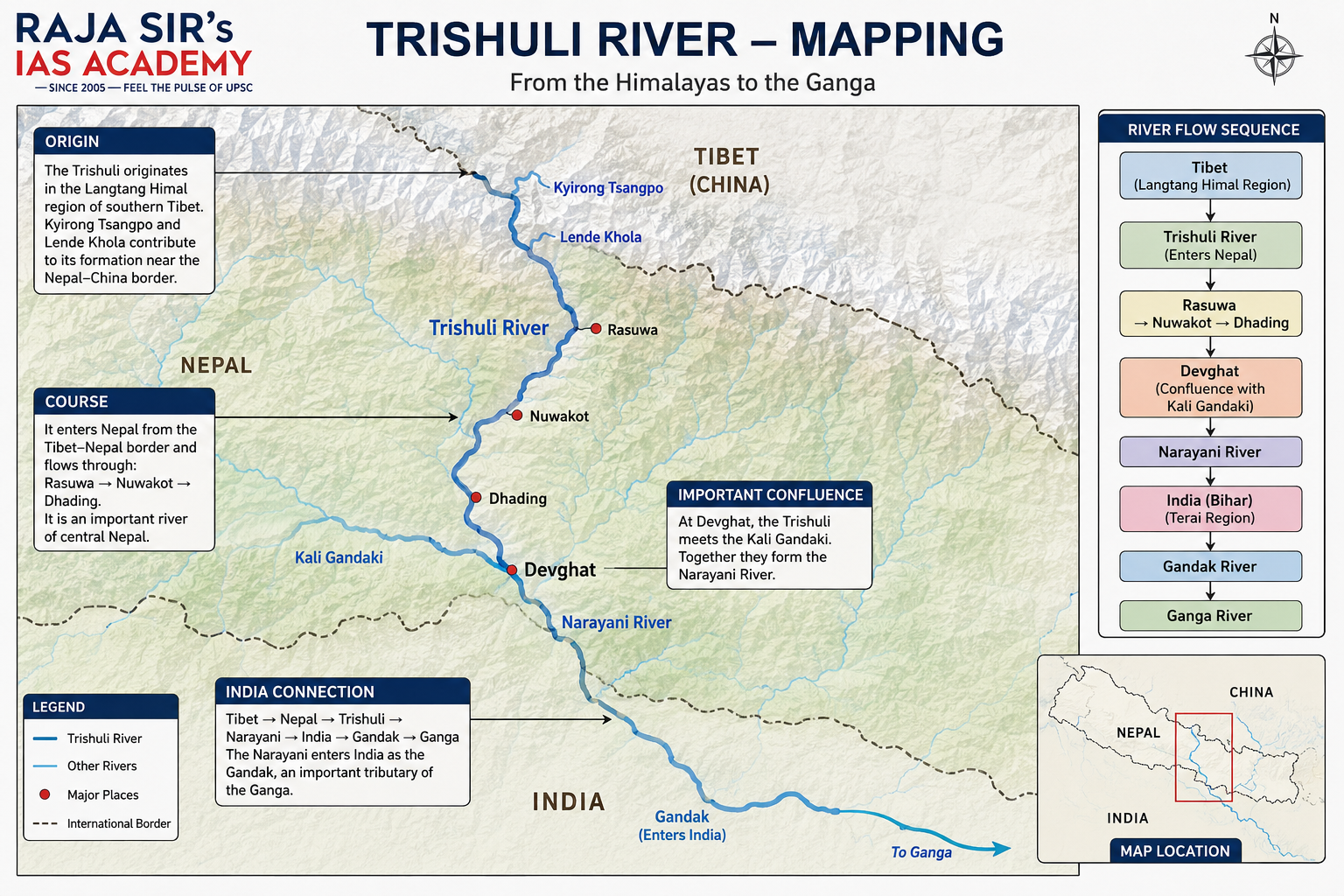
Trishuli River
Prelims | Geography
Why in News?
The Trishuli River system came into focus following the Nepal flash-flood disaster.
Origin
The Trishuli originates in the Langtang Himal region of southern Tibet. Kyirong Tsangpo and Lende Khola contribute to its formation near the Nepal–China border.
Course
- It enters Nepal from the Tibet–Nepal border.
- Flows through Rasuwa → Nuwakot → Dhading.
- It is an important river of central Nepal.
Important Confluence
At Devghat, the Trishuli meets the Kali Gandaki. Together they form the Narayani River.
India Connection
- Tibet → Nepal → Trishuli → Narayani → India → Gandak → Ganga
- The Narayani enters India as the Gandak.
- The Gandak is an important tributary of the Ganga.
|
|
Uranium Mining and Processing in Meghalaya
GS Paper II & III | Federalism + Tribal Rights + Energy Security
Why in News?
Meghalaya Assembly opposed uranium mining and ore-processing facilities in the state. The issue reflects long-standing concerns of local communities in South West Khasi Hills.
Aim
The challenge is to balance nuclear energy needs with tribal rights and environmental protection.India wants to increase domestic access to uranium for its nuclear-energy programme.
Significance
- Strategic Resource : Uranium is essential for nuclear power generation.
- Energy Security : Domestic uranium reduces dependence on foreign sources of nuclear fuel.
- Tribal Rights : Meghalaya has strong customary and community-based land ownership systems.
- Sixth Schedule : Meghalaya enjoys special constitutional protection for tribal areas and local institutions.
- Federalism : The issue tests the balance between Central strategic interests and State/local concerns.
Impact
- Energy : Opposition can delay domestic uranium extraction and processing.
- Environment : Mining may create concerns over water, soil and radioactive waste management.
- Society : Lack of local acceptance can lead to protests and prolonged conflicts.
- Governance : It tests whether development projects adequately respect tribal and customary rights.
Way Forward
- Consult local communities before taking major decisions.
- Conduct independent environmental and health assessments.
- Ensure safe radioactive-waste management.
- Provide transparent benefit-sharing with affected communities.
- Protect customary land and tribal rights.
- Follow a consensus-based Centre–State approach.
|
Posted on 27-08-2026 • By Admin