



 Latest News
DECEMBER 10, 2025
Tsunami Warning in Japan
- A tsunami warning was issued in Japan following an earthquake of magnitude 7.6.
- An earthquake is the shaking of the Earth’s surface caused by seismic waves produced by the sudden release of energy from movements in the Earth’s crust or upper mantle.
Tsunami
- A tsunami is a series of powerful ocean waves caused by the sudden, large-scale displacement of water, usually in oceans or large lakes.
- The term “tsunami” is a Japanese word meaning “harbour wave.”
- Major Examples: Include the 2004 Indian Ocean tsunami caused by a magnitude 9.1–9.3 earthquake near Sumatra, and the 2011 Japan tsunami caused by a magnitude 9.0 undersea quake.
Causes of Tsunamis
- Earthquakes: It is the most common cause (about 80%). Megathrust earthquakes at subduction zones with a magnitude of 7.0 or above mainly trigger tsunamis.
- Landslides: Coastal or submarine landslides can violently displace water, creating large waves near the source that diminish with distance.
- Volcanic Activity: Explosive underwater eruptions or the collapse of volcanic islands can push large water volumes upward, generating tsunamis.
- Other Causes: Large oceanic meteorite impacts or underwater explosions can cause tsunami-like waves.
Characteristics of Tsunami Waves
- Speed: In deep oceans, tsunamis may travel at over 800 km/h, yet appear only as low, broad swells.
- Wavelength: They have extremely long wavelengths, often hundreds of kilometres between crests.
- Shoaling Effect: As they enter shallow water, speed drops, but wave height and force increase dramatically, sometimes surpassing 10m at the shore.
- Wave Train: Tsunamis arrive as a series of waves minutes to hours apart, often preceded by a sudden recession of water from the shore.
Karnataka Hate Speech Bill, 2025
- Karnataka has introduced the Hate Speech and Hate Crimes (Prevention) Bill, 2025, to create India’s first State-level law explicitly defining hate speech.
Key Provisions of Karnataka Hate Speech Bill, 2025
- Explicit Definition: Covers expressions causing injury, hostility, or disharmony based on religion, caste, sex, gender identity, sexual orientation, race, disability, or place of birth.
- Punishment Range: Imprisonment from 2 to 10 years with fines, based on severity and recurrence.
- Collective Liability: If a crime is linked to an organisation, office-bearers can be held as culprits.
- Online Regulation: The State is empowered to remove or restrict digital content carrying hate speech.
- Suo Motu Action: Enables police to act without a formal complaint in specified circumstances.
India’s Legal Framework Against Hate Speech
- BNS Section 196 (Ex-153A IPC): Penalises promoting enmity between groups on grounds of religion, race, language, etc.
- BNS Section 299 (Ex-295A IPC): Punishes deliberate acts intended to outrage religious feelings.
- BNS Section 353: Penalises statements likely to incite offences against State or disturb public order.
- IT Act 2015 (Section 66A): Previously used for online content, struck down by the Supreme Court (Shreya Singhal Judgement) for being vague and overbroad.
- Tehseen Poonawalla Judgment (2018): Mandated nodal officers to prevent hate crimes and mob violence, especially related to targeted group attacks.
Challenges in Hate Speech Regulation
- Low Convictions: Only 1 in 5 cases under Sec. 153A result in conviction (20.2%, NCRB).
- Over-criminalisation Risk: 2,000+ arrests annually, but weak evidence collection leads to acquittals.
- Online Escalation: 70% hate speech content originates online/off social media (NCRB).
- Subjective Definition: SC noted (2023) that difficulty in “defining hate speech objectively” leads to misuse.
- Political Influence: Hate speech FIR filings rise by 30–50% before elections (Common Cause study, 2022).
Way Forward
- Clear Definition: Adopt harm-based definitions (incitement + targeting) to avoid vague interpretation. (Law Commission 267th Report).
- Independent Nodal: Create independent nodal authorities outside the police chain for hate speech monitoring. E.g. UK’s Crown Prosecution Service Hate Crime Units.
- Digital Protocols: Mandate 48-hour takedown windows and traceability for repeat hate content pages.
- Evidence Standards: Develop forensic documentation protocols for voice/video hate content to improve conviction. E.g. Delhi Police Cyber Forensics Lab protocols for hate speech.
India-UK Defence Partnership
- India and the UK are deepening defence cooperation through joint exercises and a 10-year Defence Industrial Roadmap signalling a stronger Indo-Pacific partnership.
India–UK Defence Partnership
- Operational Interoperability: Regular high-end exercises strengthen joint warfighting skills and trust; E.g., Ajeya Warrior 2025 trained both armies in complex multi-domain operations in Rajasthan.
- Maritime Cooperation: Shared Indo-Pacific priorities push both navies to coordinate on sea control and air defence; E.g., KONKAN 2025 saw INS Vikrant operate with HMS Prince of Wales.
- Defence Industrial Synergy: Complementary strengths allow co-production. E.g., 10-year Defence Industrial Roadmap supports Make in India while boosting UK defence manufacturing.
- High-Value Defence Deals: Government-to-government agreements boost strategic trust; E.g., the £350-million deal to supply Lightweight Multirole Missiles (LMM) to the Indian Army.
- Advanced Technology Collaboration: Joint work on emerging propulsion enhances future capabilities; E.g., UK–India cooperation on maritime electric propulsion for Indian naval platforms.
Potential of India–UK Defence Partnership
- Indo-Pacific Stability: Joint carrier operations and maritime coordination strengthen a rules-based order and deter coercive actions in critical sea lanes.
- Counter-Terror & Intelligence: Deeper information-sharing and joint training enhance India–UK capability to tackle cross-border terrorism and emerging hybrid threats.
- Resilient Supply Chains: Defence-industrial collaboration reduces dependence on single-source suppliers and supports secure, diversified global defence ecosystems.
- Humanitarian Operations: Combined expertise in logistics, airlift, and disaster relief boosts joint response capacity for regional crises, from evacuations to natural disasters.
- Emerging Tech Governance: Cooperation in cyber, AI-enabled defence systems, and space domain awareness helps shape global norms for responsible military technology use.
The Unit – a Pilot Gold Backed Digital Trade Currency
- Several reports and expert circles are speculating that BRICS may unveil a pilot gold-backed digital trade currency called “The Unit”, though no official announcement has been made yet.
Pilot Gold-Backed Digital Trade Currency
- A digital, blockchain-based settlement currency designed for cross-border trade within BRICS, backed by physical gold and BRICS national currencies.
Launched by:
- Developed as a pilot by the International Research Institute for Advanced Systems (IRIAS), supported informally by BRICS members.
Aim:
- Reduce reliance on the US dollar for international trade.
- Provide a stable, neutral settlement instrument anchored in gold.
- Build an alternative financial architecture for the Global South.
How It Works?
- 40% gold + 60% BRICS currency basket: The Unit’s value is anchored in physical gold while balancing currency exposure, ensuring stability and diversified risk across the five BRICS economies.
- Daily value recalibration: Its price updates every day based on gold rates and currency fluctuations, keeping the Unit aligned with real-world macroeconomic movements.
- Blockchain-based settlement (Cardano): Transactions run on a permissioned Cardano blockchain, enabling secure, traceable, tamper-proof settlement across countries.
- Not a national currency replacement: The Unit serves only as a cross-border settlement tool, reducing dollar dependence while leaving domestic monetary policy untouched.
Key Features
- Gold-anchored stability: Pegging to physical gold protects the Unit from extreme volatility and fiat currency shocks, making it a reliable trade-settlement medium.
- Transparency through blockchain: Blockchain ensures all transactions are auditable and immutable, reducing manipulation risks and increasing trust among BRICS members.
- AI-led governance: The AI-governed Unit Foundation minimizes political bias in decision-making, providing consistent oversight and automated, rules-based management.
- Reserve sovereignty: Member countries keep gold reserves domestically while still backing the Unit, avoiding the geopolitical risks of pooling gold offshore.
- Improves gold liquidity: By using gold in active trade settlement rather than storage, the Unit increases gold’s transactional role and deepens global gold-market liquidity.
Significance
- Major step toward de-dollarisation by offering a non-Western settlement option.
- Strengthens BRICS’ role in global monetary reform and south-south cooperation.
- Potential to become the first large-scale gold-backed digital settlement system if scaled.
Boreendo
- UNESCO has inscribed Pakistan’s Boreendo, a rare clay vessel-flute linked to the Indus Valley musical tradition, on the Intangible Cultural Heritage in Need of Urgent Safeguarding list.
What it is?
- The Boreendo is a spherical clay vessel-flute, producing mellow, breathy tones used in folk melodies, pastoral songs and winter gatherings in Sindh.
- Origin: It originates from Keti Mir Muhammad Lund in Sindh, with roots tracing back to Mohenjo-daro artefacts, indicating a long sonic lineage from the Indus Valley Civilization.
Characteristics
- Terracotta Craft: Handmade from sun-dried and kiln-fired clay, keeping the instrument fully eco-friendly.
- Spherical Vessel Design: Egg-shaped hollow body with 1 inlet and 3–5 holes enables simple melodic variation.
- Tilt-Based Sound Control: Pitch and tone shift by tilting the mouthpiece rather than complex fingering.
Indus Valley Flute Tradition
- Archaeological excavations at Mohenjo-daro and Harappa have revealed terracotta and bone flutes, some nearly identical to the modern Boreendo.
- Flute fragments were found at Mohenjo-daro, Harappa, and adjoining sites of the Indus Valley Civilization (3300–1300 BCE).
Key Characteristics
- Made from clay, bone, or shell.
- Carefully drilled finger holes; sometimes uneven spacing (microtonal scales).
- Cylindrical or spherical forms similar to today’s vessel flutes.
- Evidence suggests both solo and group musical performances.
50 Years of CITES
- CITES marked its 50th anniversary at CoP20 in Samarkand, Uzbekistan, where member nations adopted major species protection decisions and debated livelihoods, sustainable use, and wildlife trade governance.
What Is CITES?
- CITES (Convention on International Trade in Endangered Species of Wild Fauna and Flora) is a legally binding multilateral treaty regulating international trade in wild animals and plants to ensure it does not threaten species survival.
History:
- Conceived by IUCN (1963) and text finalized in 1973 (Washington D.C.).
- Entered into force on 1 July 1975.
- Membership: 185 Parties (as of 2025), making it one of the world’s largest conservation agreements.
- Operates through three Appendices (I, II, III) providing graded trade restrictions.
Key Functions of CITES:
- Regulates international wildlife trade via permits and certificates.
- Maintains Appendices that assign protection levels based on extinction risk.
- Coordinates enforcement against illegal wildlife trade.
- Promotes sustainable use, scientific assessment, and global cooperation.
CITES Summit (CoP20):
- The 20th Conference of the Parties (CoP20) is the decision-making summit held every 2–3 years, shaping global wildlife trade policy.
Host:
- Hosted by Uzbekistan (Samarkand) — first CoP in Central Asia.
- Marked the 50th anniversary of CITES.
Major Outcomes
- Species Additions & Uplistings
- 77 species added to CITES Appendices.
- Sharks & rays (oceanic whitetip, whale shark; all manta & devil rays) added to Appendix I.
- Galápagos land iguanas (3 species) and marine iguana added to Appendix I.
- African reptiles such as Home’s hinge-back tortoise added to Appendix I.
- Downlistings due to Conservation Success:
- Saiga antelope (Kazakhstan) removed from Appendix II with export flexibility.
- Guadalupe fur seal (Mexico) downlisted from Appendix I added to II.
India’s Role:
- India successfully opposed EU proposal to list guggul (Commiphora wightii) in Appendix II, citing lack of scientific assessment.
Thailand–Cambodia Border Tension
- Renewed fighting has erupted along the Thailand–Cambodia border, with artillery, rockets, drones and airstrikes used by both sides, causing rising civilian and military casualties.
What the conflict is?
- A long-running border dispute along their 817 km undemarcated frontier, rooted in colonial-era mapping.
- Both sides claim sovereignty over specific stretches near ancient temple complexes and forested highlands.
Historical Background
Colonial-Era Mapping (1907):
- The border was first mapped by France (colonial ruler of Cambodia) in 1907; Thailand (then Siam) later contested parts of this map, especially around ancient temples and high ground.
Preah Vihear Temple Dispute:
- In 1962, the International Court of Justice (ICJ) awarded the Preah Vihear temple to Cambodia, but Thailand disputes parts of the surrounding territory.
- In 2013, the ICJ reaffirmed Cambodia’s sovereignty over land around the temple and asked Thailand to withdraw forces, but Bangkok has questioned the ruling’s scope.
Periodic Armed Flare-Ups:
- Major clashes occurred in 2008–2011, including a deadly artillery exchange in 2011 around Preah Vihear and nearby temples, killing soldiers and civilians and displacing thousands.
Recent Escalations in 2025:
- Tensions rose after May 2025 skirmishes and a Thai soldier’s death, followed by stricter border measures and trade bans.
Places and Areas Under Tension
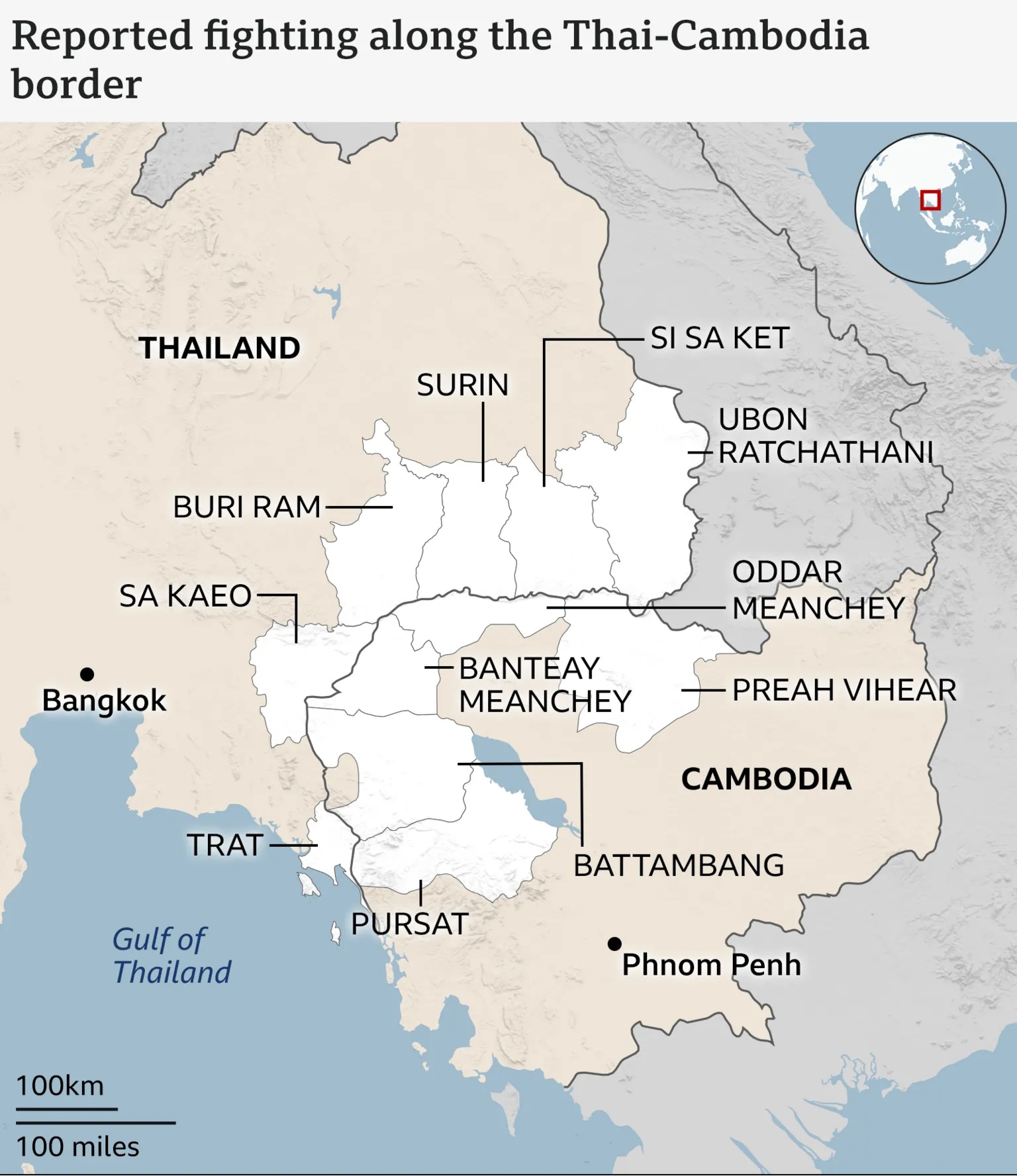
Preah Vihear Region:
- Hilltop UNESCO World Heritage temple and surrounding high ground remain symbolic and strategic flashpoints.
- Mekong River is the major waterway in Preah Vihear Province, featuring significant spots like the Preah Nimith Waterfall
Border Provinces (Thailand):
- Surin, Buri Ram, Sa Kaeo, Sisaket, Trat – reports of shelling, cross-border fire, and large-scale evacuations into temporary shelters.
Border Provinces (Cambodia):
- Adjacent districts in Oddar Meanchey, Preah Vihear, Banteay Meanchey, Battambang, Pailin, Koh Kong seeing civilian casualties, infrastructure damage, and internal displacement.
Breaking the Plastic Wave 2025
- The Pew Charitable Trusts released the “Breaking the Plastic Wave 2025” report to assess rising plastic pollution impacts and propose system-wide solutions.
Key Findings of the Study
Plastic Production
- Growth: Global plastic pollution will more than double from 130 Mt in 2025 to 280 Mt by 2040.
- Output: Annual primary plastic production will rise 52% by 2040, increasing twice as fast as waste-management capacity.
- Waste Gap: The global share of uncollected plastic waste will nearly double from 19% in 2025 to 34% by 2040.
Health Impacts
- Health Burden: Plastic-related health impacts are projected to increase by 75% by 2040.
- Costs Burden: Annual costs of health effects from plastic chemicals have exceeded US$1.5 trillion.
- Toxic Chemicals: Of the ~16,000 chemicals used in plastics, at least 25% are harmful to human health.
Climate & Microplastic
- Emission Surge: Greenhouse gas emissions from the plastic system will rise 58%, reaching 4.2 Gt CO₂-equivalent by 2040.
- If treated as a country, the plastic industry would become the world’s third-largest emitter.
- Microplastic: Pollution from microplastics is expected to increase by more than 50% by 2040.
- Major Sources: Microplastics account for 13% of plastic pollution in 2025, mainly from tyre wear and paint, agriculture, and recycling.
Key Recommendations for System Transformation
- Reduce virgin plastic production and shift toward reuse and refill systems.
- Mandate strict design standards to remove hazardous chemical additives from the supply chain.
- Expand collection and sorting systems in the Global South.
- Extend regulations beyond packaging to agriculture, construction, automotive and microplastics.
UNESCO Recognises Deepavali as Intangible Cultural Heritage
- UNESCO inscribed Deepavali on its Representative List of the Intangible Cultural Heritage (ICH) of Humanity during the 20th ICH Committee session hosted at New Delhi’s Red Fort.
- Deepavali becomes India’s 16th element on UNESCO’s ICH list, following recent additions such as Kumbh Mela (2017), Kolkata Durga Puja (2021) and Garba of Gujarat (2023).
- UNESCO: UN specialised agency (est. 1945) promoting cooperation in education, science, & culture; headquartered in Paris, with 194 members (India a founding member) and 12 associate members.
Deepavali
- Origins: A 2,500-year-old Indian festival with roots in ancient harvest celebrations, later assimilated into multiple religious traditions across regions.
- Hindu Traditions: Marks Rama’s return to Ayodhya, Lakshmi’s birth, Krishna’s defeat of Narakasura, and the Pandavas’ return – symbolising victory of light, dharma and renewal.
- Other Religions: Observed as Mahavira’s Nirvana (Jainism), Bandi Chhor Divas marking Guru Hargobind’s release (Sikhism), and Tihar/Newar Buddhist observances in Nepal.
- Cultural Practices: Celebrated over five days (Dhanteras to Bhai Dooj) with diyas, pujas, home decoration, gifting, and region-specific rituals across India and Nepal.
- Deepavali drives major economic activity across textiles, gold, handicrafts, fire crackers and e-commerce; increasingly observed globally with official recognition in several countries.
20th UNESCO ICH Committee Session
- India is hosting the 20th session of the Intergovernmental Committee for Safeguarding Intangible Cultural Heritage from 8-13 December 2025 at the Red Fort, New Delhi.
- Agenda: Examine new nominations for inscription, assess safeguarding reports, review listed elements, decide on international assistance, and discuss best practices for safeguarding “living heritage.”
- Participation: Involves 800+ delegates from 180+ countries, including Committee members, UNESCO officials, experts, accredited NGOs and ICH practitioners.
- Significance: Enhances India’s cultural diplomacy and soft power, showcases national heritage, strengthens cooperation with UNESCO, and positions India as a leader in global heritage discourse.
Sudden Stratospheric Warming
- Meteorologists have warned that a Sudden Stratospheric Warming (SSW) event might occur in December 2025.
- SSW is a rapid rise in temperature of up to 50°C within a few days in the stratosphere.
- It is triggered by Rossby waves rising upward from the troposphere that dissipate in the stratosphere, transferring energy and momentum.
- This weakens the strong, circulating polar winds called the polar vortex; as the air stops spinning, it compresses due to deceleration, and heats up significantly.
- The warmed air mass in the stratosphere then spreads downward, disrupting the jet stream and letting cold Arctic air spill into the mid-latitudes.
- Surface Impact: It causes prolonged cold spells, snowstorms, and unusual weather in North America, Europe, and Asia, with effects appearing after 1 to 3 weeks.
- The polar vortex is a year-round low-pressure, cold-air region around the poles, which becomes strongest in winter. “Vortex” refers to the anticlockwise airflow that keeps colder air near the Poles.
- Rossby waves are large-scale bends in high-altitude winds and ocean currents caused by Earth’s rotation and variations in Coriolis forces.
Cosmic Filaments
- Researchers have recently identified a cosmic filament approximately 50 million light-years long that contains at least 14 galaxies.
- Uniqueness: The galaxies were spinning in the same direction as the filament, in a coordinated motion that current models did not predict.
- Significance: The discovery indicates that ‘cosmic-web’ structures strongly influence how galaxies gain angular momentum and develop.
- The cosmic web is the large-scale structure of the universe, a vast, intricate network that shows how matter organises itself across billions of light-years.
Cosmic Filaments
- Cosmic filaments are extensive, thread-like structures that link galaxy clusters, creating the vast cosmic web network.
- They are the universe’s largest known structures, often extending hundreds of millions of light-years.
- Composition: They mainly consist of invisible dark matter, intergalactic gas, and galaxies.
- Formation: Gravity initially compressed matter into sheets, which then further collapsed at their intersections to form long, thin filaments.
- Structural Role: They form the backbone of the universe’s structure and act as cosmic highways that channel pristine gas and smaller galaxies from surrounding voids toward dense clusters.
- Significance: Filaments govern galaxy formation and growth; they impact galaxy structure, spin, and star-formation rates.
Bharat Ranbhoomi Darshan
- Sikkim is hosting a supercar rally under Bharat Ranbhoomi Darshan initiative, covering key border routes to promote battlefield and border tourism.
Bharat Ranbhoomi Darshan
- A digital platform (mobile app + web portal) developed by the Ministry of Defence with the Ministry of Tourism to enable public access to India’s historic battlefields and border sites.
- Covers 77 sites along the Line of Actual Control (LAC) and Line of Control (LoC) such as Galwan Valley, Doklam, Longewala and Nathu La, previously restricted due to security sensitivity.
- Aims to boost border tourism and awareness of military history while offering virtual tours, key historical content, route details, and a single-window permit system for restricted border sites.
POSTED ON 10-12-2025 BY ADMIN
Next previous  General Studies
Political Science and International Relations
Some Reference Essays
List of previous year essay topics (1997-2019)

IAS GOOGLE is googled by the team of Raja Sir’s Cracking IAS Academy. Sources include The Hindu, Indian Express, pib.nic.in, Down To Earth, Economic Times, Vigyan Prasar, AIR and the like. IAS GOOGLE has been prepared in pace with emerging UPSC Trends.