|
Agasthyamalai Biosphere Reserve: Conservation vs Livelihoods
GS-III: Environment | Biodiversity | Forest Governance | Tribal Issues
Why in News?
The Supreme Court ordered time-bound eviction of forest encroachments in the Agasthyamalai Biosphere Reserve, triggering concerns and protests among affected communities in Tamil Nadu.
About
Location: Southernmost Western Ghats — Tamil Nadu & Kerala.
UNESCO: Part of the Man and the Biosphere (MAB) Programme.
Ecosystem: Predominantly tropical forests.
Genetic reservoir: Cardamom, pepper, nutmeg, jamun and plantain.
Protected areas include:
- Shendurney Wildlife Sanctuary
- Peppara Wildlife Sanctuary
- Neyyar Wildlife Sanctuary
- Kalakad–Mundanthurai Tiger Reserve
- ·Indigenous community: Kani tribes.
Biodiversity Significance
- Rich diversity of mammals, birds, reptiles, amphibians and fishes.
- Important Western Ghats biodiversity landscape.
- Conserves valuable plant genetic resources.
Key Concerns
- Forest encroachment and habitat degradation.
- Livelihood dependence of indigenous communities.
- Relocation/eviction-related social distress.
- Need to distinguish genuine encroachment from traditional forest dependence.
- Potential conflict between conservation objectives and community rights.
Way Forward
- Rights-based conservation: Implement the Forest Rights Act, 2006 wherever applicable.
- Participatory management: Involve Kani communities in conservation.
- Scientific demarcation: Identify genuine encroachments through transparent surveys.
|
|
Building a Future-Ready Human Capital Partnership
GS-II: International Relations | GS-III: Education, Skill Development, AI
Why in News?
13th BRICS Education Ministers’ Meeting concluded in Bhubaneswar, Odisha, under India''s BRICS Chairship 2026.
Objectives
- ECCE & Foundational Learning: Build strong early-stage literacy, numeracy and learning foundations.
- TVET & Skills: Align skills with emerging industry and employment needs.
- AI & Innovation: Promote safe, ethical and human-centric AI in education.
- Academic Mobility: Facilitate cross-border student, faculty and research exchanges.
- Mutual Recognition: Enable easier recognition of qualifications across BRICS.
- Research Cooperation: Promote joint research, innovation and start-up collaboration.
Significance for India
- Human Capital: Strengthens India’s demographic dividend through better skills and education.
- Global Academic Mobility: Expands opportunities for Indian students and researchers.
- Research Ecosystem: Enables access to BRICS knowledge, technology and innovation networks.
- South-South Cooperation: Positions India as a leader in Global South education ooperation.
- Start-up Ecosystem: Creates opportunities for cross-border innovation and collaboration.
Way Forward
- Standardise qualifications for smoother academic mobility.
- Map emerging skill gaps collectively across BRICS.
- Expand joint research & innovation programmes.
- Develop ethical AI frameworks for education.
- Strengthen student/faculty exchanges and STEM scholarships.
|
|
Colombia: Earthquake & Geographical Significance
GS-I: World Geography | GS-III: Disaster Management
Why in News?
A major earthquake struck western Colombia, highlighting the country’s high tectonic vulnerability.
Mapping :
- Location: Northwestern South America
- Capital: Bogotá
- Borders: Panama (NW), Venezuela (E), Brazil (SE), Peru (S), Ecuador (SW)
- Water bodies: Caribbean Sea (N), Pacific Ocean (W)
Major Geographical Features:
- Andes: Cordillera Occidental, Central and Oriental
- Rivers: Magdalena and Cauca
- Llanos Orientales: Eastern plains
- Amazon Basin: Southeast
- Sierra Nevada de Santa Marta: Isolated mountain massif on Caribbean coast
Why Earthquake-Prone?
Located near the interaction of the Nazca, Caribbean and South American plates, generating active subduction zones and faults.
Earthquake Risk = Hazard × Exposure × Vulnerability
- Hazard: Seismic activity
- Exposure: Population and infrastructure in risk zones
- Vulnerability: Weak buildings and inadequate preparedness
Way Forward
- Earthquake-resistant construction: Enforce seismic building codes.
- Seismic zoning: Identify and regulate high-risk areas.
- Monitoring & early warning: Strengthen seismic networks and alerts.
- Retrofitting: Strengthen vulnerable buildings and critical infrastructure.
- Community preparedness: Regular drills and public awareness.
- Response capacity: Improve emergency services, evacuation and relief systems.

|
|
Creamy layer for SC/ST
GS-II: Polity | Social Justice | Reservation
Why in News?
The Union Government opposed extending the creamy-layer exclusion to SC/ST reservations before the Supreme Court.
What is the Creamy Layer Concept?
The creamy layer doctrine excludes the socially and economically advanced sections within a backward class from availing reservation benefits so that affirmative action reaches the genuinely disadvantaged.
Case Studies:
- Indra Sawhney v. Union of India (1992): Creamy layer principle introduced for OBCs(27% ) to prevent advanced sections from cornering reservation benefits.
- M. Nagaraj v. Union of India (2006): Upheld reservation in promotion for SC/STs subject to constitutional conditions; stressed adequate representation and administrative efficiency.
- Jarnail Singh v. Lachhmi Narain Gupta (2018): Applied the creamy-layer principle in SC/ST promotion reservations, aiming to prevent repeated benefits accruing to advanced sections.
- •State of Punjab v. Davinder Singh (2024): Allowed sub-classification within SCs so that the most disadvantaged groups can receive a greater share of reservation benefits.
Constitutional Provisions
Article 341 – Scheduled Castes : Article 342 – Scheduled Tribes
Under these Articles:
- The President notifies SC/ST lists.
- Only Parliament can include or exclude communities from these lists.
Reservation Framework :
- Article 15(4) – Special provisions for socially and educationally backward classes, SCs and STs.
- Article 16(4) – Reservation in public employment.
- Article 16(4A) – Reservation in promotion for SCs/STs.
- Article 46 – Promotion of educational and economic interests of weaker sections, especially SCs/STs.
Arguments for Applying Creamy Layer to SC/STs
- Prevents Elite Capture : A small advanced segment may repeatedly secure reservation benefits, limiting opportunities for the most deprived members.
- Promotes Intra-group Equity : Ensures equitable distribution of benefits among all sections within SC/ST communities.
- Supports First-generation Beneficiaries : Helps extend reservation benefits to those who remain underrepresented.
- Reflects Socio-economic Mobility : Recognises that some families have significantly improved their socio-economic status over generations.
- Strengthens Substantive Equality : Ensures affirmative action reaches those who continue to face severe disadvantages.
Arguments Against Applying Creamy Layer
- Caste Discrimination Persists Beyond Income : Even economically advanced SC/ST individuals may continue to face social stigma and discrimination.
- Reservation is Not an Anti-poverty Programme : SC/ST reservations address historical oppression and exclusion rather than economic deprivation alone.
- Income is an Imperfect Indicator : Economic advancement may not eliminate social backwardness.
- Constitutional Distinction : Unlike OBCs, SCs/STs were included in the Constitution because of entrenched caste-based discrimination.
- Risk of Reduced Representation : Excluding advanced SC/ST members could reduce their representation in higher education and public employment.
Way Forward :
- Evidence-based assessment: Use actual representation data to identify who remains disadvantaged.
- Updated caste & socio-economic data: Helps design targeted and objective reservation policies.
- Strengthen sub-classification: Ensure benefits reach the most deprived groups within SC/ST categories.
- Targeted support: Scholarships, hostels, coaching and skills can help first-generation learners.
- Anti-discrimination measures: Tackle caste-based discrimination alongside reservation.
|
|
Glueballs: Bound States of Gluons
GS-III: Science & Technology | Particle Physics
Why in News?
Scientists have reported potential evidence for glueballs, exotic particles predicted to arise from the self-interaction of gluons.
About
- Glueball: Hypothetical bound state made entirely of gluons.
- Gluons: Force carriers of the strong nuclear force.
- Unique feature: Gluons can interact with one another because they carry colour charge.
Fundamental forces & carriers:
- Strong force → Gluons
- Weak force → W and Z bosons
- Electromagnetic force → Photons
- Gravity → Graviton (hypothetical; not experimentally detected)
Significance
- Understanding QCD: Helps scientists test Quantum Chromodynamics, the theory describing the strong nuclear force.
- Gluon self-interaction: Provides evidence for the unique property of gluons to interact with each other.
- Quark confinement: Helps explain why quarks and gluons are normally confined within composite particles.
- Structure of matter: Offers insights into how strong-force interactions create different forms of matter.
- Particle physics: A confirmed glueball would provide an important test of the Standard Model and our understanding of strong interactions.
|
|
Hallaniyat Islands: Oil Spill & Marine Biodiversity
GS-I: Geography | GS-III: Environment, Biodiversity & Marine Pollution
Why in News?
An oil spill occurred near the Hallaniyat Islands off southern Oman, threatening sensitive marine ecosystems.
About
- Country: Oman
- Location: Arabian Sea
- Former name: Kuria Muria Islands
- Number: Five islands
- Ecological significance: Important marine biodiversity and turtle-nesting zone.
Biodiversity
- Loggerhead, Green & Hawksbill turtles - important nesting habitat.
- Arabian Sea humpback whales - isolated population in surrounding waters.
- Dolphins - Spinner and Risso’s dolphins.
- Coral reefs and diverse marine ecosystems.
- Seabirds - important breeding and nesting grounds.
- Why Geographically Important?
Located in the Arabian Sea near important maritime routes, making the islands ecologically sensitive to shipping-related pollution and oil spills.
Environmental Impact
- Threatens coastal and marine biodiversity.
- Can affect fisheries and local livelihoods.
- Oil contamination may have long-term ecosystem impacts.
Significance for India
- Highlights risks to Arabian Sea marine ecosystems.
- Relevant to India’s blue economy and maritime security.
- Reinforces the need for regional cooperation on marine pollution and oil-spill response.
Way Forward
- Stronger tanker monitoring and maritime surveillance.
- Rapid oil-spill response and containment mechanisms.
- Strengthen Marine Protected Area (MPA) management.
|
|
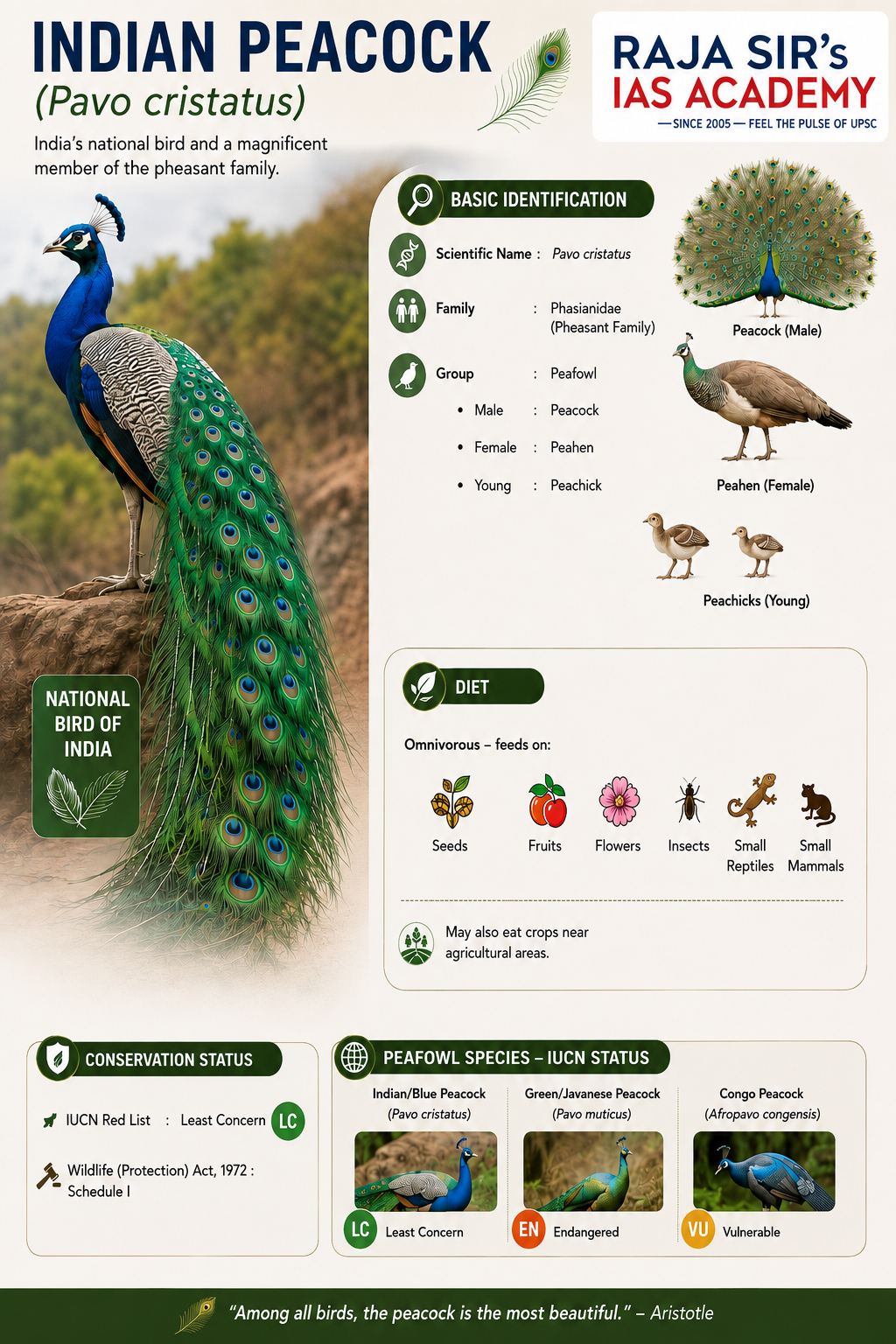
Indian Peafowl
GS-III: Environment | Biodiversity
Why in News?
India presented five Indian peafowls to the UN Office at Geneva, including a rare white-feathered male.
Feature Fact
Diet Omnivorous
Distribution Indian subcontinent
Family Phasianidae
IUCN Least Concern
National Bird India, 1963
Scientific name Pavo cristatus
Special feature Sexual dimorphism
WPA 1972 Schedule I
White-feathered individuals can result from leucism, where pigmentation is reduced/absent in feathers while eyes retain normal pigmentation.
Habitat Distribution
- Open forests, Agricultural landscapes, Grasslands, Scrublands, Human-dominated landscapes.
- Native range includes India and Sri Lanka.
- In India, mainly found in plains and low hills.
- Usually occurs up to around 1,000 m, with occasional higher records.
|
|
Lake Mead: A Warning on Water Security Under Climate Stress
GS-I: Geography | GS-III: Environment | Water Security
Why in News?
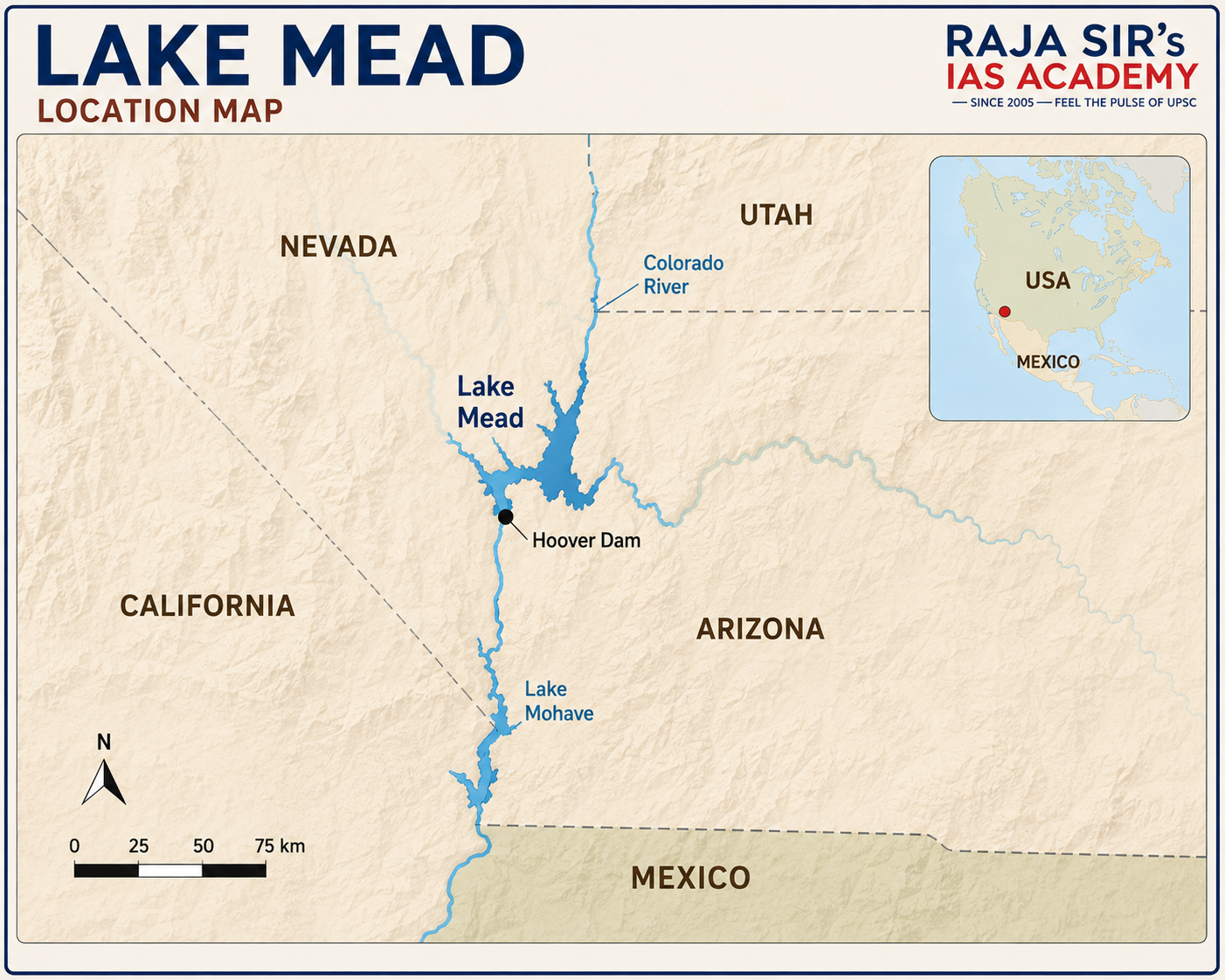
Lake Mead recorded an exceptionally low water level, highlighting growing water stress in the Colorado River Basin.
Location: Arizona–Nevada border, USA
River: Colorado River
Created by: Hoover Dam
Near: Las Vegas
Companion reservoir: Lake Powell
Major uses: Drinking water, irrigation and hydropower
Water-sharing countries: USA and Mexico
Colorado River Basin States: Arizona, California, Colorado, New Mexico, Nevada, Utah and Wyoming
Causes of Decline
- Low snowpack: Reduced Rocky Mountain snowmelt lowers river inflow.
- Megadrought: Prolonged drought has reduced water availability.
- Climate change: Higher temperatures increase evaporation and water demand.
- Over-allocation: Legal water commitments exceed sustainable river flows.
- Rising demand: Agriculture, cities and industries increase withdrawals.
Significance
- Water Security: Threatens water supply for millions in the US Southwest.
- Energy Security: Falling reservoir levels can reduce Hoover Dam’s hydropower generation.
- Agriculture: Water shortages can affect irrigation-dependent farming.
|
|
Leveraging Soft Power for Global Influence
GS-II: International Relations | GS-I: Indian Culture
Why in News?
India is increasingly using culture as a strategic diplomatic tool to strengthen international partnerships, people-to-people ties and its global influence.
What is Cultural Diplomacy?
Using culture, heritage, traditions, arts and shared values to build mutual understanding and advance national interests.
Significance for India
- Soft Power: Yoga, Bollywood, cricket, cuisine and Indian arts enhance India’s global appeal.
- Diaspora Engagement: Diaspora communities act as cultural bridges between India and host countries.
- Stronger Relations: Cultural exchanges create long-term people-to-people connections alongside formal diplomacy.
- Tourism & Economy: Indian heritage, cuisine and traditions promote tourism and cultural industries.
- Civilisational Connect: Buddhist and maritime heritage strengthens ties with countries across Asia.
- Global Image: Cultural outreach projects India as a diverse, plural and civilisational power.
Key Initiatives
Global Engagement Scheme (GES)
- Umbrella framework for India’s bilateral and multilateral cultural cooperation.
- ICEP: Festivals of India, artist exchanges and cultural programmes.
- Project Mausam: Revives historical maritime connections across the Indian Ocean.
- Brihattar Bharat: Highlights India’s historical and civilisational links.
- ICH Scheme: Safeguards India’s intangible cultural heritage.
ICCR
- Promotes Indian culture abroad through cultural centres, exhibitions, scholarships and exchanges.
Heritage Diplomacy
- MEA + ASI collaborate on restoration of heritage sites abroad, such as Angkor Wat and Ta Prohm in Cambodia.
Diaspora Initiatives
- Pravasi Bharatiya Divas (PBD)
- Know India Programme (KIP) — connects diaspora youth with India’s culture, heritage and contemporary development.
Challenges
- Risk of cultural diplomacy becoming event-oriented rather than sustained engagement.
- Need to represent India’s cultural diversity adequately.
- Limited institutional coordination and resources.
- Cultural outreach must avoid appearing as cultural projection or propaganda.
Way Forward
- Cultural diversity: Showcase India’s diverse traditions globally.
- Digital outreach: Use digital platforms to expand cultural engagement.
- Diaspora partnerships: Leverage the diaspora as cultural bridges.
- Heritage conservation: Protect and promote India’s cultural heritage.
NAVYA
GS-II: Social Justice | Women & Child Development | Skill Development
Why in News?
Government is strengthening vocational training and employability of adolescent girls through the NAVYA programme.
About :
- NAVYA = Nurturing Aspirations through Vocational Training for Young Adolescent Girls
- Launched: 2025
- Ministries: Ministry of Skill Development & Entrepreneurship + Ministry of Women & Child Development.
- Implemented under: PMKVY 4.0
- Target group: Adolescent girls aged 16–18 years.
- Expansion: 100 Aspirational Districts
- Includes On-the-Job Training (OJT).
Focus Areas
- Vocational skills: Job-oriented skills matching industry needs.
- Digital literacy: Builds basic digital and technology skills.
- Financial literacy: Develops knowledge of money management and financial services.
- Career readiness: Helps girls prepare for jobs and career choices.
Significance for India
- Female employability: Improves girls’ skills and future job opportunities.
- Workforce participation: Encourages greater participation of women in the economy.
- Demographic dividend: Converts India’s young population into productive human capital.
- Bridging gaps: Reduces gender and skill gaps, especially in Aspirational Districts.
Way Forward
- Market-linked skills: Align training with current and future industry demand.
- Quality OJT: Provide practical workplace exposure to improve job readiness.
- Digital inclusion: Strengthen digital and financial literacy, especially for girls with limited access.
- Industry partnerships: Involve industries in curriculum design, training and recruitment.
- Placement tracking: Monitor employment outcomes and provide post-training support.
|
|
NCDC Amendment Bill 2026: Strengthening India’s Cooperative Development Architecture
GS-II: Statutory Bodies | Cooperative Sector | GS-III: Agriculture
Why in News?
- NCDC Amendment Bill, 2026 introduced in Lok Sabha.
- Full form: National Co-operative Development Corporation
- Established: 1963
- Parent law: NCDC Act, 1962
- Nature: Statutory corporation
- Ministry: Ministry of Cooperation
Functions
- Loans & Grants: Provides financial assistance to cooperatives for development activities.
- Agricultural Processing: Supports processing and value addition of agricultural produce.
- Storage & Cold Chains: Finances warehouses, cold storage and related infrastructure.
- Marketing: Helps cooperatives improve market access and farmer returns.
- Inclusive Development: Supports women, SC/ST and small-farmer cooperatives.
Existing NCDC Framework 2026 Amendment Bill
Focuses on programmes through cooperative societies Broader focus on overall cooperative development
Funding primarily linked to cooperative societies Enables funding to cooperatives and supporting entities
Limited scope for capital participation Allows share-capital participation, subject to approval
Narrower definition of foodstuffs Includes processed/notified food items
Certain geographical restrictions Removes geographical restrictions for specified financing
Existinginformation-sharing framework Enables enhanced credit-information sharing with Centre, RBI and banks
|
|
Ozone Layer
GS-III: Environment | Climate Change
Why in News?
Scientists detected an unusually thick ozone layer over the North Bay of Bengal, highlighting regional variations in atmospheric ozone.
About
- Location: Mainly in the stratosphere, ~15–40 km above Earth.
- Role: Absorbs harmful ultraviolet (UV) radiation, especially UV-B.
- Ozone-depleting substances (ODS): CFCs, HCFCs, halons, carbon tetrachloride and methyl chloroform.
- Major effects of depletion: Skin cancer, cataracts, crop damage and harm to marine organisms.
- Key agreement: Montreal Protocol (1987) — controls production and consumption of ODS.
Significance
- Human health: Reduces UV-B exposure, lowering risks of skin cancer and cataracts.
- Agriculture: Protects crops and plants from UV-induced damage.
- Marine ecosystems: Safeguards phytoplankton and aquatic food chains.
- Climate & environment: Ozone protection supports atmospheric stability and ecosystem health.
- Global cooperation: Demonstrates the success of international environmental agreements like the Montreal Protocol.
|
|
PAIMANA
GS-III: Infrastructure | Governance | Investment
Why in News?
PAIMANA is monitoring 1,847 ongoing Central infrastructure projects as of June 2026.
About
- Full Form: Project Assessment, Infrastructure Monitoring and Analytics for Nation-Building.
- Launched: 2025
- Ministry: MoSPI
- Replaced: Online Computerized Monitoring System (OCMS-2006)
- Coverage: Central Sector infrastructure projects costing ₹150 crore and above.
- Nature: Web-based, data-driven project monitoring platform.
- PAIMANA-CRIP: Launched in July 2026 as a Central Repository of Infrastructure Projects.
Significance
- Transparency: Enables better tracking of project progress.
- Efficiency: Identifies delays and implementation bottlenecks.
- Data-driven governance: Supports evidence-based decision-making.
- Coordination: Improves monitoring of large infrastructure projects.
- Fiscal efficiency: Helps minimise time and cost overruns.
|
|
Paramutation
GS-III: Biotechnology | Genetics | Epigenetics
Why in News?
New research has provided evidence suggesting that paramutation may occur naturally in mammals.
About
- What is it? : One copy of a gene can change or silence the expression of another copy without changing its DNA sequence.
- How? : Through epigenetic changes, especially DNA methylation.
- Important: The change can sometimes be passed to future generations.
- Why important? : It shows that inheritance is influenced not only by DNA sequence but also by gene regulation.
Significance
- Helps understand epigenetics and gene regulation.
- Challenges the traditional understanding of heredity.
- May improve research into genetic diseases and biological processes.
|
|
Submarine Fan
GS-I: Geography | GS-III: Science & Technology, Energy
Why in News?
Scientists from NCPOR mapped a large submarine fan and channel–levee system in the Arabian Sea.
About
- Submarine fan: Fan-shaped accumulation of sediments on the deep-sea floor.
- Formation: Mainly through turbidity currents carrying sediments downslope.
- Major components: Canyons → Channels → Lobes
- Largest: Bengal Fan is the world’s largest submarine fan.
- Economic significance: Sand-rich deposits can act as potential hydrocarbon reservoirs.
Significance
- Improves understanding of deep-sea sediment transport.
- Helps reconstruct past climate and geological processes.
- Supports exploration of marine mineral and hydrocarbon resources.
- Enhances knowledge of Arabian Sea seabed morphology.
|
|
Tribunals Reforms Bill, 2026
GS-II: Polity | Judiciary | Tribunals
Why in News?
The Tribunals Reforms Bill, 2026 seeks to restructure India’s tribunal system and strengthen its independence, efficiency and accountability.
Tribunals
- Quasi-judicial bodies for specialised dispute resolution.
- Help reduce the burden on constitutional courts.
National Tribunals Commission (NTC)
Proposes a 5-member statutory body:
- 1 Chairperson
- 2 Judicial Members
- 2 Technical Members
Key Features
- CJI consultation: Adds judicial input to specified appointments.
- Selection committees: Ensures structured and transparent recruitment.
- Time-bound appointments: Prevents prolonged vacancies.
- Standardised tenure: Creates uniform service conditions and stability.
- Tribunals Data Grid: Enables digital tracking of cases, pendency and performance.
Existing Challenges
- Vacancies & delays: Unfilled posts slow dispute resolution.
- Executive influence: Government control may affect tribunal independence.
- Uneven service conditions: Different tribunals follow inconsistent rules.
- Infrastructure deficits: Limited staff, technology and facilities affect efficiency.
- Fragmented administration: Different ministries managing tribunals creates coordination problems.
Significance
- Greater independence: Reduces excessive executive influence.
- Faster justice: Streamlines appointments and case management.
- Specialisation: Enables expert handling of technical disputes.
- Transparency: Data Grid improves monitoring.
- Judicial efficiency: Helps reduce the burden on regular courts.
Core Constitutional Issue
- Judicial Independence ↔ Executive Control
- The reform must balance administrative efficiency with institutional autonomy and separation of powers.
Way Forward
- Independent appointments: Ensure merit-based and transparent selection free from undue executive influence.
- Financial autonomy: Provide adequate independent funding for effective functioning.
- Adequate infrastructure: Strengthen staff, courtrooms, technology and support systems.
|
|
Urban Air Pollution: Why NCAP Is Falling Short
GS-III: Environment | Pollution | Urbanisation
Why in News?
Government data shows that more than 80% of cities covered under NCAP continue to exceed National Ambient Air Quality Standards (NAAQS), indicating gaps in achieving clean-air targets.
About NCAP
- Launched: 2019 by MoEFCC.
- Coverage: 130 cities across 24 States/UTs.
- Approach: City-specific Clean Air Action Plans, performance-linked funding and inter-ministerial convergence.
- Target: Up to 40% reduction in PM10 and PM2.5 concentrations or achievement of NAAQS.
- PRANA: Online portal for monitoring implementation of NCAP.
NAAQS
- Notified by CPCB in 2009.
- Covers 12 pollutants.
- Annual standards: PM10: 60 µg/m³ PM2.5: 40 µg/m³
Why Cities Continue to Exceed Norms?
- Vehicular emissions: Rapid growth in urban traffic.
- Road & construction dust: Major source of particulate pollution.
- Industrial emissions: Concentrated industrial activity around cities.
- Waste burning: Open burning adds particulate matter and toxic pollutants.
- Seasonal factors: Weather conditions can trap pollutants near the surface.
- Implementation gaps: Weak enforcement and fragmented urban governance.
Significance
- Public health: Persistent PM pollution increases respiratory and cardiovascular risks.
- Urban sustainability: Highlights the need for integrated clean-air planning.
- Governance: Shows that targets require stronger implementation and monitoring.
- Climate co-benefits: Cleaner transport and energy systems can reduce both air pollutants and greenhouse gases.
Existing Measures
- GRAP: Emergency pollution-control measures in Delhi-NCR.
- BS-VI norms: Tighter vehicular emission standards.
- PRANA: Digital monitoring of NCAP implementation.
- PM e-Bus Sewa & PM E-DRIVE: Promote cleaner urban mobility.
- Nagar Van Yojana: Expands urban green spaces.
- Scheme convergence: Links NCAP with SBM-U, AMRUT and other urban programmes.
Way Forward
- Source-based monitoring: Identify and control pollution from specific sources.
- Clean mobility: Promote public transport, EVs and non-motorised transport.
- Dust management: Control road and construction dust through better practices.
- Industrial compliance: Strengthen emission standards, inspections and enforcement.
- Emission inventories: Use scientific data to identify major pollution sources.
|