AUGUST 13, 2026 CURRENT AFFAIRS
|
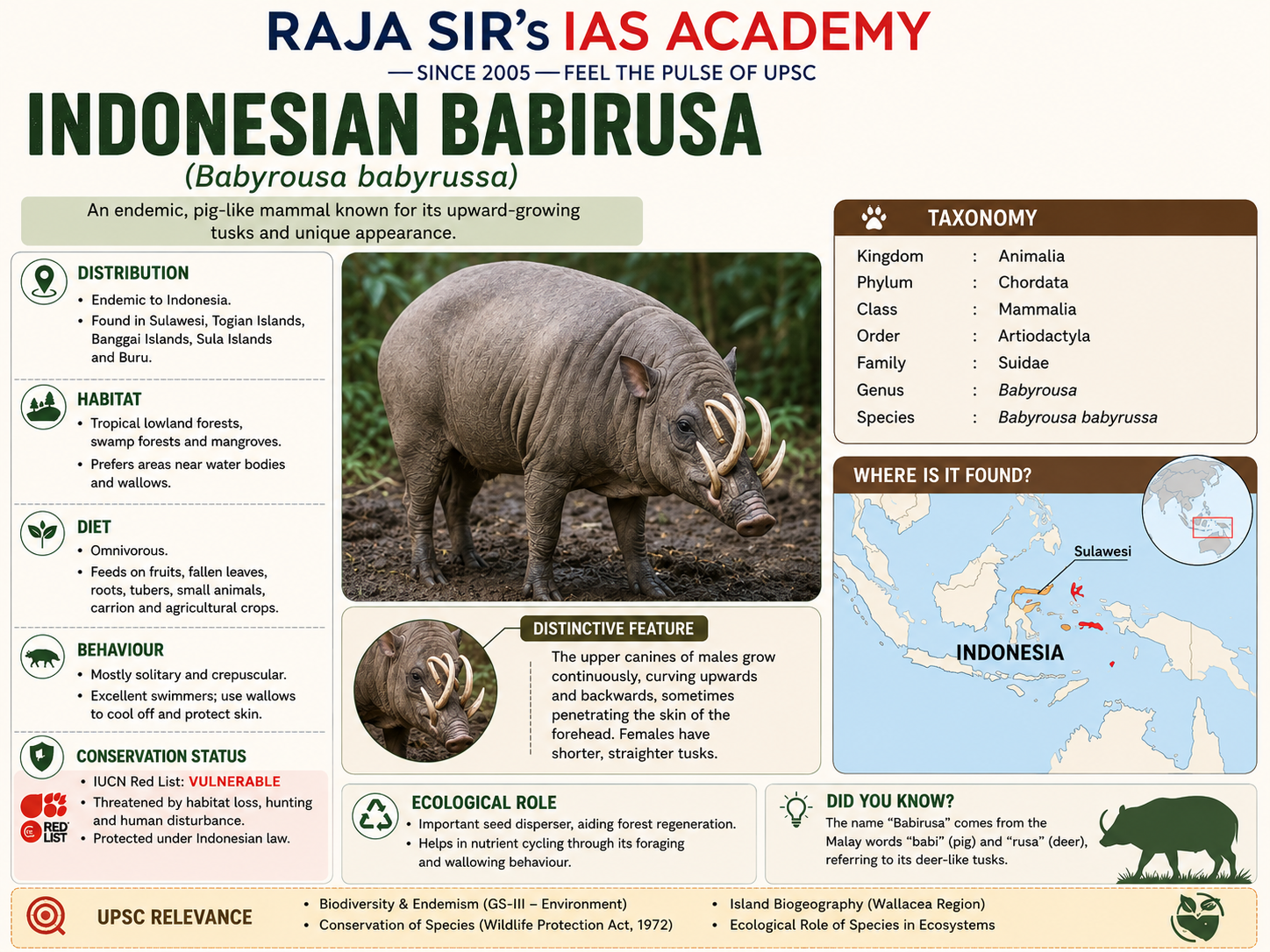
Babirusa: A Living Relic Under Conservation Pressure
GS: GS-III – Environment & Biodiversity
Why in News?
A rare babirusa piglet was born at Chester Zoo amid threats to wild populations.
Significance
- Unique biodiversity: Represents a distinctive wild-pig lineage.
- Ecological role: Supports seed dispersal and forest regeneration.
- Conservation value: Captive breeding provides a genetic safeguard.
- Distribution - Endemic to Indonesia - Sulawesi, Togian, Sula and Buru Islands.
- Habitat :Tropical rainforests, swamps, wetlands and riverine areas
- IUCN Status - Vulnerable
Key Features
- Male tusks: Upper canines grow upward through the snout and curve backward.
- Low reproduction: Usually 1–2 piglets per litter.
- Appearance: Sparse hair; piglets lack typical wild-pig stripes
- Diet:Omnivorous - roots, insects, leaves and other vegetation.
Impact
- Ecosystem health: Population decline can affect forest ecological processes.
- Genetic conservation: Captive breeding can maintain threatened genetic diversity.
- Disease threat: African swine fever adds pressure on wild populations.
|
|
Cess Conundrum: Targeted Welfare vs Fiscal Federalism
GS: GS-III – Economy | Fiscal Federalism
Why in News?
Himachal Pradesh imposed a widow and orphan cess on petrol and diesel.
Significance
- Targeted revenue: Generates funds for a specific welfare purpose.
- Fiscal flexibility: Governments can create dedicated revenue streams.
- Federal concern: Union cesses are excluded from the divisible pool.
Impact
- Welfare financing: Can provide additional resources for targeted schemes.
- Higher fuel burden: Fuel-based cess can increase consumer costs.
- Devolution concern: Greater Union reliance on cesses can reduce the tax pool shared with States.
Way Forward
- Use cesses for clearly defined purposes.
- Ensure transparency in utilisation.
- Avoid excessive dependence on cesses.
|
|
Elephants of India: Corridors, Conflict & Conservation
GS: GS-III – Environment | Biodiversity
Why in News?
World Elephant Day (August 12) highlighted India''s elephant conservation efforts.
Significance
- Keystone species: Elephants help maintain ecosystem structure.
- Ecosystem engineer: Create pathways and modify habitats.
- Seed dispersal: Support forest regeneration and biodiversity.
Impact
- Habitat connectivity: Protected corridors facilitate elephant movement.
- Human-wildlife conflict: Habitat fragmentation increases conflict.
- Railway mortality: Train collisions remain a conservation challenge.
Way Forward
- Protect and restore elephant corridors.
- Strengthen railway mitigation measures.
- Improve community-based conflict management.
- Reduce habitat fragmentation.

|
|
Keralam: Language, Identity & Constitutional Federalism
GS: GS-II – Polity | Federalism
Why in News?
Parliament passed the Kerala (Alteration of Name) Bill, 2026.
Significance
- Cultural identity: Recognises the State''s Malayalam linguistic identity.
- Federal process: Demonstrates interaction between State and Union institutions.
- Constitutional relevance: Involves Article 3 and the First Schedule.
Constitutional Basis — Article 3
- Article 3(e) empowers Parliament to alter the name of an existing State.
- The change requires modification of the First Schedule, which contains the names and territorial extent of States and UTs.
Procedure
- State Legislature’s Resolution : Kerala Legislative Assembly passed a resolution on 24 June 2024, requesting the Centre to change the name to Keralam.
- President’s Recommendation: A Bill under Article 3 cannot be introduced in Parliament without the President’s recommendation.
- Reference to State Legislature : The President refers the Bill to the concerned State Legislature for its views within a specified period.
- State’s Views — Not Binding : The State Legislature’s opinion is consultative, not binding on Parliament. In this case, Kerala Assembly unanimously agreed with the Bill.
- Parliamentary Approval : The Bill is considered and passed by both Houses of Parliament by a simple majority; it is not a constitutional amendment under Article 368.
- President’s Assent :After passage by Parliament, the Bill goes to the President for assent. On commencement, the constitutional and consequential references are updated.
Impact
- Administrative change: Official documents and institutions will require nomenclature changes.
- Identity consolidation: Reinforces regional linguistic-cultural identity.
- Precedent value: Highlights Parliament''s power to alter State names.
Way Forward
- Ensure smooth administrative transition.
- Maintain linguistic-cultural recognition alongside national integration.
|
|
One Herb, One Standard: Standardising India’s Traditional Medicine
GS: GS-II – Health | GS-III – Science & Technology
Why in News?
AYUSH and Health Ministries renewed cooperation under the One Herb, One Standard initiative.
What is it?
A joint initiative of the Ministry of AYUSH and Ministry of Health & Family Welfare.
Aim : To establish uniform quality standards for medicinal herbs used in Ayurveda and other traditional systems of medicine.
Key Features
- Standardisation: Develops common standards for the identity, purity and quality of medicinal plants.
- Pharmacopoeial standards: Promotes harmonisation of standards across Ayurvedic Pharmacopoeia of India (API) and Indian Pharmacopoeia (IP).
- Quality assurance: Helps ensure consistency and safety of herbal medicines.
- Scientific validation: Encourages collaboration between AYUSH and modern medicine institutions.
- Global acceptance: Harmonised standards can improve the credibility and export potential of Indian herbal products.
Significance
- Standardisation: Creates harmonised quality standards for medicinal herbs.
- Quality assurance: Reduces conflicting testing requirements.
- Traditional knowledge: Strengthens the credibility of Indian medicinal systems.
Impact
- Better safety: Uniform standards can improve quality control.
- Export potential: Internationally aligned standards can support AYUSH exports.
- Ease of compliance: A common standard simplifies testing for manufacturers.
Way Forward
- Develop more harmonised monographs.
- Strengthen scientific validation.
- Align standards with international benchmarks
|
|
Panama Canal: The Water-Stressed Artery of Global Trade
GS: GS-I – World Geography | GS-III – Infrastructure & Trade
Why in News?
Shipping disruptions and drought-related restrictions increased congestion and transit costs at the Panama Canal.
Significance
- Global chokepoint: Connects Atlantic and Pacific maritime routes.
- Trade efficiency: Reduces the distance and time required for shipping.
- Strategic importance: Influences global supply chains and maritime trade.
Impact
- Higher shipping costs: Congestion increases transit expenses.
- Supply-chain disruption: Delays can affect global commodity movement.
- Climate vulnerability: Water scarcity can constrain canal operations.
Way Forward
- Improve water-management systems.
- Develop resilient maritime supply chains.
- Diversify alternative shipping routes.

|
|
Rethinking Food Entitlements: From Household to Individual
GS: GS-II – Social Justice | GS-III – Food Security
Why in News?
The draft Bill proposes 7 kg/person for AAY households, subject to a 35-kg household ceiling.
Significance
- Rational allocation: Attempts to address differences between small and large AAY households.
- Equity focus: Moves towards a more individual-based entitlement.
- Nutrition debate: Reopens discussion on whether food security should move beyond cereals.
Impact
- Small households: Some small AAY households could receive less than the existing 35-kg entitlement.
- Large households: Per-person allocation could improve support until the 35-kg ceiling.
- Nutrition concerns: Cereal-based support alone may not adequately address malnutrition.
Way Forward
- Protect vulnerable small households from benefit loss.
- Update beneficiary coverage.
- Add pulses, millets and other nutritious foods to PDS.
- Strengthen last-mile delivery.
|
|
Threads of Empowerment: Women Weavers & India’s Loom Heritage
GS: GS-I – Culture | GS-II – Women | GS-III – Handloom
Why in News?
The Ministry of Textiles organised Srijan: Voices from the Loom to recognise women weavers.
Significance
- Cultural preservation: Recognises traditional weaving knowledge.
- Women empowerment: Highlights women''s contribution to the handloom sector.
- Heritage promotion: Strengthens awareness of India''s handloom traditions.
Impact
- Livelihood support: Greater visibility can improve opportunities for women artisans.
- Inter-generational transmission: Encourages continuation of traditional skills.
- Market potential: Recognition can help promote Indian handloom products.
Way Forward
- Improve credit and market access.
- Promote digital marketing and exports.
- Strengthen social-security coverage.
|
|
UPI@10: From Digital Revolution to Payment Sustainability
GS: GS-III – Economy | Digital Economy
Why in News?
UPI completed 10 years amid debate over the sustainability of the zero-MDR model.
Significance
- Financial inclusion: Enables low-cost digital payments across sections of society.
- Digital public infrastructure: UPI demonstrates India''s interoperable payment architecture.
- Formalisation: Digital transactions reduce dependence on cash.
Impact
- Payment revolution: UPI has become a dominant mode of non-cash transactions.
- Merchant expansion: QR-based payments have increased digital acceptance among small businesses.
- Sustainability concern: High infrastructure and fraud-prevention costs challenge the zero-MDR model.
Way Forward
- Use calibrated MDR for large merchants.
- Protect consumers and small merchants from excessive charges.
- Increase competition among payment apps.
- Expand cross-border UPI linkages.
|
Posted on 13-08-2026 • By Admin