|
Arresting Arbitrariness: Strengthening Constitutional Safeguards on Personal Liberty
Why in News?
The Supreme Court in Vihaan Kumar v. State of Haryana (2025) reiterated that merely informing a relative about an arrest is not equivalent to informing the arrested person of the grounds of arrest.The grounds must be communicated effectively in a language understood by the arrested person. Non-compliance can vitiate the arrest and subsequent remand.
Constitutional basis
- Article 22(1): Right to be informed of grounds of arrest and right to consult a legal practitioner.
- Article 22(2): Production before nearest magistrate within 24 hours, excluding journey time.
- Article 21: Protection of life and personal liberty.
- Articles 14, 19 & 21: Constitutional "Golden Triangle".
Case studies :
- D.K. Basu case (1997): Safeguards against custodial abuse.
- Arnesh Kumar case (2014): Arrest should not be automatic, particularly for offences punishable with imprisonment up to seven years.
- Vihaan Kumar case: Meaningful communication of grounds is a constitutional requirement.
Significance
- Strengthens Article 22 : Ensures that the right to know the grounds of arrest is meaningful, not merely a procedural formality.
- Protects Personal Liberty :Prevents arbitrary deprivation of liberty and reinforces Article 21 safeguards.
- Strengthens Judicial Oversight: Requires magistrates to scrutinise the legality of arrest before authorising remand.
- Promotes Rule of Law : Ensures that police and executive powers remain subject to constitutional procedures.
Impact
- Reduces Arbitrary Arrests : Encourages police to arrest only when legally necessary and justified.
- Improves Police Accountability : Proper documentation makes investigating agencies more accountable for their actions.
- Strengthens Legal Remedies : Better information enables the accused to effectively challenge an unlawful arrest.
- Reduces Custodial Abuse : Clear arrest procedures can reduce the scope for illegal or informal detention.
Challenges
- Routine Arrest : Police may still make arrests without adequately demonstrating necessity under the law.
- Complex Legal Language : Technical language may prevent the arrested person from actually understanding the grounds of arrest.
- Informal Detention: Delays in officially recording arrest can create scope for unauthorised custody.
- Weak Implementation : Constitutional safeguards may exist on paper but face poor enforcement in practice.
Way Forward
- Simple Communication : Grounds of arrest should be communicated in clear and understandable language.
- Digital Arrest Records : Use time-stamped digital records to prevent manipulation of arrest timings.
- Mandatory Documentation : Arrest memos should clearly record the time, place and grounds of arrest.
- Officer Accountability : Non-compliance should attract departmental and legal consequences.
|
|
From Assembly Lines to Global Value Chains: India’s Manufacturing Push
Why in News?
NITI Aayog released “Key Sectors to Position India as a Global Manufacturing Hub – Volume I”, identifying four high-potential sectors:
- Chemicals
- Textiles & Apparel
- Telecom & Networking Equipment
- Solar PV Manufacturing
Important Data
- Manufacturing contribution remains around 17.5% of GVA.
- India wants to move towards a USD 30 trillion economy by 2047.
- Solar manufacturing faces major upstream dependence, particularly in polysilicon and wafers.
Why Manufacturing Matters for India
- Employment : Manufacturing can absorb India''s expanding working-age population into productive employment.
- Export Competitiveness : A stronger manufacturing base can diversify India''s export basket.
- Import Substitution : Domestic production of critical inputs reduces external vulnerabilities.
- Technology Upgradation : Moving from assembly to component manufacturing increases domestic value addition.
Major Challenges
- Import Dependence - Critical raw materials and intermediate goods remain heavily import-dependent.
- Inverted Duty Structure - Inputs can sometimes face higher taxation than finished products, reducing domestic competitiveness.
- MSME Fragmentation - Small-scale production limits economies of scale and technology adoption.
Impact
Positive Impact
- Employment: Expansion of manufacturing can create more formal and productive industrial jobs.
- Exports: Stronger domestic capabilities can increase India’s integration into global value chains.
- FDI: Stable policies and competitive industrial ecosystems can attract greater foreign investment.
- Resilience: Domestic and diversified supply chains can reduce exposure to global disruptions.
Possible Risks
- Protectionism: Excessive tariff protection may shelter inefficient firms and reduce global competitiveness.
- Subsidy dependence: Over-reliance on incentives may encourage firms that are not commercially viable.
- Environmental pressure: Rapid industrialisation may increase pollution and resource use without strong environmental safeguards.
- MSME marginalisation: Large industrial clusters may benefit bigger firms disproportionately unless MSMEs are integrated into supply chains.
Way Forward
- Integrated manufacturing clusters: Develop plug-and-play industrial ecosystems with shared infrastructure and utilities.
- Correct inverted duty structures: Ensure inputs are not taxed more heavily than finished products.
- Strengthen domestic feedstock: Reduce dependence on imported critical raw materials and intermediate goods.
- Promote R&D and technology transfer: Encourage innovation, joint ventures and acquisition of advanced technologies.
- Improve logistics: Strengthen ports, rail-road connectivity and multimodal transport to reduce costs.
|
|
JPCs as Legislative Safety Nets: Deepening Parliamentary Scrutiny
Why in News?
The Lok Sabha referred the Foreign Contribution (Regulation) Amendment Bill, 2026 to a JPC.
About
- JPC is not explicitly mentioned in the Constitution.
- It is an ad hoc parliamentary committee.
- Members come from both Lok Sabha and Rajya Sabha.
- Generally constituted through a motion adopted by one House and agreed to by the other.
- Chairperson is appointed as per parliamentary procedure.
- Can examine documents, hear stakeholders and submit recommendations.
- Members can submit Notes of Dissent.
Significance of JPCs
- Detailed scrutiny Examines : the Bill clause-by-clause and identifies legal, technical and practical issues.
- Expert consultation Seeks : inputs from subject experts, officials and specialists to improve the quality of legislation.
- Stakeholder participation : Provides an opportunity for affected groups and the public to present their views.
- Legislative improvement: Uses these inputs to suggest amendments, making the final law more effective, practical and comprehensive.
Impact
Positive
- Improves legislative scrutiny.
- Provides bipartisan examination.
- Can identify legal and administrative loopholes.
Limitation
- Recommendations are generally persuasive rather than binding.
- Effectiveness depends on political consensus and seriousness of follow-up.
|
|
Across the Empty Quarter: Building New Corridors Beyond Maritime Chokepoints
Why in News?
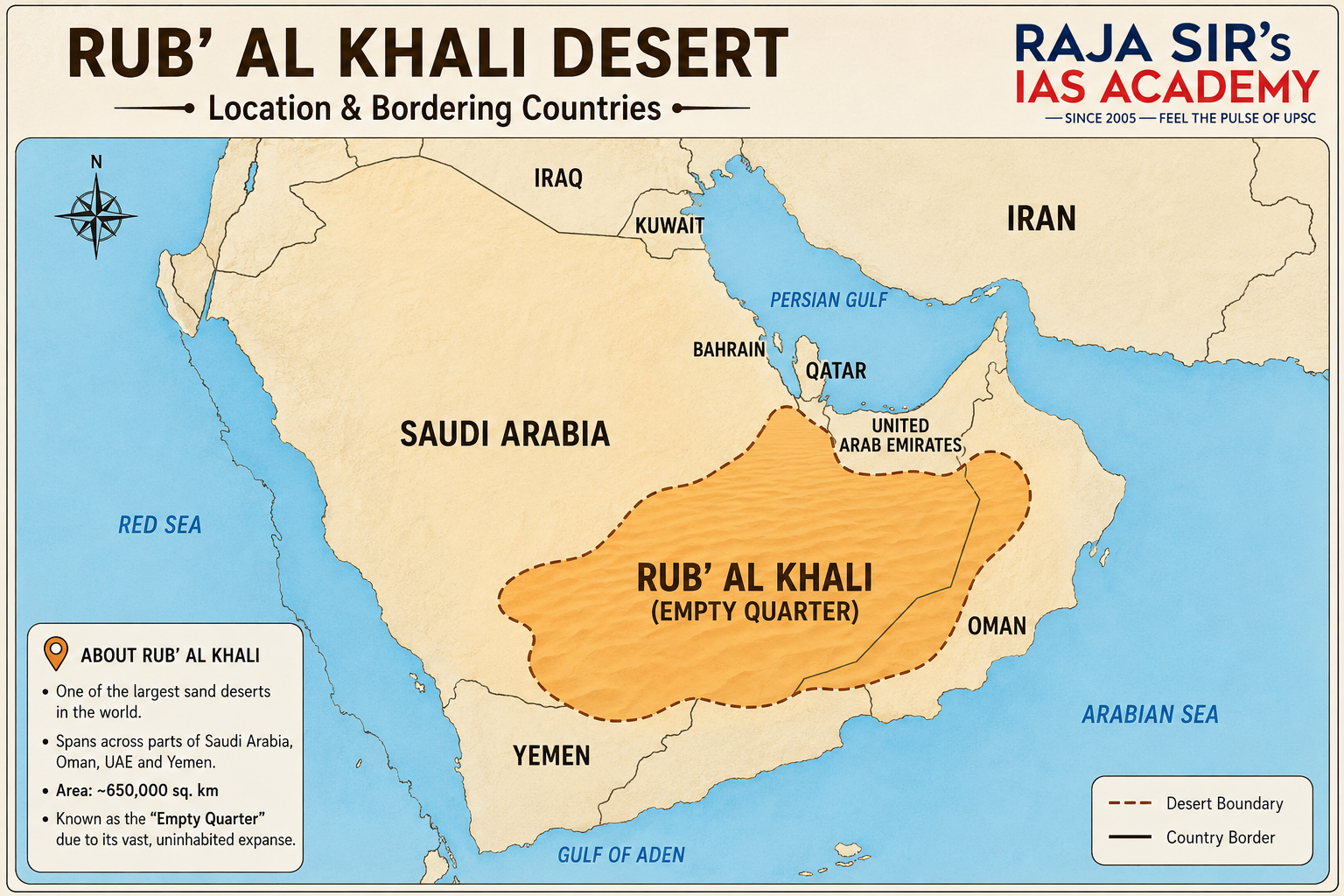
Oman and Saudi Arabia signed a cross-border freight arrangement using an overland route through the Rub'' al Khali, providing an alternative to maritime chokepoints.
Rub'' al Khali = Empty Quarter
- World''s largest continuous sand desert.
- Primarily located in Saudi Arabia.
Also extends into:
- Oman
- UAE
- Yemen
- Part of the Arabian Peninsula.
|
|
AI in Indian Languages: Bridging the Digital-Linguistic Divide
Why in News?
Researchers at IISc''s SPIRE Lab, with ARTPARK and Google, developed SraVaani, a multilingual automatic speech recognition model.
About
- Covers 65 Indian languages/dialects.
- Includes 20 scheduled languages.
- Includes 45 regional languages/dialects.
- Built on the Vaani dataset.
Significance
- Digital inclusion : Enables technology access across linguistic groups.
- AI : Strengthens Indian-language AI ecosystem.
- Governance : Can improve accessibility of digital public services.
|
|
Beyond Species Protection: Recognising India’s Frontline Elephant Guardians
Why in News?
The Gaj Gaurav Awards 2026 were conferred during the national celebrations of World Elephant Day 2026 held in Visakhapatnam, Andhra Pradesh. The awards recognise exemplary contributions to elephant conservation and management.
Gaj Gaurav Awards
- Recognise frontline conservation efforts towards elephant conservation and management.
- The 2026 awards recognised seven mahouts from Jaldapara National Park, West Bengal.
- Their contribution included rescuing six stranded captive elephants and helping 13 displaced wild rhinoceroses reach safety during floods.
Project Elephant
- Launched: 1992
- Type: Centrally Sponsored Scheme
- Ministry: Ministry of Environment, Forest and Climate Change
Major objectives:
- Conservation of elephants and their habitats
- Protection of elephant corridors
- Mitigation of Human–Elephant Conflict (HEC)
- Welfare of captive elephants
Major Initiatives in 2026
“30 Giant Steps”
A document highlighting 30 major achievements, milestones and conservation initiatives under Project Elephant during 2020–2026.
Regional Action Plan for Southern India
Covers four elephant-range States:
- Karnataka
- Kerala
- Andhra Pradesh
- Tamil Nadu
Financial support: ₹500 crore from the Government of India.
Human–Elephant Conflict
The 2026 approach emphasises a shift from “conflict management” towards “coexistence” through:
- Science-based decision-making
- AI and remote sensing
- Geospatial mapping
- Early-warning systems
- Community participation
- Habitat and corridor protection
- Coordination between States and agencies
Andhra Pradesh has adopted “Conflict to Coexistence” as its approach to HEC.
H.A.N.U.M.A.N. Initiative
Healing And Nurturing Units for Monitoring, Aid and Nursing of Wildlife .
- Focuses on wildlife monitoring and protection
- Uses technology, community participation and capacity building of frontline personnel.
|
|
Black-Necked Crane
Why in News?
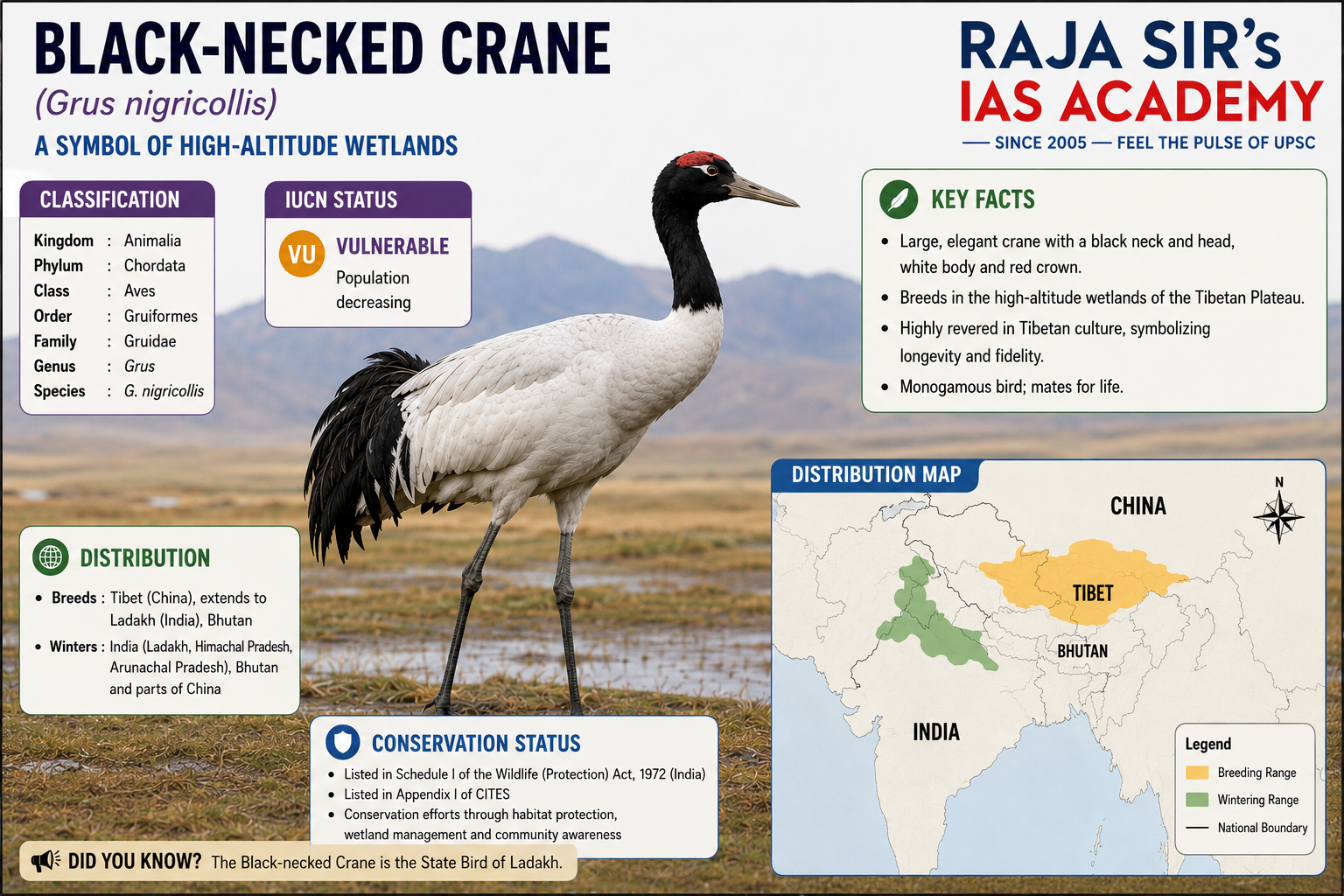
Ladakh hosted its first Black-Necked Crane Festival to promote conservation awareness.
- High-altitude crane.
- Found mainly around the Tibetan Plateau and eastern Ladakh.
- State Bird of Ladakh.
- Breeding area in India: Changthang region.
- IUCN: Near Threatened
- CITES: Appendix I
- Wildlife Protection Act: Schedule I
|
|
Demographic Dividend or Employment Deficit?
Why in News?
The ILO highlighted worsening youth employment challenges globally.
Key Data
- Youth unemployment: 12.4% in 2025
- Around 67 million unemployed youth.
- NEET youth: around 20% / 257 million.
- Women constitute more than two-thirds of NEET youth.
- Youth-to-adult unemployment ratio: 3.43.
Key Concerns
- AI : Some youth occupations face significant exposure to automation.
- Informality : Nearly 9 in 10 young workers in low/lower-middle-income countries are in informal employment.
- Gender : Care responsibilities and discrimination increase female NEET levels.
- Skill mismatch : Employers increasingly demand experience even for entry-level positions.
Significance for India
- Economic growth: A skilled workforce raises productivity and supports faster economic growth.
- Employment generation: Skills improve employability and help create productive jobs.
- Demographic dividend: Converts India’s large young population into a productive economic asset.
- Industrial competitiveness: Skilled workers strengthen manufacturing and services.
- Innovation: Digital and technical skills support entrepreneurship and technological advancement.
- Social stability: Better employment opportunities can reduce unemployment, inequality and social tensions.
Way Forward
- Apprenticeships: Provide practical, industry-based work experience.
- Industry-linked skilling: Align training with actual labour-market requirements.
- Green jobs: Prepare workers for renewable energy and other sustainable sectors.
- Digital skills: Build capabilities in AI, data, automation and digital technologies.
- Portable social security: Ensure workers retain benefits while changing jobs or locations.
- Better public employment services: Improve job matching, career guidance and placement support.
|
|
Exporting for Growth: India’s Push Towards a Competitive External Sector
Why in News?
India''s cumulative merchandise and services exports during April–July 2026–27 were estimated at about US$316.42 billion.
Key Figures
- Exports: US$316.42 bn
- Imports: US$365.85 bn
- Merchandise exports: US$173.78 bn
- Services exports: US$142.64 bn
Major Merchandise Export Drivers
- Petroleum products
- Electronic goods
- Engineering goods
- Chemicals
- Cotton yarn/textiles
|
|
GARUD High-Resolution Binoculars
Why in News?
India Optel Limited launched indigenous GARUD High Resolution Binoculars for the civilian market.
About
- Manufacturer: India Optel Limited
- Unit: Ordnance Factory, Dehradun
- Indigenous defence optical technology.
- 8× magnification
- Approximate weight: 610 g
- Derived from defence-grade optical technology.
Significance
- Defence-to-civilian technology transfer: Defence technologies can be adapted for civilian applications.
- Aatmanirbhar Bharat: Promotes indigenous development and reduces dependence on imports.
- Dual-use potential: Demonstrates how defence R&D can serve both military and civilian needs.
- DPSU diversification: Opens new civilian markets and revenue streams for Defence Public Sector Undertakings.
Possible Applications
- Wildlife observation: Enables non-intrusive monitoring of animals.
- Forestry: Supports forest surveillance and biodiversity monitoring.
- Research: Useful for scientific and field-based observations.
- Marine activities: Can assist in coastal and marine observation.
- Outdoor observation: Useful for surveillance and observation in difficult terrains.
|
|
Greening India: Plantation Targets to Ecological Outcomes
Why in News?
The CAG has highlighted serious implementation deficiencies in the Green India Mission (GIM).
The audit reported an approximately 98% shortfall against the forest-cover expansion target during 2015–16 to 2024–25.
Green India Mission
- Part of India''s National Action Plan on Climate Change (NAPCC).
- Focuses on increasing forest/tree cover and improving forest quality.
- Also seeks enhancement of ecosystem services and livelihood benefits.
Key Findings
- Target: Forest-cover expansion of 1.4 million hectares.
- Actual increase: Only around 0.03 million hectares.
- Major deficiencies: Planning, fund management, monitoring, scheme convergence and reporting.
Significance
- Outcome-based governance: Environmental schemes should measure actual ecological outcomes, not merely expenditure.
- Accountability: Weak monitoring can reduce transparency and reliability of reported achievements.
- Climate goals: Effective forest restoration is important for carbon sequestration and ecosystem resilience.
Impact
Environmental
- Lower carbon sequestration.
- Reduced biodiversity gains.
- Weaker ecosystem resilience.
Governance
- Weakens accountability.
- Raises concerns over the credibility of reported outcomes.
Way Forward
- GIS-based monitoring: Use satellite/GIS tools and third-party verification.
- Outcome-based funding: Link funding to measurable restoration outcomes.
- Social audits: Improve transparency through community oversight and public disclosure.
- Scheme convergence: Integrate efforts under CAMPA, MGNREGS and watershed programmes.
- Climate prioritisation: Focus restoration on climate-vulnerable landscapes.
- Community participation: Involve local communities in planning and restoration.
|
|
Kuril Islands
Why in News?
Japan protested a Russian presidential visit to the Kuril Islands, reflecting the continuing territorial dispute.
Location
Located between Kamchatka Peninsula and Hokkaido (Japan).
Forms a chain separating:
Sea of Okhotsk → Kuril Islands → Pacific Ocean
Extends from Russia’s Kamchatka Peninsula towards Japan’s Hokkaido.
Geographical Significance
- Volcanic island arc formed due to tectonic activity.
- Part of the Pacific Ring of Fire.
- Associated with the Kuril Trench and subduction of the Pacific Plate.
- Region is highly prone to earthquakes and volcanic activity.
Strategic Significance
- Territorial dispute: Japan and Russia continue to dispute sovereignty over the southern Kuril Islands, which Japan calls the Northern Territories.
- Maritime security: Controls access between the Sea of Okhotsk and the Pacific Ocean.
- Military importance: Strategic location for Russian naval and military deployments.
- Fisheries: Rich fishing grounds support economic activity.
|
|
Prambanan: India–Indonesia’s Shared Civilisational Heritage
Why in News?
India and Indonesia launched a project for restoration of the Prambanan Temple.
Located in Indonesia.
- Built around the 9th century.
- Largest Hindu temple compound in Indonesia.
- Dedicated principally to the Trimurti: Brahma, Vishnu, Shiva
- UNESCO World Heritage Site.
- Also known as Loro Jonggrang.
|
|
Rising Global Debt: Shrinking Fiscal Space in an Uncertain World
Why in News?
The IMF has highlighted the continuing rise in global public debt.
Key Facts
- Global debt was around 94% of global GDP in 2025.
- Could approach 100% by 2029.
- High debt ratios include Japan, Singapore and Sudan.
- India''s debt-to-GDP ratio is estimated at around 55.6% of GDP in BE 2026–27 in the material provided.
Significance
High public debt can:
- Reduce fiscal space.
- Increase debt-servicing burden.
- Constrain developmental expenditure.
- Increase vulnerability to interest-rate shocks.
|
|
River Board
Why in News?
The Chairperson of the Cauvery Water Management Authority suggested a unified River Board for integrated management of the Cauvery basin.
Constitutional Framework
- Entry 17 — State List - Water, irrigation, canals, drainage etc.
- Entry 56 — Union List - Regulation and development of inter-State rivers and river valleys, subject to Parliamentary declaration.
- Article 262 - Adjudication of inter-State river-water disputes.
River Boards Act, 1956
- Provides for establishment of River Boards for inter-State rivers.
- Intended to facilitate integrated river-basin development.
- Despite the legislation, no River Board has actually been established under the Act.
Potential Benefits
- Integrated reservoir management.
- Flood and drought management.
- Ecological flows.
- Better water allocation.
- Reduced interstate friction.
- Improved basin-level planning.
|
|
Securing the Magnetic Core of India’s Clean-Tech Future”
Why in News?
The Government received bids under the Rare Earth Permanent Magnets Scheme.
REPMs are crucial for:
- EV motors
- Wind turbines
- Electronics
- Aerospace
- Defence
Objective: Establish 6,000 MTPA(Million tonnes per annum) integrated REPM manufacturing capacity.
- Financial outlay: ₹7,280 crore.
- Duration: 7 years
- 2 years → facility establishment
- 5 years → incentives
Significance
- Supply-chain resilience: Reduces vulnerability to disruptions in critical rare-earth supplies.
- Clean-tech growth: Supports domestic manufacturing of EVs, wind turbines and other clean technologies.
- Defence capability: Strengthens indigenous production of magnets used in defence and aerospace systems.
- Import reduction: Reduces dependence on imported permanent magnets.
- Aatmanirbhar Bharat: Promotes an integrated domestic value chain from rare-earth oxides → metals → alloys → magnets.
- Manufacturing boost: Helps India build capacity in high-value, technology-intensive manufacturing.
|
|
Small Reactors, Big Energy Ambitions: India’s Nuclear Transition
Why in News?
India plans to develop and operationalise at least five indigenous SMRs by 2033 as part of its nuclear expansion strategy.
SMR = Small Modular Reactor
- Generally defined by IAEA as reactors with individual electrical output of up to 300 MWe.
- Based on nuclear fission.
- Smaller than conventional gigawatt-scale reactors.
- Designed for modular/factory-based production.
Key Features
- Modular construction : Components can be manufactured centrally and assembled at the site.
- Passive safety: Greater reliance on natural physical processes for emergency cooling.
- Scalability : Additional modules can be added according to demand.
- Smaller footprint : Potentially lower land and infrastructure requirements.
Significance
- Energy Security - Provides reliable low-carbon electricity.
- Industrial Decarbonisation - Potential to provide process heat to industries.
- Manufacturing - Can create a domestic nuclear manufacturing ecosystem.
- Strategic - Supports India''s long-term nuclear energy ambitions.
Challenges
- High initial technology costs.
- Nuclear waste management.
- Regulatory and safety requirements.
|
|
Taking Consumer Justice Closer to Citizens
Why in News?
The Supreme Court asked the Centre to consider establishing regional and circuit benches of the NCDRC to improve disposal of consumer cases.
NCDRC = National Consumer Disputes Redressal Commission
- Quasi-judicial body.
- Established in 1988.
- Headquartered in New Delhi.
- Part of India''s consumer dispute redressal mechanism.
Significance
- Better access to justice: Brings consumer dispute resolution closer to people.
- Reduces geographical barriers: Citizens need not travel long distances to seek remedies.
- Reduces pendency: Distributes cases across benches and can speed up disposal.
- Strengthens consumer protection: Makes the grievance-redressal system more accessible and effective
|
|
When Parliament Falls Silent: The Crisis of Legislative Productivity
Why in News?
The 2026 Monsoon Session recorded very low productivity, with Lok Sabha functioning for around 15% of scheduled time and Rajya Sabha around 33%, according to the figures cited in the material.
Causes
- Political polarisation: Differences between parties hinder consensus.
- Frequent disruptions: Reduce the time available for debates and legislation.
- Reduced committee scrutiny: Limits detailed examination of Bills.
- Limited debate: Important legislation may receive inadequate deliberation.
- Weak consensus: Makes constructive parliamentary functioning difficult.
Impact
- Legislative: Less scrutiny can result in poorly examined or hasty legislation.
- Financial: Limited parliamentary scrutiny can weaken examination of government expenditure and public finances.
- Democratic : Reduces opportunities for debate, representation and public accountability.
- Judicial : Legislative gaps or ambiguity may increase the scope for judicial intervention.
Way Forward
- Strengthen Parliamentary Committees : Enable detailed and bipartisan scrutiny.
- Ensure minimum sitting days : Provide adequate time for legislative business.
- Curb persistent disruptions : Enforce existing parliamentary rules.
- Improve research support for MPs : Enable evidence-based debates.
- Protect Question Hour : Strengthen executive accountability.
- Build cross-party consensus : Promote constructive parliamentary functioning.
|