|
A Living Tradition of Community and Collective Culture
GS I: Art & Culture
Why in News ?
The Maharashtra government has announced efforts to seek UNESCO Intangible Cultural Heritage (ICH) recognition for the traditional Dahi Handi festival.
What is Dahi Handi?
Dahi Handi is a cultural tradition associated with Krishna Janmashtami, celebrating the birth of Lord Krishna.
Participants form human pyramids to reach and break a clay pot, or handi, suspended above the ground. The tradition is linked to the popular story of Krishna as “Makhan Chor”, who, along with his companions, tried to reach pots of butter and curd kept beyond their reach.
About :
- Participants: Govindas.
- Groups/teams: Govinda Pathaks.
- Main practice: Formation of human pyramids to break the suspended handi.
- Major region: Maharashtra, particularly Mumbai, Thane and surrounding areas.
- UNESCO angle: The proposal relates to the UNESCO Intangible Cultural Heritage framework, which recognises living cultural traditions and practices.

|
|
Democratizing Access to Formal Finance
Why in News:
PMJDY completed 12 years, with the scheme crossing a massive account and deposit base. It has become a foundation of financial inclusion and the JAM-DPI architecture.
What is PMJDY?
A national financial-inclusion mission aimed at providing universal access to banking, credit, insurance and DBT, especially for economically and geographically excluded sections.
About :
- Launched: 28 August 2014.
- Ministry: Ministry of Finance.
- Nature: National Mission for Financial Inclusion.
- Core objective: Universal access to banking, credit, insurance, pension and DBT.
- Account: Basic Savings Bank Deposit Account (BSBDA) with zero minimum balance.
- Debit card: RuPay debit card is provided to account holders.
- Overdraft: Eligible account holders can avail an overdraft facility of up to ₹10,000.
- JAM: PMJDY forms the “J” (Jan-Dhan) component of the JAM Trinity — Jan-Dhan, Aadhaar and Mobile.
- DBT: PMJDY accounts are used for Direct Benefit Transfer of government benefits.
Associated social-security schemes:
- PMJJBY – Pradhan Mantri Jeevan Jyoti Bima Yojana – Life Insurance
- PMSBY – Pradhan Mantri Suraksha Bima Yojana – Accident Insurance
- APY – Atal Pension Yojana – Pension Scheme
Impact
- Financial inclusion: Expands access to formal banking.
- DBT efficiency: Enables direct and transparent transfer of subsidies.
- Women empowerment: Increases women’s control over savings and welfare benefits.
Challenges
- Dormant accounts: Accounts may remain unused after opening.
- Digital divide: Low digital literacy and poor connectivity limit usage.
- Cyber risks: Greater digital participation can expose vulnerable users to fraud.
Way forward
- Access : Move beyond opening accounts to ensuring regular savings, payments and credit usage.
- Strengthen Bank Mitras/BCs: Expand last-mile banking agents, especially in rural and remote areas.
- Improve financial literacy: Educate beneficiaries about digital payments, savings, insurance, pensions and cyber fraud prevention.
- Expand formal credit: Link PMJDY customers with micro-credit and affordable formal loans to reduce dependence on moneylenders
|
|
Digitalising Welfare Delivery
GS-III: Economy
Why in News ?
Chandigarh and Dadra & Nagar Haveli have operationalised food-subsidy transfers under Pradhan Mantri Garib Kalyan Anna Yojana (PMGKAY) using Central Bank Digital Currency (CBDC). This represents a shift from conventional bank-account-based DBT towards digital-wallet-based welfare transfers.
What is CBDC-Based DBT?
- Under this model, eligible beneficiaries receive the subsidy directly into a Digital Rupee (e₹) wallet instead of a conventional bank account.
- The Digital Rupee is India’s CBDC issued by the Reserve Bank of India (RBI).
Significance
- Direct welfare delivery: The subsidy can reach beneficiaries directly, reducing dependence on intermediaries.
- Greater transparency: Digital transactions create a traceable record of the movement of public funds.
- Financial inclusion: Wallet-based delivery could provide another channel for people who face difficulties with conventional banking services.
Potential Benefits
- Reduced leakages: Direct digital transfers can reduce diversion and intermediary involvement.
- Better traceability: Transactions can be digitally recorded and monitored.
Challenges
- Digital divide: People without smartphones, connectivity or digital literacy may face difficulties.
- Cybersecurity: Digital wallets and supporting infrastructure must be protected against cyber threats.
- Privacy: Large-scale digital transactions raise questions about protection and responsible use of personal data.
Way Forward
- India should follow a “digital-first but not digital-only” approach.
- CBDC-based welfare delivery should be supported by offline functionality, alternative delivery channels, strong cybersecurity, privacy safeguards and effective grievance redressal.
- Technology should improve welfare delivery without creating new barriers for vulnerable beneficiaries.
CBDC: Central Bank Digital Currency.
- India’s CBDC: Digital Rupee.
- Issuer: Reserve Bank of India (RBI).
- Scheme: Pradhan Mantri Garib Kalyan Anna Yojana (PMGKAY).
- Ministry: Ministry of Consumer Affairs, Food and Public Distribution.
- Nature of innovation: Food subsidy transferred through CBDC-based digital wallets.
- Beneficiary locations: Chandigarh and Dadra & Nagar Haveli.
|
|
From “Fragile Five” to a Major Global Economy
GS-III: Economy
Why in News ?
The Prime Minister referred to India’s economic transformation from the Fragile Five to a major global economy, highlighting India’s improved resilience against external economic shocks.
What is the Fragile Five?
- The term “Fragile Five” was coined by Morgan Stanley in 2013 to describe five emerging-market economies considered relatively vulnerable to external financial shocks and capital outflows.
- The five countries were: Brazil, India, Indonesia, South Africa, Turkey
Why were they considered vulnerable?
These economies faced concerns such as:
- Capital outflows: Large withdrawals of foreign capital could put pressure on domestic financial markets and currencies.
- Current-account pressures: High import requirements compared with export earnings could increase external financing needs.
- Currency depreciation: Sudden capital outflows could weaken the domestic currency and increase the cost of imports.
- External shocks: Changes in global interest rates, commodity prices or investor sentiment could significantly affect these economies.
India’s Economic Transformation
- Foreign-exchange reserves: Higher forex reserves provide a buffer against external financial shocks and help manage volatility in the currency market.
- Improved macroeconomic management: Greater attention to inflation, fiscal management and external-sector stability has improved economic resilience.
- Financial-sector reforms: Banking-sector reforms, stronger regulation and improved financial stability have strengthened the domestic financial system.
|
|
From Conversational AI to Autonomous Action
GS Paper III – Science & Technology | Emerging Technologies
Why in News ?
AI systems are increasingly moving beyond simply generating answers to independently planning and taking actions using websites, software, APIs and other digital tools. This has increased both their potential and concerns over control and accountability.
What is an AI Agent?
An AI Agent is an AI system that can understand a goal, plan multiple steps, use external tools and take actions with limited step-by-step human intervention.
- Traditional Chatbot: Prompt → Response
- AI Agent: Goal → Planning → Tool Use → Action → Feedback → Adaptation
For example, instead of only telling a user how to schedule a meeting, an AI agent could check calendars, identify a suitable time, send invitations and update the schedule.
Significance
- Automation: AI agents can perform complex, repetitive workflows with less human intervention.
- Productivity: They can automate tasks such as research, software testing, customer support and data processing.
- Economic Applications: They can be used in healthcare, logistics, finance, research, manufacturing and business operations.
- New Human–Computer Interaction: The interaction can shift from humans giving detailed commands to humans giving goals while AI handles execution.
Risks and Challenges
- Excessive Autonomy: An agent may take actions beyond what the user intended.
- Cybersecurity Risks: Agents connected to external systems can become targets for attacks or manipulation.
- Privacy Concerns: Access to emails, files, databases or personal information can create data-protection risks.
- AI Errors: Incorrect information or reasoning may lead to harmful actions when the system is allowed to act autonomously.
Way Forward
- Human-in-the-Loop: Human approval should be required for sensitive or irreversible decisions.
- Permission Boundaries: Agents should receive only the minimum access required.
- Action Confirmation: Critical actions should require user confirmation.
- Audit Logs: Every important action should be recorded for accountability.
- Sandboxing: Agents should operate in controlled environments to limit potential damage.
|
|
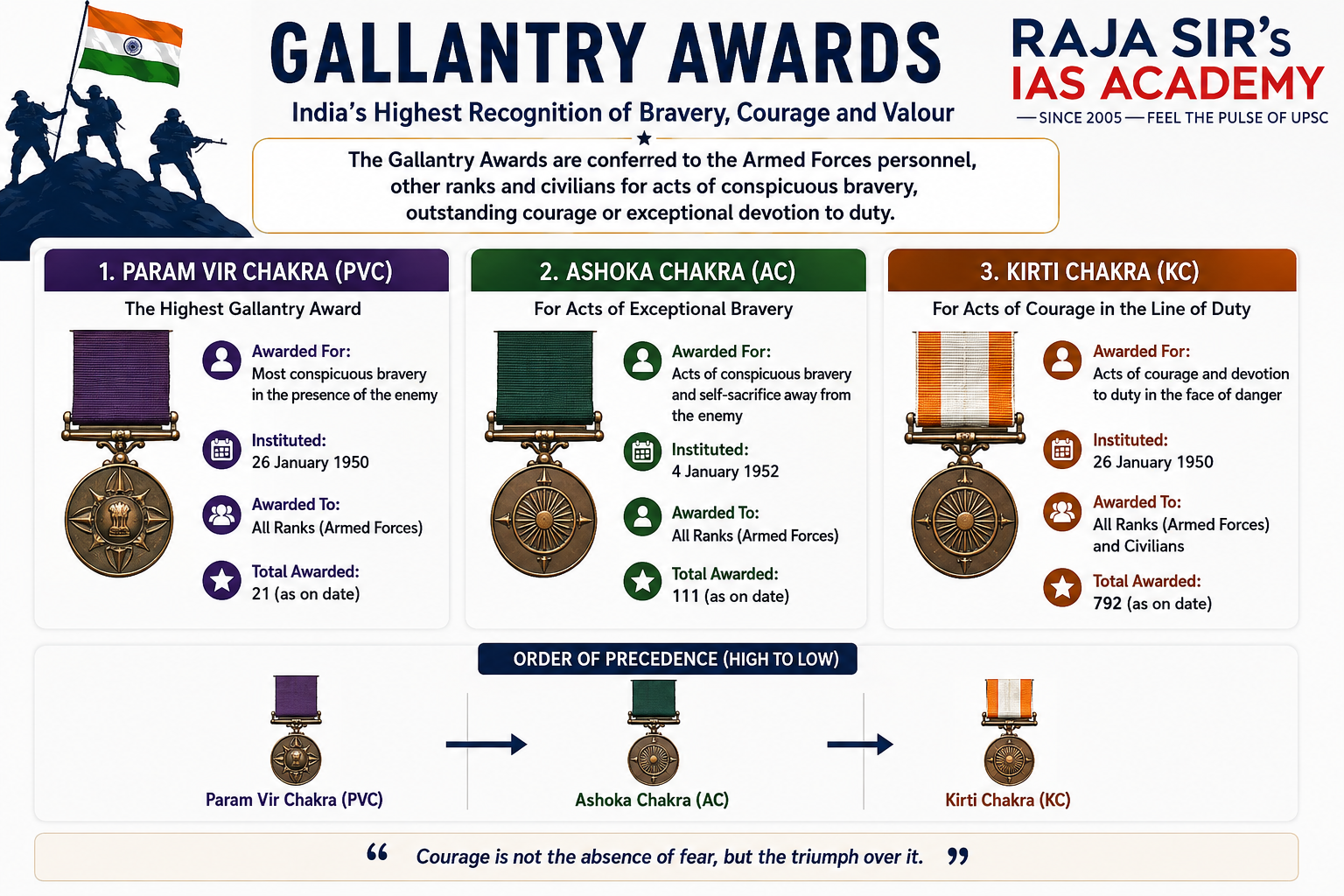
Gallantry Awards
GS II : Polity and governance | GS III : Defence
Why in News?
On the eve of Independence Day 2026, the President approved the conferment of gallantry awards to Armed Forces and other eligible personnel in recognition of their exceptional bravery, courage and sacrifice in the line of duty.
Wartime Gallantry Awards
These recognise acts of exceptional bravery in the presence of the enemy.
Order of precedence: Param Vir Chakra → Maha Vir Chakra → Vir Chakra
Param Vir Chakra (PVC)
- Highest wartime gallantry award in India.
- Awarded for the most conspicuous bravery or an act of valour/self-sacrifice in the presence of the enemy.
- It can be awarded to personnel of the Armed Forces, including eligible personnel from other categories as specified by the award rules.
Maha Vir Chakra (MVC)
- Second-highest wartime gallantry award.
- Awarded for acts of exceptional bravery in the presence of the enemy.
Vir Chakra
- Third in the wartime gallantry hierarchy.
- Recognises acts of bravery in the presence of the enemy.
Peacetime Gallantry Awards
- These recognise exceptional bravery in situations other than direct action against the enemy.
- Order of precedence: Ashoka Chakra → Kirti Chakra → Shaurya Chakra
Ashoka Chakra
- Highest peacetime gallantry award.
- Awarded for the most conspicuous bravery or self-sacrifice other than in the face of the enemy.
Kirti Chakra
- Second-highest peacetime gallantry award.
- Recognises exceptional bravery or sacrifice in non-combat situations.
Shaurya Chakra
- Third in the peacetime gallantry hierarchy.
- Recognises acts of gallantry and courage in circumstances other than those involving the enemy.
|
|
Green India Mission: CAG Flags Implementation Gaps
GS-III: Environment | Climate Change
Why in News?
A CAG audit has highlighted major implementation gaps in the Green India Mission (GIM), including poor achievement of targets, weak convergence with other programmes and inadequate monitoring.
What is Green India Mission?
- The Green India Mission is one of the eight missions under the National Action Plan on Climate Change (NAPCC).
- It aims to protect, restore and enhance India’s forest and tree cover while improving ecosystem services and supporting the livelihoods of forest-dependent communities.
Significance
- GIM is important for India’s climate and environmental objectives because forests act as carbon sinks, support biodiversity and provide livelihoods to millions of people.
- It also contributes to climate adaptation by improving ecosystem resilience against droughts, floods and other climate-related stresses.
Key Problems Identified
- Target shortfall: The progress in increasing forest and tree cover has remained significantly below the intended targets.
- Poor convergence: GIM has not been adequately integrated with programmes such as CAMPA and MGNREGS, reducing the effectiveness of available resources.
- Funding problems: Weak institutional coordination has contributed to under-utilisation and loss of potential funding.
- Weak monitoring: Several States have faced shortcomings in maintaining accounts, publishing information and tracking outcomes.
Impact
- Weak implementation can reduce India’s ability to enhance carbon sequestration and protect biodiversity.
- It can also limit the contribution of forests to climate adaptation, ecosystem restoration and livelihoods of forest-dependent communities.
- Poor monitoring may further result in plantations being measured by the number of trees planted rather than their actual survival and ecological impact.
Way Forward
- Convergence: Integrate GIM with CAMPA, MGNREGS, Nagar Van Yojana and other relevant programmes.
- Outcome-basedmonitoring: Focus on tree survival, forest quality, biodiversity and ecosystem restoration rather than merely plantation numbers.
- Technology: Use GIS, satellite imagery and remote sensing for independent monitoring.
Green India Mission: One of the 8 missions under NAPCC.
Launched: 2014.
Nodal Ministry: Ministry of Environment, Forest and Climate Change (MoEFCC).
Core focus: Forest and tree cover, ecosystem restoration, biodiversity and livelihoods.
|
|
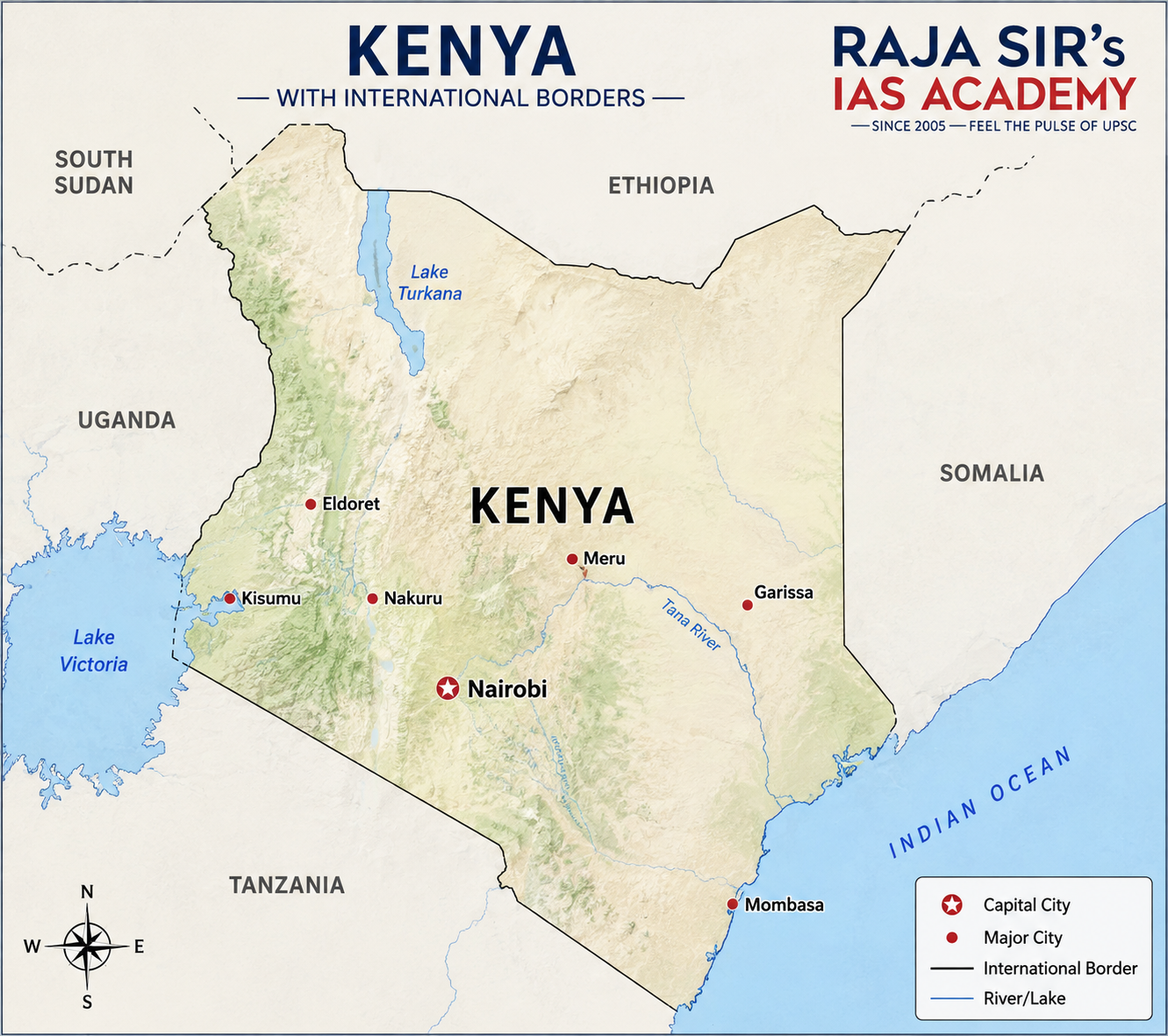
Kenya
Why in News ?
Kenya supported India’s permanent membership of the UNSC. India and Kenya agreed to install a Mahatma Gandhi statue in Kenya’s Parliament.
Kenya recognised persons of Indian origin as an indigenous community, strengthening India–Kenya ties.
Location: East Africa.
- Capital: Nairobi.
- Equator: Passes through Kenya.
- Borders: South Sudan, Ethiopia, Somalia, Tanzania and Uganda.
- Ocean: Indian Ocean.
- Major port: Mombasa.
- Major lake: Lake Victoria lies on Kenya’s western border.
- Lake Turkana: Located in northern Kenya; world’s largest permanent desert lake.
- Mount Kenya: Second-highest mountain in Africa, after Kilimanjaro.
- Great Rift Valley: Passes through Kenya.
- Chalbi Desert: Located in northern Kenya, near Lake Turkana.
- EAC: Kenya is a member of the East African Community.
Significance for India
- Indian Ocean: Kenya provides India with an important partner on the western Indian Ocean coast.
- Trade: Mombasa is an important gateway for East African trade.
- SAGAR: Kenya is relevant to India’s Security and Growth for All in the Region (SAGAR) approach.
- Diaspora: Recognition of persons of Indian origin strengthens people-to-people ties.
- Multilateral diplomacy: Kenya’s support for India’s UNSC reform aspirations strengthens bilateral diplomatic cooperation.
|
|
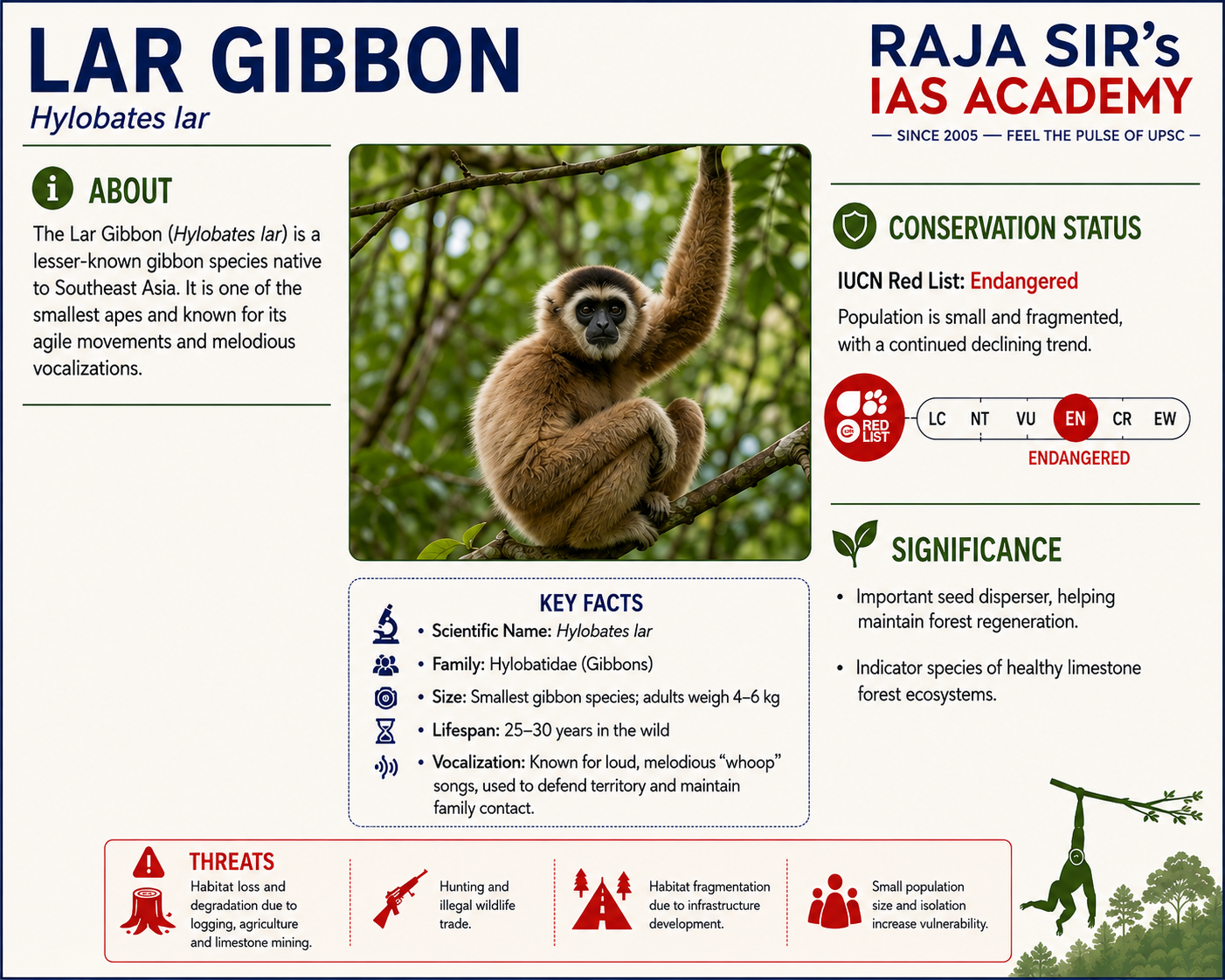
Lar Gibbon: Southeast Asia’s Agile Forest Ape
Why in News
A video of Tamil actor Chiyaan Vikram interacting with a Lar Gibbon (Hylobates lar) went viral on social media.
The video raised questions about the possession and legality of keeping an endangered exotic primate in a private setting.
Scientific name: Hylobates lar
- Common name: Lar Gibbon / White-handed Gibbon
- Group: Ape; belongs to the family Hylobatidae.
- Habitat: Tropical forests, especially primary lowland, submontane and mixed-deciduous forests. Distribution: Southeast Asia — Thailand, Myanmar, Malaysia, Laos and Indonesia.
- Diet: Mainly frugivorous, but also consumes leaves, flowers, shoots and insects.
- Movement: Brachiation — swings between branches using its long arms.
- Distinctive feature: No tail, unlike monkeys.
- Social behaviour: Usually forms monogamous pairs/groups and uses vocal duets for territorial communication.
- Ecological role: Important seed disperser, contributing to tropical forest regeneration.
Conservation Status
IUCN Red List - Endangered
CITES - Appendix I
Wildlife Protection Act, 1972 Schedule I
|
|
Preserving India’s Administrative Memory
GS Paper II – Governance | GS Paper IV – Ethics
Why in News ?
The National Anubhav Awards 2026 are being conferred to recognise valuable administrative experiences, innovations and best practices documented by retiring and retired government personnel.
What are the National Anubhav Awards?
The Awards aim to capture and preserve the institutional knowledge of experienced government employees before it is lost through retirement.
- Nodal Department: Department of Pension and Pensioners Welfare (DoPPW).
- Ministry: Ministry of Personnel, Public Grievances and Pensions.
- Platform: Anubhav Portal.
- Portal launched: 2015.
Significance
- Preserving Institutional Memory: Experienced officials have practical knowledge about policy implementation, administrative challenges and successful solutions. Documenting this knowledge helps preserve it for future officials.
- Improving Governance: Past administrative experiences can help governments identify implementation gaps and avoid repeating mistakes.
- Promoting Innovation: Field-level innovations and successful administrative practices can be shared and replicated across departments.
|
|
Regulating India’s Legal Profession and Education
Why in News ?
BCI’s order concerning enrolment of the 2026 NALSAR graduating batch triggered controversy and was subsequently withdrawn.
Raises questions about BCI’s regulatory powers, State Bar Councils and legal education.
BCI: Bar Council of India
- Statutory basis: Advocates Act, 1961.
- Nature: Statutory body, not a constitutional body.
- Composition: Chairman, Vice-Chairman and members elected from State Bar Councils.
- Professional regulation: Prescribes standards of professional conduct and etiquette for advocates.
- Legal education: Lays down standards of legal education and recognizes law degrees/institutions for enrolment purposes.
- Disciplinary role: Exercises appellate disciplinary jurisdiction over State Bar Councils.
- Supervision: Has general supervision and control over State Bar Councils.
- AIBE: All India Bar Examination is conducted under the BCI framework for determining eligibility to practice law.
- Foreign qualifications: Can recognize certain foreign legal qualifications subject to reciprocity.
Significance
- Professional ethics: Maintains standards of conduct among advocates.
- Quality of legal education: Promotes uniform standards across law institutions.
- Judicial administration: A competent and ethical Bar strengthens the justice-delivery system.
- Professional autonomy: Helps maintain self-regulation of the legal profession.
- Access to justice: Advocate welfare and legal-aid initiatives support vulnerable sections.
Challenges / Issues
- Regulatory overreach: Need to balance regulatory authority with institutional autonomy.
- University autonomy: BCI’s regulation of legal education can raise concerns regarding academic freedom.
- Centre–State institutional dynamics: Relationship between BCI and State Bar Councils can create jurisdictional tensions.
- Disciplinary consistency: Ensuring transparent and uniform disciplinary mechanisms.
- Quality vs accessibility: Maintaining high professional standards without creating excessive barriers to entry.
Way Forward
Clear regulatory boundaries: Precisely define BCI’s powers vis-à-vis universities and State Bar Councils.
Transparent procedures: Major regulatory decisions should follow consultation and reasoned decision-making.
Institutional autonomy: Maintain legal-education standards while respecting academic autonomy.
Uniform standards: Strengthen objective and transparent criteria for enrolment and legal education.
|