AUGUST 16, 2026 CURRENT AFFAIRS
|
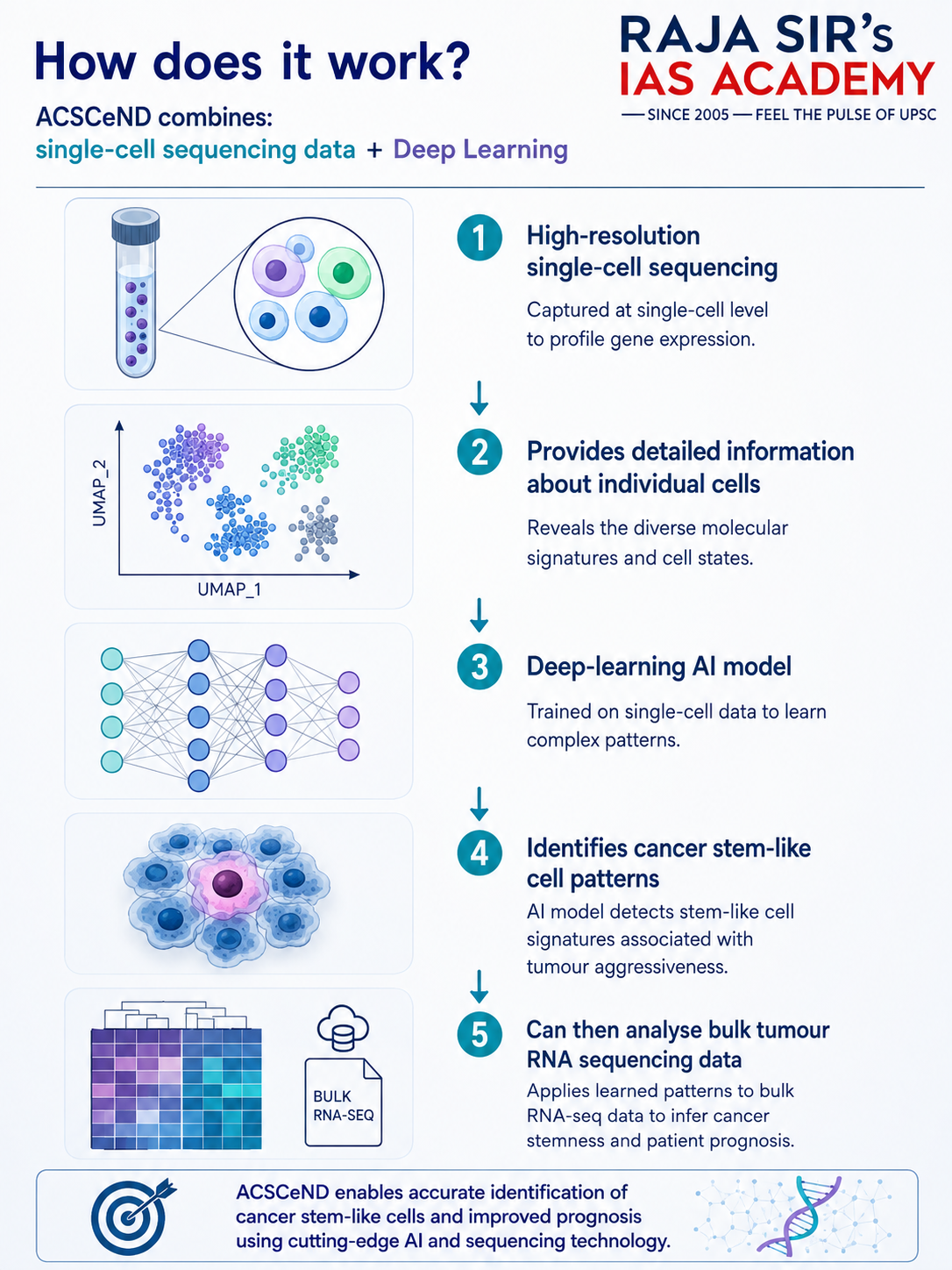
ACSCeND — AI Framework for Cancer Stem-like Cells GS III Science & Technology Why in News? Indian scientists have developed ACSCeND, an AI-based framework that can identify and study hidden cancer stem-like cells inside tumours. What are Cancer Stem-like Cells? ● Think of a tumour as a large group of cancer cells. Among them, some cells have stem-cell-like properties. ● These cells may have a greater ability to: Renew themselves, Produce different types of cancer cells, Help the tumour grow, Contribute to treatment resistance and recurrence What does ACSCeND do? Earlier, researchers often gave a tumour one overall "stemness" score. ACSCeND goes further.It identifies 3 different states:
Why is this important? ACSCeND helps use information learned from single-cell data to analyse more commonly available bulk RNA-sequencing data. ACSCeND could help researchers: ● Identify hidden cancer stem-like cells ● Understand their biological mechanisms ● Discover new drug targets ● Develop more precise cancer therapies ● Improve understanding of tumour progression and patient outcomes
|
||||||||
|
Alang–Sosiya Ship-Recycling Cluster GS-III | Indian Economy , Infrastructure Why in News? Alang–Sosiya in Gujarat is India''s dominant ship-recycling cluster and accounts for the overwhelming majority of India''s ship-recycling activity. Location ● Alang–Sosiya - Gujarat ● District - Bhavnagar ● Located along the Gulf of Khambhat (Cambay). ● Situated on India''s western coast. ● International standard - Hong Kong Convention About ● Accounts for approximately 98% of India''s ship-recycling activity. ● It is India''s principal ship-recycling cluster. Why Alang is Suitable for Ship Recycling? ● Natural Factors ● Gulf of Khambhat ● Strong tidal range ● Coastal location ● Relatively broad intertidal zone |
||||||||
|
Himalayan Traditional System of Medicine Why in News? Dr. Padma Gurmet, Director of the National Institute of Sowa-Rigpa (NISR), Leh, was conferred the UT Ladakh State Award 2025 for her contribution to Sowa-Rigpa. What is Sowa-Rigpa? ● A traditional system of medicine originating in the Himalayan region. ● Particularly associated with Tibet. ● Also known as the Amchi System of Medicine. ● In India, it is recognised as a system of traditional medicine under the Ministry of AYUSH. Important Text :Gyud-Zi (Four Tantras) → fundamental/classical text of Sowa-Rigpa. Influences Sowa-Rigpa incorporates knowledge from: ● Tibetan medical traditions ● Ayurveda ● Traditional Chinese medicine ● Local Himalayan medical traditions Important Institution National Institute of Sowa-Rigpa (NISR) Location: Leh, Ladakh
|
||||||||
|
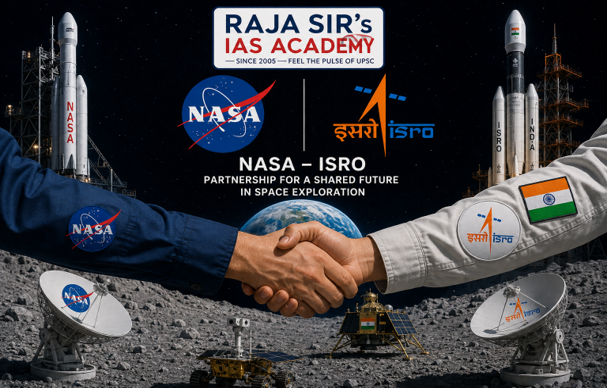
India’s Lunar Future: From Chandrayaan to Sustained Lunar Exploration Why in News ? India’s lunar programme is entering a new phase with deeper NASA–ISRO cooperation and growing focus on future lunar infrastructure and long-term exploration. India’s Key Lunar and Space Initiatives ● NASA–ISRO Cooperation: Greater cooperation can provide India access to advanced technologies and scientific expertise for future lunar missions. ● Gaganyaan: Experience in human spaceflight and astronaut training can strengthen India’s capability for more complex deep-space missions. ● Chandrayaan Programme: Chandrayaan missions have progressively expanded India’s understanding of the Moon and laid the foundation for future exploration. ● NISAR: The NASA–ISRO Synthetic Aperture Radar mission strengthens India’s capabilities in advanced Earth observation and space technology cooperation. ● Private Space Sector: Indian space startups can participate in developing spacecraft components, robotics, communication systems and other technologies required for future missions. Strategic Opportunities for India ● Advanced Technology: Collaboration can accelerate India’s development of robotics, autonomous systems, life-support technologies and lunar surface systems. ● Space Economy: Future lunar activities can create new markets for Indian private space companies and strengthen domestic space manufacturing. ● Global Space Leadership: Greater participation in international lunar programmes can increase India’s influence in shaping the future rules and standards of space exploration. ● Challenges for India ● High Costs: Building and maintaining lunar infrastructure requires large and sustained investments. Way Forward
|
||||||||
|
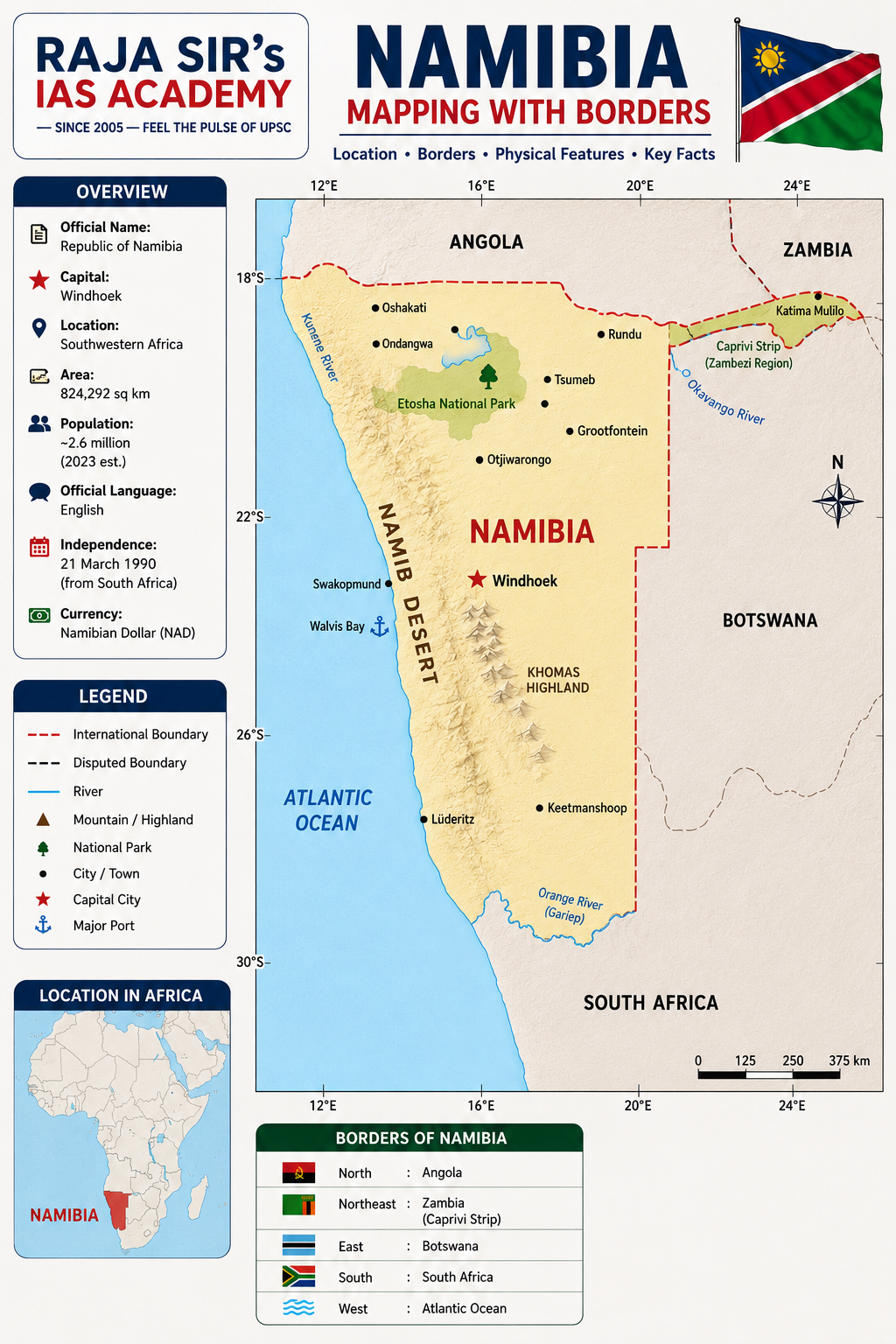
Namibia Why in News? India and Namibia agreed to deepen trade and economic cooperation during the 4th Session of the India–Namibia Joint Trade Committee (JTC) held in New Delhi. Location
Neighbours
Physical Features
Great Escarpment
Important Rivers
Significance
Way forward
|
||||||||
|
Oil Spill Threat to Iran’s Coastal Ecosystem GS III Environment Why in News? An oil spill in the Persian Gulf poses a threat to the Hara mangrove ecosystem around Qeshm Island in Iran. This is important because mangroves are highly valuable coastal ecosystems but are vulnerable to oil pollution and coastal disturbances. Location
Dominant Species
Why is an Oil Spill Dangerous?
|
||||||||
|
Preserving India’s Manuscript Heritage through Digitisation GS-I: Art & Culture | GS-II: Governance Why in News? A Parliamentary panel flagged the slow progress in digitisation of India’s manuscripts. This brings attention to the Gyan Bharatam Mission, which seeks to preserve, digitise and make India’s manuscript heritage more accessible. What is the Gyan Bharatam Mission? The Gyan Bharatam Mission is aimed at preserving India’s manuscript heritage through survey, conservation, digitisation and dissemination of manuscripts. The broader objective is to ensure that India’s traditional knowledge does not remain confined to fragile physical documents. Why is Digitisation Important?
Role of Artificial Intelligence One particularly important emerging application is AI-based handwritten-text recognition. Traditional handwritten manuscripts can be difficult to read because of:
|
||||||||
|
Socio-Economic Empowerment of Scheduled Castes - Pradhan Mantri Anusuchit Jaati Abhyuday Yojana Why in News? The PM-AJAY scheme came into focus through the PIB case of Ruby Devi, a Scheduled Caste woman from Bihar, who received ₹17,000 under PM-AJAY to strengthen her grocery business.
What is PM-AJAY? PM-AJAY is an integrated scheme for the socio-economic development of Scheduled Castes. It seeks to improve the living conditions of SC communities through:
How did PM-AJAY originate? PM-AJAY was formed by merging three existing schemes:
|
||||||||
|
Strengthening India’s EXIM Logistics through Digital Tracking GS-III: Infrastructure | Economy Why in News? The Logistics Data Bank crossed an important milestone in tracking EXIM containers. EXIM = Export-Import. What is the Logistics Data Bank? The Logistics Data Bank system provides end-to-end visibility of container movement. In simple terms: Container enters logistics chain → movement is tracked → stakeholders can monitor its journey → bottlenecks can be identified. Technologies Used The system uses technologies such as: RFID, Radio Frequency Identification, IoT, Cloud computing Why is Container Tracking Important? A container may move through: Factory → Inland Container Depot → Road/Rail → Port → Ship Delays can occur at multiple points. Tracking helps identify:
|