|
Carbon at the Border: BRICS, CBAM and the Global South’s Trade Dilemma
GS Paper II – International Relations | GS Paper III – Environment | International Trade
Why in News?
BRICS has raised concerns over the European Union’s Carbon Border Adjustment Mechanism (CBAM) and its possible impact on developing economies.
What is CBAM?
The Carbon Border Adjustment Mechanism (CBAM) is an EU mechanism that imposes a carbon-related cost on certain imported goods based on their embedded carbon emissions.
Aim of CBAM
- Prevent Carbon Leakage : Prevents industries from shifting production to countries with weaker climate regulations.
- Encourage Cleaner Production : Creates incentives for exporters to reduce the carbon intensity of production.
- Support EU Climate Targets : Aligns trade policy with the EU''s climate objectives.
- Equalise Carbon Costs : Attempts to reduce differences between the carbon costs faced by EU producers and foreign producers.
Why Does BRICS Object?
- Higher Export Costs :Carbon-intensive exports entering the EU may become more expensive.
- Impact on Developing Economies : Developing countries may have fewer technological and financial resources to decarbonise production.
- Historical Responsibility : Developing countries emphasise the principle of historical responsibility for greenhouse-gas emissions.
- Unequal Technological Capacity : Advanced economies generally possess greater access to clean technologies and climate finance.
Significance for India
- Carbon-Intensive Export Sectors : India’s steel, aluminium, cement and fertiliser industries are likely to face greater exposure to CBAM due to their relatively high carbon intensity.
- Competitiveness Challenge : If Indian industries remain carbon-intensive, higher carbon intensity can lead to higher CBAM-related costs, increasing export prices and reducing their competitiveness in international markets.
- Green Transition : CBAM can encourage Indian industries to adopt cleaner technologies, improve energy efficiency and accelerate industrial decarbonisation.
- Impact on Developing Economies : Carbon-border measures may impose additional financial and compliance burdens on developing countries with limited technological and financial capacities.
- CBDR Principle : The principle of Common but Differentiated Responsibilities (CBDR) recognises that countries have different responsibilities and capabilities in addressing climate change.
|
|
Congo at the Crossroads
GS Paper I – World Geography | GS II – International Relations
Why in News?
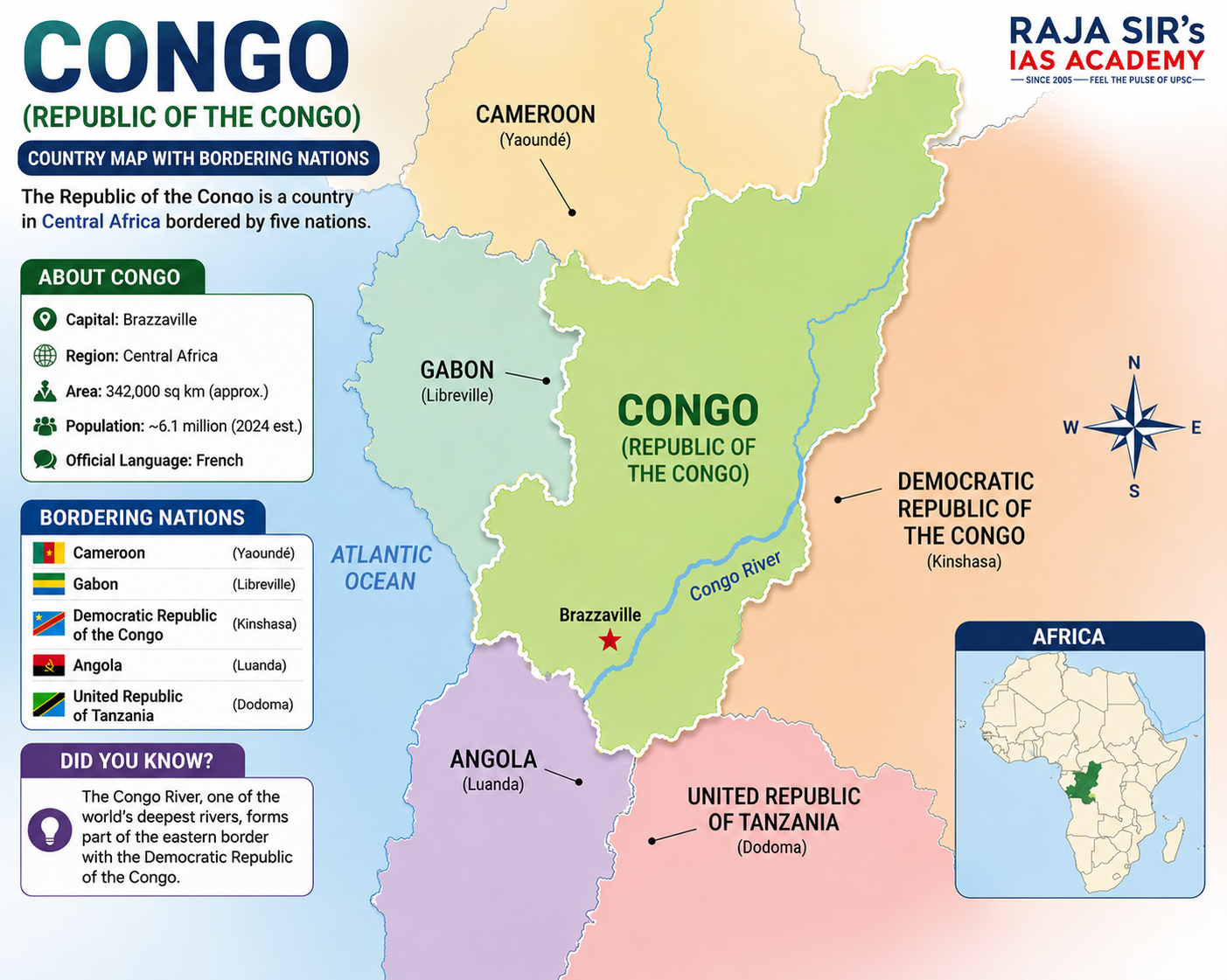
The Democratic Republic of the Congo (DRC) is in focus due to a severe Ebola outbreak, with the supplied material highlighting transmission involving the rare Bundibugyo strain.
- Capital: Kinshasa
- Region: Central Africa
- Equator: Passes through the country
- Former name: Zaire
- Borders – 9 Countries
Geography:
- Congo Basin : One of the world''s major tropical rainforest regions.
- Great Lake : Eastern DRC connects with the African Great Lakes region.
- Important lakes include:Albert, Edward, Kivu, Tanganyika
- Virunga region : Active volcanic region. Includes Mount Nyiragongo.
- Mineral wealth : Cobalt, Copper, Industrial diamonds
About Ebola
- Formerly called Ebola haemorrhagic fever.
- Severe and often fatal disease affecting humans and other primates.
- Caused by viruses of the Orthoebolavirus genus, family Filoviridae.
Major outbreak-causing species:
- Ebola virus (EBOV) - Ebola virus disease
- Sudan virus (SUDV) - Sudan virus disease
- Bundibugyo virus (BDBV) - Bundibugyo virus disease
Origin
First identified in 1976 during simultaneous outbreaks in: Yambuku, Democratic Republic of the Congo — near the Ebola River.
Transmission
- Zoonotic: Associated with fruit bats of the Pteropodidae family; transmission can occur through contact with infected animals such as chimpanzees, gorillas and monkeys.
- Human-to-human: Direct contact with blood or other bodily fluids of infected or deceased persons, or contaminated objects.
Symptoms
- Initial: Fever, fatigue, muscle pain, headache and sore throat.
- Advanced: Vomiting, diarrhoea, rash, kidney/liver impairment and sometimes severe bleeding.
- Fatality : Average case-fatality rate is around 50% Historically, rates have ranged from approximately 25% to 90%, depending on strain and healthcare response.
Treatment
- Early supportive care: Rehydration and symptomatic treatment improve survival.
- Monoclonal antibodies: Inmazeb and Ebanga are available for Ebola virus disease caused by the Zaire ebolavirus species.
Impact of Disease Outbreaks
- Human Mortality : Severe outbreaks can result in significant loss of life.
- Pressure on Healthcare Systems : Sudden increases in patients can overwhelm hospitals and healthcare workers.
- Cross-Border Transmission Risks : Movement of people across borders can facilitate the geographical spread of infectious diseases.
Challenges
- Weak Health Infrastructure : Shortages of healthcare facilities, personnel and medical resources can limit outbreak response.
- Conflict & Displacement : Armed conflict can destroy health infrastructure and displace populations.
- Difficult Terrain : Remote forests, mountainous areas and poor transport connectivity can delay medical teams and supplies.
Way Forward
- Strengthen Disease Surveillance : Develop stronger laboratory and early-warning systems.
- Improve Cross-Border Health Coordination : Strengthen information sharing between neighbouring countries.
- Strengthen Outbreak-Response Teams : Maintain trained and rapidly deployable emergency response teams.
|
|
Crowd to Catastrophe: Preventing Human Stampedes in India
GS Paper III – Disaster Management | Internal Security | Governance
Why in News?
At least seven devotees were killed and several injured in a stampede-like incident outside Ashok Dham Temple in Lakhisarai, Bihar, highlighting persistent weaknesses in crowd management during religious gatherings.
What is a Human Stampede?
A human stampede is a rapid, uncontrolled and uncoordinated movement of a large crowd, usually triggered by panic, excitement, perceived danger or crowd-management failure.
Aim of Crowd Management
- Prevent dangerous crowd-density build-up.
- Maintain controlled entry and exit flows.
- Prevent panic and rumours.
- Ensure rapid evacuation and emergency medical access.
- Protect life while facilitating religious and public gatherings.
Major Causes
- Excessive crowd influx: Number of people exceeds venue carrying capacity.
- Sudden arrival of trains/buses can create an uncontrolled surge.
- Rumour-induced panic: Unverified information about fire, electricity, structural collapse etc. can trigger sudden movement.
- Infrastructure bottlenecks: Narrow corridors, Single-entry/exit points, Weak barricades, Steep stairs
- Bidirectional movement: Incoming and outgoing crowds collide in restricted spaces.
- Poor inter-agency coordination: Temple authorities, police, district administration and transport agencies may operate without a unified crowd plan.
Way Forward :
- Capacity management: Calculate venue carrying capacity and regulate inflow.
- Unidirectional movement: Separate entry and exit routes.
- Holding areas: Create tiered holding zones and snake/zigzag queues.
- Emergency corridors: Keep dedicated ambulance and fire-service access routes.
- Rumour management: Centralised PA systems and verified real-time communication.
- Mandatory Event Disaster Management Plans: Major religious gatherings should have pre-approved evacuation, medical and emergency-response plans.
|
|
Emergency Finance, Public Trust: Understanding the PM CARES Fund
GS Paper II – Polity | Governance | Disaster Management
Why in News?
The PM CARES Fund released delayed audited statements for FY 2023–24 and FY 2024–25. The supplied material highlights its large closing balance relative to expenditure during FY25.
What is PM CARES?
Prime Minister''s Citizen Assistance and Relief in Emergency Situations Fund .Established in 2020, during the COVID-19 pandemic.
Aim
To provide assistance during:
- Public health emergencies
- Natural calamities
- Man-made disasters
- Healthcare crises
- Emergency relief situations
Institutional Structure
- Prime Minister - Chairperson
- Ministers of Defence, Home Affairs and Finance - ex-officio trustees
- Eminent persons - nominated trustees
Significance
- Emergency financing : Provides a flexible corpus during extraordinary crises.
- Healthcare capacity : Can support medical infrastructure and emergency preparedness.
- Citizen participation : Allows voluntary public contributions.
- Disaster response : Can supplement government relief mechanisms.
Key Features
- Voluntary contributions.
- No regular budgetary allocation from Union government.
- Donations eligible for tax benefits.
- CSR contributions permitted.
- Foreign contributions can be received under applicable arrangements.
Challenges
- Transparency & Disclosure : Need for greater transparency regarding the fund''s receipts, investments and utilisation.
- Timeliness of Audited Statements : Delayed publication of audited statements can weaken public oversight.
- Public Accountability : As the fund operates for public relief purposes, its functioning requires strong accountability mechanisms.
- Clarity Regarding Expenditure : Greater clarity is needed regarding where, how and for what purposes funds are utilised.
- Relationship with Existing Relief Mechanisms : There is a need for clearer coordination between PM CARES and established disaster-relief mechanisms.
Way Forward
- Timely Publication of Audited Statements - Ensure regular and prompt release of audited financial statements.
- Greater Proactive Disclosure : Publish relevant financial and operational information proactively.
|
|
Employment Guarantee in Transition: From MGNREGA to VB-G RAM G
GS Paper II + III – Welfare Schemes | Rural Development | Employment
Why in News?
Economist Jean Drèze highlighted a sharp contraction in rural employment generation during the transition from MGNREGA, 2005 to the VB-G RAM G Act, 2025. The supplied material reports only 70 crore person-days during April–July 2026, substantially lower than the recent annual averages.
What is VB-G RAM G?
The Viksit Bharat–Guarantee for Rozgar and Ajeevika Mission (Gramin) Act seeks to restructure India''s rural employment guarantee framework while increasing the statutory employment guarantee from 100 to 125 days.
Aim
- Expand guaranteed rural employment.
- Create durable rural infrastructure.
- Integrate employment with Gram Panchayat planning.
- Improve digital monitoring and implementation.
- Strengthen rural livelihoods.
|
MGNREGA
|
VB-G RAM G
|
|
100 days
|
125 days
|
|
Demand-driven funding
|
Normative/pre-fixed allocations
|
|
Centre bore 100% unskilled wage component
|
60:40 Centre-State in general states
|
|
Gram Sabha-led works
|
Integrated Viksit Gram Panchayat Plans
|
|
No statutory seasonal pause
|
Provision for pause during peak agricultural season
|
Potential positive impact
- Higher employment guarantee.
- Better rural infrastructure.
- Greater planning integration.
- Improved accountability through digital systems.
Potential negative impact
- Pre-fixed allocations may weaken the demand-driven character.
- State cost-sharing may burden fiscally constrained states.
- Digital authentication may exclude vulnerable workers.
- Transition delays can disrupt employment precisely when demand is highest.
Implementation Challenges
- Rule-making delays: Administrative uncertainty during transition.
- Fiscal burden on States: 40% contribution may discourage work creation in poorer states.
- Digital exclusion: Facial recognition, biometric systems and digital muster rolls can face connectivity and authentication problems.
- Allocation ceilings: Districts may hesitate to open works if allocations are exhausted.
- Seasonal vulnerability: Agricultural slack periods are precisely when rural workers require employment support.
Way Forward
- Ensure timely Centre-State fund releases.
- Maintain flexibility beyond normative allocations during employment distress.
- Provide offline authentication alternatives.
- Strengthen Gram Panchayat administrative capacity.
- Conduct regular social audits.
- Ensure unemployment allowance where legally applicable.
- Establish transition protocols before replacing an existing employment framework.
|
|
Empowering Women Across the Life Cycle
GS Paper I – Indian Society | GS Paper II – Social Justice, Health, Education & Governance
Why in News?
The Government''s women-centric interventions increasingly follow a life-cycle approach, addressing women''s needs from childhood and adolescence to motherhood, employment and leadership.
What is Life-Cycle Empowerment?
Instead of treating women-specific policies as isolated welfare schemes, the approach addresses:
Aim
- Improve survival and health.
- Increase female education.
- Promote economic independence.
- Improve safety and dignity.
- Increase political participation.
- Enable women to become agents of development.
Girl Child
- Beti Bachao Beti Padhao (BBBP) - Promotes the survival, protection and education of the girl child and seeks to address gender discrimination.
- Sukanya Samriddhi Yojana (SSY) - Smallsavings scheme aimed at building financial security for the girl child, particularly for education and future needs.
Maternal Health
- PM Matru Vandana Yojana (PMMVY) - Provides maternity benefit support to eligible pregnant and lactating women.
- Pradhan Mantri Surakshit Matritva Abhiyan (PMSMA) - Provides quality antenatal care to pregnant women on designated days.
- Janani Suraksha Yojana (JSY) - Promotes institutional deliveries among pregnant women, especially from vulnerable sections.
- Janani Shishu Suraksha Karyakram (JSSK) - Provides free and cashless delivery, C-section and essential maternal/newborn services in public health institutions.
Education
- Samagra Shiksha - Integrated school-education programme aimed at equitable, inclusive and quality education, including reduction of gender gaps.
- Kasturba Gandhi Balika Vidyalaya (KGBV) - Provides residential schooling facilities for disadvantaged girls, particularly at the upper-primary/secondary level.
- Gender Inclusion Fund - Under NEP 2020, supports measures to improve equitable access to education for girls and other disadvantaged groups.
Women in STEM
- Vigyan Jyoti - Encourages girls, especially from disadvantaged backgrounds, to pursue STEM education and careers.
Skill & Employment
- Pradhan Mantri Kaushal Vikas Yojana (PMKVY) -Provides industry-relevant skill training and certification to improve employability, including that of women.
- NAVYA - Promotes vocational training and skill development among adolescent girls to enhance employability.
- DAY-NRLM - Organises rural women into Self-Help Groups (SHGs) and promotes livelihoods, financial inclusion and women-led enterprises.
- Womaniya on GeM - Facilitates market access for women entrepreneurs and women-led enterprises through Government e-Marketplace.
Health & Nutrition
- Ayushman Bharat- Provides a framework for health coverage and access to healthcare, including financial protection for vulnerable families.
- Ayushman Arogya Mandirs - Strengthen comprehensive primary healthcare, including reproductive, maternal and child health services.
- POSHAN 2.0 - Focuses on improving nutrition outcomes among children, adolescent girls, pregnant women and lactating mothers.
- Saksham Anganwadi - Upgrades Anganwadi infrastructure and services for nutrition, early childhood care and maternal support.
- Mission Indradhanush - Aims to increase full immunisation coverage, particularly among children and pregnant women.
Safety & Dignity
- Mission Shakti - Umbrella programme focused on women''s safety, security and empowerment.
- Women Helpline - Provides women with 24-hour assistance and support and facilitates access to relevant services.
- SHe-Box - Online platform for registering and monitoring complaints of sexual harassment at the workplace.
- Nari Adalats -Community-level platforms aimed at women''s grievance redressal, rights awareness and empowerment.
|
|
Exercise MAITREE-XV
GS Paper II – International Relations | India–Thailand Relations | Defence Cooperation
Why in News?
The Indian Army contingent departed for Surat Thani, Thailand, to participate in the 15th edition of Exercise MAITREE-XV, a joint military exercise between India and Thailand.
What is Exercise MAITREE?
MAITREE is a bilateral military exercise between the Indian Army and Royal Thai Army.
Evolution of MAITREE
- 2006 - Started as Thai-Indian Cooperation Field Exercise (TICAFE).
- 2013 - Renamed as Exercise MAITREE.
- Hosted alternately by India and Thailand.
Significance for India
- Act East Policy - Thailand is an important partner in India''s Act East Policy.
- Indo-Pacific Engagement - Military cooperation with Thailand supports India''s broader strategic engagement in the Indo-Pacific.
- Counter-Terrorism - Provides both countries an opportunity to exchange experience in: Counter-insurgency, Counter-terrorism, Jungle warfare
- Regional Security : Stronger India–Thailand defence ties contribute to regional stability and security.
|
|
Financing the Global South: The Rise of the BRICS New Development Bank
GS Paper II – International Relations | International Institutions
Why in News?
Iran is advancing toward official membership in the New Development Bank (NDB) associated with BRICS.
What is NDB?
The New Development Bank is a multilateral development bank established by the founding BRICS countries.
Headquarters: Shanghai, China.
Aim
- Finance infrastructure.
- Support sustainable development.
- Provide development finance to emerging economies.
- Promote greater use of local currencies.
- Reduce dependence on traditional development-finance institutions.
Evolution
- 2012 : Idea discussed at BRICS Summit in New Delhi.
- 2014 : Agreement signed at Fortaleza, Brazil.
- 2015: NDB became operational.
Significance for India
- Global South cooperation: Strengthens South-South development financing.
- Alternative financing: Provides another source of infrastructure finance beyond traditional MDBs.
- Local currency financing: Can reduce exposure to foreign-exchange volatility.
- Climate finance: Supports green infrastructure and sustainable development.
Key Functions
Infrastructure Financing
- Provides long-term financing for infrastructure projects.
- Supports sectors such as transport, energy, water and digital infrastructure.
Equity Participation
- Invests equity in development projects.
- Helps strengthen the capital base of infrastructure and development initiatives.
Credit Guarantees
- Provides guarantees to reduce financing risks.
- Helps mobilise additional private and institutional investment.
Technical Assistance
- Provides project-preparation support.
- Assists developing countries with feasibility studies, institutional capacity-building and project management.
Green Financing
- Supports renewable energy and climate-resilient infrastructure.
- Promotes sustainable and environmentally responsible development.
Local-Currency Financing
- Provides financing in members'' domestic currencies.
- Helps reduce exposure to exchange-rate volatility and foreign-currency risks.
Challenges
Financial Credibility
- Expansion of membership must not compromise the bank''s financial strength.
- Maintaining strong credit ratings is essential for low-cost borrowing.
Geopolitical Differences
- Members may have different strategic and economic interests.
- Geopolitical tensions can complicate collective decision-making.
Development vs Creditworthiness
- The NDB must balance:nDevelopmental needs ↔ Financial sustainability
- Excessively concessional lending could affect financial viability.
Way Forward
Strengthen Governance & Transparency
- Improve institutional accountability.
- Ensure transparent project selection and lending practices.
Expand Local-Currency Financing Prudently
- Gradually increase domestic-currency lending.
- Develop deeper local financial markets to manage associated risks.
Maintain High Credit Standards
- Conduct rigorous project appraisal.
- Maintain prudent lending and risk-management practices.
|
|
Living with Giants: Building Coexistence with India’s Elephants
GS Paper III – Environment | Biodiversity | Wildlife Conservation
Why in News?
The Ministry of Environment, Forest and Climate Change (MoEFCC) released a Regional Action Plan for Comprehensive Understanding and Management of Human-Elephant Conflict during the 23rd Steering Committee Meeting of Project Elephant.
What is Human-Elephant Conflict?
Human-Elephant Conflict (HEC) refers to negative interactions between humans and elephants resulting in: Human deaths and injuries, Elephant deaths, Crop damage, Property damage, Livelihood losses
Aim
The approach seeks to shift from reactive conflict management to landscape-level coexistence by addressing the ecological and socio-economic causes of conflict.
Key Recommendations
· Invasive Species Control: Remove invasive plants that reduce natural elephant forage. Restore native vegetation and food availability.
· Conflict-Based Zoning Create three management zones: Elephant Conservation Zones
· Human-Elephant Coexistence Zones, Human-Elephant Management Zones
· Improve elephant habitats through: Fodder enrichment, Water augmentation Ecological restoration.
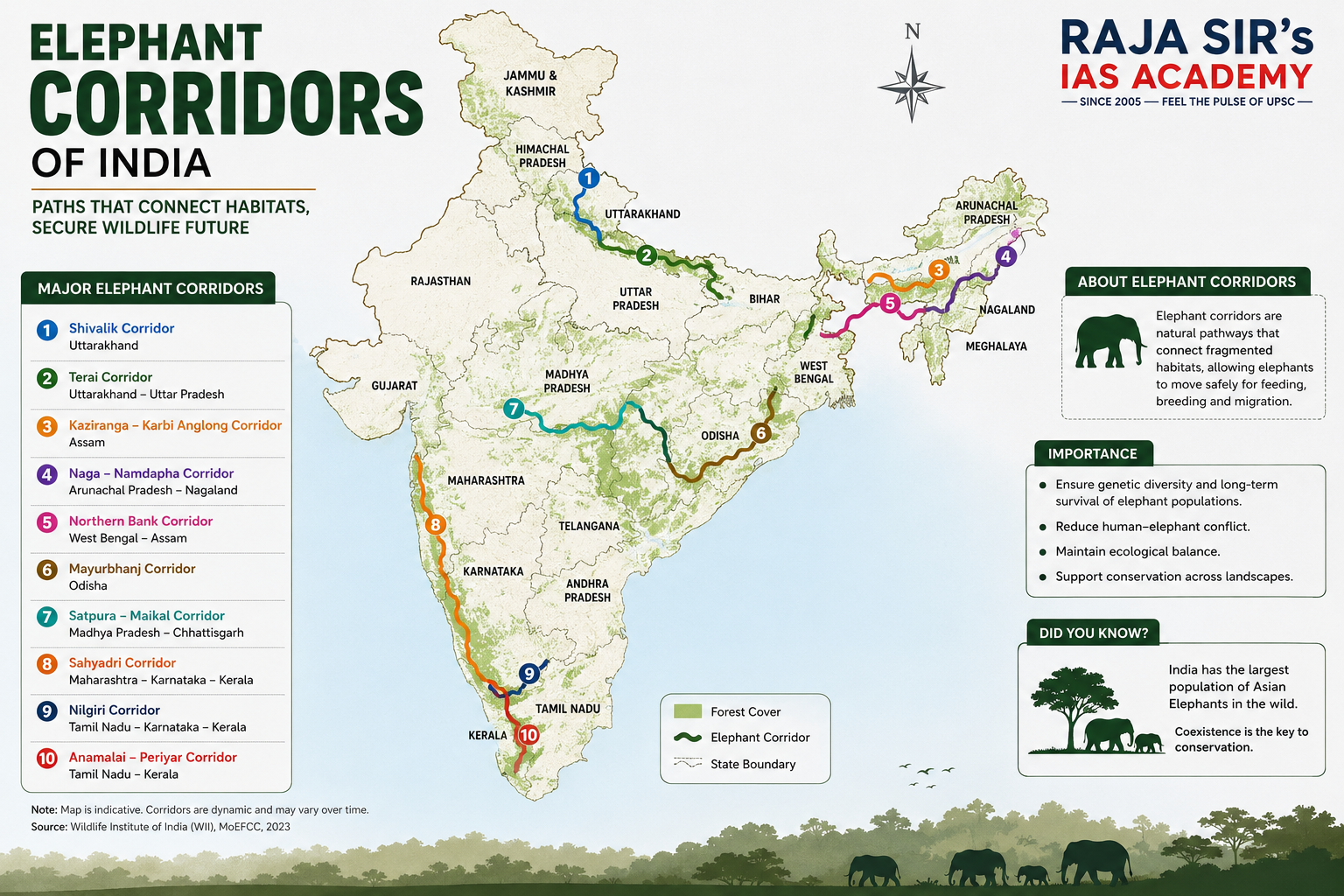
· Corridor Protection : Preserve elephant movement routes and protect ecological connectivity.
· Adopt landscape-level planning rather than focusing only on protected areas.
· Conflict-Risk Mapping : Identify HEC hotspots and match preventive measures with local risk levels.
· Community Participation : Local communities should become active partners in conflict mitigation through participation in monitoring, prevention and conservation.
|
|
Nuclear Power, Public Safety: Balancing Investment with Liability
GS Paper II – Government Policies & Interventions | GS Paper III – Science & Technology | Energy
Why in News?
The SHANTI Act, 2025 has brought renewed attention to India''s nuclear-liability framework and concerns regarding compensation, supplier liability and nuclear safety.
What is the SHANTI Act, 2025?
The Act seeks to provide a legislative framework for India''s civilian nuclear-energy sector, including nuclear power generation, regulation and participation in the sector.
Aim
· Expand India''s nuclear-energy capacity.
· Facilitate greater participation in nuclear power development.
· Create a clearer legal framework for nuclear liability.
· Support India''s clean-energy transition.
· Balance investment requirements with nuclear safety and public protection.
Significance
· Energy Security : Nuclear energy can provide reliable, low-carbon baseload electricity.
· Climate Goals : Greater nuclear capacity can help reduce dependence on fossil fuels.
· Private Participation : A clearer legal framework can potentially attract greater investment and technology.
· Strategic Importance : Nuclear technology has implications for India''s energy security, technological capability and strategic autonomy.
Major Challenges
· Adequacy of Compensation : Nuclear accidents can cause large-scale and long-term damage.
· Operator vs Supplier Liability : A key issue is determining the responsibility of the nuclear operator and equipment supplier in case of an accident. Excessive supplier liability may discourage investment, while weak supplier accountability may dilute safety incentives.
· Regulatory Independence : Effective nuclear safety requires a strong, technically competent and independent regulator.
· Long-Term Environmental Consequences : Radioactive contamination can have long-term ecological and health implications.
Way Forward
· Strong & Independent Nuclear Regulation : Strengthen regulatory capacity and technical expertise.
· Adequate Compensation Mechanisms : Ensure compensation frameworks are sufficient, accessible and timely.
· Apply the Polluter Pays Principle : Entities responsible for environmental damage should bear the appropriate cost of remediation and compensation.
|
|
Positive Indigenisation List (PIL)
GS Paper III – Defence | Indigenisation | Manufacturing
Why in News?
The Department of Defence Production (DDP) notified the 6th Positive Indigenisation List, containing 405 strategically important defence items with estimated business potential of ₹3,070 crore.
What is PIL?
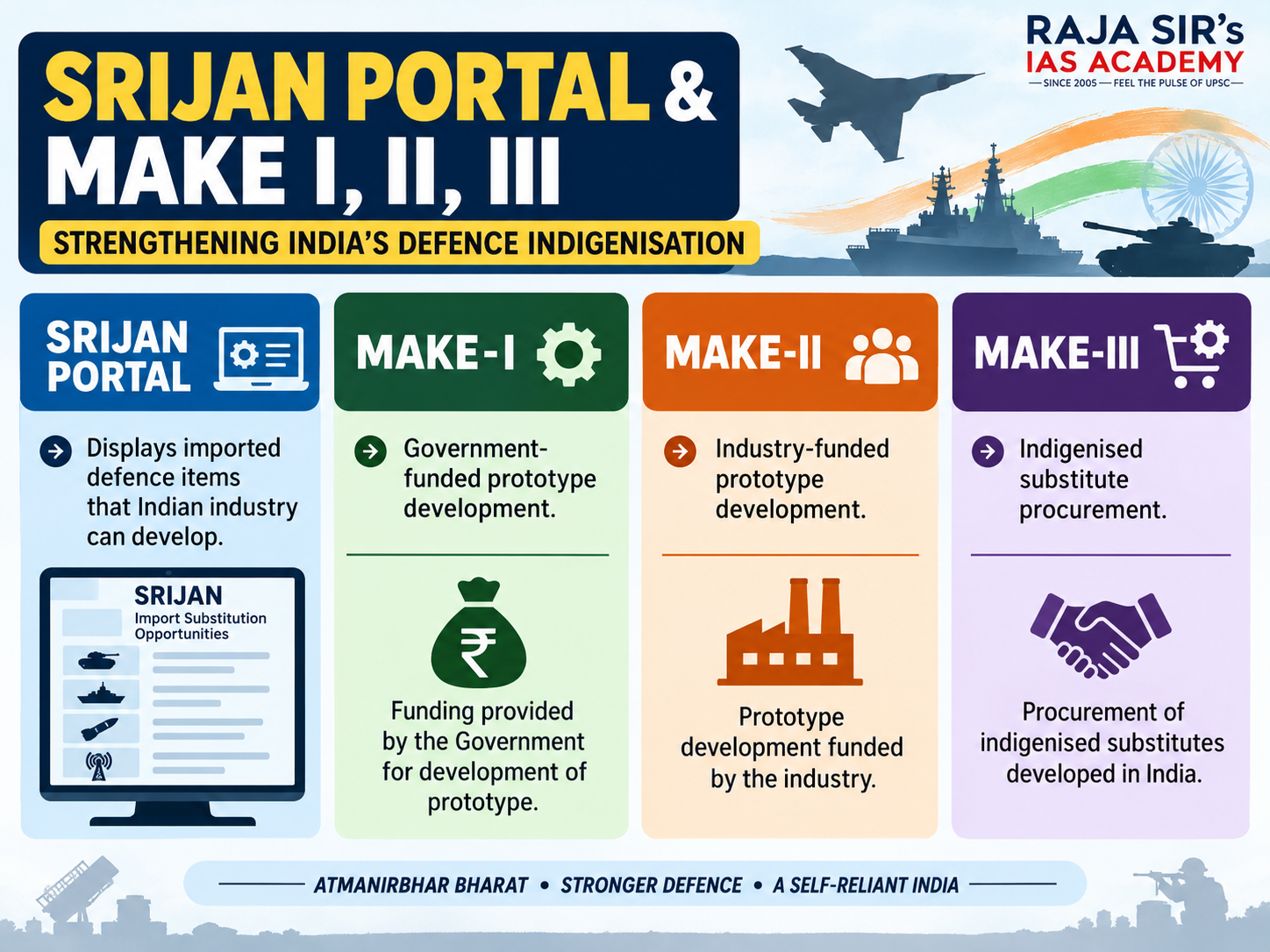
The Positive Indigenisation List identifies defence items for which imports are progressively restricted after specified deadlines, encouraging domestic production.
Aim:
· Reduce import dependence
· Promote domestic manufacturing
· Strengthen MSMEs and start-ups
· Boost defence R&D and indigenous technology
· Enhance strategic autonomy
Significance
· Strategic autonomy : Reduces dependence on foreign suppliers.
· Defence preparedness : Domestic supply chains improve resilience during geopolitical crises.
· Industrial development : Creates demand for Indian manufacturers, MSMEs and start-ups.
· Technology development : Encourages indigenous design, prototyping and advanced manufacturing.
Impact
· Defence Manufacturing Ecosystem : Expands domestic defence manufacturing. Strengthens the indigenous defence industrial base.
· Domestic Supply Chains : Deepens local supply chains, reduces dependence on imported components and sub-systems.
· Defence Export Potential : Creates opportunities for India to emerge as a defence-exporting country. Improves competitiveness of Indian defence products.
· Technology Absorption : Encourages acquisition and development of advanced defence technologies and promotes indigenous technological capabilities.
Challenges
· Limited Advanced Technology: Domestic capability remains limited in some sophisticated defence systems.
· Long Procurement Cycles: Lengthy military procurement processes can delay indigenisation.
· Quality & Testing Requirements: Defence equipment must meet stringent military standards. Testing and certification can be time-consuming.
· Component-Level vs Core Technology : Risk of merely replacing imported components without developing core technologies and intellectual property.
· Need for Stable Orders: Defence companies require predictable and long-term procurement orders to justify investment.
Way Forward
· Increase Defence R&D : Increase investment in indigenous defence research and advanced technologies.
· Ensure Predictable Procurement : Provide long-term procurement visibility. Reduce uncertainty for domestic manufacturers.
· Build Critical Technology Ecosystems Develop domestic capabilities in: Semiconductors Advanced metallurgy, Sensors, Electronics, Propulsion systems
· Promote Defence Start-ups : Encourage start-ups and MSMEs. provide testing, prototyping and technology-development support.
|
|
The Digitalisation of Terror
GS Paper II – Internal Security | GS Paper III – Cyber Security & Technology
Why in News?
The increasing use of social-media platforms by terrorist and extremist networks has emerged as a major internal-security challenge.
Significance
· Low-Cost Terrorism : Terrorist organisations can reach thousands of people without maintaining large physical networks.
· Rapid Radicalisation : Algorithms and online echo chambers can repeatedly expose vulnerable individuals to extremist content.
· Lone-Wolf Threat : An individual may become radicalised online without direct physical contact with a terrorist organisation.
· Psychological Warfare : Deepfakes, misinformation and propaganda can create fear and social instability.
Major Challenges
· Encrypted Communication : Law-enforcement agencies may face difficulty accessing terrorist communications.
· Online Radicalisation : Extremist narratives can spread rapidly through closed communities.
· Deepfakes : AI-generated content can be used for: Fake speeches, False military information, Communal provocation, Disinformation.
· Cross-Border Nature : Terrorist networks can operate from outside India''s jurisdiction.
Way Forward
AI-enabled monitoring : Identify extremist patterns while respecting legal safeguards.
Counter-narratives : Develop credible alternative narratives rather than relying exclusively on censorship.
Digital literacy : Improve citizens'' ability to identify misinformation and manipulated content.
Platform accountability : Strengthen cooperation between government and social-media companies.
International cooperation : Terrorism increasingly requires cross-border cyber and intelligence cooperation.
|
Institution / Law
|
Full Form
|
|
Ministry Agency
|
Primary Role
|
|
|
I4C
|
Indian Cyber Crime Coordination Centre
|
|
Ministry of Home Affairs (MHA)
|
Coordinates efforts against cybercrime
|
|
|
|
CERT-In
|
Indian Computer Emergency Response Team
|
|
MeitY
|
Responds to computer-security incidents
|
|
|
|
NATGRID
|
National Intelligence Grid
|
|
Ministry of Home Affairs
|
Integrates information from multiple databases for intelligence purposes
|
|
|
|
MAC
|
Multi Agency Centre
|
|
Intelligence Bureau (IB)
|
Shares and coordinates intelligence among agencies
|
|
|
|
CCTNS
|
Crime and Criminal Tracking Network & Systems
|
|
Ministry of Home Affairs / Police system
|
Digitises and networks crime and criminal records
|
|
|
|
UAPA
|
Unlawful Activities (Prevention) Act, 1967
|
|
Ministry of Home Affairs / Legal framework
|
Deals with unlawful activities and terrorism
|
|
|
|
IT Act, 2000
|
Information Technology Act, 2000
|
|
MeitY
|
Provides legal framework for cyberspace and cyber offences
|
|
|
|