|
Death penalty
GS Paper II — Polity & Governance | Fundamental Rights | Judiciary
Why in News?
The Supreme Court upheld the constitutional validity of execution by hanging, rejecting the challenge that hanging constitutes cruel, inhuman or degrading treatment and violates the dignity guaranteed under Article 21.
What is the Issue?
- India retains the death penalty for the “rarest of rare” cases.
- Under the Bharatiya Nagarik Suraksha Sanhita (BNSS), 2023, execution of a death sentence is carried out by hanging.
Aim of Judicial Scrutiny
- Protect human dignity.
- Prevent cruel or excessive punishment.
- Ensure constitutional safeguards.
- Balance individual rights with legitimate punishment.
Significance
- Article 21 and Human Dignity : Article 21 does not merely protect physical existence; judicial interpretation has expanded it to include dignity and humane treatment.
- Judicial Review : Even after conviction, the State''s method of punishment remains subject to constitutional scrutiny.
- Rarest-of-Rare Doctrine : The death penalty is not imposed routinely but only in exceptional circumstances.
Important Constitutional Provisions
- Article 14 - Equality : Requires that State action should not be arbitrary or discriminatory.
- Article 21 - Life and Personal Liberty : Provides the constitutional foundation for:Human dignity, Humane treatment
- Article 32 : Provides the right to approach the Supreme Court for enforcement of fundamental rights.
- Article 72 : Gives the President power to grant pardon, reprieve, respite, remission or commutation in certain cases.
- Article 161 : Provides similar clemency powers to the Governor within the State''s constitutional domain.
Landmark Judgments
Bachan Singh v. State of Punjab, 1980
- Whether the death penalty itself violates the Constitution.
- Supreme Court''s Position : The Court upheld the constitutional validity of capital punishment but established the: “Rarest of Rare” Doctrine Death penalty should be imposed only when the alternative option of life imprisonment is unquestionably inadequate.
Deena v. Union of India, 1983
- Whether execution by hanging violates Article 21.
- Supreme Court''s Position : The Court upheld hanging as the prescribed method of execution, subject to proper and humane implementation.
Shatrughan Chauhan v. Union of India, 2014
- Whether excessive delay in deciding mercy petitions can justify commutation of a death sentence.
- Supreme Court''s Position : The Court recognised that undue delay in execution can cause extreme psychological suffering and may violate Article 21.
Law Commission of India, 2015
- The Law Commission''s 262nd Report examined the death penalty.
- It recommended abolition of the death penalty for all crimes except terrorism-related offences and waging war against the State, while acknowledging the complexity of the issue.
Impact
- Human dignity: Reinforces Article 21 and humane treatment even after conviction.
- Criminal justice: Demands stronger safeguards against wrongful convictions.
- Prison administration: Requires standardised and humane execution procedures.
- Victim justice: Supports proportional punishment while highlighting compensation and speedy justice.
- Human-rights debate: Keeps the debate alive between retributive and reformative justice.
Challenges
- Wrongful execution: Death is irreversible if the conviction is later found wrong.
- Pain & dignity: Questions remain over whether hanging causes avoidable suffering.
- Scientific uncertainty: No universal consensus on the most humane execution method.
- Execution delays: Prolonged death-row confinement can cause psychological suffering.
- Unequal legal access: Poor legal representation can affect capital cases.
- Deterrence debate: Evidence on whether death penalty deters crime more than life imprisonment remains contested.
Way Forward
- Scientific review: Regularly assess execution methods using medical and forensic evidence.
- Strong safeguards: Improve investigation, forensic evidence and legal representation.
- Standard protocols: Ensure uniform, humane execution procedures.
- Faster justice: Reduce unnecessary delays in appeals and mercy petitions.
- Victim-centric justice: Combine punishment with compensation, rehabilitation and speedy justice.
- Periodic review: Reassess capital punishment based on constitutional values and evidence.
|
|
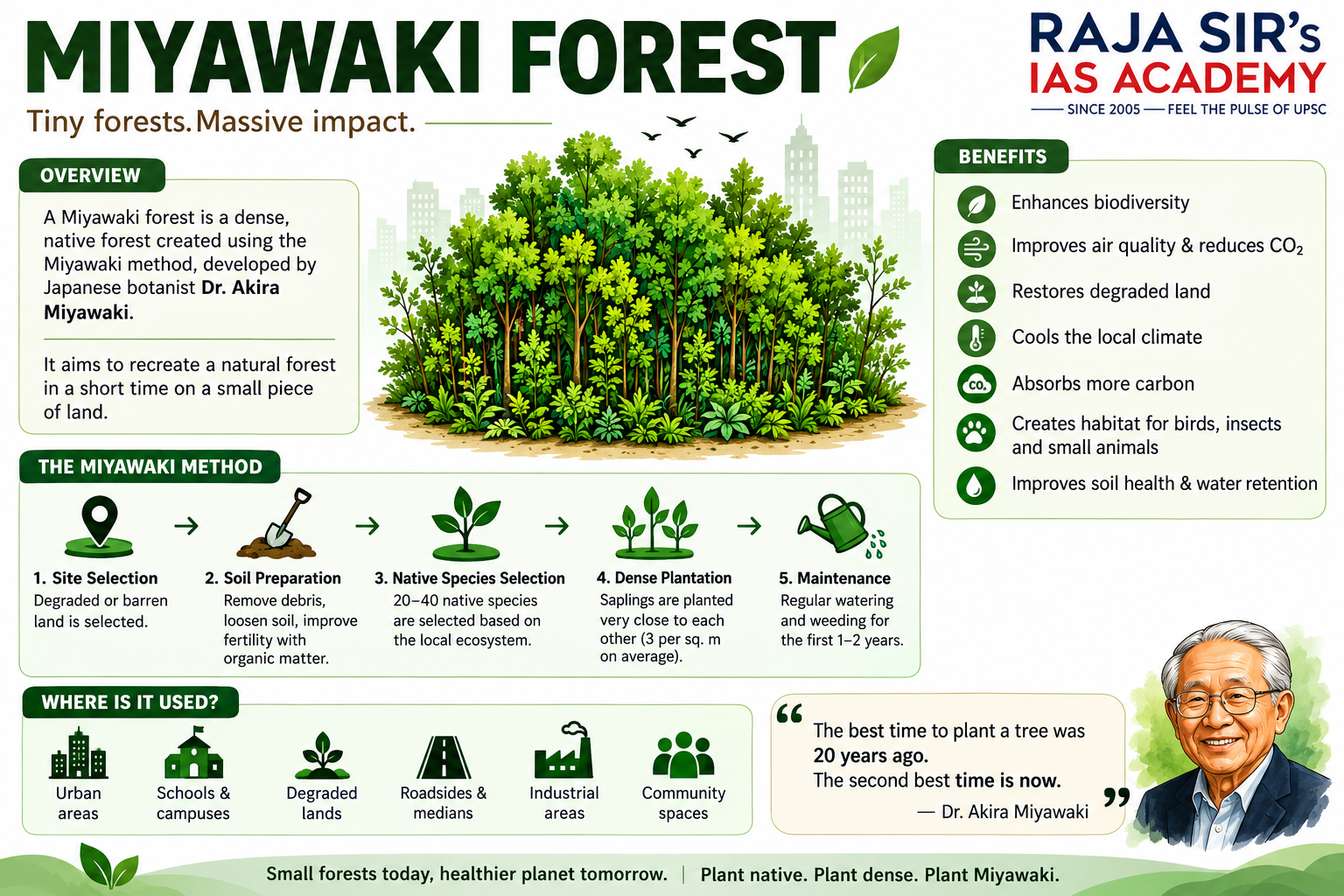
Raichur Miyawaki Forest
GS Paper III — Environment | Urbanisation
Why in News?
Raichur''s legacy-waste remediation project has been highlighted as a case study where reclaimed dumpsite land is being transformed into a Miyawaki urban forest.
Aim
To convert: Legacy waste → reclaimed land → ecological asset
Significance
- Biodiversity: Creates habitat for urban flora and fauna.
- Carbon sequestration: Vegetation absorbs atmospheric CO₂.
- Temperature reduction: Trees help reduce the urban heat-island effect.
- Green spaces: Converts degraded land into ecological spaces.
Impact
Positive
- Reduces pressure on landfills.
- Improves urban environment and aesthetics.
- Creates green and recreational spaces.
- Helps moderate local temperatures.
Limitations
- Requires proper species selection and maintenance.
- May require considerable water if poorly designed.
- Cannot replace waste segregation, recycling and source reduction.
Challenges
- Legacy waste: May contain hazardous contaminants.
- Poor soil: Reclaimed land may need soil restoration.
- Water needs: Plantation survival can be difficult in water-stressed areas.
- Maintenance: Requires long-term monitoring and care.
- Invasive species: Wrong species selection can harm native biodiversity.
Way Forward
- Scientific remediation: Safely process legacy waste before plantation.
- Native species: Prefer locally adapted, diverse species.
- Monitoring: Regularly assess soil, water, biodiversity and survival rates.
- Urban integration: Include such forests in city biodiversity and climate plans.
|
|
From Wetlands to a High-Value Agri Opportunity
GS Paper III — Agriculture | Food Processing | Rural Economy | Wetland-Based Livelihoods
Why in News?
India’s makhana market is projected to reach ₹11,000–12,000 crore by 2029–30, driven by rising domestic and global demand, improved cultivation and processing. The Centre has also approved a ₹476.03-crore scheme and established the National Makhana Board to develop the sector.
What is Makhana?
- Scientific name: Euryale ferox
- Family: Nymphaeaceae (water-lily family)
- It is a high-value aquatic macrophyte crop.
- Its starchy seeds are processed, roasted and popped into fox nuts/gorgon nuts.
Natural Habitat
Makhana grows mainly in:
- Shallow freshwater wetlands
- Perennial ponds
- Oxbow lakes/beels
- Ditches
- Flood-prone lowlands
- It prefers warm, humid conditions, adequate water and clayey/alluvial organic-rich pond beds.
Geographical Significance
- India accounts for the majority of global makhana production.
- Bihar -Major Production Hub
- Important districts include: Darbhanga, Madhubani, Purnia, Katihar, Saharsa, Supaul, Araria and Sitamarhi.
GI Tag - Mithila Makhana received a GI tag in 2022.
National Makhana Board
- Ministry: Ministry of Agriculture & Farmers Welfare
- Department: Department of Agriculture & Farmers Welfare (DA&FW)
- Established: 2025
- Announced: Union Budget 2025–26
- Officially launched: 15 September 2025
- Headquarters/Location: Bihar
- Chairperson: Secretary, Department of Agriculture & Farmers Welfare
- Focus: Production, processing, value addition, marketing and exports of makhana
- Financial Support: ₹476.03 crore Central Sector Scheme (2025–26 to 2030–31)
- Target Beneficiaries: Makhana farmers, processors, FPOs, exporters and other stakeholders
|
|
Institutionalising Cooperative Federalism
GS Paper II — Polity & Governance | Cooperative Federalism
Why in News?
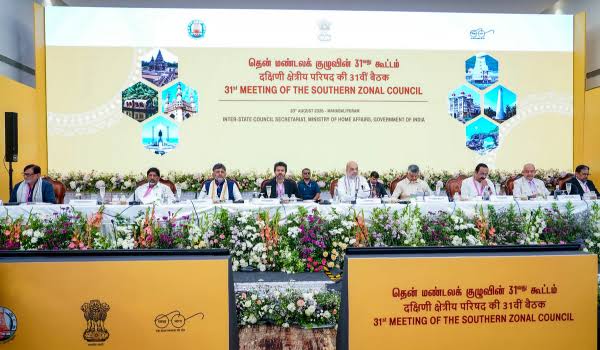
The 31st Southern Zonal Council meeting was held under the chairmanship of the Union Home Minister, highlighting the role of Zonal Councils in resolving inter-State issues and strengthening cooperative federalism.
About Zonal Councils
- Established: 1956
- Legal Basis: States Reorganisation Act, 1956
- Nature: Statutory bodies
- Number: 5 Zonal Councils
- Chairman: Union Home Minister
- Vice-Chairman: Chief Minister of one of the member States, by rotation
- Members: Chief Ministers and selected Ministers of member States; Union Ministers may also be associated.
Five Zonal Councils
- Northern Zonal Council
- Central Zonal Council
- Eastern Zonal Council
- Western Zonal Council
- Southern Zonal Council
Note :
- North Eastern Council (NEC) is NOT a Zonal Council.
- Established: 1971
- Legal basis: North-Eastern Council Act, 1971
- Covers the North-Eastern region.
Aim
- Promote cooperative federalism.
- Resolve inter-State disputes through dialogue.
- Coordinate regional development.
- Discuss common issues such as: Water sharing, Infrastructure, Transport, Border issues, Economic development, Internal security
Significance
- Governance - Provides an institutional platform for Centre–State and inter-State coordination.
- Federalism - Encourages consultation and consensus rather than confrontation.
- Regional Development- Helps neighbouring States coordinate on projects and common challenges.
|
|
Eyes in the Sky
GS Paper III — Science & Technology | Space Technology | Disaster Management
Why in News?
GISAT-1A (EOS-05) is an Earth-observation satellite associated with ISRO’s effort to provide frequent and near-real-time imaging of the Indian region for applications such as disaster management, agriculture and strategic monitoring.
About GISAT-1A
- Full Form : GISAT: Geo Imaging Satellite ; EOS-05: Earth Observation Satellite-05
- Agency : ISRO - Indian Space Research Organisation
- Satellite Type - Earth-observation / remote-sensing satellite
- Orbit - Geostationary orbit, Approximately 36,000 km above Earth
- Launch Vehicle - GSLV
|
|
Expanding India’s Path to Universal Health Coverage
GS Paper II — Health | Social Justice | Government Schemes
Why in News?
Ayushman Bharat–Pradhan Mantri Jan Arogya Yojana (AB-PMJAY) continues to be a major government initiative for expanding health insurance coverage and reducing out-of-pocket expenditure, with its coverage expanded to all citizens aged 70 years and above, irrespective of income.
About the Scheme
- Full Name : Ayushman Bharat – Pradhan Mantri Jan Arogya Yojana (AB-PMJAY)
- Launched : 23 September 2018
- Ministry : Ministry of Health & Family Welfare
- Implementing Agency : National Health Authority (NHA)
- Nature : Government-funded health assurance scheme
- Treatment: Secondary & tertiary hospitalisation
- Mode: Cashless and paperless
- Portability: Across India
- Pre-existing diseases: Covered from day one
- 70+ expansion: All citizens aged 70 years and above, irrespective of socio-economic status
Coverage
- ₹5 lakh per family per year
- Covers secondary and tertiary hospitalisation.
Aim
- Financial Protection
- Reduce the financial burden of major medical treatment.
- Universal Health Coverage
- Improve access to quality healthcare for vulnerable populations.
- Reduce Out-of-Pocket Expenditure
- Protect families from catastrophic healthcare expenses.
|
Component
|
Full Form / Nature
|
Main Focus
|
Key Features
|
|
AB-PMJAY
|
Ayushman Bharat – Pradhan Mantri Jan Arogya Yojana
|
Hospitalisation & Financial Protection
|
₹5 lakh per family/year cover; secondary & tertiary hospitalisation; cashless & paperless treatment; portability across India
|
|
Ayushman Arogya Mandirs
|
Formerly Health & Wellness Centres
|
Comprehensive Primary Healthcare
|
Preventive care; maternal & child health; NCD screening; mental health; elderly care; essential medicines & diagnostics
|
|
ABDM
|
Ayushman Bharat Digital Mission
|
Digital Health Ecosystem
|
ABHA; digital health records; health facility & professional registries; interoperable digital health infrastructure; consent-based data sharing
|
|
PM-ABHIM
|
Pradhan Mantri Ayushman Bharat Health Infrastructure Mission
|
Health Infrastructure & Preparedness
|
Public health laboratories; disease surveillance; critical-care capacity; district/block-level infrastructure; pandemic preparedness
|
|
|
Australia’s Strategic Outpost in the Eastern Indian Ocean
GS Paper I — Geography | Mapping | Environment
Why in News?
Christmas Island came into focus in connection with space-related activity in the Indian Ocean, highlighting its strategic location and Australia''s presence in the eastern Indian Ocean.
About Christmas Island
Location
- Located in the eastern Indian Ocean.
- Lies south of Indonesia.
- Located relatively close to Java and Sumatra.
Political Status
- External territory of Australia.
- Not part of mainland Australia.
Administrative Facts
- Capital: Flying Fish Cove
- Country: Australia
- Region: Indian Ocean
Significance
- Strategic Location : Located near major maritime routes connecting the Indian and Pacific Oceans.
- Biodiversity : Famous for the annual migration of Christmas Island red crabs.
- Natural Resources : Historically significant for phosphate deposits.
Environment : A large part of the island is protected as Christmas Island National Park.
|
|
Polygamy and Personal Laws
GS Paper II — Polity | Fundamental Rights | Judiciary | Social Justice
Why in News?
The Supreme Court examined a challenge concerning the constitutional validity of polygamy, raising questions about the relationship between personal laws, religious freedom and fundamental rights.
What is Polygamy?
Polygamy refers to a marital system in which a person has more than one spouse.
In the Indian context, the debate primarily concerns polygyny — a man having multiple wives.
Constitutional Framework
- Article 14 -Guarantees equality before law and equal protection of laws.
- Article 15 -Prohibits discrimination on specified grounds, including sex.
- Article 21-Protects life and personal liberty, including dignity.
- Article 25 -Protects freedom of conscience and the right to profess, practise and propagate religion.
Significance
- Constitutional Rights : Raises the question of whether personal-law practices can be tested against equality and dignity.
- Gender Justice: The debate focuses on the impact of polygamy on women''s equality, autonomy and dignity.
- Personal Law Reform : Highlights the broader challenge of balancing religious freedom with constitutional values.
- Judicial Role:Raises questions about the extent to which courts can review practices governed by personal laws.
Impact
Positive Possibilities
- Greater focus on gender equality and dignity.
- Could encourage reforms in discriminatory practices.
- Strengthens constitutional debate on personal laws.
Concerns
- May create tensions between religious freedom and equality rights.
- Personal-law reform requires sensitivity to India''s religious and cultural diversity.
- Judicial intervention can raise questions about institutional boundaries.
Challenges
- Personal Law vs Fundamental Rights :Determining when a personal-law practice can be subjected to constitutional scrutiny.
- Essential Religious Practices : Courts may need to determine whether a practice is an essential part of religion.
- Gender Equality : Balancing religious freedom with women''s constitutional rights.
- Uniformity vs Diversity : Reform must balance constitutional equality with India''s plural legal traditions.
Way Forward
- Constitutional Approach : Evaluate personal laws through equality, dignity and non-discrimination.
- Consultative Reform : Encourage dialogue with communities, legal experts and women''s organisations.
- Gender-Centred Reform : Prioritise women''s autonomy, dignity and equal legal protection.
- Legislative Clarity : Parliament and State legislatures can provide clear, rights-compatible legal frameworks.
Important Case Studies
Sarla Mudgal v. Union of India (1995)
- The Supreme Court held that conversion to Islam cannot be used merely to circumvent an existing monogamous marriage and contract another marriage.
- Significance: Prevented misuse of religious conversion to evade marriage law.
Javed v. State of Haryana (2003)
- The Supreme Court upheld restrictions on persons with more than two children contesting certain local elections and observed that polygamy is not an essential religious practice protected by Article 25.
- Significance: Important case for understanding the relationship between polygamy and religious freedom.
Shayara Bano v. Union of India (2017)
- The Supreme Court invalidated instant triple talaq (talaq-e-biddat).
- Significance: Demonstrated judicial scrutiny of personal-law practices in the context of constitutional rights, though the judgment did not decide the constitutional validity of polygamy.
|
|
India - Malaysia
GS Paper II — International Relations | Governance | Act East Policy
Why in News?
India and Malaysia held discussions on governance and public-administration cooperation, focusing on areas such as digital governance, capacity building and institutional cooperation.
Significance
- Governance : Sharing of digital governance and administrative practices. Strengthens institutional capacity.
- Strategic : Supports India''s Act East Policy. Deepens India''s engagement with ASEAN.
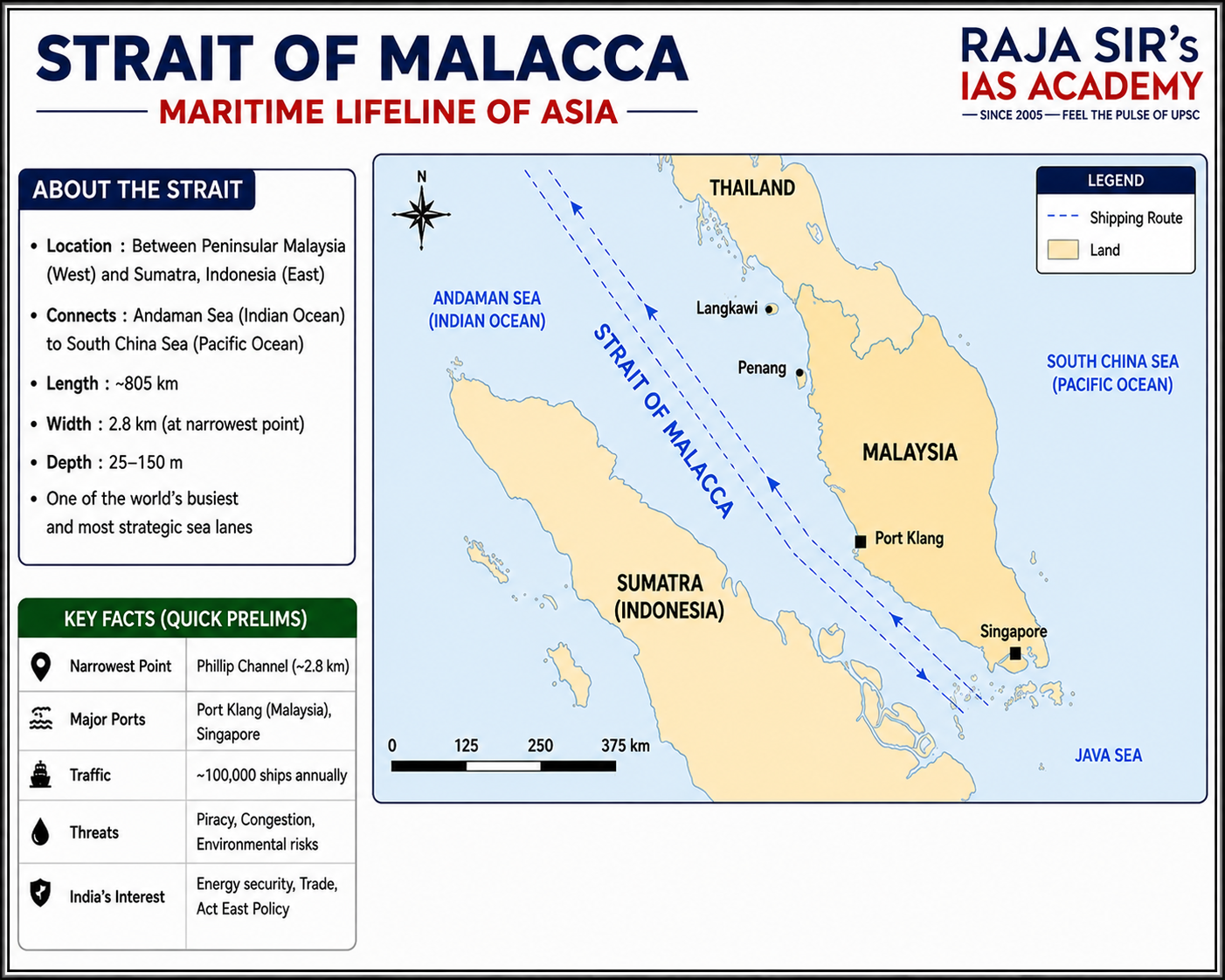
- Maritime: Malaysia''s location near the Strait of Malacca gives it importance for India''s maritime interests.
|
|
Internatioanal criminal court — ICC
GS Paper II — International Organisations | International Law
Why in News?
The International Criminal Court (ICC) has been in the news over disputes surrounding its jurisdiction and sanctions imposed on its officials, highlighting tensions between international criminal justice and State sovereignty.
About ICC
Established - Rome Statute: 1998 ; Operational: 2002.
Headquarters : The Hague, Netherlands.
Crimes Under Jurisdiction: Genocide, Crimes against humanity, War crimes, Crime of aggression
Key Principle
The ICC acts when national legal systems are unwilling or genuinely unable to investigate or prosecute serious international crimes.
Significance
- International Justice : Provides a permanent institution for prosecuting individuals responsible for the gravest international crimes.
- Accountability : Helps address situations where domestic judicial mechanisms fail.
India''s Position
- India is not a party to the Rome Statute.
- Therefore, it is not an ICC State Party.
|
Feature
|
ICC
|
ICJ
|
|
Full name
|
International Criminal Court
|
International Court of Justice
|
|
Deals with
|
Individuals
|
States
|
|
Main purpose
|
Prosecutes individuals for international crimes
|
Resolves disputes between States
|
|
Advisory opinions
|
No
|
Yes
|
|
Established by
|
Rome Statute
|
UN Charter
|
|
Location
|
The Hague
|
The Hague
|
|
Part of UN?
|
No
|
Yes — principal judicial organ of UN
|
|
|
Banni Grassland
GS Paper I — Geography | Environment | Biodiversity
Why in News?
The Banni Grassland of Gujarat is important in discussions on grassland conservation, pastoral livelihoods and the spread of invasive Prosopis juliflora.
About
|
Aspect
|
|
Details
|
|
Location
|
|
Banni Grasslands are located in Kutch district, Gujarat.
|
|
Region
|
|
They lie in northern Kutch, near the Great Rann of Kutch.
|
|
Type
|
|
They are an arid to semi-arid grassland ecosystem.
|
|
Area
|
|
The grasslands cover about 2,600 sq km.
|
|
Major Community
|
|
The Maldharis, a traditional pastoral community, depend on the grasslands for their livelihoods.
|
|
Famous Livestock
|
|
The region is famous for the Banni buffalo, an indigenous buffalo breed adapted to local conditions.
|
|
Vegetation
|
|
The landscape consists mainly of grasses, shrubs and scattered trees adapted to dry conditions.
|
|
Climate
|
|
The region has an arid and drought-prone climate with highly variable rainfall.
|
|
Ecological Importance
|
|
Banni provides grazing land, supports biodiversity, stores carbon and sustains pastoral livelihoods.
|
|
Major Issues
|
|
Major challenges include the spread of Prosopis juliflora, changing rainfall patterns, salinity, overgrazing and grassland degradation.
|
|
Nearby Ecosystem
|
|
Banni forms part of the broader Rann of Kutch desert–grassland landscape.
|
|
|
Spiny Guardians
GS Paper III — Environment | Biodiversity | Marine Ecosystem
Why in News?
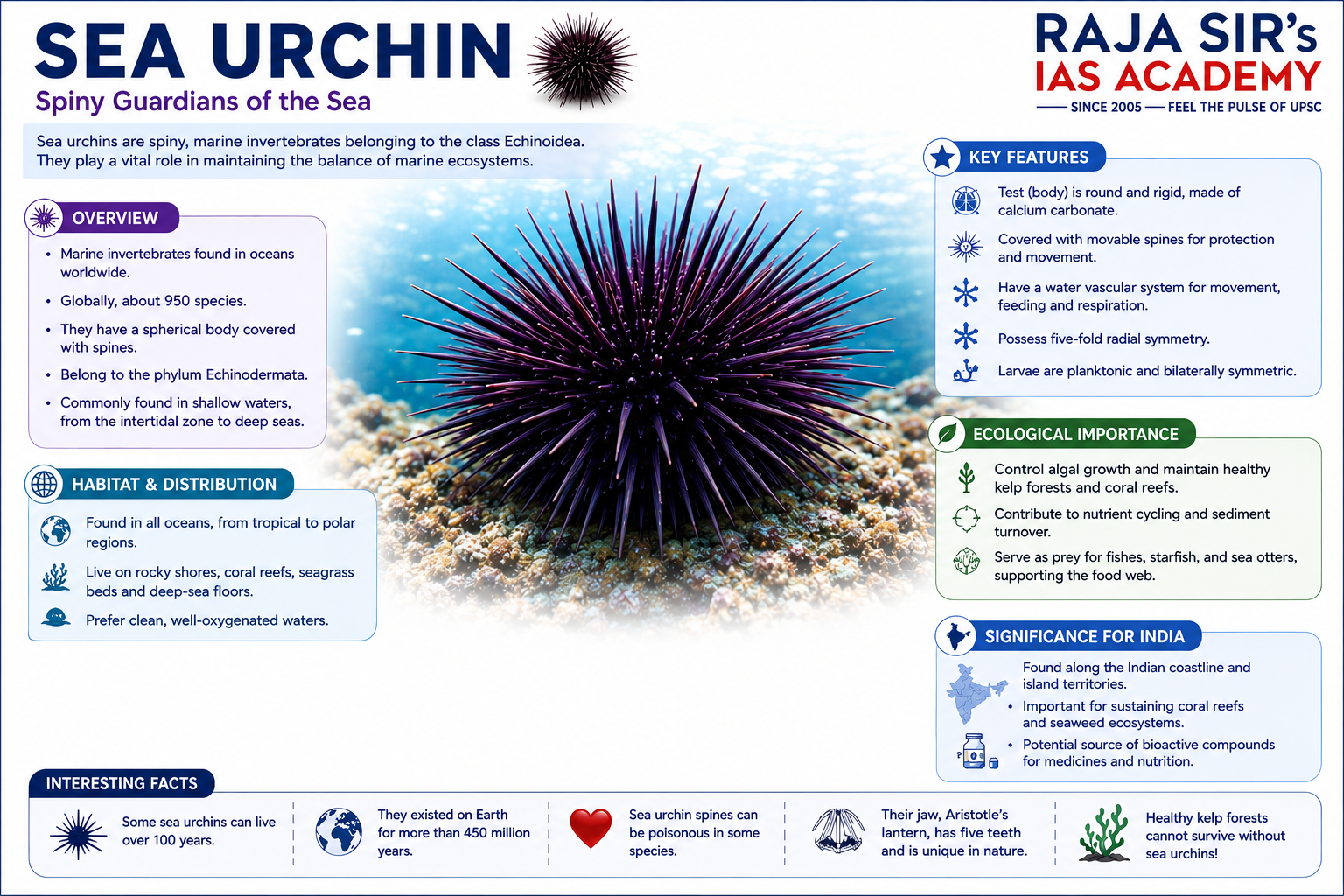
Sea urchins are important in marine ecosystem conservation because their grazing on algae helps maintain ecological balance, particularly in coral-reef and rocky coastal ecosystems.
About Sea Urchin
- Marine invertebrate belonging to Phylum Echinodermata.
- Related to: Starfish, Sea cucumbers, Brittle stars, Sea lilies
- Usually have a globular body covered with movable spines.
- Found mainly on seabeds and rocky marine habitats.
Significance
- Marine Ecosystem: Act as important herbivores, feeding on algae. Help control excessive algal growth.
- Coral Reefs: Grazing can prevent algae from overgrowing corals. Thus, they contribute to reef ecosystem balance.
- Food Chain: Form an important link in the marine food web. Serve as prey for fish, sea otters and other marine predators.
- Biodiversity : Their presence indicates the health and functioning of coastal marine ecosystems.
Impact of Decline
- Ecological : Decline in sea urchins can cause algal overgrowth. May disturb coral-reef ecological balance.
- Fisheries : Overharvesting can reduce local populations. Loss of healthy populations can affect marine food webs.
Challenges
- Overexploitation : Harvesting for food and commercial purposes can reduce populations.
- Climate Change : Ocean warming and acidification can affect their growth, reproduction and survival.
- Pollution : Marine pollutants can damage their habitat and life cycles.
- Disease : Marine diseases can cause sudden population declines in some regions.
Way Forward
- Conservation : Regulate unsustainable harvesting. Protect important marine habitats.
- Marine Protected Areas: Strengthen protection of coral reefs and coastal ecosystems.
- Pollution Control: Reduce plastic, chemical and sewage pollution entering oceans.
- Climate Action : Reduce pressures from ocean warming and acidification through broader climate mitigation.
|
|
The Rise of Synthetic Drug Trafficking
GS Paper III — Internal Security | Health | International Organisations
Why in News?
The illicit production and trafficking of methamphetamine is a growing concern for drug-control agencies because of its highly addictive nature and links with organised crime and cross-border trafficking.
About Methamphetamine
- A synthetic psychoactive stimulant.
- Belongs to the Amphetamine-Type Stimulants (ATS) group.
- Highly addictive and can cause serious physical and psychological dependence.
- Unlike plant-based drugs, it can be produced synthetically, making trafficking networks difficult to control.
Impact
- Health : Can cause neurological and cardiovascular problems. Long-term use may result in severe dependence and mental-health complications.
- Internal Security : Drug trafficking can support: Organised crime, Money laundering, Cross-border criminal networks, Corruption
- International Security : Production and trafficking often cross national borders.Requires cooperation among law-enforcement and drug-control agencies.
Challenges
- Synthetic Production : Can be manufactured without large agricultural areas. Makes detection and suppression difficult.
- Cross-Border Trafficking :Criminal networks exploit porous borders and international routes.
- Digital Networks : Online platforms and encrypted communication can facilitate trafficking.
- Rehabilitation : Addiction requires long-term treatment, rehabilitation and social reintegration.
Way Forward
- Enforcement : Strengthen border surveillance and intelligence-sharing.
- Precursor Control : Monitor precursor chemicals used in illicit drug manufacture.
- Financial Investigation : Track and disrupt money-laundering networks and illicit financial flows.
- International Cooperation : Strengthen cooperation through UNODC and regional drug-control mechanisms.
United Nations Office on Drugs and Crime (UNODC):
Establishment
- UNODC was established in 1997 as the Office for Drug Control and Crime Prevention (ODCCP) by merging two UN offices.
- It was renamed the United Nations Office on Drugs and Crime (UNODC) in 2002.
- Its headquarters is located in Vienna, Austria.
Main Objective
- UNODC works to combat illicit drugs, transnational crime and related threats to international security.
- It also supports crime prevention and criminal justice reform in different countries.
Major Areas of Work
- UNODC addresses illicit drug trafficking and drug abuse.
- It works on crime prevention and strengthening criminal justice systems.
- It supports international efforts against organised crime and corruption.
- It provides legal and technical assistance to counter terrorism.
- It spreads awareness about the dangers of drug abuse.
Research and Policy Analysis
- UNODC publishes the World Drug Report annually.
- The World Drug Report provides information on global drug use, production, trafficking and emerging trends.
International Conventions
- UNODC supports the implementation of international drug-control conventions.
- It supports the United Nations Convention against Transnational Organized Crime (UNTOC).
- It supports the United Nations Convention against Corruption (UNCAC)
|
|
Strengthening India’s Consumer Justice System
GS Paper II — Polity | Governance | Consumer Protection
Why in News?
The National Consumer Disputes Redressal Commission (NCDRC) is India''s apex consumer dispute-redressal body, functioning under the Consumer Protection Act, 2019.
About NCDRC
- Nature : Statutory body, Quasi-judicial body
- Legal Basis :Established under the Consumer Protection Act, 1986. Continues under the Consumer Protection Act, 2019.
- Headquarters : New Delhi
Aim
- Provide speedy and accessible consumer justice.
- Protect consumer rights.
- Provide remedies against defective goods and deficient services.
|