Download PDF
Download PDF
GS Linked
PYQ Based

AUGUST 4 , 2026 CURRENT AFFAIRS

Cloudburst Triggers Flash Floods in Jammu & Kashmir

Why in News: A cloudburst caused flash floods in J&K, distinct from typical steady, widespread monsoon rainfall.

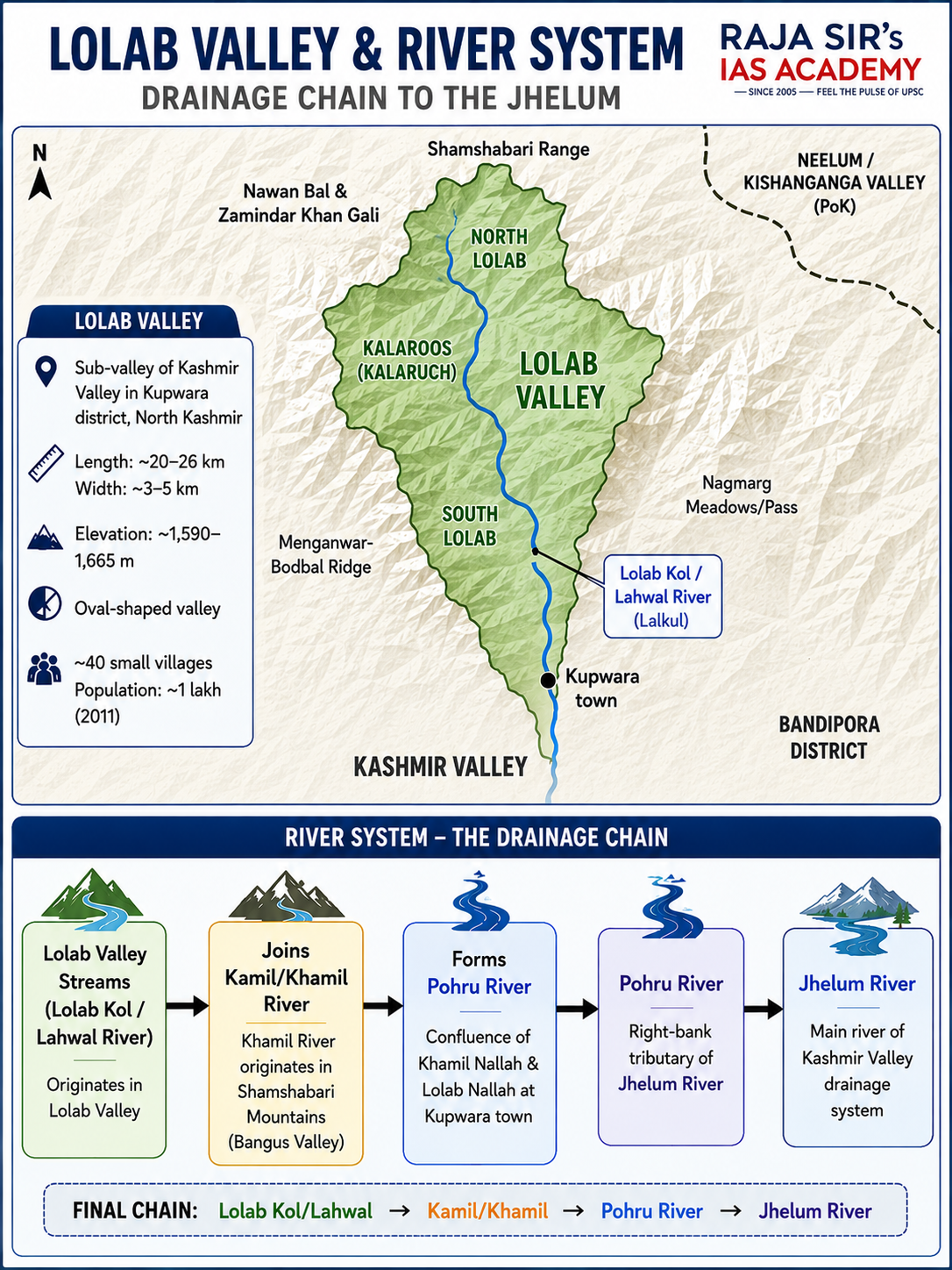
LOLAB VALLEY

  • Also called Wadi-e-Lolab ("valley of love and beauty") — a Himalayan sub-valley of the larger Kashmir Valley, located in Kupwara district, North Kashmir.
  • Lies about 90 km north of Srinagar, stretching northwest toward Andarbugh.

Dimensions & Sub-divisions

  • Length variously given as ~20–26 km  width ~3–5 km.
  • Oval-shaped; comprises three principal sub-valleys: Kalaroos (Kalaruch), North Lolab (Potnai), and South Lolab (Brunai) .

Surrounding Geography

  • The valley is ringed by mountains — Nawan Bal and Zamindar Khan Gali (northwest), Menganwar-Bodbal ridge (west), and the Shamshabari Range to the north/northwest.
  • Borders: Kashmir Valley to the south, Neelum/Kishanganga Valley (PoK side) to the north, separated from Bandipora by the Nagmarg Meadows/Pass to the east.
  • Kupwara district''s northwestern portion lies along the Line of Control.

Ecology

  • Roughly three-fourths forested — pine, deodar, fir — home to black bears, markhor, wild bulls, and musk deer;
  • Notably lacks a wildlife sanctuary, national park, or bird sanctuary despite its biodiversity

Kupwara District 

  • Known as the "walnut district" — major walnut and apple producer.
  • Other rivers in the district: Pohru, Mawar, Batmooji, Talri, and the Kishanganga River, which flows through the district''s outer areas from east to west.
  • About 71.58% of Kupwara''s geographical area is under forest cover.


Commonwealth Games 2030 — India to Host

Why in News: The 2026 Commonwealth Games (Glasgow) concluded; India will host the 2030 Centenary Games in Ahmedabad, Gujarat.

About :

  • India becomes the first Asian nation to host CWG twice (earlier: Delhi 2010).
  • CWG origin: formerly British Empire Games; first held in Canada, 1930 → 2030 marks the Centenary.
  • 72 Commonwealth Games Associations (CGAs) participate; India debuted in 1934.
  • Commonwealth of Nations: 56 member countries; founded via the London Declaration (1949); latest entrants Gabon, Togo (2022).


e-Pratyaropan Digital Platform

Why in News: Unveiled at the 16th Indian Organ Donation Day, New Delhi, by the Union Minister of State for Health.

About

  • Nodal Ministry: MoHFW ( Ministry of Health and Family Welfare)
  • Apex Agency: NOTTO. (National Organ and Tissue Transplant Organisation)
  • Allocation follows THOTA (Transplantation of Human Organs and Tissues Act) guidelines - protocol-based (medical priority, geography, urgency).
  • Hospitals/ROTTOs/SOTTOs must log transplant data within 48 hours post-procedure.
  • Aim: Establish a transparent, fair, efficient, technology-enabled organ donation and allocation ecosystem, eliminating manual delays and discretionary bias.

 Features:

  • Unified national donor-recipient registry - one central database of all donors, patients, and pledges nationwide.
  • Algorithm-based allocation under THOTA - organs matched to patients by fixed protocol, not human discretion.
  • Real-time green-corridor tracking via the NOTTO app - live monitoring of an organ''s transit from donor to recipient.
  • Mandatory time-bound data logging -  hospitals must update transplant records within 48 hours, ensuring no delays or falsification.

Significance: Fits within India''s broader Digital Public Infrastructure (DPI) model (alongside CoWIN, ABHA); curbs illegal organ trade through encrypted, centralised allocation.

Impact: Faster donor-recipient matching, especially critical for time-sensitive organs (heart); improved public trust in the transplant ecosystem.

Causes (why needed): Persistent gap between organ demand and supply; opacity and malpractice risk in manual allocation systems; low public awareness limiting donor registration.

Way Forward: Pair digitisation with sustained public awareness campaigns to expand the donor pool; ensure last-mile hospital compliance (especially in Tier-2/3 cities); periodic audit of allocation algorithms for fairness.


Glaw Lake (Glow Lake) — India''s 101st Ramsar Site

Why in News: Union Environment Minister announced Glaw Lake, Arunachal Pradesh, as India''s 101st Ramsar Site — the state''s first.

About

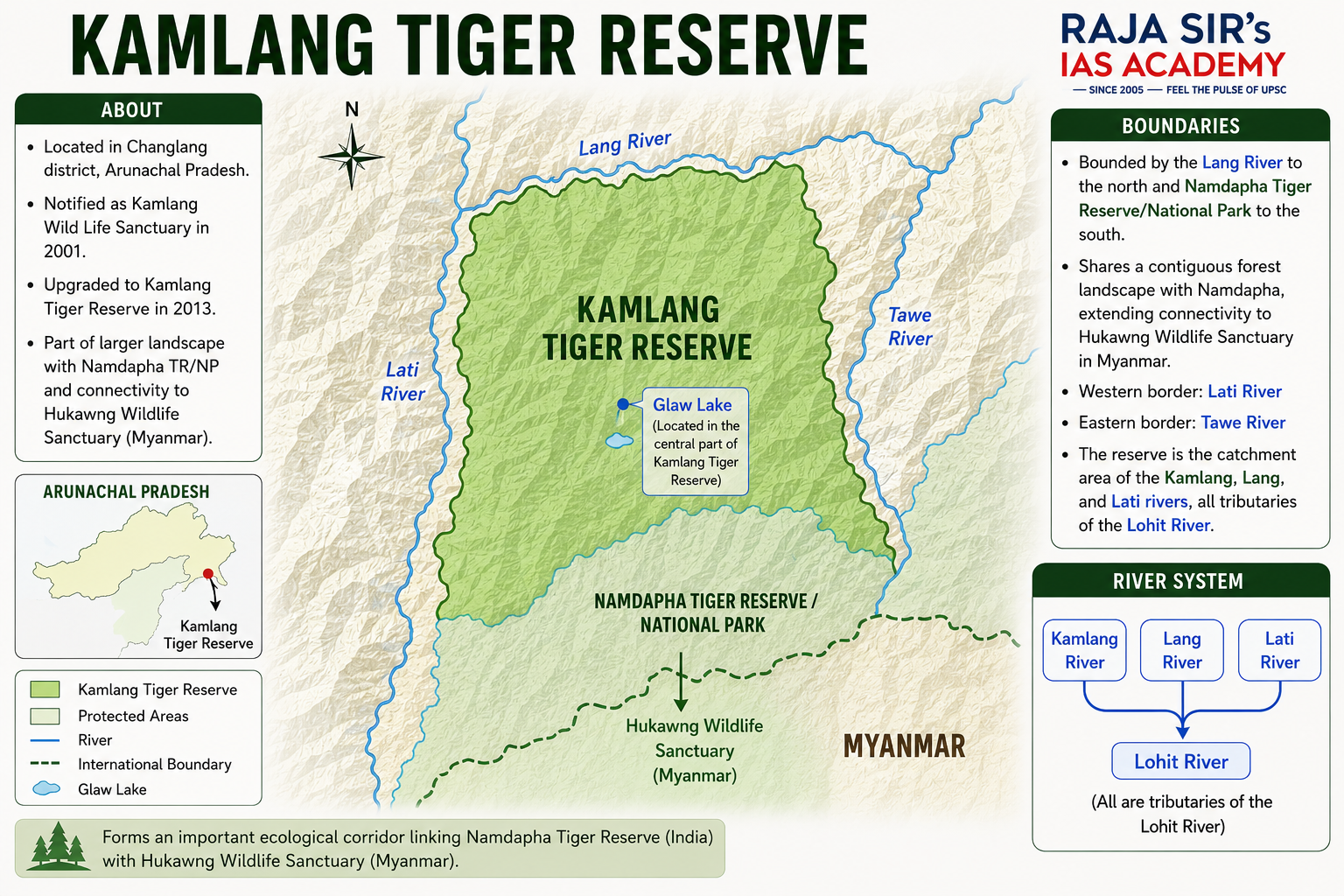
  • Location: Lohit district, Arunachal Pradesh; inside Kamlang Tiger Reserve.
  • Area: ~8 sq km; elevation ~1,168 m; source of the Kamlang River.
  • Hosts all four Himalayan big cats: Bengal Tiger (EN), Indian Leopard (VU), Clouded Leopard (VU), Snow Leopar (VU).
  • 150+ tree species, 49 wild orchid species.

Kamlang Tiger Reserve

  • Location: south-eastern Lohit district, Arunachal Pradesh, near the Myanmar border; headquartered at Wakro.
  • Named after the Kamlang River, which flows through it and eventually joins the Brahmaputra.
  • Part of the Eastern Himalayan Biodiversity Hotspot
  • Declared a Wildlife Sanctuary in 1989.
  • Notified as India''s 50th Tiger Reserve.
  • In 2024, declared an Eco-Sensitive Zone.

Boundaries

  • Bounded by the Lang River to the north and Namdapha Tiger Reserve/National Park to the south — shares a contiguous forest landscape with Namdapha, extending connectivity to the Hukawng Wildlife Sanctuary in Myanmar.
  • Western border: Lati River; eastern side: Tawe River (per one source) — the reserve is the catchment area of the Kamlang, Lang, and Lati rivers, all tributaries of the Lohit River.

Fauna

  • All four big cats: Tiger, Leopard, Clouded Leopard, Snow Leopard.
  • Other carnivores: Asiatic dhole, golden jackal, yellow-throated marten, marbled cat, golden cat.
  • Other mammals: Asian elephant, Malayan sun bear, slow loris, Hoolock gibbon, Mishmi takin.
  • Birds: White-bellied heron, Great hornbill (notable, since white-bellied heron is Critically Endangered — a strong standalone fact).

Local Communities  : Mishmi group — specifically Digaro Mishmi and Miju Mishmi tribes reside in and around the reserve.


Kisan Credit Card–Modified Interest Subvention Scheme (KCC-MISS)

Why in News: A third-party assessment found KCC-MISS improved agricultural productivity, income diversification, and credit access.

  • Ministry: Agriculture & Farmers Welfare; covers loans up to 3 lakh, plus dairy/fisheries/animal husbandry.
  • Interest subvention: 1.5%; farmer rate 7% → effective 4% via 3% Prompt Repayment Incentive
  • Aim: Ensure affordable, timely institutional credit to farmers, reducing dependence on informal high-cost lending.
  • Features: Interest subvention to banks + repayment-linked farmer incentive; extended coverage to allied sectors (dairy, fisheries).
  • Significance: Directly supports farm productivity and income diversification by lowering the effective cost of working capital.
  • Impact: Third-party assessment confirms improved productivity and credit access — evidence-based validation of the subvention model.

Way Forward:

  •  Expand digital, Aadhaar-linked disbursal (via Kisan Rin Portal) to reduce delays
  •  periodically review subvention rates against changing interest-rate cycles.
  • ·extend financial literacy support so farmers maximise the PRI benefit through timely repayment.


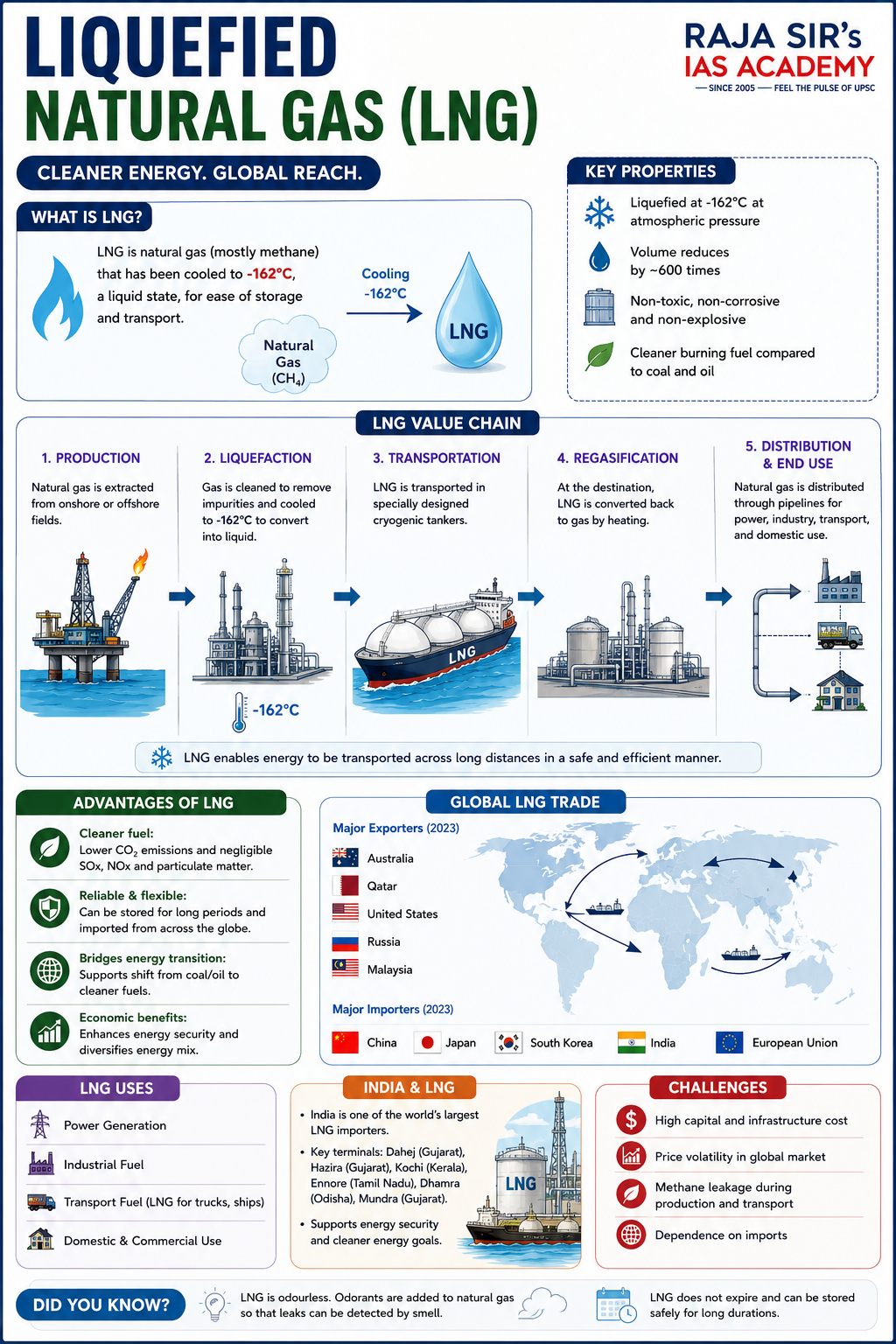
Liquefied Natural Gas (LNG)

Why in News: India''s LNG imports from the US, Oman, Nigeria, and Angola rose, offsetting decline from Strait of Hormuz disruptions.

About

  • LNG cooled to ~−162°C; volume reduced ~600 times.
  • India meets ~50% of gas demand via LNG; ~60% of that transits the Strait of Hormuz (mainly Qatar, UAE)

Causes: Geopolitical disruptions in the Strait of Hormuz threatening a chokepoint through which the majority of India''s LNG imports flow.

Impact: Short-term supply risk to India''s gas-dependent power, industry, and household sectors; price volatility risk if disruptions persist.

Significance: Demonstrates India''s ability to diversify suppliers quickly (US, Oman, Nigeria, Angola) — a positive resilience signal for energy security.

Way Forward:

  • Continue diversifying LNG sourcing geography to reduce chokepoint dependence.
  •  invest in strategic gas storage capacity; accelerate domestic gas production and city-gas-distribution network expansion.
  •  pursue long-term supply contracts with diversified partners to reduce spot-market price exposure.


The MSME Development (Amendment) Bill, 2026

Why in News: Parliament passed the Bill after Rajya Sabha approval, amending the MSME Development Act, 2006.

About

  • Removes fixed statutory investment thresholds; registration made voluntary; mandatory TReDS for CPSEs.
  • Mediation: 90 days
  • arbitration: commence within 30 days
  • award within 90 days
  •  ≥50% interim relief if court proceedings exceed 6 months.
  • Adjudicating authority: Development Commissioner (MSME); appeals to MSME Secretary.

Aim: Improve the MSME business environment through faster payments, streamlined dispute resolution, flexible classification, and decriminalised compliance.

why needed: Chronic delayed payments to MSMEs from larger buyers/CPSEs; rigid, outdated classification thresholds; disproportionate criminal liability for minor/technical compliance lapses discouraging entrepreneurship.

Significance: Fits into the broader "Ease of Doing Business" and decriminalisation agenda (Jan Vishwas Act family); directly protects MSME cash flow, the sector''s most persistent vulnerability.

Impact: Likely to improve MSME liquidity and reduce litigation timelines; shifting classification power to executive notification increases agility but reduces Parliamentary oversight — a trade-off worth flagging.

Way Forward:

  • Ensure timely notification updates to classification thresholds to keep pace with inflation/economic growth.
  • Build institutional capacity at MSME Facilitation Councils to meet the new time-bound mandates.


Nitrosamines

Why in News: Rising consumption of processed foods, pharmaceuticals, and treated water has raised concern over nitrosamine exposure

About

  • Formed when amines react with nitrites/nitrates under heat, acidic pH, or oxidising conditions.
  • Key compound: NDMA — found in water and medicines; long-term exposure linked to cancer risk

Causes: Increasing dietary reliance on processed/preserved foods; certain drug formulations prone to nitrosamine formation during manufacturing and storage.

Impact: Potential long-term public health risk (carcinogenicity)  has triggered global pharmaceutical recalls when detected above safety thresholds.

Significance: Exposes gaps in food and drug safety regulation and testing infrastructure in a rapidly processed-food-consuming population.

Way Forward:

  • Strengthen FSSAI and CDSCO testing protocols for nitrosamine detection.
  • Set clear permissible-limit standards for food, water, and pharmaceuticals
  • Promote public awareness on processed food and preservative-related health risks.


Prime Minister''s Viksit Bharat Rozgar Yojana (PM-VBRY)

Why in News: PM-VBRY completed one year, with over 72 lakh first-time workers joining the formal workforce.

  • Ministry: Labour & Employment; Implementing agency: EPFO; Outlay: 99,446 crore; Target: 3.5+ crore jobs.
  • Part A: up to ₹15,000 for employees; Part B: up to ₹3,000/month for employers (4 yrs manufacturing, 2 yrs others).

Aim: Promote formal employment by directly incentivising both first-time employees and employers who create new jobs.

Features: Two-part incentive structure (employee lump-sum + employer monthly support); sector-differentiated duration favouring manufacturing.

Significance: Uses EPFO enrolment as a measurable, verifiable proxy for formalisation — addresses India''s long-standing informal-employment challenge.

Impact: 72 lakh first-time formal workers in one year is a strong early formalisation signal; question remains on retention — whether jobs persist once the subsidy period ends.

Way Forward:

  • Build in retention-tracking metrics beyond initial registration.
  • pair incentive-driven formalisation with skilling programmes to improve job quality and productivity


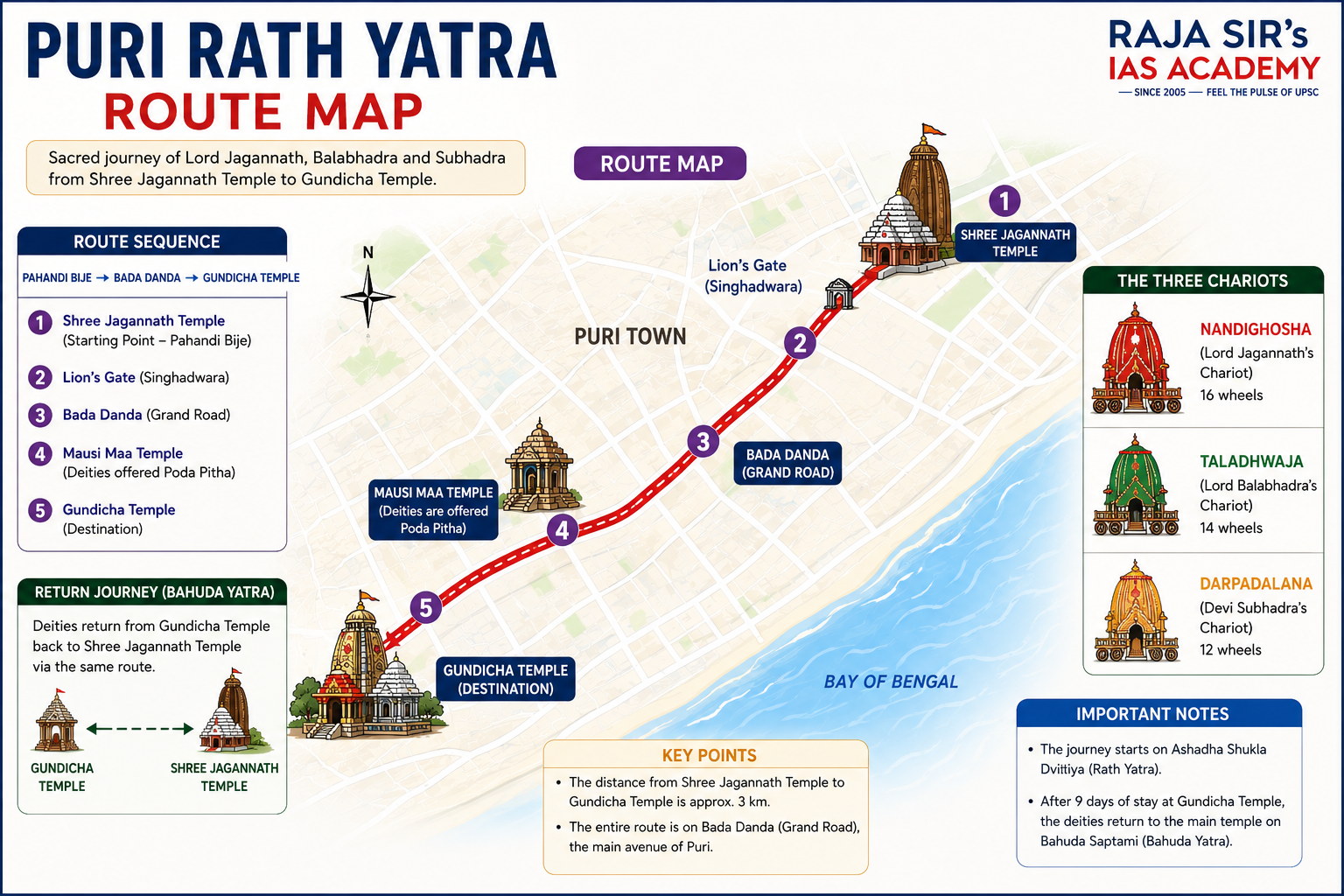
UNESCO Tag Proposal for Puri Rath Yatra

Why in News: Odisha CM urged the Centre to nominate the Puri Rath Yatra for UNESCO''s Representative List of Intangible Cultural Heritage.

ABOUT :

  • Proposal by SJTA (Shree Jagannatha Temple Administration)
  • Three chariots — Nandighosha, Taladhwaja, Darpadalana.
  • hereditary artisans - Maharanas.
  • Route: Pahandi Bije → Bada Danda → Gundicha Temple; return: Bahuda Rath Yatra.


Section 498A (Indian Penal Code) — Supreme Court Ruling

Why in News: SC held Section 498A IPC applies to women in live-in relationships "in the nature of marriage," permitting prosecution for domestic cruelty.

·         Original: Section 498A, IPC 1860 — cognizable, non-bailable, non-compoundable.

  • Post-BNS (2023): now Sections 85 and 86 of the Bharatiya Nyaya Sanhita.

What is Section 498A?

Section 498A IPC (now Section 85 BNS) punishes: Cruelty by a husband or his relatives against a woman.

Maximum punishment: Imprisonment up to 3 years and Fine

What is "Cruelty"?

(A) Physical or Mental Cruelty

·         Drive a woman to commit suicide

·         Cause grave injury

·         Affect physical or mental health

(B) Dowry-related Harassment

·         Dowry

·         Property

·         Valuable security

Why is the recent judgment important?

Earlier understanding: Section 498A mainly protected legally married women.

Now the Supreme Court says: If a live-in relationship is "in the nature of marriage", the woman can also invoke the anti-cruelty provision.

Landmark Cases to Remember

Arnesh Kumar v. State of Bihar (2014) : No automatic arrest under Section 498A.

Sushil Kumar Sharma v. Union of India (2005) :  Misuse of a law is not a reason to strike it down.

Social Action Forum v. Union of India (2018): Protect women while preventing arbitrary arrests.

Supreme Court (2026) : Extended protection to marriage-like live-in relationships.


Supreme Court (Number of Judges) Amendment Bill, 2026

Why in News: Lok Sabha passed the Bill increasing Supreme Court judge strength.

  • Amends the 1956 Act; replaces the 2026 Ordinance; judges (excl. CJI) increased 33 → 37 (total incl. CJI: 38).
  • Rationale: 92,000+ pending cases in the SC as of 2026; basis — Article 124(1).

Aim: Reduce judicial backlog and improve case-disposal capacity at the Supreme Court.

Causes: Rapidly growing case pendency outpacing the existing judge strength.

Significance: Judge-strength increase is a direct, immediate-capacity solution well within Parliament''s constitutional authority.

Impact: Likely to marginally improve disposal rates, but backlog reduction depends on parallel factors — timely appointment of judges (avoiding vacancies), case-management reform, and reduced adjournments.

Way Forward: Fill sanctioned judge vacancies promptly strengthen alternate dispute resolution to reduce case inflow. invest in court digitisation and case-management systems (e-Courts) to complement the numerical increase.


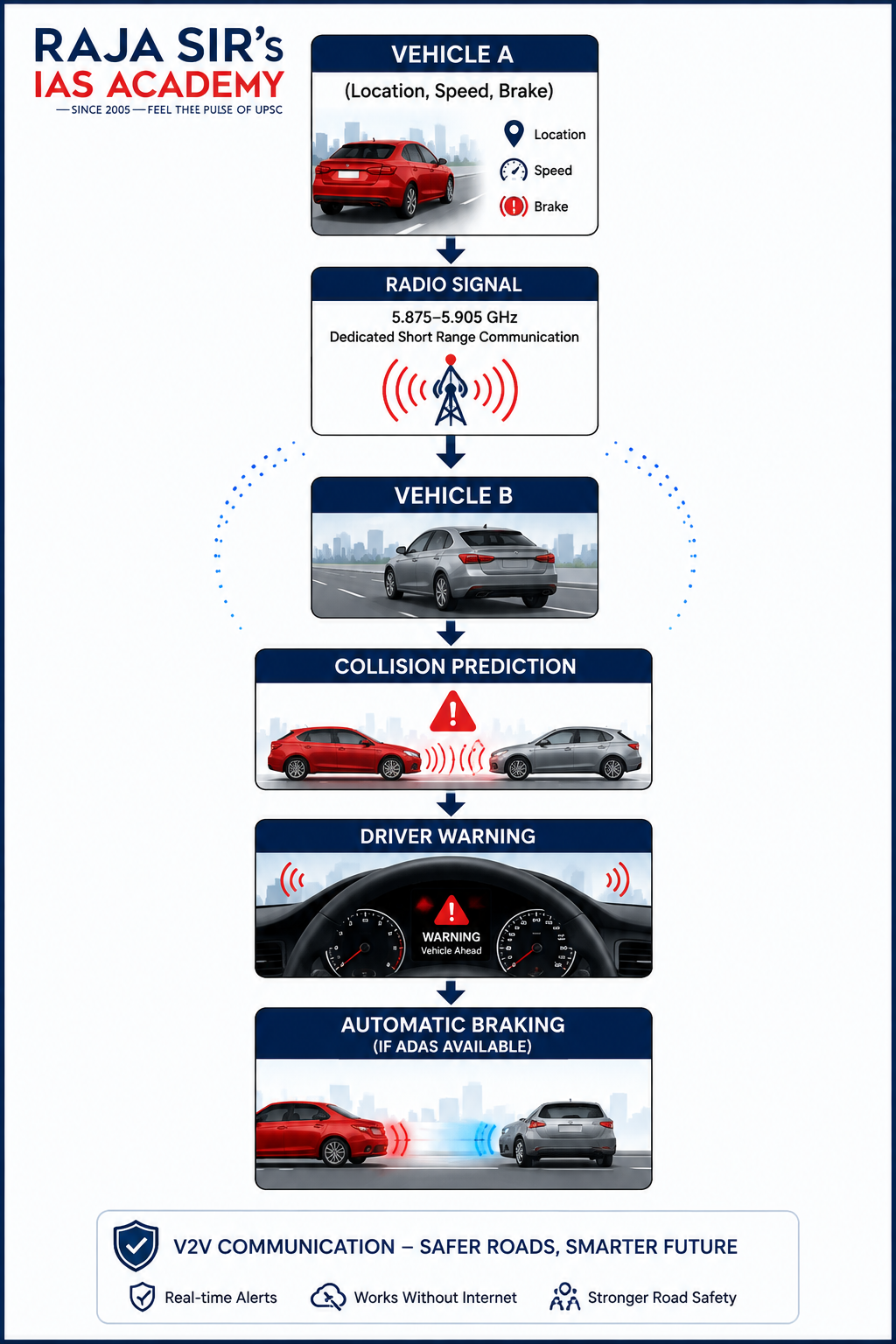
V2V Communication

Why in News: MoRTH ( Ministry of Road Transport and Highways)proposed mandating V2V communication in all new vehicles in a phased manner from October 2027.

What is Vehicle-to-Vehicle (V2V) Communication?

Vehicle-to-Vehicle (V2V) Communication is a wireless communication technology that enables vehicles to exchange information directly with one another in real time, without relying on mobile networks or the internet.


The system continuously shares information such as:

  • Vehicle location
  • Speed
  • Direction of travel
  • Braking status
  • Acceleration
  • Lane movement


Aim: Enhance road safety through real-time vehicle-to-vehicle hazard and collision-risk communication.

why needed: India has among the highest road-fatality rates globally; existing passive safety measures (seatbelts, airbags) don''t prevent accidents, only mitigate injury — V2V is a proactive, preventive layer.

Significance: Represents a shift toward Intelligent Transportation Systems (ITS) and smart-mobility infrastructure.

Impact: Potential to reduce collision rates and improve traffic flow; implementation challenges include cost to manufacturers/consumers, network infrastructure readiness, and interoperability across vehicle makes.

Way Forward: Phase in the mandate with cost-support mechanisms for manufacturers; ensure interoperability standards are set early to avoid fragmented adoption; pair with complementary road-safety regulation (enforcement, driver behaviour) since technology alone cannot solve India''s road-safety crisis.


Windfall Tax

Why in News: India hiked the windfall tax on petrol, diesel, and ATF exports.

What is Windfall tax ?

Tax on above-average profits from favourable external conditions; sector/commodity-specific; rates revised periodically.

  • Aim: Capture abnormal profits arising from external price shocks (e.g., global crude price spikes) for public/fiscal benefit, while managing domestic fuel availability.
  • Causes: Global energy price volatility creating outsized refining margins for exporters, sometimes at the cost of domestic fuel supply.
  • Significance: A fiscal tool balancing private windfall gains against public revenue needs and energy-security considerations.
  • Impact: Positive — additional government revenue, incentive to prioritise domestic supply over exports during price spikes;  Negative — potential disincentive to refining-sector investment if rates are seen as unpredictable/high.
  • Way Forward: Maintain a transparent, rule-based revision mechanism  to preserve investor confidence; calibrate rates to balance revenue capture with refining-sector competitiveness; periodically


Posted on 04-08-2026 • By Admin

Coming Soon

Student Self Tracker app will be available soon.