
JANUARY 04, 2026 Current Affairs
U.S. take over of Venezuela
- Nicolás Maduro was captured in a U.S. military operation and is being held in New York to face narcotics-terrorism charges, triggering a leadership vacuum in Venezuela.
Venezuela:
- Venezuela is a federal multiparty republic in northern South America, historically shaped by oil-led growth and, since 1999, by a socialist political project begun under Hugo Chávez and continued by Nicolás Maduro.
- Location: Northern end of South America, with coastlines on the Caribbean Sea and Atlantic Ocean.
- Capital: Caracas.
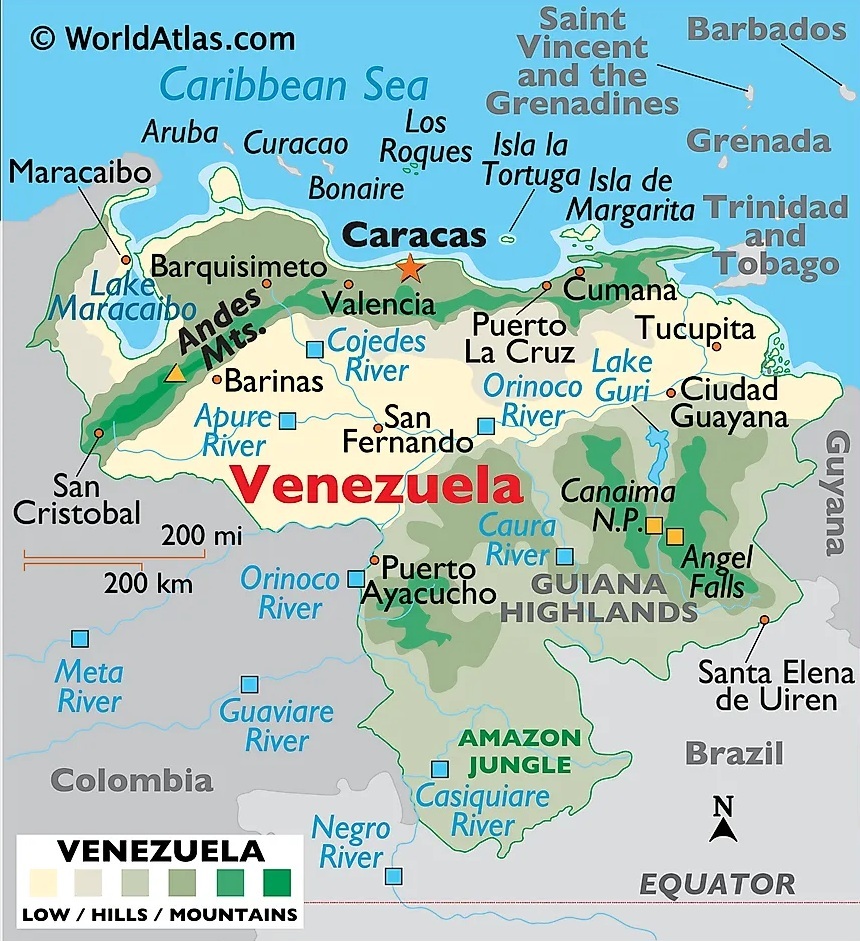
Key features:
- Andes Mountains: In the northwest (Cordillera de Mérida), including Bolívar Peak.
- Lake Maracaibo Basin: One of South America’s major oil-producing regions.
- Llanos: Vast tropical plains along the Orinoco River, important for cattle and hydrocarbons.
- Guiana Highlands: Ancient crystalline uplands in the southeast with tepuis (tabletop mountains) and Angel Falls, the world’s highest waterfall.
- Orinoco River System: Drains most of the country and anchors its ecological and economic geography.
- Neighbouring countries: Caribbean Sea, Guyana, Brazil and Colombia.
- Venezuela also administers several Caribbean islands (e.g., Margarita, Los Roques) and has a long-running territorial dispute with Guyana over the Essequibo region.
Historical context
- Pre-1999: Periods of democratic stability supported by oil revenues.
- 1999 onwards: Hugo Chávez launched the “Bolivarian Revolution,” nationalising key sectors, especially oil.
- Post-2013: Under Nicolás Maduro, economic collapse, hyperinflation, sanctions, and rising authoritarianism deepened political isolation.
- January 2026: The U.S. operation capturing Maduro marked an unprecedented escalation, with Washington signalling an interim external role until a political transition, including plans to revive Venezuela’s oil infrastructure.
Need for Invalidation of All Forms of Unilateral Talaq
- The Supreme Court’s ongoing reviews of Muslim personal law have reignited debate over abolishing unilateral talaq to ensure gender-neutral divorce rights.
Current Status of Unilateral Talaqs in India
- Talaq-e-Biddat: Instant triple talaq leading to irrevocable divorce was declared unconstitutional in Shayara Bano v. Union of India (2017) and was subsequently criminalised.
- Talaq-e-Ahsan: Single pronouncement followed by a 90-day waiting period (iddat) for reconciliation remains a legally valid extra-judicial divorce form.
- Talaq-e-Hasan: Three pronouncements across three months during the purity period (tuhr) is currently valid but under constitutional challenge (Benazeer Heena v. Union of India, 2025).
Key Rationale for Invalidation
- Fundamental Rights: Unilateral talaq violates Articles 14 and 15, which guarantee the right to equality and prohibit discrimination based on sex.
- Human Dignity: Instant divorce practices create fear and insecurity, undermining women’s right to dignity enshrined under Article 21.
- Economic Security: Unilateral divorce often leads to homelessness and loss of financial support.
- Gender Inequality: Unilateral talaq grants men absolute divorce authority, while women need to pay or seek judicial relief.
- Maintenance Evasion: Extra-judicial divorces are often used to bypass legal obligations of alimony and child support.
- International Norms: India’s international human rights commitments require equal divorce rights for men and women at marriage dissolution.
Legal Framework in India
- Parliament criminalised instant triple talaq as a cognisable, non-bailable offence punishable up to three years under the Muslim Women (Protection of Rights on Marriage) Act (MWPRD), 2019.
- The Muslim Personal Law (Shariat) Application Act, 1937, recognises various forms of talaq; it is currently under judicial review regarding whether personal laws yield to Article 13.
- Section 144 of the Bharatiya Nagarik Suraksha Sanhita (BNSS) provides a secular framework for the maintenance of women after divorce.
Reform Pathways
- Personal Law Codification: Codify Muslim personal law to standardise divorce procedures and align them with Articles 14, 15, and 21.
- Gender-Neutral Divorce: Provide a legal framework for equal divorce procedures for men and women under judicial oversight.
- Post-Divorce Protection: Strictly enforce maintenance laws and expand legal awareness to prevent women’s post-divorce destitution.
- Community Reform: Internal reform to revise nikahnama clauses to prohibit unilateral or instant talaq.
- Institutional Resolution: Mediation and conciliation through Alternative Dispute Resolution (ADR) systems to encourage reconciliation and reduce social trauma.
- Uniformity in Approach: A consensus-based Uniform Civil Code (UCC) under Article 44, adopting best practices across personal laws.
Land Acquisition Major Hurdle in India’s Infrastructure Development
- Land acquisition has been identified as the biggest bottleneck in India’s infrastructure projects reviewed under PRAGATI.
- Land acquisition caused 35% of project delays, while environmental clearances and right-of-way issues together account for 73% of total delays nationwide.
- PRAGATI: Pro-Active Governance and Timely Implementation is a three-tier platform launched in 2015 to enable real-time project reviews and monitoring of government schemes.
Land Acquisition in India
- Land acquisition involves the government acquiring private land for public uses like infrastructure, defence, industrial projects, and social infrastructure.
- It is governed by the Right to Fair Compensation and Transparency in Land Acquisition, Rehabilitation and Resettlement (LARR) Act, 2013.
- The Act mandates a Social Impact Assessment (SIA) to evaluate the impacts on livelihoods, infrastructure, and communities before acquisition.
- Consent Norms: Prior consent of 80% families is required for private projects and 70% for PPP projects.
- Compensation Rule: Landowners receive four times the market value in rural areas and twice the market value in urban areas.
- An additional “solatium” equal to 100% of compensation is paid to account for the involuntary nature of the acquisition.
Landscape of Infrastructure Development in India
- Financial Outlay: The 2025-26 Union Budget allocated a record ₹11.21 lakh crore (3.1% of GDP) for capital investment, a 10.1% increase from the previous year.
- Road: India has the 2nd-largest road network, with national highways spanning 1,46,145 km in 2024.
- Railway: Indian Railways has electrified 99.2% of the Broad Gauge network by 2025.
- Aviation: India is the 3rd largest domestic aviation market after the United States and China.
- Shipping: Under Sagarmala 2.0, cargo handling reached 1,630 MT, improving India’s global ranking in international shipments from 44th to 22nd.
- Urban Infrastructure: India now has the 3rd-largest operational metro network, spanning 1,013 km across 23 cities (May 2025).
- Rural Development: Jal Jeevan Mission (JJM) achieved 80% rural tap water coverage by early 2025.
Banks Can Now Manage Assets in the National Pension System (NPS)
- The PFRDA has approved a framework that allows banks to set up pension funds to manage assets under the National Pension System (NPS).
- Earlier Role: Scheduled Commercial Banks were earlier limited to acting as Points of Presence for onboarding and servicing NPS subscribers.
- Expanded Scope: Banks can now directly sponsor a Pension Fund Manager entity, subject to meeting prescribed financial criteria.
- Eligibility Norms: Bank eligibility will align with RBI norms on net worth, market capitalisation, and overall prudential soundness.
National Pension System (NPS)
- NPS is a voluntary, defined-contribution retirement scheme regulated by the Pension Fund Regulatory and Development Authority (PFRDA).
- Subscriber Choice: Subscribers can choose a Pension Fund Manager and asset allocation, while the Permanent Retirement Account Number (PRAN) remains portable across jobs and locations.
- Investment Pattern: Professional managers allocate contributions among equities, government securities, corporate bonds, and alternative assets to generate market-linked returns.
- Eligibility Scope: Any Indian citizen or Overseas Citizen of India aged 18-70 can open NPS accounts.
- Retirement Withdrawal: At the normal retirement age of 60, government employees may withdraw up to 60% of their accumulated corpus tax-free.
- Annuity Rule: At least 40% of the corpus must be used to purchase an annuity from PFRDA-empanelled providers to receive a taxable monthly pension.
- For non-government subscribers, recent reforms allow a lump sum withdrawal of up to 80%.
PFRDA
- Statutory Regulator: PFRDA is the primary statutory pension regulator under the Ministry of Finance.
- Legal Status: It was constituted as an interim body in 2003 and later became statutory through the PFRDA Act, 2013.
- Core Objective: PFRDA promotes old-age income security by establishing, developing, and regulating pension funds.
- Regulatory Role: It prescribes guidelines for pension fund operations, investment norms, and performance benchmarking standards.
- Major Schemes: PFRDA administers National Pension System (NPS), Atal Pension Yojana (APY), Unified Pension Scheme (UPS), and NPS Vatsalya.
Circular Model for Waste Management in India
- India must transition from linear waste management to a circular model to minimise waste and recover energy and material resources.
India’s Waste Management Landscape
- Waste Generation: India generates about 1.70 lakh tonnes of municipal solid waste daily, projected to reach 165 million tonnes annually by 2030.
- Processing Gap: Only 55-70% of collected waste is scientifically treated, leaving over 16 crore tonnes of legacy waste piled at 2,450 active dumpsites.
- E-Waste Growth: India ranks third globally in e-waste generation, with volumes increasing annually by nearly 15-20%.
- C&D Waste: 150 million tonnes of construction and demolition waste are generated annually, often illegally dumped in wetlands or along roadsides.
- Plastic Burden: India generates about 9 million tonnes of plastic waste annually, dominated by single-use plastics.
Waste Management Framework in India
- Municipal Powers: Article 243W and the 12th Schedule empower municipalities to manage public health, sanitation, conservancy, and solid waste.
- Fundamental Duty: Article 51A(g) places a fundamental duty on citizens to protect and improve the natural environment.
- Umbrella Law: The Environment (Protection) Act, 1986, serves as the umbrella legislation for all waste management rules.
- SWM Rules: The Solid Waste Management Rules, 2016, mandate source segregation into wet, dry, and domestic hazardous waste streams.
- C&D Rules: The Construction and Demolition Waste Management Rules, 2025, introduce Extended Producer Responsibility (EPR) and mandatory recycling targets.
- Plastic Rules: The Plastic Waste Management Amendment Rules, 2025, mandate QR-based digital tracking and set targets for recycled-plastic content.
Prime Minister Pays Tribute to Rani Velu Nachiyar on Her Birth Anniversary.
Rani Velu Nachiyar (1730-96)
- Born: In 1730 as the princess of Ramnad (Ramanathapuram), Tamil Nadu.
- Skills: Trained extensively in warfare, including horse riding, archery, and martial arts like Silambam and Valari.
Key Contributions:
- Forged an alliance with Hyder Ali of Mysore.
- Established the "Udaiyaal" battalion: one of the first all-women army units in world history.
- Pioneer of Suicide Tactics: Her loyal commander, Kuyili, is credited with the first recorded suicide attack in Indian history by setting herself on fire to destroy a British ammunition depot in 1780.
- In 1780, she successfully recaptured Sivaganga, defeating the British nearly 77 years before the 1857 Revolt.
Board of Trade (BoT)
- BoT highlighted slowing exports due to the steep US tariffs of 50 %.
Board of Trade
- About: It is apex advisory body on policy measures related to the Foreign Trade Policy aimed at strengthening India’s trade ecosystem.
- Chairman: Minister for Commerce & Industry.
- Members: Comprise ministers in charge of trade and commerce in state governments and union territories, export promotion councils, industry associations etc.
- It was reconstituted in 2019 through the merger of the Council for Trade Development and Promotion with the BoT.
Galaxy Frog
- According to a recent study, a group of seven galaxy frogs vanished from the Western Ghats due to rise in photo tourism.
About Galaxy frog
- Location: The only known species of its genus (Melanobatrachus indicus), it is endemic to the Western Ghats of south-western Ghats.
- It is mostly found in high-altitude evergreen forest and shola forest.
Characteristics:
- It is a rare frog with a slender, elongated body of uniform width.
- This species is terrestrial and associated with leaf-litter, rocks and another ground cover of moist evergreen tropical forests.
- IUCN status: Vulnerable