
JANUARY 28, 2026 Current Affairs
India and EU Concluded Negotiations on Free Trade Agreement (FTA)
India and the European Union (EU) announced the conclusion of negotiations on a landmark Free Trade Agreement (FTA).
- Deal Scale: Dubbed the “mother of all trade deals,” it creates a free-trade zone spanning a combined market of 2 billion people, representing about 25% of global GDP.
- Timeline: The agreement is expected to apply provisionally by Q4 2026 and fully enter force by early 2027 after ratification.
- Review Clause: A joint committee will review the agreement every two years to resolve implementation issues and update its provisions.
Key Provisions of India-EU Free Trade Agreement
Trade in Goods
- EU Commitments: The European Union will eliminate tariffs on 99.5% of India’s exports by value, granting immediate zero-duty access to 90.7% of India’s export value.
- India Concessions: India grants tariff concessions covering 97.5% of EU import value, with duty elimination or reduction across 92.1% of tariff lines.
- Tariff Schedule: While customs duties on 49.6% of European tariff lines are eliminated immediately, India adopts phased cuts over 5, 7, and 10 years for the remaining 39.5% of lines.
- Labour Sectors: Labour-intensive sectors like textiles, apparel, leather, footwear, gems and jewellery, and marine products will receive immediate duty-free access.
- Sensitive Exclusion: Sensitive sectors, including dairy, cereals, poultry, and sugar, are excluded from the agreement to protect domestic producers.
- Auto Imports: Import duties on European automobiles will be progressively reduced to 10%, with a fixed annual quota of 250,000 units.
Trade in Services
- Market Access: India gains access to 144 EU service subsectors, including IT, professional services, and education, while the European Union gains access to 102 Indian subsectors.
- Professional Movement: The EU provides binding commitments to ease visa requirements for Indian IT professionals, nurses, and consultants.
- Commercial Presence: European companies gain privileged access to India’s financial, legal, and maritime services markets.
- Family Rights: Spouses and dependents of intra-corporate transferees are granted both entry and work rights.
- AYUSH Provision: For the first time, AYUSH practitioners may work under home titles in EU states where these practices remain unregulated.
- Source Code: The pact prohibits the mandatory transfer of source code as a condition for market access, thereby safeguarding the intellectual property of Indian IT firms.
Regulatory Framework
- Rules Origin: The agreement adopts Product-Specific Rules (PSRs) with self-certified ‘Statements of Origin’ to determine origin and reduce the compliance burden.
- SPS Alignment: An Equivalence Agreement on Sanitary and Phytosanitary measures aims to harmonise standards and reduce the rejection rate for Indian agricultural exports.
- CBAM Dialogue: A formal Technical Dialogue is created to align carbon reporting standards under the CBAM to protect Indian exporters from unfair taxation.
- Rebalancing Mechanism: India retains the right to impose retaliatory tariffs if EU non-tariff barriers (like CBAM) nullify trade benefits.
Significance of India-EU Free Trade Agreement
- Strategic Autonomy: Deep economic integration with the EU may strengthen India’s strategic autonomy by diversifying dependencies beyond the US-China binary.
- Technology Spillovers: Cheaper imports of European high-tech machinery and precision equipment will likely accelerate modernisation and automation of Indian industries.
- Export Parity: Duty-free access will level the playing field for Indian exporters vis-à-vis Bangladesh and Vietnam, which enjoy prior preferential access.
- Standards Upgrade: Alignment with stringent European standards may incentivise modernisation of India’s domestic quality control and production ecosystems.
Concerns with the India-EU Free Trade Agreement
- Phytosanitary Barriers: Strict European phytosanitary standards may continue to restrict Indian agricultural exports despite the equivalence agreement.
- CBAM Impact: The Carbon Border Adjustment Mechanism (CBAM) can erode tariff advantages for Indian steel and aluminium exporters by imposing additional compliance costs.
- MSME Competition: Increased imports of European machinery and chemicals may pose competitive challenges for domestic MSMEs that lack economies of scale.
- Data Status: The absence of the EU “Data Secure” status for India will limit cross-border flows of sensitive personal data required for advanced IT services.
- Rules Origin: Complex ‘Rules of Origin’ requirements have historically lowered FTA utilisation rates among Indian exporters.
India-EU Comprehensive Strategic Agenda ‘Towards 2030’
- India and the European Union adopted “Towards 2030: India-EU Joint Comprehensive Strategic Agenda” to elevate bilateral strategic cooperation.
- The 16th India-EU Summit was held in New Delhi and co-chaired by PM Narendra Modi, European Commission President Ursula von der Leyen, and European Council President Antonio Costa.
About ‘Towards 2030’
- Agenda Adoption: ‘Towards 2030’ is the India-EU Joint Comprehensive Strategic Agenda, adopted at the 16th India-EU Summit in New Delhi.
- Framework Shift: The agenda replaces the earlier ‘Roadmap to 2025’, marking a shift from high-level dialogue to time-bound, actionable outcomes.
- Partnership Status: It formally elevates the partnership by recognising India and the EU as ‘trusted, predictable and like-minded’ partners.
- Structural Design: The document is organised around five pillars to deepen strategic autonomy and economic integration.
Pillar 1: Prosperity and Sustainability
- Trade Timeline: The agenda prioritises the timely implementation of the concluded India-EU Free Trade Agreement (FTA) to eliminate tariff barriers.
- Investment Protection: A separate Investment Protection Agreement is prioritised to increase inflows of European foreign direct investment.
- Carbon Markets: India’s Carbon Credit Trading Scheme (CCTS) will be linked to the EU’s system to align with CBAM norms.
- Green Hydrogen: The India-EU Green Hydrogen Task Force will harmonise certification standards for exporting green ammonia to Europe.
Pillar 2: Technology and Innovation
- Policy Coordination: The Trade and Technology Council (TTC) will coordinate policies on semiconductor manufacturing and AI safety.
- Digital Standards: India aims to align its Digital Public Infrastructure (DPI) with European digital standards to facilitate cross-border interoperability.
- Research Access: Exploratory talks have been launched for India’s associate membership of ‘Horizon Europe’, the EU’s flagship research funding programme.
- Industrial Clusters: The Blue Valleys initiative will create clean-energy industrial clusters that link European investors with Indian manufacturers.
Pillar 3: Security and Defence
- Defence Framework: The agenda operationalises the India-EU Security and Defence Partnership to expand military-to-military cooperation.
- Indo-Pacific Order: Both sides commit to a rules-based international order that ensures freedom of navigation in the Indo-Pacific.
- New Domains: Dedicated dialogues are established for non-conventional threats, including cybersecurity, space defence, and maritime security cooperation.
Pillar 4: Connectivity and Global Issues
- Economic Corridor: Leaders reaffirm their commitment to the India-Middle East-Europe Economic Corridor (IMEC) to counter Chinese connectivity initiatives.
- Global Gateway: India’s regional connectivity projects will align with the EU’s Global Gateway strategy for sustainable infrastructure financing.
- Third Countries: Both sides agreed on joint infrastructure projects in third countries, especially in Africa, to offer sustainable development alternatives.
Pillar 5: People-to-People Enablers
- Mobility Framework: The MoU on the Comprehensive Framework on Co-operation on Mobility was signed to ease visa norms for Indian students and skilled professionals.
- Visa Digitalisation: The EU committed to simplifying travel for Indians through the upcoming digitalisation of Schengen visa procedures.
- Institutional Dialogue: Regular Parliamentary Exchanges and a Human Rights Dialogue are formalised to sustain long-term mutual trust.
4B Movement
- The 4B movement, a radical feminist current originating in South Korea, has resurfaced in public debate amid renewed discussions on patriarchy, gender violence, and women’s autonomy.
4B Movement:
- The 4B movement is a feminist resistance framework where women refuse participation in four core institutions associated with patriarchy:
- Bihon (No marriage): Refusing heterosexual marriage.
- Bichulsan (No childbirth): Refusing to have children.
- Biyeonae (No dating): Refusing to date men.
- Bisekseu (No sex): Refusing sexual relationships with men.
- It represents a political and social rejection, not merely a lifestyle choice, of traditional heterosexual norms.
Origin:
- Emerged in South Korea in the late 2010s
- Rooted in long-standing gender inequality, online misogyny, and institutional indifference
- Gained visibility through social media during South Korea’s #MeToo movement
Key features:
- Non-negotiation with patriarchy rather than reform from within.
- Rejection of unpaid care work, emotional labour, and reproductive expectations placed on women.
- Emphasis on bodily autonomy, consent, and self-determination.
- Collective resistance instead of individual coping strategies.
Significance:
- Challenges the assumption that marriage and motherhood are essential to womanhood.
- Highlights how structural misogyny, not isolated incidents, shapes women’s lives.
- Reframes abstention as a form of political agency.
- Sparks global debates on feminism, demography, social norms, and gender justice.
Maharashtra launches country’s first menopause clinics
- Maharashtra has launched the country’s first dedicated menopause clinics across government hospitals and urban health facilities to address women’s physical and mental health needs.
About country’s first menopause clinics:
- Dedicated menopause clinics within the public healthcare system that provide integrated medical and psychological care for women undergoing menopause, recognising it as a natural but health-sensitive life stage.
Aim:
- To provide holistic, dignified, and accessible healthcare to women during menopause.
- To address physical, hormonal, and mental health challenges associated with menopause.
- To mainstream menopause-related care into public health policy.
Key features:
- One-stop care model offering gynaecological consultation, counselling, screening, and medicines.
- Mental health counselling to address stress, anxiety, sleep disorders, and depression.
- Screening services for bone health (osteoporosis), heart health, and hormonal imbalance.
- Free or affordable services through government hospitals and urban health centres.
- Focus on awareness, guidance, and emotional support, not just clinical treatment.
Buddhist Diamond Triangle Joins UNESCO World Heritage Tentative List
- UNESCO World Heritage Centre has officially added Odisha’s famed Buddhist Diamond Triangle—comprising Lalitgiri, Udayagiri, and Ratnagiri—to India’s Tentative List for World Heritage Sites.
What is the Buddhist Diamond Triangle?
- The Diamond Triangle is a serial cultural nomination of three interconnected monastic complexes located in the Jajpur and Cuttack districts of Odisha. These sites are unique because they document 1,500 years of continuous history, showcasing the transition of Buddhism through three major schools:
- Theravada (Hinayana)
- Mahayana
- Vajrayana (Esoteric Buddhism)
- Lalitgiri: The Ancient Spiritual Hub
- Located in the Cuttack district, Lalitgiri is the oldest site in the triangle, dating back to the 2nd–3rd Century BCE.
- Key Discovery: A massive stupa containing sacred relic caskets made of gold, silver, and stone—believed by many to be the relics of Lord Buddha himself.
- Architectural Marvel: Home to an east-facing apsidal chaityagriha, the first of its kind discovered in Odisha.
- Historical Significance: Inscriptions of “Sri Chandraditya Vihara” prove it was a highly organized center of learning for over a millennium.
- Udayagiri: The Sunrise Hill of Monasteries
- Udayagiri, the largest complex in the group, flourished between the 1st and 13th Century CE.
- Advanced Architecture: Features a unique double-storeyed monastery and the Madhavapura Mahavihara.
- Artistic Grandeur: The site is famous for its colossal images of Avalokiteswara and the Pancha Dhyani Buddhas, representing the peak of Mahayana artistic complexity.
- Ratnagiri: The Epicentre of Vajrayana Buddhism
- Often compared to Nalanda, Ratnagiri is a powerhouse of Vajrayana (Tantric) Buddhism.
- Vajrayana Iconography: The site boasts an incredible collection of sculptures including Tara, Vajrapani, and Jambhala.
- Female Patronage: Evidence suggests significant support from female devotees, notably Queen Karpurashri.
- Architectural Syncretism: Its stupas blend Buddhist motifs with Brahmanical architectural styles, creating a unique aesthetic found nowhere else in the world.
First National Coordinators Meeting in Beijing & SCO
- The first meeting of the SCO Council of National Coordinators (CNC) for 2026 opened in Beijing, under the chairmanship of the Kyrgyz Republic, to finalize the agenda for high-level summits later this year.
What it is?
- The Council of National Coordinators (CNC) is the primary coordination and management mechanism of the SCO. It serves as the vital link between the standing bodies of the organization and the member states.
Core functions
- Coordination: To synchronize the multilateral cooperation of member states in accordance with the SCO Charter.
- Preparation: To conduct all necessary groundwork for the meetings of the Council of Heads of State (CHS) and Council of Heads of Government (CHG).
- Implementation: To oversee the execution of decisions and agreements reached during previous summits.
Shanghai Cooperation Organization (SCO):
- The Shanghai Cooperation Organization (SCO) is a permanent intergovernmental international organization that has evolved into the world’s largest regional body in terms of geographic scope and population.
- It represents approximately 42% of the world population and over 23% of global nominal GDP.
- Headquarters (Secretariat): Beijing, China.
- Established In: June 15, 2001.
- Predecessor: The Shanghai Five (established in 1996).
- Official Languages: Russian and Chinese.
- The 10 Member States:
- Republic of Belarus (Joined 2024)
- Republic of India (Joined 2017)
- Islamic Republic of Iran (Joined 2023)
- Republic of Kazakhstan
- People’s Republic of China
- Kyrgyz Republic
- Islamic Republic of Pakistan (Joined 2017)
- Russian Federation
- Republic of Tajikistan
- Republic of Uzbekistan
Permanent Bodies
- SCO Secretariat (Beijing): The main executive body implementing organizational decisions.
- RATS (Tashkent): The Regional Anti-Terrorist Structure, focusing on the “Three Evils”—Terrorism, Separatism, and Extremism.
- The “Shanghai Spirit”:
- The core philosophy of the SCO, known as the Shanghai Spirit, is defined by:
- Mutual trust and mutual benefit.
- Equality and consultation.
- Respect for the diversity of civilizations.
- Pursuit of common development.
Smart Fishing Harbour at Mayabunder
- In a major boost to India’s maritime infrastructure, the Union Department of Fisheries has sanctioned the development of a Smart and Integrated Fishing Harbour at Mayabunder, Andaman & Nicobar Islands.
Mayabunder: Where it is?
- Mayabunder is a town and tehsil and the administrative headquarters of the North and Middle Andaman district, serving as a key economic, fisheries, and tourism hub in northern Andaman.
Located in:
- Northern part of Middle Andaman Island, within the Andaman and Nicobar Islands.
- About 242 km from Port Blair by road (Andaman Trunk Road) and 136 km by sea.
Geographical features:
- Karmatang Beach: Known as the “Turtle Paradise” of Andaman, Karmatang Beach is a globally recognized sea turtle nesting ground. It serves as a vital eco-sensitive zone where Olive Ridley and Leatherback turtles return annually
- Interview Island: As the largest wildlife island in the Andaman group, Interview Island is notable for its natural freshwater springs and limestone caves, a rare feature in saline island systems.
- Avis (Aves) Island: Located near Mayabunder, Avis Island is an uninhabited coral island known for extensive coconut plantations and clear lagoons.
- Mayabunder lies within a seismically active zone and a highly productive marine ecosystem.
Key Features of the Mayabunder Smart Harbour:
- The new harbour isn’t just a landing site; it’s an integrated tech-ecosystem designed to handle 9,900 tonnes of fish annually.
- Vessel Capacity: Safe berthing and landing facilities for 430 fishing vessels.
- IoT-Enabled Systems: Integration of digital traceability and IoT for real-time monitoring
- Sustainable Management: Focused on combating Illegal, Unreported, and Unregulated (IUU) fishing.
- Energy Efficiency: Implementation of green energy and eco-friendly post-harvest handling to reduce losses.
Rojava Region
- Renewed fighting between Syrian government forces and the Kurdish-led SDF has endangered Rojava’s autonomy after the collapse of Bashar al-Assad’s regime in 2024.
- Despite a 14-point ceasefire and integration agreement, sharp disputes over autonomy, force deployment, and the roles of Türkiye and the U.S. continue.
About Rojava Region:
- Rojava, officially called the Democratic Autonomous Administration of North and East Syria (DAANES), is a de facto autonomous region in northeastern Syria.
- It follows the ideology of democratic confederalism, emphasizing local self-rule, gender equality, and ethnic pluralism, though it lacks international recognition.
Located in:
- Rojava lies in northeastern Syria, covering parts of Hasakah, Raqqa, Deir ez-Zor, Aleppo (Kobane)
- It is strategically located along the Euphrates basin and key oil- and gas-rich areas of eastern Syria.
- Neighbouring countries / regions
- Türkiye to the north
- Iraq (Kurdistan Region) to the east
- Syrian government–controlled areas to the west and south
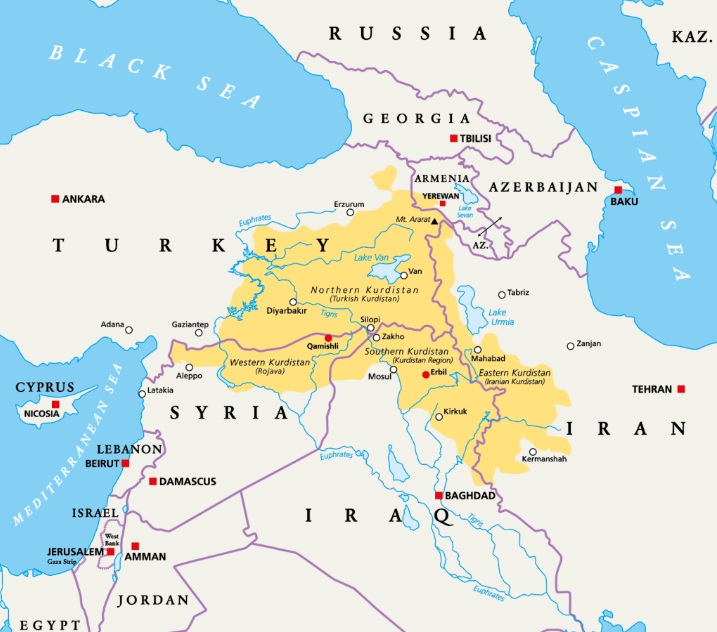
- This location makes Rojava a geopolitical crossroads involving regional and global powers.
History
- 2012: Syrian state forces withdrew from Kurdish areas during the civil war, allowing Kurds to establish self-administration.
- 2014–2015: Kurdish militias, especially the People’s Protection Units (YPG), gained global prominence after defeating ISIS at Kobane with U.S. air support.
- 2015: Formation of the Syrian Democratic Forces (SDF), a multi-ethnic alliance led by Kurds.
- 2016–2023: Region evolved through multiple constitutional forms, culminating in DAANES.
- 2024–26: After Assad’s fall, Syrian interim leader Ahmed al-Sharaa moved to re-centralise power, leading to clashes and loss of nearly 80% of DAANES-held territory.
Core issues
- Autonomy vs centralisation: Damascus wants a unified, centralised Syrian state; Kurds seek to retain self-rule built over a decade.
- Security control: The government demands individual integration of SDF fighters, while Kurds resist deployment of state troops in core Kurdish cities like Kobane and Qamishli.
External actors:
- Türkiye opposes Kurdish autonomy, viewing the YPG as linked to the PKK.
- United States earlier backed the SDF against ISIS but is now warming to Damascus to counter Iran and Russia.
- ISIS risk: Fighting has enabled jailbreaks and instability, reviving jihadist threats.
PANCHAM Chatbot for Panchayats
- The Ministry of Panchayati Raj launched PANCHAM (Panchayat Assistance & Messaging Chatbot) on the eve of the 77th Republic Day.
- It is a flagship digital initiative to empower Panchayat Elected Representatives and Functionaries.
- It is designed as a digital companion for Panchayats, providing contextual guidance, simplified workflows, and easy access to governance information.
- Key Benefits: The platform reduces reliance on intermediaries to curb corruption and enables photo-based grievance redressal with automated updates.
- Significance: PANCHAM creates a first-of-its-kind direct digital bridge between the central government and grassroots administration, strengthening digital governance.
Key Features of PANCHAM
- WhatsApp Interface: Enables user interaction through WhatsApp, eliminating the need for a separate mobile application.
- Multilingual Support: The chatbot supports regional languages and voice notes to overcome literacy and language barriers.
- 24/7 Availability: Provides round-the-clock assistance for governance and service delivery queries.
- Real-time Feedback: Supports two-way communication for quicker resolution of field-level issues and continuous feedback loops.
Lonar Lake Faces Threat from Rising Water Levels
- Lonar Lake is facing a critical threat from an unprecedented rise in water levels.
- Key Causes: Borewell drilling in catchment areas punctured basalt layers, activating underground channels that direct groundwater into the crater; new springs and higher rainfall increased inflow.
- Key Impacts: Freshwater inflow has lowered lake alkalinity, threatening microbe diversity; rising water levels have submerged ancient temples, while pesticide use is causing geological damage.
About Lonar Lake
- Lonar Lake is a hyper-velocity impact crater formed when a meteorite struck the basaltic Deccan Plateau during the Pleistocene Epoch.
- It is India’s only basaltic impact crater and one of only four high-velocity basaltic impact craters worldwide (others are in Brazil).
- National Status: The site is a notified National Geo-heritage Monument under the Geological Survey of India (GSI) and is located within the Lonar Wildlife Sanctuary.
- Ramsar Recognition: It was designated a Ramsar Site in 2020, making it Maharashtra’s 2nd such site.
- Hydrological Nature: The lake is an endorheic basin with no outlet, historically containing highly saline and alkaline water; It is often called a ‘Soda Lake’ because of its high alkalinity.
- Microbial Diversity: The lake hosts extremophiles such as haloarchaea, which produce carotenoid pigments in high salinity.
- These haloarchaea caused the lake’s striking pink colour change observed prominently in 2020.
- Cultural Heritage: The crater rim contains ancient temples, including the Daitya Sudan Temple in the Hemadpanthi style and the Kamalja Devi Temple.
New Mushroom Species Discovered in Uttarakhand
- Researchers have discovered a new mushroom species, Hemileccinum indicum, in the temperate oak forests of Bageshwar district, Uttarakhand.
- The discovery marks the first official record of this group of fungi in India.
- Hemileccinum indicum is a bolete mushroom characterised by pores rather than gills under its cap.
- Morphology: It has a wrinkled violet-brown cap that matures into a leathery brown surface.
- Pore Surface: The pastel yellow pore layer shows no colour change when bruised.
- Unique Feature: Scanning Electron Microscope (SEM) analysis reveals tiny, intricate pits on the spores.
- Diagnostic Distinction: The microscopic pinholes and a smooth stem surface distinguish it from American and Asian relatives.
- Ecological Role: The species is ectomycorrhizal, forming symbiotic root associations with oak trees to enable nutrient exchange and forest health.
Banks Concerns Over ECL Norms
- Banks have sought further consultations with the RBI on the proposed Expected Credit Loss (ECL) framework, particularly its application to crop loans from April 2027.
About ECL Norms
- Forward Loss Recognition: The Expected Credit Loss (ECL) framework requires banks to estimate potential loan losses in advance, rather than waiting for defaults to occur.
- Risk-Based Estimation: Banks forecast expected cash shortfalls using Probability of Default (PD), Loss Given Default (LGD) and Exposure at Default (EAD) to measure credit risk.
- Cash Flow Gap Concept: Credit loss is calculated as the difference between contractual cash flows due and the cash flows expected to be received over time.
- Three-Stage Approach: Financial assets move through Stage 1 (performing), Stage 2 (significant risk increase) and Stage 3 (credit impaired) based on credit quality.
- Regulatory Scope: Applies to Scheduled Commercial Banks and All India Financial Institutions, excluding Small Finance Banks, Payment Banks and Regional Rural Banks.
- Implementation Timeline: ECL norms will become effective from April 1, 2027, with a transition glide path till March 31, 2031, to smooth provisioning impact.
Proposed ECL Norms
- Stage 2 Classification: Loan accounts overdue between 30–90 days will be treated as having a significant increase in credit risk, triggering higher provisioning.
- Higher Provisioning Floor: Stage 2 assets will attract lifetime ECL provisioning with a minimum regulatory floor of 5%, far above current norms.
- Crop Loan NPA Trigger: Crop loans will be classified as Stage 3 if overdue for two crop seasons for short-duration crops or one season for long-duration crops.
Why are banks raising concerns?
- Seasonal Repayments: Agricultural loans follow crop harvesting cycles rather than fixed monthly instalments, causing technical overdue classification.
- Routine Rollovers: Frequent forward and backward rollovers during crop seasons artificially inflate overdue days without actual default risk.
- Capital Impact: Higher lifetime loss recognition is expected to erode banks’ capital buffers, particularly for lenders with high agricultural loan exposure
- Steep Provision Jump: Current Special Mention Account (SMA) provisioning of 0.4% will rise sharply to a minimum 5% under Stage 2 ECL, creating a sudden financial burden.
- The SMA category refers to loan assets showing early signs of stress before turning non-performing.
Way Forward
- Crop-Sensitive Norms: Design ECL triggers aligned with seasonal repayment realities in agriculture; E.g., crop-cycle-linked KCC loan classification model.
- Gradual Transition: Use an extended phase-in period to absorb provisioning impact smoothly; E.g., RBI’s Basel III capital buffer transition approach.
- Data Strengthening: Improve agri-loan performance analytics to assess true credit risk; E.g., digital farm credit monitoring under PMFBY-linked databases.
- Risk Differentiation: Apply lower ECL floors for cyclical agricultural stress rather than structural risk.
Kheechna Festival Raises Child Rights Concerns in Rajasthan
- Recent reports have highlighted the adverse impacts of Rajasthan’s Kheechna festival on underage girls in rural areas.
Kheechna (Bhagoria) Festival
- Kheechna, also known as Bhagoria, is a tribal festival celebrated by the Bhil and Garasia communities.
- It is primarily celebrated in western Madhya Pradesh and southern Rajasthan.
- The festival is held annually for about seven days in March (Phalguna), leading up to Holi.
- It traditionally symbolises freedom of choice, enabling young men and women (often minors) to choose partners for informal unions.
- Such unions involve no formal marriage rituals, priests, dowry, or written documentation.
Key Issues and Concerns
- Legal Grey Zone: Informal unions circumvent the Prohibition of Child Marriage Act, 2006, leaving authorities without legal grounds to intervene.
- Practice Normalisation: Mobile phones and social media have transformed Kheechna from an annual event into year-round informal elopements.
- Loss of Childhood: Informal unions cause school dropouts and adolescent pregnancies, increasing long-term economic exclusion and health risks.
- Constitutional Conflict: The practice exposes a conflict between preserving cultural rights (Article 29) and education and child protection mandates (Articles 21A & 24).
New plant species: Hoya nagaensis
- Researchers from Nagaland University have recorded a new plant species, Hoya nagaensis, from a community-managed forest in Nagaland.
Hoya nagaensis :What it is?
- Hoya nagaensis is a previously undocumented flowering plant species belonging to the Hoya genus (known for ornamental and waxy flowers), newly described through taxonomic research.
Region found in:
- Kavünhou Community Reserved Forest,
- Located in Phek district, within the Eastern Himalayan biodiversity region.
Key features:
- Distinctive leaf morphology and floral traits that clearly differentiate it from known Hoya species
- High-altitude temperate forest habitat, largely unexplored scientifically
- Extremely restricted distribution, recorded from a single location
- Provisionally assessed as Critically Endangered due to limited range and habitat pressures
Significance:
- Biodiversity discovery: Reinforces the Eastern Himalaya as a global biodiversity hotspot with many undocumented species
- Community conservation model: Demonstrates the effectiveness of indigenous and community-led forest management in conserving rare flora
- Scientific value: Adds to global plant taxonomy; findings published in Kew Bulletin, a leading international journal