|
100 Years of UPSC: From Colonial Recruitment to Constitutional Guardian of Merit
GS II – Polity & Governance
Why in News?
The Union Public Service Commission (UPSC) completed 100 years of institutional existence on 1 October 2026, marking a century since the establishment of the first Public Service Commission in India in 1926.
Evolution: From Patronage to Constitutional Merit
- Before 1853 – Patronage System : The East India Company''s civil servants were largely nominated through a patronagebased system and trained in institutions such as Haileybury College in Britain.
- 1853 – Charter Act : The Charter Act ended the Company''s patronagebased recruitment system and introduced the principle of open competitive recruitment.
- 1854 – Macaulay Committee : The recommendations associated with Thomas Babington Macaulay provided the framework for competitive recruitment to the Indian Civil Service.
- 1855 – First ICS Competitive Examination : The first competitive ICS examination was held in London. The examination''s location, language and classical syllabus created significant barriers for Indian aspirants.
Gradual Indianisation of Civil Services
- 1863 – Satyendranath Tagore : Satyendranath Tagore became the first Indian to qualify for the ICS. He joined the service in 1864 and served in the Bombay Presidency.
- 1878–79 – Statutory Civil Service : Lord Lytton introduced the Statutory Civil Service scheme, providing a limited route for Indians into higher administration.
- 1886–87 – Aitchison Commission : The Commission examined the organisation of civil services and recommended restructuring and classification of services.
- 1912 – Islington Commission : The Commission examined recruitment to India''s public services and recommended greater Indian representation in the higher services.
Road to the Public Service Commission
- 1919 – Government of India Act : The Government of India Act, 1919, provided the statutory basis for establishing a Public Service Commission.
- Section 96C provided for a Public Service Commission to undertake functions relating to recruitment and control of public services.
- 1922 – ICS Examination in India : For the first time, the ICS examination was conducted in India at Allahabad, alongside London. It was later shifted to Delhi in 1928.
1924 – Lee Commission : The Lee Commission, chaired by Lord Lee of Fareham, recommended:
- Greater Indianisation of higher civil services.
- Establishment of a permanent Public Service Commission.
- Protection of the civil services from excessive political influence.
- A professional and impartial recruitment mechanism.
1926: Birth of the Public Service Commission
- On 1 October 1926, the first Public Service Commission was established.
- First Chairman: Sir Ross Barker
- Initial composition: Chairman + four Members
- Location: Metcalfe House, Delhi
- Legal framework: Public Service Commission (Functions) Rules, 1926
- Statutory basis: Government of India Act, 1919
From Public Service Commission to UPSC
1935 – Federal Public Service Commission
The Government of India Act, 1935 provided for:
- A Federal Public Service Commission.
- Provincial Public Service Commissions.
- Greater institutionalisation of recruitment.
- A more developed framework for consultation on service matters.
The Federal Public Service Commission came into operation on 1 April 1937.
1947 – Independence
- Following Independence, the Federal Public Service Commission continued to provide administrative continuity.
- H.K. Kripalani became the first Indian Chairman of the Commission. The first examination after Independence was held in December 1947, marking the transition from the colonial ICS system towards India''s own administrative services.
1950 – Constitutional UPSC
- With the Constitution coming into force on 26 January 1950, the Federal Public Service Commission became the Union Public Service Commission.
- The institution was placed within the constitutional framework under Part XIV, Articles 315–323.
Constitutional Framework: Articles 315–323
|
Article
|
Provision
|
|
315
|
Establishment of UPSC, State PSCs and Joint PSCs
|
|
316
|
Appointment and tenure of Chairman and Members
|
|
317
|
Removal and suspension of Chairman and Members
|
|
318
|
Conditions of service of Members and staff
|
|
319
|
Restrictions on further employment
|
|
320
|
Functions of Public Service Commissions
|
|
321
|
Extension of functions of PSCs
|
|
322
|
Expenses charged on the Consolidated Fund
|
|
323
|
Annual report and explanation for non-acceptance of PSC advice
|
Why is UPSC Significant?
- Merit Based Recruitment : UPSC institutionalises competitive selection and reduces dependence on patronage and arbitrary recruitment.
- Equality of Opportunity : Competitive examinations support Article 16''s principle of equality of opportunity in public employment.
- Administrative Neutrality : An independent recruitment mechanism helps create a professional civil service capable of functioning across changes in political leadership.
- National Integration : A nationwide competitive examination brings candidates from different regions, languages and socioeconomic backgrounds into the higher public services.
- Public Trust : The credibility of the recruitment process depends on the perception that selection is fair, transparent, impartial and insulated from political favouritism.
|
|
ASEAN–India Maritime Exercise 2026
GS II – International Relations | Maritime Security
Why in News?
The second edition of the ASEAN–India Maritime Exercise (AIME2026) commenced at Subic Bay, Philippines, strengthening maritime cooperation between India and ASEAN.
Key Facts
- Participants: Indian Navy and navies of ASEAN member states.
- Host: Philippines.
- Location: Subic Bay.
- First edition: 2023, Singapore.
- Phases: Harbour Phase and Sea Phase.
- Activities: Surface warfare, air defence, VBSS (Visit, Board, Search and Seizure), helicopter cross deck operations and tactical formations.
- Strategic framework: Linked with India''s MAHASAGAR vision.
Significance
- ASEAN Centrality: Reinforces India’s engagement with ASEANled maritime mechanisms.
- Interoperability: Enhances operational coordination among participating navies.
- Maritime Security: Supports maritimedomain awareness and cooperative responses to emerging threats.
- IndoPacific: Contributes to a free, open and rulesbased maritime order and freedom of navigation.
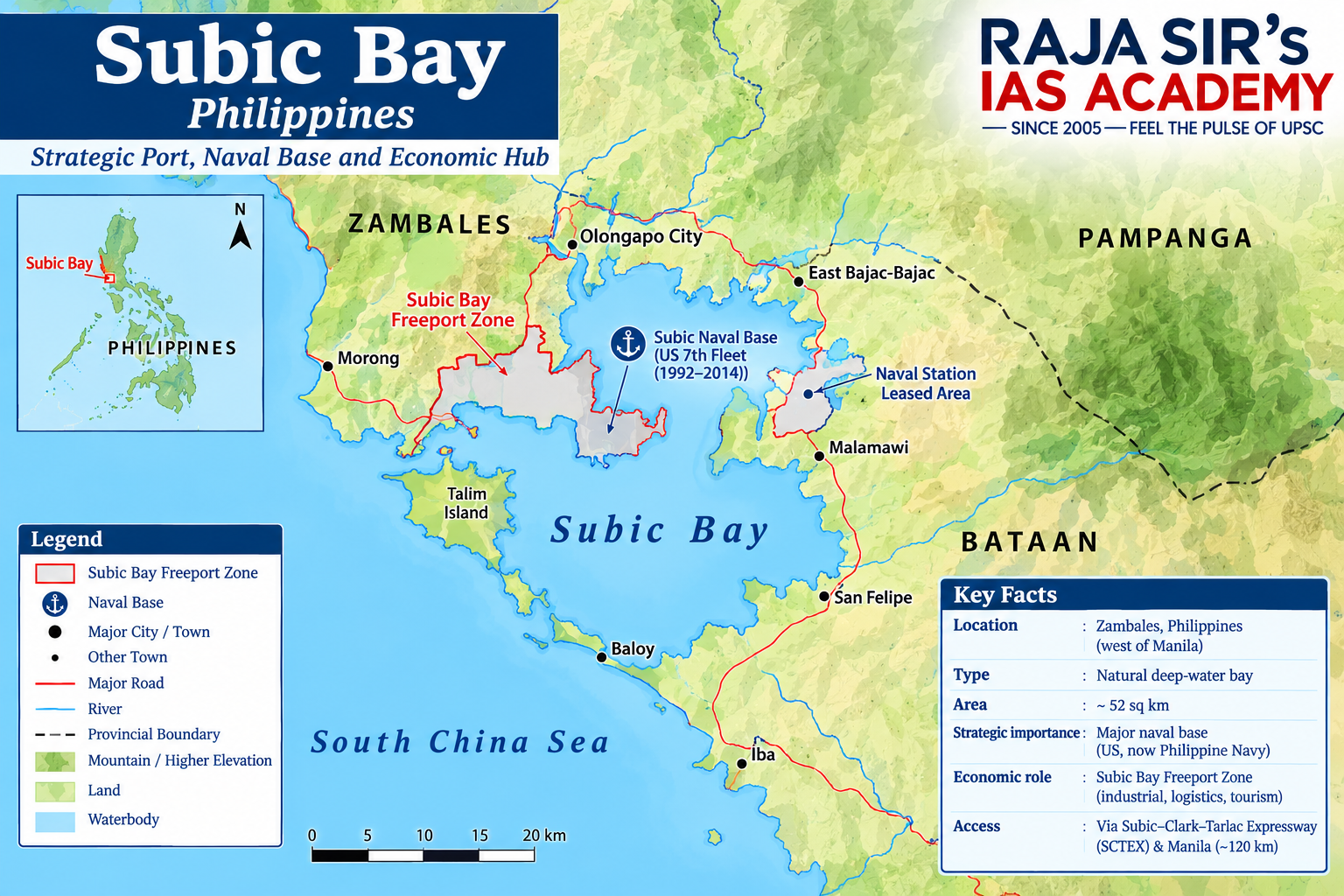
Subic Bay
|
Aspect
|
Key Fact
|
|
Location
|
Western Luzon, Philippines
|
|
Water Body
|
South China Sea
|
|
Strategic Importance
|
Major naval and commercial maritime hub
|
|
Historical Significance
|
Hosted the former U.S. Naval Base Subic Bay
|
|
Present Significance
|
Important for shipping, logistics, tourism and defence cooperation
|
|
Nearby Feature
|
Subic Bay Freeport Zone
|
|
International significance
|
South China Sea geopolitics, Indo-Pacific and maritime security
|
|
|
Corporate Average Fuel Economy – CAFE III
GS III – Environment & Energy
Why in News?
The Ministry of Power notified CAFE-III norms, applicable from 1 April 2027 to 31 March 2032, to progressively improve the fuel efficiency of passenger vehicle fleets.
What are CAFE Norms?
CAFE norms regulate the average fuel consumption of a manufacturer’s passenger-vehicle fleet, rather than prescribing the same efficiency level for every individual car. They aim to reduce fuel consumption and associated CO₂ emissions.
Key Features
|
Parameter
|
Details
|
|
Full Form
|
Corporate Average Fuel Economy
|
|
Implementing Ministry
|
Ministry of Power
|
|
Period
|
2027–28 to 2031–32
|
|
Vehicles Covered
|
New M1 category passenger vehicles manufactured or imported for sale in India
|
|
Fuel-Efficiency Benchmark
|
Tightens from 3.996 L/100 km in 2027–28 to 3.3273 L/100 km in 2031–32
|
|
Overall Improvement
|
Around 16.7% over five years
|
|
Objective
|
Improve fuel efficiency, reduce fuel consumption and CO₂ emissions
|
|
Technology Approach
|
Supports EVs, hybrids, alternative fuels and efficiency-enhancing technologies
|
Key Changes
- Progressive tightening: Efficiency requirements become stricter each year.
- Technology-neutral approach: Manufacturers can use EVs, hybrids, alternative fuels and other efficiency technologies to meet targets.
- EV incentives: EVs receive significant compliance benefits through super/volume credits. Credit mechanism: Manufacturers exceeding their targets can generate credits, while those falling short can use the compliance mechanism to address the deficit.
- No separate small-car concession: The final framework does not retain the proposed special concession for petrol cars weighing up to 909 kg.
Significance
- Energy security: Lower fuel consumption can reduce dependence on imported crude oil.
- Climate mitigation: Greater fleet efficiency can reduce transport-sector CO₂ emissions.
- EV transition: Higher recognition for EVs and cleaner technologies can encourage manufacturers to diversify their vehicle portfolios.
- Technological innovation: Creates incentives for technologies such as regenerative braking and other fuel-saving systems.
|
|
DDUGKY 2.0
GS II – Government Schemes & Social Justice
Why in News?
The Ministry of Rural Development has accelerated the rollout of the revamped Deen Dayal Upadhyaya Grameen Kaushalya Yojana (DDUGKY) 2.0, aimed at improving employment outcomes for poor rural youth.
About DDUGKY
- Launched: 2014.
- Framework: Placementlinked rural skilldevelopment initiative under DAYNRLM.
- Target group: Poor rural youth.
- Implementation: Project Implementing Agencies, with monitoring through State Rural Livelihood Missions.
Aim
To connect rural youth with marketoriented wage employment, gig work and selfemployment, thereby promoting nonfarm livelihood diversification.
Major Reforms
- Standardised training: 576 hours covering technical and employability skills.
- Employment retention: Longer verification of sustained employment.
- Gig & self employment: Recognises gig work and registered self employment as employment outcomes.
- Retention incentive: Financial incentives linked to continued employment.
- Migration support: Increased support for Migration Support Centres.
- Geographical incentive: Additional support for remote and difficult areas.
|
|
Electoral Roll System and ECINET: Balancing Digital Integration with Statutory Accountability
GS II – Polity & Governance
Why in News?
The Election Commission of India (ECI) constituted a committee to review the functioning of ECINET, amid concerns over whether greater digital integration could affect the statutory role and decision making authority of Electoral Registration Officers (EROs).
What is ECINET?
- ECINET is an integrated digital platform intended to bring together multiple electionrelated applications and services of the Election Commission.
- It seeks to create a more unified digital interface for election administration and citizenfacing services.
Broad Objectives
- Integrate multiple election related applications.
- Simplify voter facing services.
- Facilitate voter registration and electoral roll services.
- Enable application/status tracking.
- Improve data management.
- Reduce duplication between separate digital systems.
- Promote greater standardisation in election administration.
Electoral Roll
- An electoral roll is the official list of persons entitled to vote in a particular constituency.
Constitutional Basis
Article 324
- Vests the superintendence, direction and control of elections in the ECI.
- Provides the overarching constitutional basis for election administration.
Article 325
- Provides for one general electoral roll for every territorial constituency.
- Prohibits exclusion from an electoral roll solely on grounds of religion, race, caste or sex.
Article 326
- Provides for elections to the Lok Sabha and State Legislative Assemblies on the basis of adult suffrage, subject to constitutional/statutory qualifications.
Qualifying Dates
The law provides four qualifying dates for determining eligibility for registration:
- 1 January
- 1 April
- 1 July
- 1 October
This allows eligible citizens who attain the qualifying age during the year to seek registration without waiting for a single annual qualifying date.
Electoral Roll Revision
Electoral rolls are periodically revised to:
- Include newly eligible voters.
- Remove names of deceased or otherwise ineligible persons.
- Correct errors.
- Update addresses and other particulars.
- Facilitate transfer of registration when voters change residence.
|
|
Gandak River
GS I – Geography
Why in News?
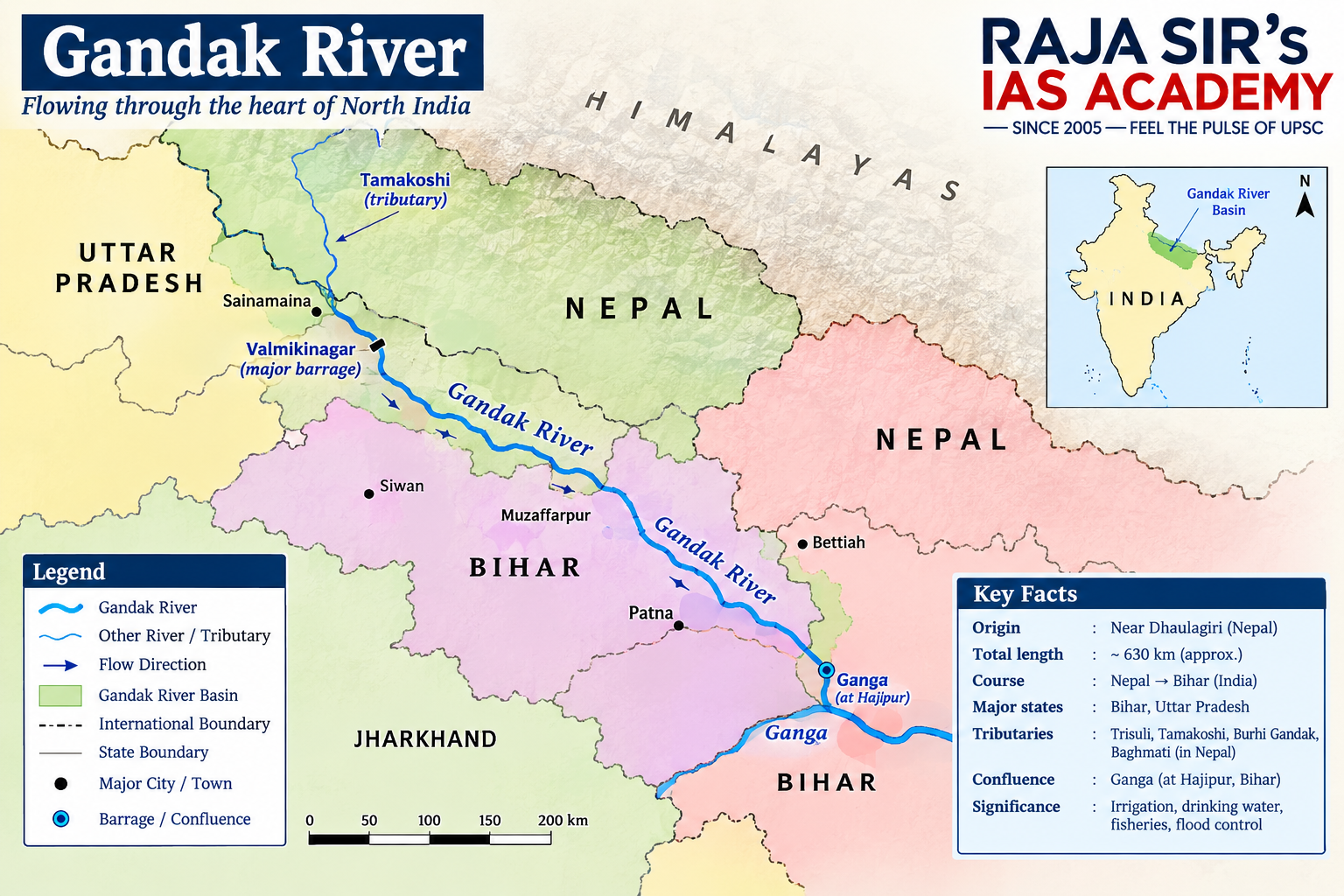
Heavy rainfall in Nepal and increased discharge from the Valmikinagar Barrage contributed to flooding in Bihar.
About
- Names: Gandak in India; Narayani/Sapt Gandaki in Nepal.
- Origin: Himalayan region near the Nepal–Tibet border.
- Major tributary: The Kali Gandaki forms an important part of its upper Himalayan system.
- Course: Flows through Uttar Pradesh and Bihar before entering the Ganga system.
- Ganga tributary: A major leftbank tributary of the Ganga.
- Confluence: Joins the Ganga near Sonepur, Bihar.
- Valmikinagar Barrage: Important for irrigation and water management in the Gandak basin.
- Geographical feature: The Kali Gandaki Gorge is associated with the river system.
- Hazards: The Himalayan catchment is vulnerable to high sediment load, landslides, glacial hazards and extreme rainfall.
|
|
Green Energy Corridor – Phase III
GS III – Energy & Infrastructure
Why in News?
The Union Cabinet approved the third phase of the Green Energy Corridor (GECIII) with an outlay of around ₹1.86 lakh crore to strengthen transmission infrastructure and integrate largescale renewable energy into the grid.
Aim
To expand intrastate transmission capacity and facilitate reliable evacuation and integration of renewable power into the national electricity system.
Key Features
- Total outlay: Around ₹1.86 lakh crore.
- Transmission infrastructure: Around ₹1.36 lakh crore.
- Battery Energy Storage Systems: Around ₹50,000 crore.
- Storage capacity: About 50 GWh BESS.
- Renewable evacuation capacity: Around 135 GW.
- Greenfield projects: Through Tariff Based Competitive Bidding (TBCB).
- Brownfield upgrades: On a Cost Plus basis.
Significance
- Renewable Integration: Transmission and storage help manage the variability of solar and wind power.
- Lower Curtailment: Greater evacuation capacity enables renewable electricity to reach demand centres despite network constraints.
- Energy Security: Higher renewable utilisation can reduce dependence on imported fossil fuels.
- NetZero Transition: Modern transmission and storage infrastructure are essential for a lowcarbon electricity system.
|
|
INS Ranvijay Port Call at Oman
GS II – International Relations | Maritime Security
Why in News?
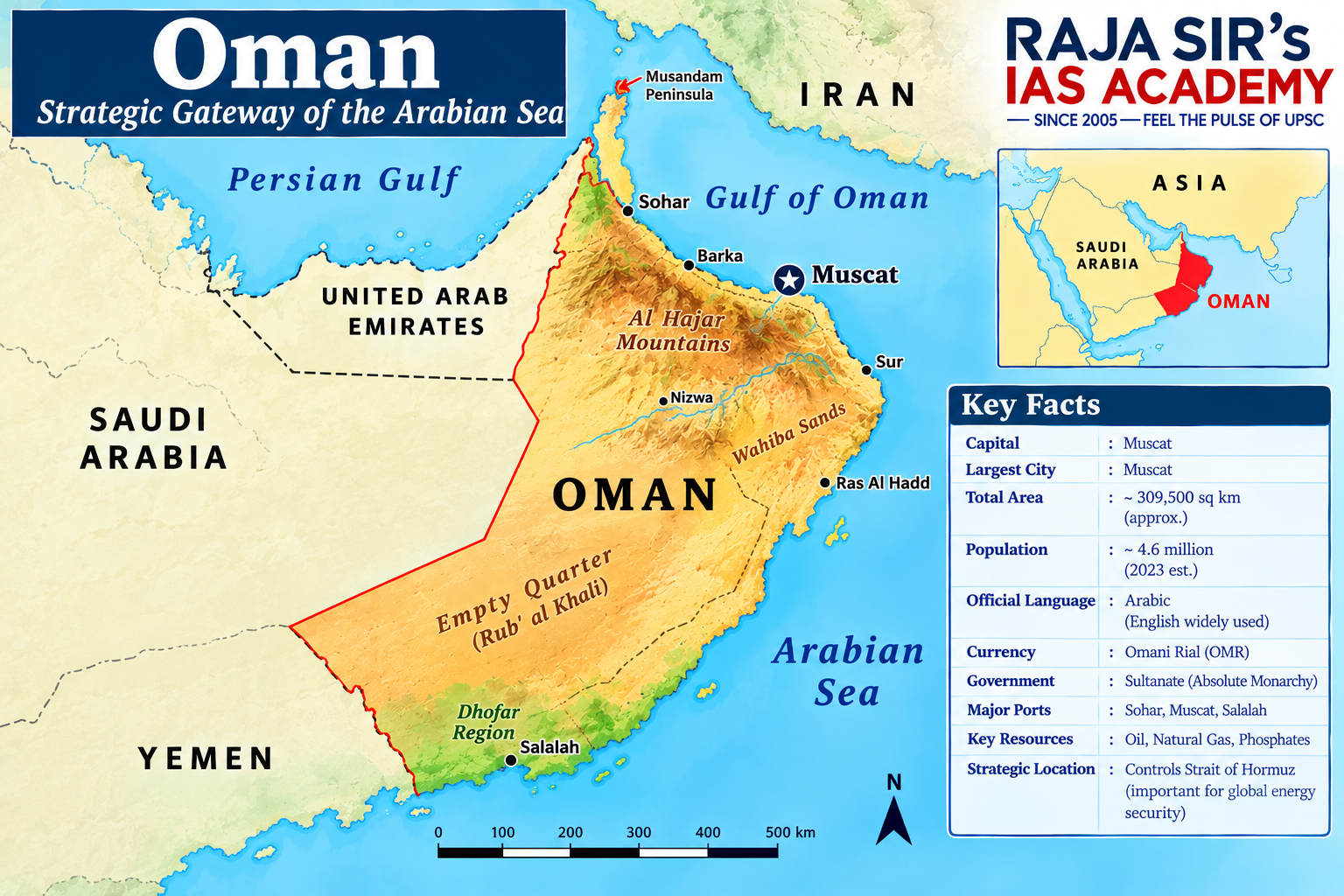
Indian naval ship INS Ranvijay made a port call at Salalah, Oman, highlighting India–Oman maritime cooperation and India’s engagement in the western Indian Ocean.
INS Ranvijay
- Type: Guidedmissile destroyer.
- Class: Rajputclass.
- Commissioned: 1988.
- Role: Maritime surveillance, air defence and surface warfare.
- Command: Eastern Naval Command.
- Name: Ranvijay means “victorious in battle”.
Oman – Mapping
- Capital: Muscat.
- Important ports: Salalah, Sohar and Duqm.
- Neighbours: Saudi Arabia, UAE and Yemen.
- Water bodies: Arabian Sea and Gulf of Oman.
- Highest peak: Jabal Shams.
- Climate: Predominantly arid, with seasonal wadis rather than major perennial rivers.
- Strategic location: Oman lies near the Strait of Hormuz, connecting the Persian Gulf with the Gulf of Oman and Arabian Sea.
|
|
Intelligent Traffic Management System – Delhi
GS III – Infrastructure & Urbanisation
Why in News?
The CCEA approved the Intelligent Traffic Management System (ITMS) for Delhi with an outlay of ₹1,789.52 crore to improve traffic management, road safety and enforcement through AI-enabled technologies.
Aim
To create a real-time, integrated traffic management ecosystem using AI, sensors and automated control systems for smoother traffic flow, faster emergency response and reduced congestion-related pollution.
How ITMS Works
- Realtime monitoring: Cameras and sensors collect traffic information.
- AIbased analysis: Data is analysed to identify congestion, violations and unusual traffic patterns.
- Automated enforcement: Violations can be detected and processed digitally.
- Adaptive management: Traffic signals and traffic flows can be adjusted according to realtime conditions.
Key Features
- AI-enabled adaptive signals based on real-time traffic conditions.
- Automated violation detection and number-plate recognition.
- Emergency green corridors for ambulances and emergency services.
- Central traffic command centres for integrated monitoring.
- Variable Message Signs (VMS) for real-time traffic information.
- Disaster-recovery infrastructure to ensure system continuity.
|
|
National Coastal Mission 2.0
GS III – Environment & Ecology
Why in News?
The Ministry of Environment, Forest and Climate Change (MoEFCC) has released implementation guidelines for National Coastal Mission (NCM) 2.0, focusing on coastal ecosystem conservation, climate resilience and sustainable Blue Economy development.
Aim
NCM 2.0 seeks to integrate coastal conservation with climate adaptation and sustainable livelihoods through ecosystem restoration, pollution control, improved coastal planning and community participation.
Key Focus Areas
- Ecosystem Conservation: Protection and restoration of mangroves, coral reefs, seagrasses, estuaries and coastal wetlands.
- climate Resilience: Ecosystem-based adaptation to sea-level rise, coastal erosion, cyclones and other climate risks.
- Integrated Planning: Strengthening Integrated Coastal Zone Management Plans (ICZMPs) and Coastal Marine Spatial Planning.
- Pollution Control: Addressing marine litter and land-based sources of coastal pollution.
- Livelihoods & Blue Economy: Supporting sustainable fisheries, coastal livelihoods and nature-based economic activities.
|
|
Restoration of Statehood to Jammu & Kashmir
GS II – Polity & Governance
Why in News?
The Jammu & Kashmir Legislative Assembly on 28 September 2026 passed a resolution calling upon the Government of India for the immediate and urgent restoration of full statehood to Jammu & Kashmir. The resolution was moved by Chief Minister Omar Abdullah and was passed amid protests and a walkout by BJP legislators.
Evolution of Jammu & Kashmir''s Constitutional Status
1947 – Instrument of Accession
- The princely state of Jammu & Kashmir acceded to India through the Instrument of Accession signed by Maharaja Hari Singh in October 1947.
- The accession initially related to specified subjects including defence, external affairs and communications, within the constitutional framework then applicable.
1949–1950 – Article 370
- Article 370 created a special constitutional arrangement for Jammu & Kashmir within the Constitution of India.
- It was placed in Part XXI – Temporary, Transitional and Special Provisions.
1954 – Presidential Order
- The Constitution (Application to Jammu and Kashmir) Order, 1954 extended several provisions of the Indian Constitution to J&K.
- It also provided the constitutional basis for Article 35A, which empowered the J&K legislature to define "permanent residents" and confer specified rights and privileges on them.
1957 – J&K Constitution
- The Constitution of Jammu & Kashmir came into force on 26 January 1957.
- The State continued to have its own Constitution alongside the Constitution of India.
2019 – Constitutional Reorganisation
- In August 2019, the Union government took a series of constitutional and legislative measures concerning J&K.
These included:
- Constitution (Application to Jammu and Kashmir) Order, 2019.
- Presidential declaration making the provisions of Article 370 inoperative, subject to the constitutional process adopted.
- Jammu and Kashmir Reorganisation Act, 2019.
The former State was reorganised into two Union Territories:
- Union Territory of Jammu & Kashmir, Union Territory of Ladakh
- The Union Territory of Jammu & Kashmir was provided with a Legislative Assembly, while Ladakh was constituted as a Union Territory without a legislature.
2023 – Supreme Court Judgment
- In Article 370, a Constitution Bench of the Supreme Court upheld the constitutional changes relating to Article 370 and the reorganisation of the former State.
- The Court also held that the Constitution of Jammu & Kashmir had become inoperative and upheld the creation of the Union Territory of Ladakh.
2024 – Legislative Assembly Elections
- Assembly elections were held in J&K in 2024, followed by the formation of an elected government.
- This restored an elected legislative and executive structure within the existing Union Territory framework, rather than restoring full statehood.
2026 – Statehood Resolution
- The Legislative Assembly passed a fresh resolution in September 2026 seeking immediate and urgent restoration of full statehood and resolving to forward the resolution to the Government of India.
State vs Union Territory with Legislature
|
Aspect
|
Jammu & Kashmir – Present UT Framework
|
Full Statehood
|
|
Constitutional Status
|
Union Territory with Legislature
|
State
|
|
Legislature
|
Legislative Assembly
|
State Legislative Assembly
|
|
Executive Authority
|
Elected Government within the Lieutenant Governor framework
|
Governor + elected State Government
|
|
Police
|
Primarily under Union/UT administration
|
State Government
|
|
Public Order
|
Primarily under Union/UT administration
|
State Government
|
|
Federal Position
|
Greater role for the Union
|
Greater State autonomy
|
|
Administrative Accountability
|
Shared institutional responsibility
|
Greater responsibility of the elected State Government
|
|
|
SC/ST Act and “Public View” in Digital Spaces
GS II – Polity & Social Justice
Why in News?
The Calcutta High Court examined whether casteist abuse on social media platforms can satisfy the “public view” requirement under the SC/ST (Prevention of Atrocities) Act, 1989.
Legal Framework
SC/ST (Prevention of Atrocities) Act, 1989
The Act was enacted to prevent atrocities against members of Scheduled Castes and Scheduled Tribes, provide special mechanisms for speedy trial, and strengthen protection, relief and rehabilitation of victims.
|
Aspect
|
Details
|
|
Enacted
|
1989
|
|
Objective
|
Prevention of atrocities against SCs and STs
|
|
Nature
|
Special criminal legislation
|
|
Special Courts
|
Special/Exclusive Special Courts for speedy trial
|
|
Victim Protection
|
Relief, rehabilitation and protection of victims and witnesses
|
|
2015 Amendment
|
Expanded offences and strengthened victim/witness safeguards
|
|
2018 Amendment
|
Strengthened provisions relating to arrest and anticipatory bail, subject to judicial interpretation
|
|
Section
|
Provision
|
|
3(1)(r)
|
Intentional insult or intimidation with intent to humiliate an SC/ST person in any place within public view
|
|
3(1)(s)
|
Abusing an SC/ST person by caste name in any place within public view
|
Meaning of “Public View” : The expression has been interpreted by courts in relation to the visibility or audibility of the act to members of the public.
|
Case
|
Judicial Principle
|
|
Daya Bhatnagar (2004)
|
“Public view” depends on whether the act was visible or audible to independent members of the public.
|
|
Swaran Singh (2008)
|
A private place may satisfy “public view” if members of the public are present.
|
|
Hitesh Verma (2020)
|
Mere occurrence in a private place is insufficient when no member of the public could see or hear the act.
|
|
|
Sengol: The Sceptre of Righteous Governance
GS I – Art & Culture | Modern Indian History
Why in News?
The NCERT Class 9 Social Science textbook has incorporated the Sengol as a historical symbol associated with the transfer of power in 1947.
About
- Meaning: Ceremonial sceptre associated with Tamil traditions of righteous governance and justice.
- 1947: Presented to Jawaharlal Nehru in connection with the transfer of power.
- Associated institution: Thiruvaduthurai Adheenam, Tamil Nadu.
- Crafted by: Vummidi Bangaru Chetty.
- Symbolism: Represents dharma, justice and righteous rule.
- 2023: Installed in the new Parliament building.
- Distinctive feature: Topped by a Nandi figure.
|
Aspect
|
Key Fact
|
|
Location
|
Thiruvavaduthurai, Mayiladuthurai district, Tamil Nadu
|
|
Tradition
|
Shaivism / Saiva Siddhanta
|
|
Institution
|
Saivite Adheenam (monastic institution)
|
|
Religious Role
|
Preservation and propagation of Tamil Shaivite traditions and literature
|
|
Sengol Connection
|
Representatives of the Adheenam were involved in the 1947 Sengol ceremony associated with the transfer of power
|
|