|
Accelerating India’s Transition from Linear to Circular Economy
GS Paper III – Environment & Economy
Why in News?
India is hosting the World Circular Economy Forum (WCEF) 2026 in Gandhinagar, Gujarat, from 15–18 September 2026. The forum focuses on accelerating the global transition towards a circular economy.
Significance
- Circular-Economy Diplomacy: Provides India a platform to showcase initiatives such as Extended Producer Responsibility (EPR), resource efficiency and Mission LiFE.
- Private Investment: Creates linkages between circular technologies, investors and markets.
- Digital Technologies: Encourages the use of AI, IoT, material tracking and Digital Product Passports for better resource management.
- Resource Efficiency: Promotes recycling, reuse, repair, refurbishment, remanufacturing and industrial symbiosis.
- Sustainable Development: Circular production can reduce pressure on natural resources while supporting sustainable economic growth.
About
- WCEF: World Circular Economy Forum
- 2026 Host: India (2025: São Paulo, Brazil) (2024: Brussels, Belgium)
- Venue: Mahatma Mandir, Gandhinagar, Gujarat
- Dates: 15–18 September 2026
- First held: 2017
- Theme : Circular Economy: Transition for People and Prosperity
- Organised by: Sitra and Central Pollution Control Board (CPCB)
- Supported by: Ministry of Environment, Forest and Climate Change (MoEFCC), Government of India, and Government of Gujarat.
|
|
BRICS New Delhi Declaration 2026: Strengthening Global South Multilateralism
GS II International Relations
Why in News?
The 18th BRICS Summit was held in New Delhi on 12–13 September 2026 under India’s chairship, with the theme “Building for Resilience, Innovation, Cooperation and Sustainability.” Leaders adopted the New Delhi Declaration, covering political-security, economic-financial, and people-to-people cooperation.
Key Outcomes
- UN Reform: Called for comprehensive UN Security Council reform and greater representation of developing countries. China and Russia reiterated support for the aspirations of India and Brazil for a greater role in the UN.
- WTO Reform: Called for restoration of a fully functional two-tier dispute-settlement mechanism, including the Appellate Body.
- Trade Protectionism: Opposed unilateral tariffs and non-tariff barriers and raised concerns regarding measures such as the EU’s Carbon Border Adjustment Mechanism (CBAM).
- Counter-Terrorism: Condemned terrorism in all forms and called for progress towards the Comprehensive Convention on International Terrorism (CCIT).
- Local-Currency Payments: Supported greater use of national currencies and interoperable cross-border payment systems rather than establishing a common BRICS currency.
- New Development Bank: Supported strengthening the NDB, including greater use of local-currency financing.
- Food Security: Advanced proposals for a BRICS Grain Exchange and established BRICS AGRIN for cooperation on agricultural inputs, genetic resources and information.
- Digital Public Infrastructure: Supported a BRICS Digital Public Infrastructure Repository to facilitate sharing of open-source digital public goods.
- Artificial Intelligence: Committed to implementing the BRICS Leaders’ Statement on Global Governance of AI.
- Critical Minerals: Emphasised diversified and resilient critical-mineral supply chains while respecting the sovereignty of resource-rich countries.
- Energy Transition: Reaffirmed CBDR-RC and technological neutrality while recognising the continuing role of fossil fuels in developing-country transitions.
- Health: Established a BRICS network of Centres of Excellence on mental health, with NIMHANS, Bengaluru as the coordinating centre.
- Pandemic Preparedness: Proposed an integrated early-warning mechanism for mass infectious diseases.
- Employment: Adopted BRICS CONNECT for capacity building, employability and new skills in response to green and digital transformations.
Challenges
- Divergent Strategic Interests: BRICS members differ considerably on geopolitical and economic issues.
- China–India Differences: Bilateral strategic and economic differences can affect consensus.
- Institutional Effectiveness: Converting declarations into implementable projects remains a major challenge.
- Economic Asymmetry: BRICS members have different levels of development, financial systems and trade structures.
- Payment-System Complexity: Interoperable cross-border payments require regulatory, technological and cybersecurity coordination.
- Expansion vs Cohesion: A larger membership increases the group''s representativeness but can make consensus more difficult.
Way Forward
- Issue-based cooperation: Focus on areas where members have genuine convergence—development finance, health, food security, climate and technology.
- Institutional implementation: Establish measurable timelines and monitoring mechanisms for BRICS initiatives.
- Reform multilateral institutions: Build wider coalitions with developing countries rather than limiting reform efforts to BRICS.
- Payment interoperability: Develop compatible standards while ensuring financial stability, transparency and cybersecurity.
- Inclusive Global South diplomacy: Use BRICS as a platform for constructive reform of existing institutions rather than creating parallel systems wherever unnecessary.
|
|
Doping in Indian Sports
GS Paper II – Governance & Social Issues
Why in News?
Multiple recent anti-doping cases involving Indian athletes have renewed attention on the effectiveness of India''s anti-doping framework. India''s testing and sanction system operates through the National Anti-Doping Agency (NADA), while the 2026 Prohibited List follows the framework established by the World Anti-Doping Agency (WADA).
Major Causes
- Performance Pressure: High competition, career expectations and pressure to achieve results may incentivise athletes to violate anti-doping rules.
- Awareness Gaps: Athletes may inadvertently consume prohibited substances through medicines, supplements or contaminated products.
- Testing Gaps: Smaller competitions and less-resourced sporting events may have comparatively limited anti-doping testing.
- Medical Complexity: Athletes with legitimate medical requirements may need Therapeutic Use Exemptions (TUEs), requiring proper medical documentation and oversight.
Institutional Framework
|
Institution
|
Full Form
|
Key Facts
|
Core Role
|
|
NADA
|
National Anti-Doping Agency
|
India’s national anti-doping organisation; works under the Ministry of Youth Affairs and Sports
|
Anti-doping testing, investigations and education in India
|
|
WADA
|
World Anti-Doping Agency
|
Established 1999; headquarters Montreal, Canada
|
Establishes the global anti-doping framework; publishes the World Anti-Doping Code and Prohibited List
|
|
ADDP
|
Anti-Doping Disciplinary Panel
|
Deals with cases at the disciplinary adjudication stage
|
Adjudication of anti-doping rule violations
|
|
ADAP
|
Anti-Doping Appeal Panel
|
Deals with appeals against applicable anti-doping decisions
|
Appellate mechanism in anti-doping cases
|
|
UNESCO Convention
|
International Convention against Doping in Sport
|
Adopted in 2005; entered into force in 2007; India is a party
|
Provides a framework for international governmental cooperation against doping
|
|
National Anti-Doping Rules, 2021
|
—
|
India’s operational anti-doping framework; based on principles of the World Anti-Doping Code
|
Rules and procedures relating to anti-doping violations and adjudication
|
Way Forward
- Wider Testing: Expand testing coverage beyond major national and international competitions.
- Athlete Education: Strengthen awareness among athletes, coaches, doctors and support staff about prohibited substances and anti-doping responsibilities.
- Medicine & Supplement Monitoring: Improve systems for checking medicines and supplements for prohibited ingredients.
- Scientific Capacity: Strengthen laboratory infrastructure, analytical techniques and testing capabilities.
- Transparent Adjudication: Ensure independent, transparent and timely handling of anti-doping cases.
- Preventive Approach: Shift greater emphasis from punishment alone towards education, risk prevention and athlete support.
|
|
Dravidian Architecture and the Sacred Geography of Rameswaram
GS Paper I – Art & Culture
Why in News?
The Ramanathaswamy Temple at Rameswaram, Tamil Nadu, was featured as a major cultural backdrop during the 18th BRICS Summit in New Delhi, highlighting India’s cultural heritage and civilisational traditions.
Key Facts
- Location: Located on Rameswaram Island, Tamil Nadu.
- Deity: Dedicated to Lord Shiva, worshipped as Ramanathaswamy.
- Architecture: A prominent example of Dravidian temple architecture, known for its massive corridors and intricately carved pillars.
- Jyotirlinga: One of the 12 Jyotirlingas of Lord Shiva.
- Char Dham: Rameswaram is one of the four major pilgrimage centres associated with the Char Dham tradition.
- 22 Theerthams: The temple complex contains 22 sacred water bodies (theerthams) associated with ritual bathing.
- Pillared Corridors: The temple is particularly famous for its long and expansive pillared corridors, among the notable features of South Indian temple architecture.
- Ramayana Connection: Closely associated with the Ramayana tradition, particularly the story of Rama worshipping Shiva before proceeding towards Lanka.
Historical Development
The Ramanathaswamy Temple evolved gradually over several centuries through contributions from different rulers and communities.
- 12th century: The sanctum is traditionally associated with Parakramabahu I of Sri Lanka.
- 15th century: The Sethupathy rulers of Ramanathapuram contributed to the temple''s expansion.
- 16th–17th centuries: Major additions, including the Nandi Mandapa and parts of the gopurams, were undertaken.
- 1897–1904: The nine-tiered Eastern Rajagopuram, about 126 ft high, was completed with contributions from the Nattukottai Chettiar community.

|
|
Jatindranath Das (Jatin Das)
GS Paper I – Modern Indian History
Why in News?
Jatindranath Das (Jatin Das) was remembered on his death anniversary on 13 September, highlighting his role in India’s revolutionary nationalist movement and his protest for the rights and humane treatment of political prisoners.
|
Year/Date
|
Event
|
|
27 October 1904
|
Born in Calcutta (present-day Kolkata), Bengal.
|
|
1919
|
The Jallianwala Bagh massacre and the wider anti-colonial atmosphere influenced the growth of revolutionary nationalism among young Indians.
|
|
Early 1920s
|
Became associated with the Anushilan Samiti, a revolutionary organisation active mainly in Bengal.
|
|
1921
|
Participated in the Non-Cooperation Movement and was arrested during anti-British activities.
|
|
1925
|
Came into contact with revolutionary networks and developed expertise in making bombs and explosives.
|
|
1928
|
Became associated with revolutionary groups connected with the Hindustan Republican Association (HRA) and its wider revolutionary network.
|
|
1928
|
The HSRA (Hindustan Socialist Republican Association) emerged as a major revolutionary organisation; Jatin Das was associated with its revolutionary activities.
|
|
1929
|
Arrested in connection with the Lahore Conspiracy Case following revolutionary activities against British rule.
|
|
July 1929
|
Began a hunger strike in Lahore Jail, demanding better and more humane treatment for political prisoners, including improved food, clothing and prison conditions.
|
|
13 September 1929
|
Died in Lahore Jail after a prolonged hunger strike, at the age of 24.
|
|
September 1929
|
His death generated widespread public sympathy and his body was taken from Lahore to Calcutta, with large crowds participating in the funeral procession.
|
|
|
Moth Bean (Vigna aconitifolia)
GS Paper III – Agriculture & Environment
Why in News?
The ICAR–Central Arid Zone Research Institute (CAZRI) has developed four new moth bean varieties — CAZRI Moth-4, 5, 6 and 7 — with improved resilience under dry conditions.
Key Facts
- Scientific Name: Vigna aconitifolia
- Other Names: Mat bean / Dew bean
- Family: Fabaceae (Leguminosae)
- Habitat: An important pulse crop of arid and semi-arid regions, particularly western Rajasthan and the Thar Desert.
- Climate Resilience: Highly drought- and heat-tolerant, making it suitable for dryland agriculture.
- Crop Duration: A short-duration crop, allowing cultivation under limited rainfall conditions.
- Nitrogen Fixation: As a legume, its root nodules harbour Rhizobium, which helps convert atmospheric nitrogen into forms usable by plants.
- Soil Conservation: Its prostrate/spreading growth helps protect the soil surface, reducing erosion and supporting moisture conservation.
Central Arid Zone Research Institute (CAZRI)
CAZRI is headquartered at Jodhpur, Rajasthan and works on arid-zone agriculture, desertification control and natural-resource management.
Area covered
According to ICAR, CAZRI’s research mandate covers both hot and cold arid regions of India:
- Hot arid region: about 32 million hectares across Rajasthan, Gujarat, Punjab, Haryana, Karnataka and Telangana.
- Cold arid region: about 7 million hectares in Jammu & Kashmir and Himachal Pradesh.
- Together, India''s arid zones account for about 12% of the country''s geographical area.
|
|
Papikonda National Park
GS Paper III – Environment & Biodiversity
Why in News?
An Indian Gaur (Bos gaurus) was rescued from an illegal wire snare in the Papikonda landscape of Andhra Pradesh, highlighting the region''s wildlife-conservation challenges.
Location
- State: Andhra Pradesh
- Geographical Region: Eastern Ghats
- Landscape: Located around the Papikonda Hills and Godavari River valley.
- Ecosystem: Characterised mainly by moist and dry deciduous forests, along with bamboo vegetation.
- Watershed Importance: The forests form an important part of the Godavari river catchment, supporting soil, water and ecosystem stability.
Significance
- Eastern Ghats Biodiversity: Protects a significant forest ecosystem and wildlife habitat within the Eastern Ghats.
- Godavari Watershed: Forest cover helps protect the Godavari catchment and maintain ecological stability.
- Tribal Livelihoods: The landscape is associated with tribal communities including Konda Reddis and Koyas, whose livelihoods are closely connected with forest resources.
Indian Gaur
- Scientific Name: Bos gaurus
- Common Names: Indian Gaur, Gaur, Indian Bison
- IUCN Status: Vulnerable
- Wildlife Protection Act, 1972: Schedule I
- CITES: Appendix I
- Habitat
- Tropical evergreen, semi-evergreen and deciduous forests.
- Also found in grasslands and forest edges, generally near water sources.
Distribution in India
- Western Ghats: Karnataka, Kerala, Tamil Nadu, Goa and Maharashtra.
- Central India: Madhya Pradesh, Chhattisgarh and adjoining regions.
- Eastern Ghats: Odisha and Andhra Pradesh.
- Northeast India: Assam, Arunachal Pradesh, Nagaland, Meghalaya and neighbouring states.
|
Feature
|
Konda Reddis
|
Koyas
|
|
PVTG
|
Yes
|
No
|
|
Major region
|
Godavari hills & Eastern Ghats
|
Godavari basin & adjoining regions
|
|
States
|
Andhra Pradesh, Telangana
|
Telangana, Andhra Pradesh, Chhattisgarh, Odisha
|
|
Traditional livelihood
|
Shifting cultivation + forest produce
|
Agriculture + forest produce
|
|
Language family
|
Dravidian
|
Dravidian
|
|
|
Saudi East–West Oil Pipeline
GS Paper II – International Relations & GS III – Energy Security
Why in News?
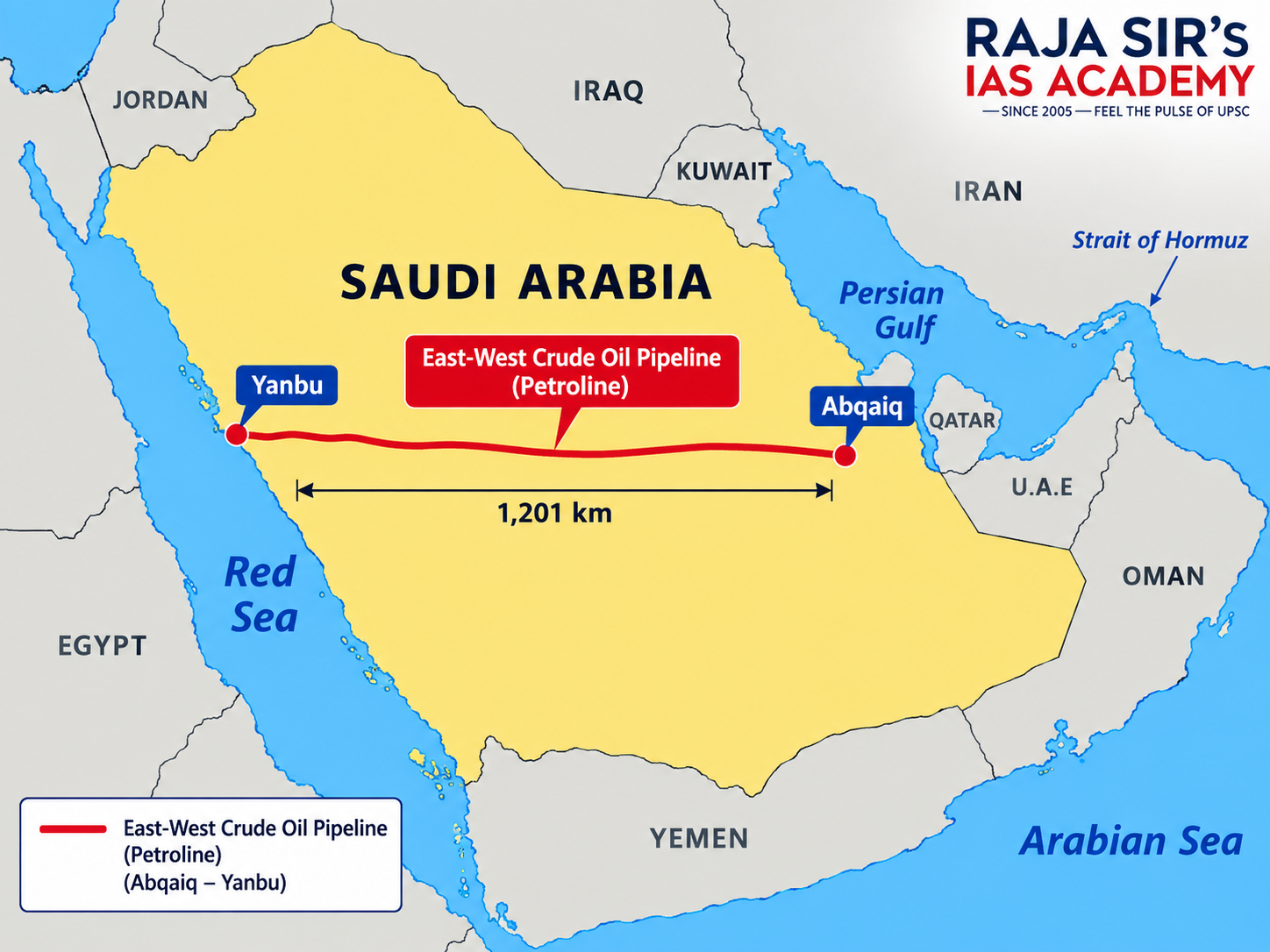
Saudi Arabia temporarily shut its East–West oil pipeline after attacks damaged the infrastructure amid heightened regional tensions. The approximately 1,200-km pipeline connects Saudi Arabia’s eastern oil-producing region with Yanbu on the Red Sea, providing an alternative route for transporting crude without relying entirely on the Strait of Hormuz.
What is the East–West Pipeline?
- Route: Eastern Saudi Arabia → Yanbu, Red Sea
- Length: Approximately 1,200 km
- Purpose: Transports crude oil from Saudi Arabia’s major oil-producing areas in the east towards the Red Sea coast.
- Strategic Function: Provides Saudi Arabia with an alternative export route that can reduce dependence on the Persian Gulf–Strait of Hormuz route.
- Strategic Importance
- Hormuz Bypass: Enables Saudi crude to reach the Red Sea without passing through the Strait of Hormuz.
- Energy Security: Damage or disruption can affect the resilience of regional and global oil supply chains.
- Red Sea Connectivity: Yanbu provides access to Red Sea maritime routes and markets beyond the Gulf.
- Strategic Redundancy: Demonstrates the importance of having multiple transportation and export routes for critical energy supplies.
Impact on India
- Higher Import Bill: A sustained rise in global crude prices can increase India''s expenditure on petroleum imports.
- Inflation: Costlier crude can raise transportation, logistics and production costs, contributing to inflationary pressures.
- Current Account: A larger oil import bill can widen the trade deficit and put pressure on the current account balance.
- Rupee: Higher demand for foreign exchange to pay for energy imports can contribute to depreciation pressure on the rupee.
|
|
Table Top Exercise (TTX) under Colombo Security Conclave
GS Paper II – International Relations
Why in News?
A three-day Table Top Exercise (TTX) under the Colombo Security Conclave (CSC) was conducted at the Eastern Naval Command, Visakhapatnam, focusing on coordinated responses to maritime security challenges.
What is a Table Top Exercise?
Table Top Exercise (TTX): A simulation-based exercise in which commanders, officials and agencies discuss and rehearse responses to hypothetical crisis scenarios without physically deploying forces or operational assets.
Focus Areas
- Maritime Terrorism: Coordinated response to terrorist threats at sea.
- Drug Trafficking: Strengthening mechanisms to detect and disrupt maritime drug networks.
- Human Trafficking: Improving cooperation against trafficking through maritime routes.
- Piracy: Developing coordinated responses to piracy incidents.
- IUU Fishing: Addressing Illegal, Unreported and Unregulated (IUU) fishing through information and operational coordination.
- Information Sharing: Facilitating timely exchange of maritime-security information.
- Maritime Domain Awareness (MDA): Improving the ability to monitor and understand activities occurring in the maritime domain.
|
|
Turning Wetland Waste into Green Livelihoods
GS Paper III – Environment & Economy
Why in News?
A Srinagar-based artisan has developed “Grass Mache”, a sustainable craft technique that uses aquatic weeds and grasses removed from Dal Lake to make decorative and utility products.
- What is Grass Mache?
- Waste-to-Wealth Technique: Converts unwanted aquatic vegetation into value-added handicraft products.
- Papier-Mâché Inspired: Draws inspiration from Kashmir’s traditional papier-mâché craftsmanship while using locally available plant material.
- Process: Aquatic grasses are collected, dried and processed into a fibrous material, which is then moulded, shaped and dried to create finished products.
Significance
- Circular Economy: Converts waste biomass into useful products, reducing resource wastage.
- Wetland Conservation: Provides a productive use for aquatic vegetation removed during Dal Lake cleaning and management.
- Traditional Knowledge: Combines traditional Kashmiri craft skills with an innovative response to a contemporary environmental problem.
- Women’s Livelihoods: Can create opportunities for women-led handicraft and micro-enterprises.
- Green Entrepreneurship: Demonstrates how environmental challenges can be transformed into local livelihood and income-generation opportunities.
|