|
6th All India Official Language Conference
GS I & GS II – Indian Society / Polity
Why in News?
The 6th All India Official Language Conference was held in Mumbai during Hindi Diwas 2026.
About
- Organised by the Department of Official Language, Ministry of Home Affairs.
- The conference was initiated in 2021.
- It promotes the progressive use of Hindi in official work while recognising India''s multilingual character.
Constitutional Provisions
- Article 343: Hindi in Devanagari script is the official language of the Union.
- Article 351: Directs the Union to promote the spread and development of Hindi so that it can serve as a medium of expression for India''s composite culture.
Key Features
TOLIC: Town Official Language Implementation Committee
- Purpose: Promotes and monitors the use of Hindi (Rajbhasha) in the work of Central Government offices and organisations located in a particular town/city.
- Composition: Officials from Central Government offices, PSUs, banks and other Central Government-linked organisations in the town.
- Nodal Ministry: Ministry of Home Affairs – Department of Official Language.
Rajbhasha Kirti & Rajbhasha Gaurav Awards
Rajbhasha Kirti Puraskar
- Awards given to Government offices/departments/organisations for outstanding performance in the use and implementation of Hindi.
- Focus: Institutional performance.
Rajbhasha Gaurav Puraskar
- Awards given to individuals for notable contributions to Hindi writing and literature, particularly in areas related to official-language work.
- Focus: Individual contribution.
|
|
Balancing Digital Payment Growth with Financial Sustainability
GS Paper III – Economy
Why in News?
The government notified changes relating to charges on RuPay debit-card transactions and UPI transactions up to ₹2,000, aimed at keeping small-value digital payments affordable.
What is MDR?
Merchant Discount Rate (MDR) is the fee paid by a merchant to participants in the digital-payment ecosystem, such as banks, payment service providers and app operators, for processing a transaction.
Key Features
- Under the new framework, P2M UPI transactions above ₹2,000 will attract an MDR of 0.4%. For transactions above ₹75,000, the MDR will be capped at a flat ₹300. Merchants are not permitted to pass this MDR directly on to consumers.
- P2P transactions are completely exempt from MDR. Small merchants and street vendors receiving up to ₹1 lakh per month through P2M transactions are also exempt.
- For essential sectors such as railways, telecom, fuel, insurance, utility bills and agricultural inputs, a flat MDR of ₹5 will apply to transactions above ₹2,000.
- For the capital market sector, including mutual funds, securities and stockbrokers, MDR will be 0.02%, capped at ₹300.
- Around 5% of MDR collections will be used to support UPI adoption among small merchants.
Need for MDR
- Financial Sustainability: UPI handles enormous transaction volumes, while its operating costs remain high. The Parliamentary Standing Committee on Finance had cited UPI''s operating cost at around ₹20,700 crore, compared with approximately ₹2,000 crore in subsidy.
- Infrastructure and Cybersecurity: A sustainable revenue model could encourage banks and other payment ecosystem participants to invest more in cybersecurity, infrastructure and technological improvements.
- Limited Impact: Exemptions for P2P transactions and small merchants are intended to ensure that the framework does not significantly affect low-value digital payments. Around 96% of merchant UPI transactions are expected to remain unaffected.
Concerns
- Pass-through to Consumers: Although merchants are prohibited from directly charging consumers for MDR, critics argue that businesses may indirectly recover the cost by increasing prices.
- Impact on Digital Payments: Additional costs could discourage some merchants from accepting digital payments and may encourage a shift back towards cash transactions.
- Question of Cost: Critics also argue that UPI has relatively low operational costs compared with card payments because it does not require the same level of card-terminal infrastructure, while digital payments also reduce cash-handling costs for banks and governments.
- Financial Inclusion: If transaction costs become significant, they could affect the adoption of digital payments among small businesses and informal-sector participants.
About UPI
- Unified Payments Interface (UPI) is India''s real-time, interoperable payment system, enabling instant payments between individuals and merchants on a 24×7 basis.
- UPI was developed by the National Payments Corporation of India (NPCI). Its important features include two-factor authentication, Open APIs and interoperability. A user can also access multiple bank accounts through a single UPI-enabled application.
- UPI has become the world''s largest retail fast-payment system by transaction volume and is accepted in 11 countries: Greece, Maldives, UAE, Singapore, Bhutan, Nepal, Sri Lanka, France, Mauritius, Qatar and Cambodia.
|
|
Criminalisation of Politics: Special Courts and Judicial Backlog
GS Paper II – Polity & Governance
Why in News?
An August 2026 amicus curiae report submitted to the Supreme Court highlighted that criminal cases involving sitting and former MPs/MLAs increased from 4,075 in 2018 to 4,266 in July 2026, despite the creation of special courts.
What is Criminalisation of Politics?
It refers to the increasing presence of persons facing criminal charges or with criminal backgrounds in the electoral and legislative process.
Background
- In Ashwini Kumar Upadhyay v. Union of India (2017), the Supreme Court directed the establishment of dedicated Fast Track Courts for speedy disposal of criminal cases involving elected representatives.
- The objective was to prevent prolonged trials from allowing criminal cases to remain pending throughout a legislator''s political career.
Key Findings
- Persistent Backlog: 4,266 cases were pending as of July 2026.
- Long-Pending Cases: About 1,838 cases have remained pending for more than five years, including 746 cases pending for over a decade.
- New Cases: In 2025, special courts disposed of 1,454 cases, but 1,234 new cases were added.
- Legislators Affected: Pending cases involve 401 sitting MPs and 1,393 sitting MLAs, besides former legislators.
- Regional Concentration: Uttar Pradesh has the highest pendency, followed by Kerala, Bihar, Maharashtra and Odisha.
Why are Special Courts Failing to Reduce Backlog?
- Non-Dedicated Courts: Many designated courts continue to handle ordinary criminal cases along with MP/MLA cases.
- High Court Stays: Petitions seeking quashing of proceedings or challenging interlocutory orders can result in prolonged stays.
- Investigation and Prosecution Delays: Delays in filing chargesheets, serving summons and producing witnesses slow down trials.
- Witness Vulnerability: Prolonged trials can increase the possibility of witnesses becoming hostile or evidence weakening over time.
- Frequent Adjournments: Repeated postponements undermine the objective of speedy trials.
- Weak Monitoring: High Court monitoring mechanisms have not consistently ensured continuous supervision of these cases.
Electoral Reform Debate
- The Law Commission''s 170th Report (1999) recommended disqualification upon framing of charges for certain serious offences.
- The Election Commission (2004) proposed restrictions on candidates against whom charges had been framed for offences punishable with five years or more imprisonment.
- A key concern is balancing electoral integrity with the principle that an accused person is presumed innocent until conviction.
Way Forward
- Dedicated Benches: MP/MLA courts should function exclusively for cases involving elected representatives.
- Day-to-Day Trials: Cases pending for more than three years should receive continuous hearings wherever legally feasible.
- Time-Bound Stay Decisions: High Courts should avoid prolonged interim stays and decide such applications expeditiously.
- Stronger Prosecution: Investigation and prosecution should be adequately staffed and institutionally insulated from political interference.
- Technology-Based Monitoring: A centralised dashboard can track case age, adjournments, stays and disposal rates.
|
|
Expanding Economic Engagement with Latin America
GS Paper II – International Relations | GS Paper III – Economy
Why in News?
India and MERCOSUR are negotiating an expansion of their existing Preferential Trade Agreement (PTA) to widen product coverage and strengthen bilateral trade and economic cooperation.
What is MERCOSUR?
- MERCOSUR stands for Mercado Común del Sur (Southern Common Market).
- It is a South American regional economic integration bloc.
- Core members: Argentina, Brazil, Paraguay and Uruguay.
- Bolivia: Joined as a full member.
- Venezuela: Remains suspended.
India–MERCOSUR PTA
- Signed: 2004
- Entered into force: 1 June 2009
- Provides preferential tariff treatment for selected goods.
- Has limited product coverage compared with a comprehensive Free Trade Agreement (FTA).
Recent Development
- The First Additional Protocol facilitates the acceptance of electronic Certificates of Origin (e-CoO).
- Certificate of Origin: A document certifying the country in which a product was produced, helping determine its eligibility for preferential tariff treatment.
Significance for India
- Market Diversification: Provides greater access to South American markets beyond India''s traditional trading partners.
- Critical Resources: MERCOSUR economies offer access to agricultural commodities, energy resources and critical minerals.
- Export Opportunities: Wider market access can benefit sectors such as pharmaceuticals, engineering goods and automobiles.
- Global South Engagement: Strengthens India''s economic engagement with Latin America and the wider Global South.
|
|
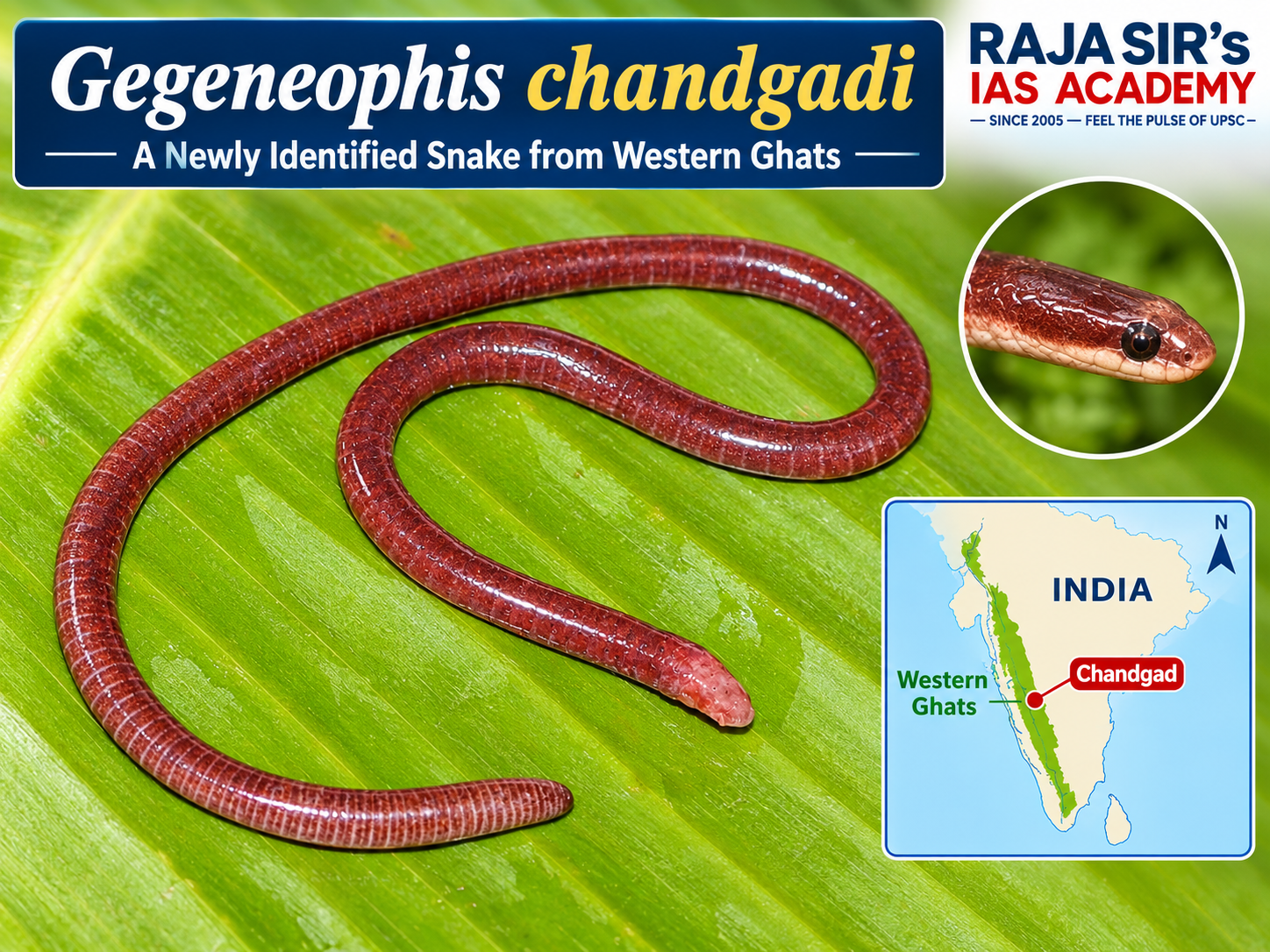
Gegeneophis chandgadi
GS III – Environment & Biodiversity
Why in News?
Scientists discovered a new species of subterranean, legless amphibian from Maharashtra.
Key Facts
- Scientific name: Gegeneophis chandgadi
- Group: Caecilians
- Class: Amphibia
- Body: Legless
- Lifestyle: Primarily subterranean
- Habitat: Lives mainly in soil and underground habitats. It has been recorded in agricultural and residential landscapes, showing that caecilians are not restricted to protected forests.
What are Caecilians?
- Caecilians are legless, elongated amphibians that generally live underground or in aquatic environments.
- Key feature: Unlike snakes, caecilians are amphibians, not reptiles.
|
|
India’s Himalayan Livestock Genetic Heritage
GS III – Agriculture / Animal Husbandry
Why in News?
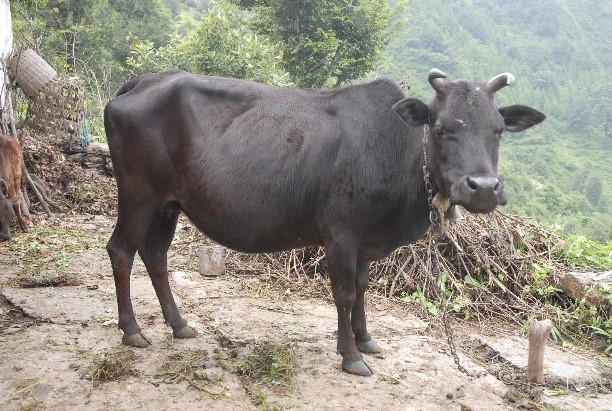
India produced its first Badri cattle calf through OPU-IVF technology at Pantnagar, Uttarakhand.
About Badri Cattle
- Indigenous humped cattle breed of Uttarakhand.
- Belongs to the Bos indicus group.
- Native to the Uttarakhand Himalayas.
- Locally known as Pahadi cattle.
- Registered with the National Bureau of Animal Genetic Resources (NBAGR).
Distribution & Habitat
- Mainly found in the Garhwal and Kumaon regions of Uttarakhand.
- Adapted to cold, mountainous terrain and low-input grazing systems.
Key Characteristics
- Mountain Adaptation: Compact body and strong legs help movement across steep terrain.
- Hardiness: Well adapted to harsh Himalayan conditions.
- Milk Production: Relatively low milk yield, but valued for its adaptability and indigenous genetic traits.
OPU-IVF Technology
- OPU – Ovum Pick-Up: Collection of oocytes (eggs) from a female animal.
- IVF – In Vitro Fertilisation: Fertilisation of the collected oocyte with sperm outside the animal''s body.
- The resulting embryo can be transferred to a suitable surrogate female.
|
Feature
|
Details
|
|
Full Form
|
National Bureau of Animal Genetic Resources (NBAGR)
|
|
Established
|
1984
|
|
Headquarters
|
Karnal, Haryana
|
|
Under
|
Indian Council of Agricultural Research (ICAR)
|
|
Ministry
|
Ministry of Agriculture & Farmers Welfare
|
|
Major Role
|
Conservation, characterisation and utilisation of India’s livestock and poultry genetic resources
|
|
Key Function
|
Registration of indigenous livestock and poultry breeds
|
|
Importance
|
Helps conserve indigenous animal breeds and genetic diversity
|
|
Examples
|
Badri cattle, Gir cattle, Sahiwal cattle, Murrah buffalo, etc.
|
|
|
Indian Air Force Dronathon-2026
GS Paper III – Defence Technology / Security
Why in News?
The Indian Air Force inaugurated Dronathon-2026 at the Pokhran Field Firing Range, Jaisalmer, from 14–16 September 2026 to assess indigenous unmanned systems under realistic operational conditions.
What is Dronathon-2026?
An IAF initiative connecting the armed forces, defence industry, start-ups, MSMEs and research institutions to test emerging unmanned technologies against operational requirements.
Key Features
- Multi-Domain Testing: Surveillance, reconnaissance, autonomous operations, drone swarms, electronic warfare and counter-UAS capabilities.
- Operational Evaluation: Systems are assessed for reliability, adaptability and effectiveness rather than merely technological performance.
- Industry–Military Linkage: Provides Indian start-ups, MSMEs and defence companies direct exposure to military requirements.
- Vayu UTtaM: Indigenous unmanned traffic management capability demonstrated real-time detection and tracking of military and civilian UAS.
Vayu UTTAM
- Type: Airborne Electronic Warfare (EW) system.
- Developed by: DRDO.
- For: Indian Air Force (IAF).
- Purpose: Detects, identifies and responds to hostile electromagnetic/radar threats.
- Key capability: Supports electronic surveillance and countermeasures.
- Significance: Enhances the survivability and situational awareness of fighter aircraft.
|
|
India–Vietnam Defence Cooperation
GS Paper II – International Relations
Why in News?
India and Vietnam agreed to deepen defence and security cooperation, including cooperation in the co-production of Indian defence equipment, during the 19th India–Vietnam Joint Commission Meeting.
Evolution of Relations
- 2003: Partnership
- 2007: Strategic Partnership
- 2016: Comprehensive Strategic Partnership
- 2026: Enhanced Comprehensive Strategic Partnership
Significance for India
- Indo-Pacific: Vietnam''s strategic location gives it importance in India''s wider Indo-Pacific engagement.
- Maritime Security: Both countries support freedom of navigation and adherence to the UN Convention on the Law of the Sea (UNCLOS).
- Strategic Autonomy: Defence cooperation with multiple partners helps diversify India''s strategic relationships.
- ASEAN Engagement: Vietnam provides an important link between India''s Act East Policy and its broader engagement with ASEAN.
|
Feature
|
Details
|
|
Full Form
|
United Nations Convention on the Law of the Sea
|
|
Adopted
|
1982
|
|
Signed
|
10 December 1982, Montego Bay, Jamaica
|
|
Entered into force
|
16 November 1994
|
|
Nature
|
International legal framework governing uses of the oceans and seas
|
|
Key Areas
|
Territorial sea, contiguous zone, EEZ, continental shelf, high seas and marine resources
|
|
Territorial Sea
|
Up to 12 nautical miles
|
|
Contiguous Zone
|
Up to 24 nautical miles
|
|
Exclusive Economic Zone (EEZ)
|
Up to 200 nautical miles
|
|
Continental Shelf
|
Seabed and subsoil beyond territorial sea, subject to UNCLOS provisions
|
|
High Seas
|
Areas beyond national jurisdiction
|
|
Important Institution
|
International Tribunal for the Law of the Sea (ITLOS)
|
|
Other Bodies
|
International Seabed Authority (ISA) and Commission on the Limits of the Continental Shelf (CLCS)
|
|
India
|
India is a party to UNCLOS
|
|
|
Indrayani River
GS I – Geography
Why in News?
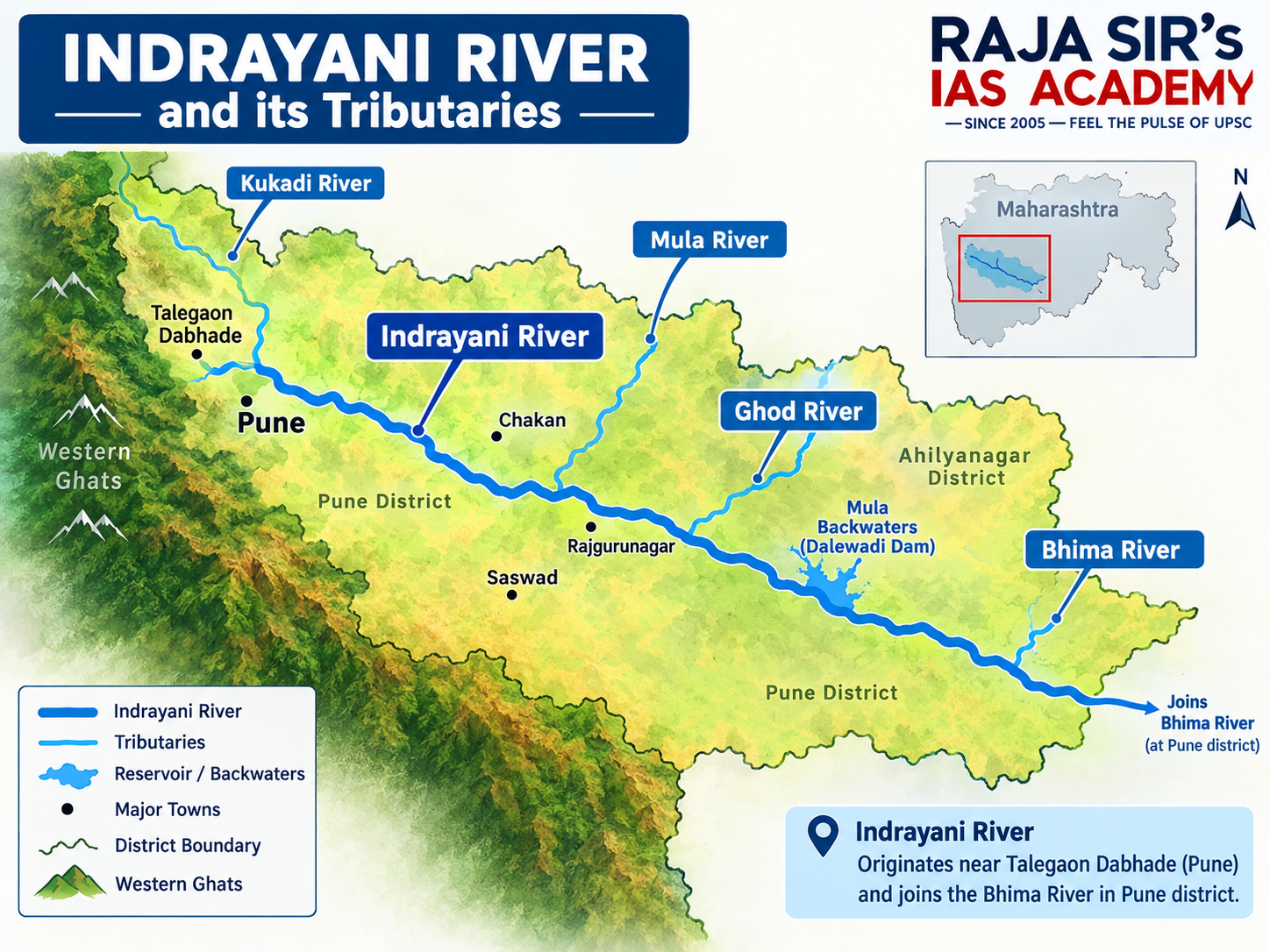
A major fish kill was reported in the Indrayani River near Alandi in Pune district, Maharashtra, raising concerns over pollution from urban and industrial sources.
Key Facts
- State: Maharashtra
- Origin: Near Kurvande village, close to Lonavala.
- Physiographic setting: Western Ghats → Deccan Plateau
- Flow: Generally eastward
- Important places: Dehu and Alandi
- Tributary of: Bhima River
- Bhima River: Major tributary of the Krishna River
Environmental Concerns
- Sewage Pollution: Untreated domestic sewage increases the organic load of the river.
- Industrial Effluents: Discharge from industries can introduce pollutants and toxic substances into the river.
- Low Dissolved Oxygen: Increased organic pollution raises oxygen demand, reducing dissolved oxygen and potentially causing fish mortality.
|
|
S-400 Air Defence System
GS Paper III – Defence Technology
Why in News?
The Defence Ministry Annual Report 2025–26 highlighted the operational use of India''s S-400 air-defence system during Operation Sindoor.
About S-400
- Origin: Russia
- Developer: Almaz-Antey
- Type: Long-range surface-to-air missile (SAM) system
- NATO designation: SA-21 Growler
- Designed for long-range detection, tracking and interception of aerial threats.
NATO
|
Feature
|
|
Details
|
|
Full Form
|
|
North Atlantic Treaty Organization
|
|
Established
|
|
1949
|
|
Headquarters
|
|
Brussels, Belgium
|
|
Nature
|
|
Political and military alliance
|
|
Members
|
|
32 countries
|
|
Founding Treaty
|
|
North Atlantic Treaty / Washington Treaty
|
|
Core Principle
|
|
Collective defence
|
|
Article 5
|
|
An armed attack against one member is considered an attack against all
|
|
Latest Member
|
|
Sweden (joined in 2024)
|
|
India
|
|
Not a NATO member
|
|
India–NATO
|
|
India maintains political dialogue and cooperation with NATO.
|
|
|
Strategic Islands of the Red Sea
GS I & GS II – Geography / International Relations
Why in News?
Strategic islands and maritime chokepoints in the southern Red Sea have gained attention amid continuing regional tensions and their importance for international shipping.
Key Locations
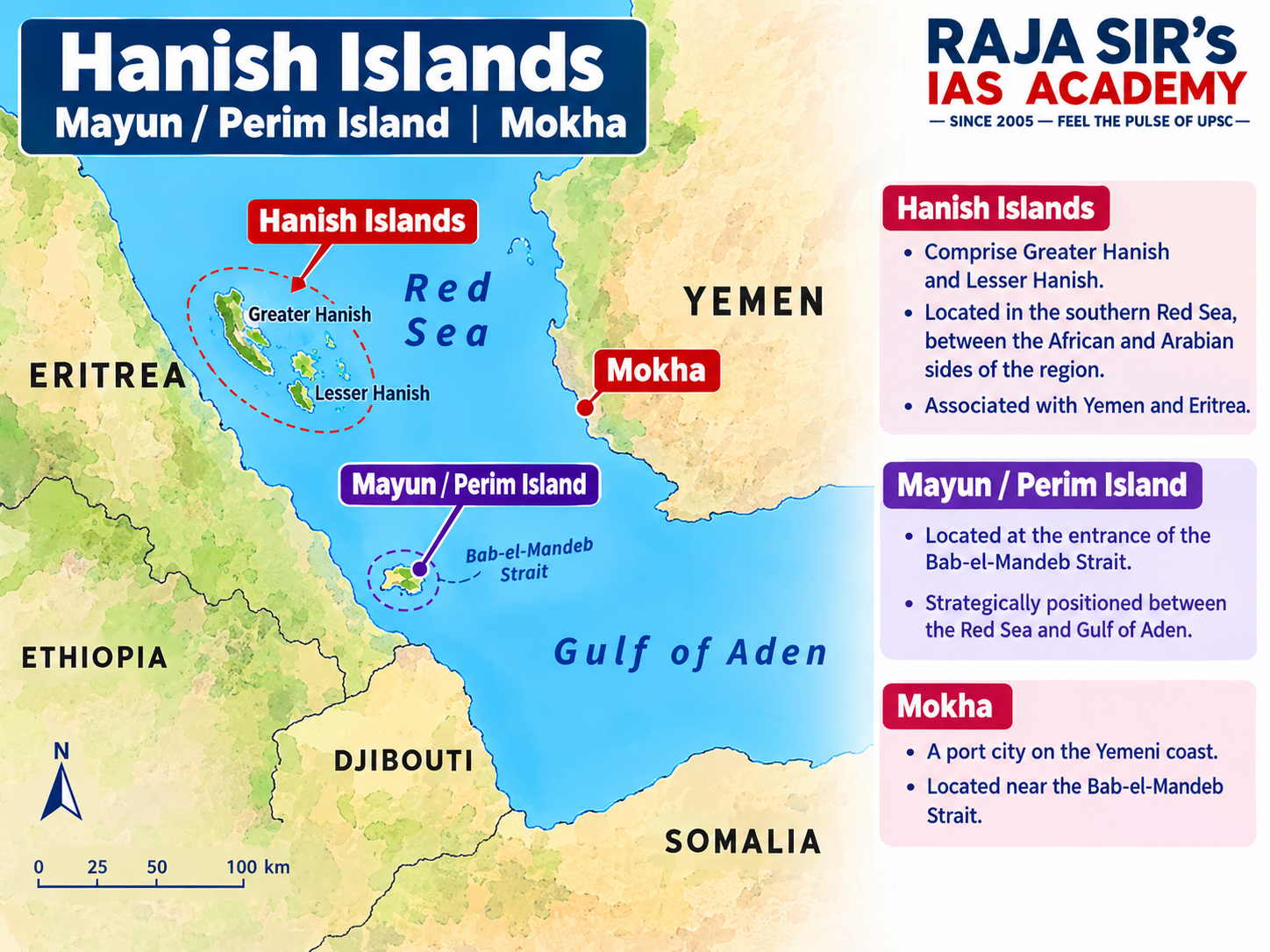
Hanish Islands
- Comprise Greater Hanish and Lesser Hanish.
- Located in the southern Red Sea, between the African and Arabian sides of the region.
- Associated with Yemen and Eritrea.
Mayun / Perim Island
- Located at the entrance of the Bab-el-Mandeb Strait.
- Strategically positioned between the Red Sea and Gulf of Aden.
Mokha
- A port city on the Yemeni coast.
- Located near the Bab-el-Mandeb Strait.
|
|
Thirukkural
GS I – Art & Culture
Why in News?
A translated edition of Thirukkural was presented to the Russian President during the BRICS Summit, highlighting the international recognition of Tamil literary heritage.
About Thirukkural
- Author: Thiruvalluvar
- Language: Classical Tamil
- Nature: Ethical and philosophical work
- Total: 1,330 couplets (kurals)
- Structure: 133 chapters, with 10 couplets in each chapter.
Divided into 3 books (Pal)
- Aram: Virtue / Ethics
- Porul: Wealth, polity, governance and social life
- Inbam: Love / Human relationships
Significance
- Ethical Philosophy: Discusses morality, personal conduct, justice and human values.
- Governance: Porul contains ideas relating to rulership, administration, justice and social order.
- Universal Values: Its ethical teachings address human conduct across social and cultural boundaries.
- Tamil Heritage: It is a major work representing the literary and philosophical heritage of Tamil civilisation.

|
|
Women''s Asia Cup 2026
GS I – Society / Sports
Why in News?
India won the Women’s Asia Cup 2026, defeating Sri Lanka by 72 runs in the final at the Dubai International Cricket Stadium on 13 September 2026. India secured a record-extending eighth Women’s Asia Cup title.
|
Feature
|
Details
|
|
Organiser
|
Asian Cricket Council (ACC)
|
|
Format
|
Women’s T20 International
|
|
Host
|
United Arab Emirates
|
|
Dates
|
28 August – 13 September 2026
|
|
Teams
|
8
|
|
Champion
|
India
|
|
Runner-up
|
Sri Lanka
|
|
Final margin
|
India won by 72 runs
|
|
Final venue
|
Dubai International Cricket Stadium
|
|
Player of the Match
|
Shafali Verma
|
|
India’s title count
|
8th
|
Asian Cricket Council (ACC)
- Established: 1983.
- Nature: Regional governing body for cricket in Asia.
- Headquarters: Colombo, Sri Lanka.
- Members: Asian cricket-playing nations, including India, Pakistan, Sri Lanka, Bangladesh, Afghanistan and Nepal.
|