|
12 Years of Make in India: From Assembly to Deep Manufacturing
GS III – Indian Economy
Why in News?
The Make in India initiative completed 12 years, with the government highlighting expansion in manufacturing, electronics, defence, pharmaceuticals, capital goods and emerging technologies.
Core Issue: India has expanded manufacturing capacity and attracted investment, but the next challenge is to move from assemblyled growth to high domestic value addition, technological capability and deeper Global Value Chain (GVC) integration.
Key Achievements
- FDI expansion: Cumulative FDI inflows reached about $843 billion, indicating sustained investor interest in India’s production ecosystem.
- Electronics manufacturing: Mobilephone manufacturing expanded nearly 33fold, strengthening India’s electronics production base.
- Defence manufacturing: Indigenous defence production rose by 283%, reaching around ₹1.78 lakh crore in FY 2025–26.
- Capital goods: Capacity expanded in sectors such as earthmoving equipment, mining machinery and heavy electrical equipment.
- Industrial ecosystem: Manufacturing growth has supported the development of supplier networks, logistics infrastructure and sectorspecific industrial capabilities.
Challenges
- Manufacturing share: Manufacturing continues to account for only around 16–17% of GDP, below the longstanding 25% ambition.
- Employment challenge: Output growth has not translated proportionately into largescale employment, reflecting increasing automation and capital intensity.
- Weak GVC integration: India remains less deeply embedded in fragmented international production networks than major manufacturing economies.
- R&D deficit: R&D expenditure remains below 0.7% of GDP, limiting domestic innovation and technological upgrading.
- Assembly dependence: Strong growth in final assembly can coexist with significant imports of semiconductors, components, machinery and other highvalue inputs.
Way Forward
- Rationalise tariffs: Correct inverted duty structures and reduce the cost of imported intermediate goods required for domestic production.
- Integrate MSMEs: Connect Indian MSMEs with Tier1 and Tier2 suppliers of global manufacturers.
- Strengthen R&D: Build stronger publicprivate partnerships in robotics, advanced materials, semiconductors and Industry 4.0 technologies.
- Build industrial clusters: Develop plugandplay manufacturing zones with reliable power, logistics, testing and common facilities.
- Deepen GVC participation: Encourage production of components, machinery and intermediate goods rather than focusing predominantly on final assembly.
- Promote technological ownership: Link production incentives increasingly with domestic value addition, technology development and innovation.
|
|
Analogue Paneer: Food Standards and Consumer Protection
GS III – Food Processing & Food Safety
Why in News?
The Food Safety and Standards Authority of India (FSSAI) has proposed regulations concerning products that resemble paneer but substitute milk constituents with non-milk ingredients.
About
- Analogue paneer refers to a product in which one or more milk constituents are replaced wholly or partly by non-milk ingredients.
- Common substitutes may include vegetable fats, starches and other plant-based ingredients.
- It may resemble conventional paneer in appearance, texture or culinary use, but its composition differs from dairy paneer.
Core Issue
- Consumer confusion: Similar appearance and marketing can make it difficult for consumers to distinguish analogue products from genuine dairy products.
- Labelling: Clear declaration of ingredients and product identity is essential to prevent misleading representation.
- Food safety: Substitution of ingredients requires appropriate standards for composition, quality and permitted additives.
- Consumer protection: Consumers should be able to make informed choices based on the actual composition and nutritional characteristics of the product.
FSSAI – Food Safety and Standards Authority of India
What is FSSAI?
The Food Safety and Standards Authority of India (FSSAI) is the statutory authority responsible for regulating and supervising food safety and food standards in India.
Key Facts
- Established: 2008
- Parent Ministry: Ministry of Health and Family Welfare
- Legal Basis: Food Safety and Standards Act, 2006
- Headquarters: New Delhi
- Nature: Statutory, autonomous body
- Chairperson: Appointed by the Central Government.
|
|
Cool Leaders Award: Making Cooling ClimateSmart
GS III – Environment / Climate Change
Why in News ?
The UNEPled Cool Coalition launched the inaugural Cool Leaders Award during the Global Cooling Pledge Assembly 2026, recognising practical approaches to sustainable cooling.
Key Areas
- Passive cooling: Building design, shading, ventilation and reflective surfaces that reduce dependence on mechanical cooling.
- Urban greenery: Trees, parks and green infrastructure can reduce local heat through shade and evapotranspiration.
- Efficient cooling systems: Promote highefficiency air conditioners, refrigeration and cooling equipment.
- Heatresilient planning: Integrate heat mitigation into urban design, buildings and public infrastructure.
- Lowcarbon technologies: Encourage cooling technologies with lower energy consumption and reduced climate impact.
- cool Coalition: UNEPled global coalition working towards sustainable cooling.
- Global Cooling Pledge: Launched at COP28 to accelerate action on reducing coolingrelated emissions.
|
|
Exercise VARUNA: Deepening India–France Maritime Interoperability
GS II – International Relations | GS III – Defence
Why in News ?
INS Trishul reached Toulon, France, to participate in the 24th edition of Exercise VARUNA, the flagship bilateral naval exercise between India and France.
What is Exercise VARUNA?
VARUNA is an annual bilateral naval exercise between the Indian Navy and French Navy, designed to improve operational coordination and maritime interoperability.
Strategic Significance
- IndoPacific cooperation: Strengthens the operational dimension of India–France strategic ties.
- SLOC security: Improves preparedness for protecting Sea Lines of Communication, critical to international trade.
- Operational familiarity: Regular exercises allow both navies to understand each other''s procedures, communication systems and tactics.
- Maritime readiness: Provides experience in conducting coordinated operations across different maritime environments.
- Strategic autonomy: Expands India''s network of defence partnerships while maintaining an independent approach to maritime security.
|
Exercise
|
Service
|
Key Focus
|
|
VARUNA
|
Navy
|
Maritime security, naval warfare and interoperability
|
|
GARUDA
|
Air Force
|
Air combat operations and interoperability
|
|
SHAKTI
|
Army
|
Joint military operations and counter-terrorism
|
|
|
Pandit Deendayal Upadhyaya: Integral Humanism and Antyodaya
GS I History
Why in News?
Pandit Deendayal Upadhyaya’s birth anniversary is observed on 25 September.
Key facts
- Bharatiya Jana Sangh: A prominent ideologue and leader of the Bharatiya Jana Sangh, the political organisation that preceded the Bharatiya Janata Party.
- Integral Humanism: His philosophical framework emphasised the holistic development of the individual, balancing material, social, cultural and spiritual dimensions rather than viewing economic growth in isolation.
- Antyodaya: Emphasised the upliftment of the last person in society, particularly the poorest and most marginalised, as a measure of development.
- Decentralisation: Favoured decentralised economic and political structures, with greater importance to local communities and grassroots institutions.
- Swadeshi and Self-Reliance: Advocated development rooted in indigenous capabilities, local resources and appropriate technology, while avoiding excessive dependence on external models.
- Labour-Intensive Development: Stressed the importance of employment generation and productive participation of labour, particularly in a developing economy.
Bharatiya Jana Sangh (BJS)
What is it?
The Bharatiya Jana Sangh (BJS) was a political party founded in 1951, with Shyama Prasad Mukherjee as its founder-president. It emerged as an important political force on the Indian right and later became the political predecessor of the Bharatiya Janata Party (BJP).
Key Features
- Founded: 1951
- Founder-President: Shyama Prasad Mukherjee
- Major Ideologue: Pandit Deendayal Upadhyaya
- Political Base: Emphasised nationalism, cultural identity and economic self-reliance.
- Electoral Role: Participated in parliamentary politics and became a significant opposition party in the early decades of the Republic.
- 1977: BJS merged with several opposition parties to form the Janata Party.
- 1980: Former Jana Sangh members formed the Bharatiya Janata Party (BJP).
|
|
Parali Protection Force: Technology-Enabled Crop-Residue Governance
GS III – Environment & Agriculture
Why in News ?
Haryana has proposed a dedicated Parali Protection Force involving field-level surveillance, drone monitoring and inter-departmental coordination to curb paddy-stubble burning.
Aim
- Prevent stubble burning: Detect and respond to crop-residue burning at the field level.
- Reduce air pollution: Address seasonal spikes in air pollution, particularly across the NCR.
- Support farmers: Facilitate access to residue-management machinery and financial alternatives.
- Combine enforcement and incentives: Move beyond punitive action towards a compliance-oriented approach.
Significance
- Technology-enabled governance: Drones and digital surveillance can improve real-time detection and verification.
- Institutional coordination: Brings agriculture, revenue, pollution-control and district administration agencies into a coordinated framework.
- Resource recovery: Paddy residue can be channelled towards bioenergy, compressed biogas, fodder and industrial applications.
- Local implementation: Demonstrates that national air-quality objectives depend substantially on effective state and district-level governance.
|
|
PB-SHABD: Digital Content-Sharing Platform of Prasar Bharati
GS II – Governance | Media & Communication
What is PB-SHABD?
PB-SHABD stands for Prasar Bharati Shared Audio-Visuals for Broadcast and Dissemination.
It is a Prasar Bharati initiative launched in 2024 to provide media organisations with access to a range of curated news and multimedia content for wider dissemination.
Key Features
- Multimedia content: Provides text, video, audio, photographs and infographics.
- Multilingual: Content is available in multiple Indian languages.
- Content sharing: Facilitates wider dissemination of news and public-information material.
- Digital media ecosystem: Strengthens the role of public broadcasting in the digital information environment.
Prasar Bharati
- Prasar Bharati is India’s public service broadcaster and a statutory autonomous body established under the Prasar Bharati (Broadcasting Corporation of India) Act, 1990.
- It came into existence on 23 November 1997, taking over the broadcasting functions of All India Radio (Akashvani) and Doordarshan.
Major Components
- Akashvani (All India Radio): Radio broadcasting and related digital audio services.
- Doordarshan: National and regional television broadcasting.
- Digital platforms: Extends public broadcasting through digital and multimedia platforms such as PB-SHABD.
|
|
PLA-Based Bioplastics: From Agricultural Feedstocks to Sustainable Materials
GS III – Science & Technology | Environment
Why in News ?
India has initiated commercial development of Polylactic Acid (PLA)-based biodegradable plastics under the BioE3 framework, reflecting efforts to expand sustainable biomanufacturing and reduce dependence on fossil-fuel-based plastics.
What is PLA?
Polylactic Acid (PLA) is a bio-based biodegradable aliphatic thermoplastic polyester produced from renewable biological feedstocks.
Common feedstocks include: Sugarcane, Corn starch, Tapioca, Other carbohydrate-rich biomass
Significance
- Sustainable alternative: Provides a renewable-source alternative to conventional plastics.
- Agricultural value addition: Converts carbohydrate-rich agricultural resources into higher-value materials.
- Multiple applications: Useful in packaging, agricultural products and 3D printing.
- Medical applications: Its biocompatibility enables applications such as absorbable surgical sutures.
- Bioeconomy: Supports India''s transition towards biotechnology-driven manufacturing.
- Circular economy: Can contribute to resource-efficient material systems when appropriate collection and end-of-life infrastructure exists.
PLA vs Conventional Plastics
|
Parameter
|
PLA (Polylactic Acid)
|
Conventional PE/PP
|
|
Nature
|
Bio-based polymer
|
Predominantly petroleum-derived polymers
|
|
Feedstock
|
Renewable biomass such as corn, sugarcane and tapioca
|
Fossil-fuel-derived hydrocarbons
|
|
Key intermediate/monomer
|
Lactic acid → polymerisation → PLA
|
Ethylene / Propylene → polymerisation → PE / PP
|
|
Biodegradability
|
Biodegradable under appropriate industrial/controlled conditions
|
Generally non-biodegradable and persistent
|
|
Environmental profile
|
Potentially lower dependence on fossil feedstocks
|
Greater dependence on fossil resources
|
|
Applications
|
Packaging, 3D printing, agricultural products and medical applications
|
Packaging, containers, household goods and consumer products
|
|
Key limitation
|
Requires suitable conditions for effective degradation; feedstock and end-of-life management matter
|
Long environmental persistence and dependence on fossil resources
|
|
|
Removal of the Chief Election Commissioner: Constitutional Safeguards
GS III – Polity & Governance
Why in News ?
A move seeking the removal of the Chief Election Commissioner has brought renewed attention to the constitutional protection and security of tenure of the Election Commission. The Election Commission is a constitutional authority established under Article 324
Constitutional Basis
- Article 324(5): Provides special protection to the CEC.
- Grounds: Proved misbehaviour or incapacity, corresponding to the constitutional standard applicable to removal of a Supreme Court judge.
- Other Election Commissioners: They cannot be removed from office except on the recommendation of the CEC.
Removal Process
- Removal motion: A motion seeking removal is initiated in Parliament.
- Admission: The motion has to be admitted under the applicable parliamentary procedure.
- Investigation: The allegations are examined through the prescribed process.
- Proof of grounds: Misbehaviour or incapacity must be established.
- Parliamentary approval: The constitutional standard applicable to removal of a Supreme Court judge requires the prescribed special majority in Parliament.
- Presidential order: Removal follows upon the requisite parliamentary resolution.
Removal of the CEC and Other Election Commissioners
|
Chief Election Commissioner (CEC)
|
Other Election Commissioners (ECs)
|
|
Removal protection equivalent to that of a Supreme Court Judge
|
Cannot be removed from office except on the recommendation of the CEC
|
|
Governed by Article 324(5)
|
Governed by Article 324(5)
|
|
Removed in the same manner and on the same grounds as a Supreme Court Judge
|
CEC''s recommendation is constitutionally required
|
|
Provides stronger security of tenure to safeguard institutional independence
|
Removal protection is linked to the recommendation of the CEC
|
NOTES
CEC: Same removal protection as a Supreme Court Judge.
Other ECs: Removal requires recommendation of the CEC.
|
|
River Thames: Geography of a Major European River
GS I – Geography
Why in News ?
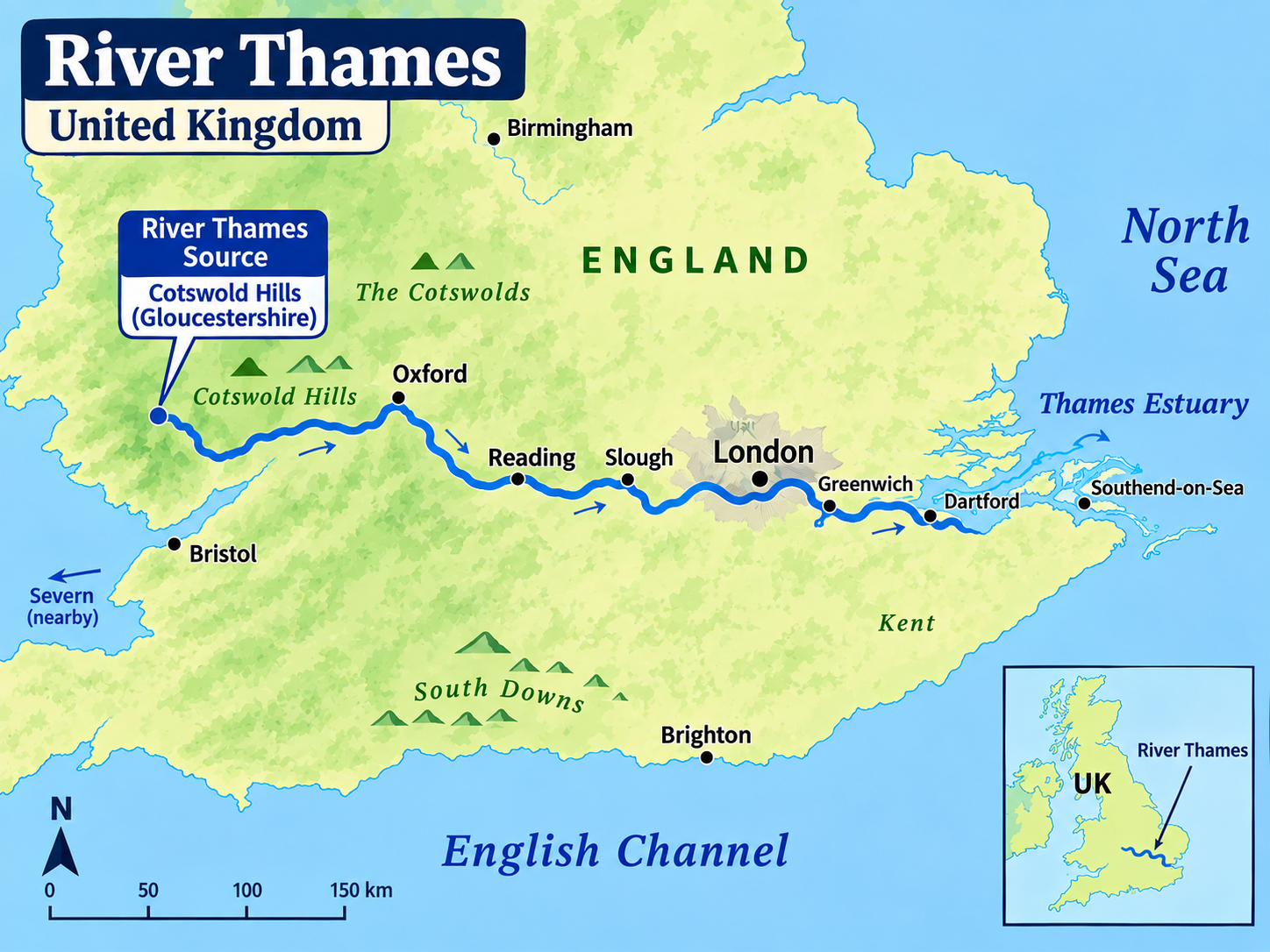
A pod of pilot whales entered the tidal waters of the River Thames near Gravesend, leading to a multiagency rescue operation and bringing attention to the geography and tidal characteristics of the river.
Geographical Profile
- Location: Southern England, United Kingdom.
- Source: The Thames rises at Thames Head in Gloucestershire.
- Flow direction: Flows broadly eastward across southern England.
- Major cities: Passes through or near Oxford, Reading, Windsor and London.
- Mouth: Enters the North Sea through the Thames Estuary.
- Tidal limit: The river becomes tidal downstream of Teddington Lock.
- Thames Barrier: Located downstream of London and designed to protect the city from tidal flooding and storm surges.
Significance
- Estuarine system: The Thames Estuary forms an important transition between freshwater and marine environments.
- Navigation: The river has historically supported London''s development as a major port and commercial centre.
- Urban geography: The Thames is closely integrated with the physical and economic geography of London.
- Flood management: The Thames Barrier represents largescale adaptation to tidal and coastal flood risks.
|
|
Sable Shearwater: Migratory Pelagic Seabird
GS III – Environment | Biodiversity
- Scientific name: Ardenna carneipes
- Common name: Fleshfooted Shearwater
- Type: Pelagic, migratory marine bird.
- Distribution: Breeds mainly on islands of the southern Indian Ocean and southwestern Pacific Ocean.
- Habitat: Spends much of its life at sea, returning to islands for breeding.
- Major threats: Plastic ingestion, Fishing bycatch, Predation and disturbance at breeding colonies.
- IUCN Red List: Near Threatened (NT).

|
|
UN Charter’s Enemy State Clauses: Anachronism in Global Governance
GS II – International Relations
Why in News ?
Japan has renewed calls for the removal of the obsolete “enemy state” clauses from the UN Charter, highlighting the continuing gap between the Charter''s post-World War II framework and the contemporary international order.
What are the Enemy State Clauses?
- The term refers to provisions of the UN Charter concerning states that had been enemies of the Allied powers during World War II.
- They were framed in the context of the 1945 post-war security architecture, when former Axis powers were viewed through a different security lens.
Relevant Articles
- Article 53: Refers to enforcement action by regional arrangements against an “enemy state” in the context of the transitional post-war framework.
- Article 77: Includes territories administered under the trusteeship system that were separated from “enemy States” as a consequence of World War II.
- Article 107: Preserves the validity of actions taken or authorised against former enemy states as a consequence of World War II.
Why Removal is Difficult
Under Article 108, amendments to the UN Charter require:
- Adoption by a two-thirds majority of the members of the General Assembly; and
- Ratification by two-thirds of UN members, including all permanent members of the Security Council.
Significance
- UN reform: Highlights the need to update institutions created for the post-1945 international order.
- Contemporary relevance: Raises questions about retaining provisions whose original geopolitical circumstances have substantially changed.
- Legitimacy: Reform can strengthen the perceived legitimacy and contemporary relevance of global institutions.
- Representation: Forms part of the wider debate over reform of the UN Security Council and global governance architecture.
- Rules-based order: Demonstrates the tension between preserving constitutional continuity and adapting international institutions to changing geopolitical realities.
|