|
Asian Development Bank: Financing Development in Asia-Pacific
GS II – International Relations | GS Paper 3 – Economy
Why in News?
The Asian Development Bank (ADB) revised its forecast for India’s 2026–27 economic growth to 7% in its Asian Development Outlook, highlighting the continuing role of external development institutions in assessing and supporting India’s growth trajectory.
ADB – Key Features
- Established: 1966.
- Headquarters: Manila, Philippines.
- Membership: 69 members.
- Ownership: Japan and the United States are the largest shareholders.
- Highest policy-making body: Board of Governors.
- India: A founding member, major shareholder and significant borrower from the ADB.
- Long-term institutional strategy: Strategy 2030.
Significance for India
- Infrastructure financing: ADB supports projects in transport, urban development, water supply, sanitation and energy, helping address India''s large infrastructure requirements.
- Climateresilient development: Financing and technical assistance support renewable energy, climate adaptation, disaster resilience and sustainable urbanisation.
- Urban transformation: ADB assistance contributes to metro rail, urban water and sanitation, municipal services and smart/green urban infrastructure.
- Industrial and economic development: ADB financing can support MSMEs, financialsector development, logistics and regional economic integration.
- Human capital: Assistance in health, education, skills and social protection complements India''s efforts to improve human development outcomes.
- NorthEast and lessdeveloped regions: ADBbacked projects can improve connectivity and basic infrastructure, supporting more balanced regional development.
- Privatesector mobilisation: Through its privatesector operations, ADB can help mobilise private investment alongside public financing.
- Regional integration: ADB provides a platform for India to engage with AsiaPacific economies on connectivity, trade, energy and sustainable development
|
|
Central Ridge Restoration: Removing Invasive Trees for Ecological Recovery
GS III – Environment & Ecology
Why in News?
The Supreme Court permitted the removal of invasive/non-native trees from a 70-hectare stretch of Delhi’s Central Ridge as part of an ecological-restoration exercise aimed at regenerating indigenous vegetation.
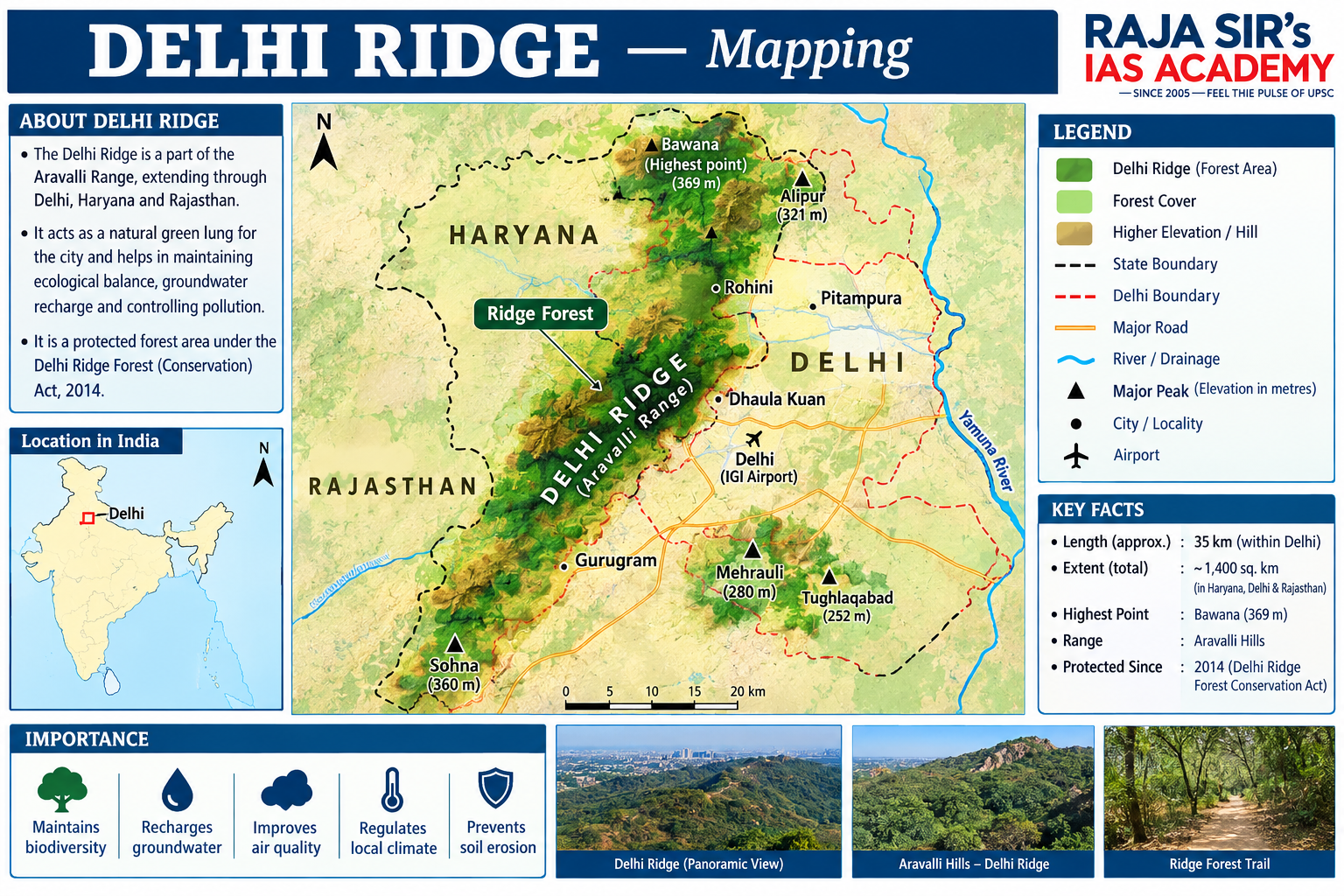
Delhi Ridge
- Location: Delhi, within the National Capital Territory.
- Geological significance: The Delhi Ridge is the northern extension of the Aravalli Range, one of India’s oldest mountain systems.
- Major sections: Northern Ridge, Central Ridge, South-Central Ridge and Southern Ridge.
- Ecological role: Functions as an important green buffer within the highly urbanised Delhi region.
- Biodiversity: Provides habitat for native vegetation, birds, mammals and other urban wildlife.
- Hydrological role: Vegetation and soil contribute to water retention and groundwater-recharge processes.
- Climate role: Helps moderate local microclimatic conditions and contributes to reducing the effects of urbanisation.
Vilayati Keekar (Prosopis juliflora)
- Common name: Vilayati Keekar / Mesquite.
- Origin: Native to the Americas and introduced into India.
- Nature: An invasive alien plant in several Indian ecosystems.
- Ecological concern: Can form dense stands and compete with native vegetation for water, nutrients, sunlight and space.
- Restoration relevance: Its removal from parts of the Central Ridge is intended to create conditions for the regeneration of indigenous vegetation.
Matri Van Initiative
- Matri Van is an ecological restoration and green-space initiative in the Aravalli hills of Gurugram, Haryana, developed under the “Ek Ped Maa Ke Naam” campaign.
- Location: Gurugram–Faridabad Road, Aravalli region, Haryana
- Area: 750 acres
- Launch: August 2025
- Implementing agency: Haryana Forest Department with multiple stakeholders
- Objective: Restore native biodiversity and ecological functions of the Aravallis while creating a large green space for the Delhi-NCR region
|
|
Enemy State Clauses: A World War II Legacy in the UN Charter
GS II – International Relations
Why in News?
Japan has called for the removal of outdated references to “enemy states” from the United Nations Charter, reviving debate over provisions that reflect the geopolitical circumstances of the post-World War II period.
Aim of the Original Provisions
- Provide a framework for dealing with states that had been enemies of the Allied powers during World War II.
- Prevent the resurgence of militarism by former Axis powers.
- Preserve the post-war security architecture established in 1945.
Where Do the Clauses Occur?
References to “enemy states” appear in:
- Article 53: Concerns enforcement action through regional arrangements and contains a reference to states covered by the historical enemy-state provisions.
- Article 77: Includes territories administered under the trusteeship system, including territories detached from enemy states as a consequence of World War II.
- Article 107: Preserves the Charter''s historical position regarding actions taken against former enemy states as a consequence of the war.
Historical Context
- The provisions primarily relate to the former Axis powers, including Germany, Italy and Japan.
- They emerged from the immediate aftermath of World War II.
- The Charter was adopted in 1945, when the security architecture was designed around the post-war balance of power.
Contemporary Status
- Outdated terminology: The term “enemy state” reflects a wartime classification that no longer corresponds to contemporary international relations.
- Practical relevance: The clauses are generally regarded as obsolete in practical terms, even though references remain in the Charter''s text.
- UN reform: Their continued presence illustrates the broader challenge of updating a Charter whose institutional framework reflects the conditions of 1945.
- Historical significance: The provisions remain useful for understanding the evolution of the UN''s post-war security architecture.
|
|
Ethiopia: Horn of Africa
GS I – Geography | GS Paper II – International Relations
Why in News?
Renewed clashes involving forces linked to the Tigray conflict have raised concerns about instability in northern Ethiopia and its wider implications for the Horn of Africa.
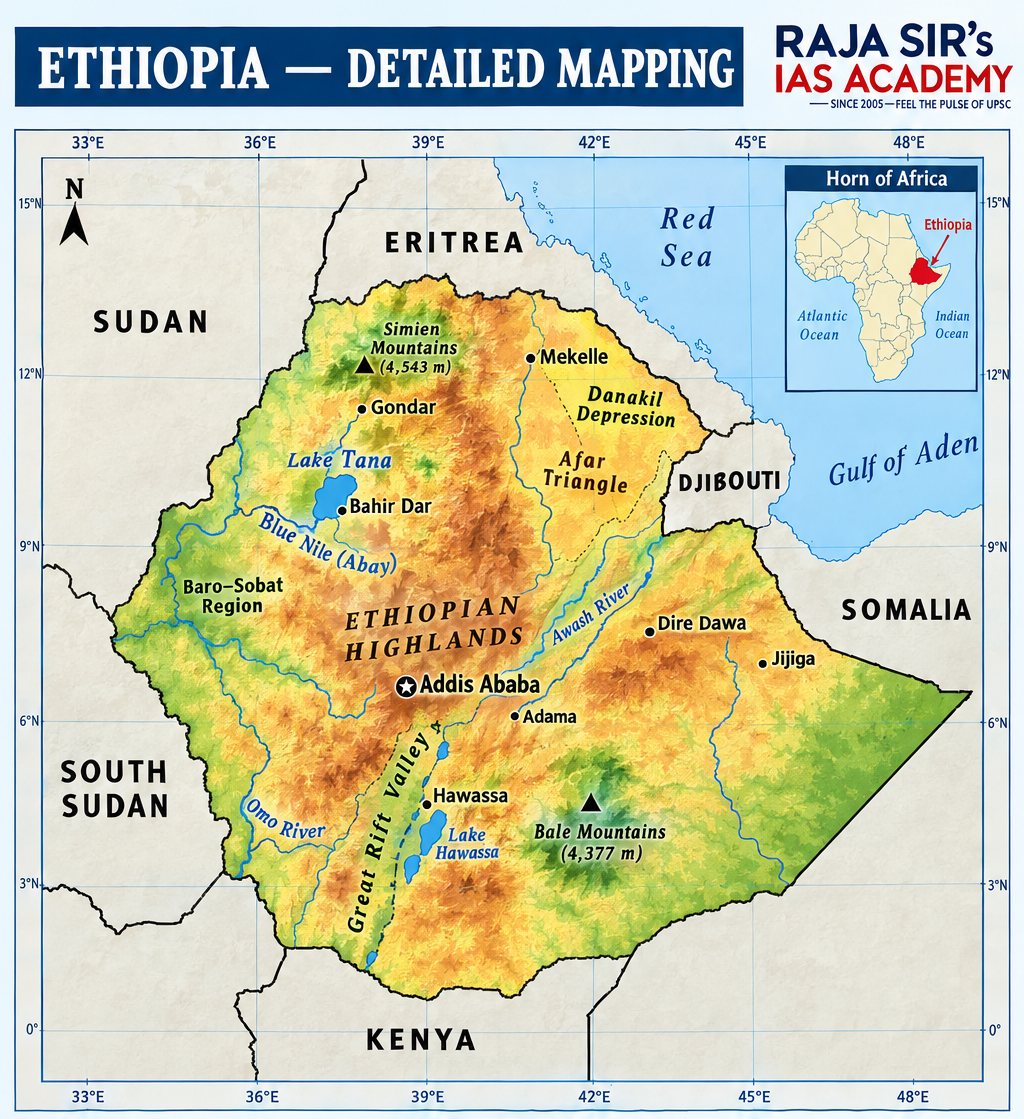
Geographical Location
- Region: Horn of Africa, eastern Africa.
- Capital: Addis Ababa.
- Status: Landlocked country.
- Borders: Eritrea, Djibouti, Somalia, Kenya, South Sudan and Sudan.
- Strategic location: Lies close to the Red Sea and Gulf of Aden, despite having no coastline.
Important Geographical Features
- Ethiopian Highlands: Major highland system of eastern Africa and an important source region for several rivers.
- Lake Tana: Largest lake in Ethiopia and the principal source region of the Blue Nile (Abay).
- Blue Nile: Flows from Ethiopia into Sudan, where it joins the White Nile at Khartoum.
- Afar Depression: Located in the East African Rift System, where major tectonic processes are active.
- Danakil Depression: Part of the Afar region; among the hottest and lowest places on Earth.
- Mount Ras Dashen: Highest peak in Ethiopia, located in the Simien Mountains.
Strategic Significance
- Red Sea connectivity: Ethiopia''s landlocked economy depends heavily on external trade corridors, particularly the Ethiopia–Djibouti corridor.
- Djibouti access: Djibouti''s ports provide Ethiopia with a major outlet for international trade.
- Horn of Africa security: Instability in Ethiopia can have spillover effects on neighbouring countries.
- Water geopolitics: Ethiopia''s highlands are the source of major tributaries of the Nile, giving the country significance in Nile Basin geopolitics.
- Regional stability: Conflict can affect trade, displacement, migration and humanitarian conditions across the Horn of Africa.
|
|
Khair Tree: A Forest Species with Economic and Ecological Significance
GS III – Environment & Ecology
Why in News?
Authorities uncovered an alleged timber-smuggling network involving Khair wood and forged transit documents, highlighting concerns over illegal extraction and transportation of forest produce.
Khair Tree – Key Features
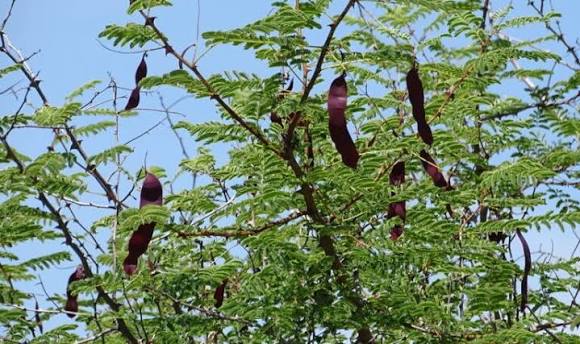
- Scientific name: Senegalia catechu.
- Family: Fabaceae (legume family).
- Nature: Thorny, deciduous and nitrogen-fixing tree.
- Habitat: Commonly found in tropical deciduous and thorn forests.
- Distribution: Occurs across parts of the Indian subcontinent, particularly in drier forest and alluvial regions.
- Ecological role: As a leguminous species, it contributes to nitrogen cycling and can aid vegetation recovery in suitable habitats.
Economic Significance
- Katha: An extract obtained from the heartwood and traditionally used in paan.
- Tanning: Khair extracts have applications in leather tanning.
- Dye: Traditionally used as a source of natural colouring material.
- Traditional medicine: Various parts/extracts have applications in traditional medicinal practices.
- Forest livelihoods: Legal harvesting and processing can contribute to the livelihoods of forest-dependent communities.
Digital Regulation – NTPS
National Transit Pass System (NTPS)
The National Transit Pass System (NTPS) is a digital platform of the Ministry of Environment, Forest and Climate Change (MoEFCC) for facilitating the seamless movement of timber, bamboo and other forest produce across States/Union Territories.
Key Features
- Online transit permits: Forest-produce transit permits can be applied for and processed digitally.
- National-level platform: Provides a common digital framework while accommodating State/UT-specific transit rules.
- Reduced paperwork: Minimises dependence on physical permits and manual verification.
- Tracking: Enables better monitoring of the movement of timber and other forest produce.
- Transparency: Creates a digital trail of permits and transactions, helping reduce regulatory ambiguity.
- Ease of doing business: Facilitates legitimate trade and transportation of forest produce.
|
|
OneSCD Global Partnership: Coordinating the Global Response to Sickle Cell Disease
GS II – Social Justice | Health | International Cooperation
Why in News?
India co-hosted the launch of OneSCD, a global partnership at the United Nations, aimed at strengthening coordinated international action against Sickle Cell Disease (SCD).
What is Sickle Cell Disease?
- Genetic disorder: Caused by mutations in the HBB gene, resulting in abnormal haemoglobin (HbS).
- Autosomal recessive: The disease generally manifests when an individual inherits the affected gene from both parents.
- Pathology: Red blood cells become rigid and sickle-shaped, causing anaemia, painful crises and vascular complications.
- Burden: Particularly significant in sub-Saharan Africa, while India also has substantial affected and at-risk populations.
Aim of OneSCD
- Global coordination: Align international efforts to address SCD.
- Early detection: Promote newborn and population-level screening.
- Equitable treatment: Improve access to essential medicines, safe blood supplies and specialised care.
- National ownership: Support country-led SCD programmes rather than replacing national health systems.
- Knowledge sharing: Facilitate collaboration among governments, international organisations, healthcare institutions and patient groups.
|
Aspect
|
Details
|
|
Mission
|
National Sickle Cell Anaemia Elimination Mission
|
|
Launched
|
2023
|
|
Target year
|
2047
|
|
Nodal ministry
|
Ministry of Health & Family Welfare
|
|
Core components
|
Screening, counselling, diagnosis, treatment & prevention
|
|
Special focus
|
Tribal and high-burden populations
|
|
Nature of disease
|
Inherited/genetic blood disorder
|
|
|
Operation Drishti: Military Medical Outreach in Border Areas
GS III – Internal Security | Defence
Why in News?
Under Operation Drishti, surgeons from the Armed Forces Medical Services (AFMS) conducted sight-restoring ophthalmic surgeries at an underground surgical facility in Tangdhar, Kupwara, near the Line of Control (LoC).
Aim
- Specialised healthcare: Provide advanced ophthalmic care to populations in remote border areas.
- Preventable blindness: Reduce avoidable visual impairment through timely surgical intervention.
- Healthcare accessibility: Overcome geographical and logistical barriers to specialist treatment.
- Community outreach: Extend medical services beyond routine military requirements.
|
Feature
|
LoC
|
International Border
|
|
Nature
|
De facto military control line
|
International boundary
|
|
India–Pakistan context
|
Jammu & Kashmir
|
Rest of the India-Pakistan boundary
|
|
Origin
|
1972 Simla Agreement
|
Established through various historical/legal processes
|
|
Internationally recognised as sovereign boundary?
|
No
|
Yes
|
|
|
Political Party Finance in India: Closing the Transparency Gaps
GS II– Polity & Governance
Why in News?
Recent concerns over the sharp rise in the income of Registered Unrecognised Political Parties (RUPPs) have renewed debate over opaque political funding, weak financial scrutiny and the regulatory treatment of inactive political parties.
RUPP Proliferation
- Meaning: A Registered Unrecognised Political Party (RUPP) is a party registered with the Election Commission of India (ECI) under Section 29A of the Representation of the People Act, 1951, but not recognised as a National or State Party.
- Proliferation: A large number of registered unrecognised parties creates challenges in monitoring their electoral participation, financial reporting and statutory compliance.
- Inactive parties: Some registered parties may remain electorally inactive for prolonged periods, raising questions about continued registration.
- Financial concerns: RUPPs may receive contributions subject to applicable tax and disclosure rules, making scrutiny of their donations, accounts and expenditure important.
- Regulatory gap: The ECI has faced limitations in deregistering parties because there is no broad statutory power to cancel registration merely on the ground of electoral inactivity.
- Reform challenge: Any deregistration mechanism should target fraudulent or persistently non-compliant entities while protecting legitimate political association.
Significance
- Electoral integrity: Transparent funding can strengthen public confidence in elections.
- Level playing field: Large financial advantages may affect the ability of political parties to compete on relatively equal terms.
- Fiscal accountability: Better monitoring can reduce potential misuse of tax concessions available to political parties.
Indrajit Gupta Committee – State Funding of Elections
The Indrajit Gupta Committee (1998) examined the feasibility of state funding of elections.
- Partial state funding: Recommended partial state funding, rather than complete government financing of elections.
- In-kind assistance: Favoured assistance mainly in kind, rather than unrestricted cash support.
- Recognised parties: State assistance was primarily envisaged for recognised National and State parties, subject to an appropriate framework.
- Election facilities: Suggested facilities such as access to certain public spaces, electoral rolls and media-related support.
- Fiscal constraints: Recognised that India’s financial resources did not permit complete state funding of elections.
- Accountability: Public funding should be accompanied by strict financial discipline and transparency in party accounts.
- Underlying objective: Reduce excessive dependence on private and corporate funding and thereby limit the influence of money in elections.
|
|
SWIFT: The Messaging Backbone of Global Banking
GS III – Economy | External Sector
Why in News?
BRICS and other Global South countries are exploring alternatives to existing international financial infrastructure amid concerns over sanctions, financial dependence and concentration within the global payments architecture.
What is SWIFT?
- SWIFT: Society for Worldwide Interbank Financial Telecommunication.
- Nature: A secure global financial messaging network used by banks and other financial institutions.
- Function: Transmits standardised financial messages relating to international transactions.
- Critical distinction: SWIFT does not itself transfer, hold or settle money. The actual movement and settlement of funds occur through banks, correspondent-banking arrangements and payment/settlement systems.
SWIFT and Sanctions
- Access restriction: A country''s banks can face severe difficulties in communicating internationally if they are excluded from SWIFT.
- Not sufficient alone: SWIFT exclusion does not automatically freeze or confiscate funds; the practical effect also depends on correspondent banking, sanctions and access to other payment channels.
- Strategic concern: Dependence on globally dominant financial infrastructure can create vulnerabilities during geopolitical conflicts.
Emerging Alternatives
|
System
|
Country/Origin
|
Broad Function
|
|
CIPS
|
China
|
Cross-border RMB clearing and settlement infrastructure
|
|
SPFS
|
Russia
|
Financial messaging system developed as an alternative to SWIFT
|
|
CBDC-based platforms
|
Multiple countries
|
Facilitate/explore cross-border payments using central bank digital currencies (CBDCs)
|
|
|
UNSC Reform: Reconciling Representation with Effective Decision-Making
GS II – International Relations
Why in News?
The United Kingdom has joined the France–Mexico initiative calling for voluntary restraint on the use of the UNSC veto in situations involving genocide, crimes against humanity and large-scale war crimes. The UK is the second permanent member after France to support the initiative.
Existing Framework
- 15 members: 5 permanent and 10 non-permanent members.
- P5: China, France, Russia, United Kingdom and United States.
- Non-permanent members: Elected by the UN General Assembly for two-year terms.
- Article 27(3): Substantive decisions require at least nine affirmative votes, including the concurring votes of the permanent members. A negative vote by a P5 member therefore blocks adoption of a substantive resolution.
- Resolution 76/262: Provides for a General Assembly debate within 10 working days whenever a veto is cast in the Security Council.
Need for Reform
- 1945 legacy: The permanent-member structure emerged from the post-World War II international order and does not fully correspond to contemporary global realities.
- Representation deficit: Major regions, particularly Africa, lack permanent representation; Latin America and the Caribbean also lack permanent seats.
- India''s contribution: India has made significant contributions to UN peacekeeping and has repeatedly served as an elected UNSC member, but remains outside permanent decision-making.
- Veto paralysis: Divisions among P5 members can prevent collective action during major conflicts and humanitarian crises.
- Legitimacy gap: A Council whose composition is perceived as insufficiently representative can face questions regarding the legitimacy of its decisions.
- Global South: Developing countries seek greater participation in institutions that make decisions affecting international peace and security.
Significance
- Legitimacy: Broader regional representation can strengthen acceptance of UNSC decisions.
- Global South: Greater representation can incorporate perspectives currently underrepresented in permanent decision-making.
- Conflict management: A more functional Council could strengthen collective responses to international conflicts.
- India: Permanent membership would provide India with a greater institutional role in shaping decisions on international peace and security.
- Multilateralism: Veto restraint can demonstrate that permanent-member privileges are compatible with greater accountability.
|
|
West Bengal Anti-Goonda Bill, 2026: Public Order, Preventive Detention and Federal Overlap
GS II – Polity & Governance | Federalism | Fundamental Rights
Why in News?
The West Bengal Public Safety and Control of Anti-Social Activities Bill, 2026, passed by the West Bengal Assembly in June, has come under scrutiny over a provision relating to offences under the Narcotic Drugs and Psychotropic Substances (NDPS) Act, 1985.
Constitutional Issues
- Preventive detention: Preventive detention operates without a prior criminal conviction and therefore directly engages constitutional safeguards relating to personal liberty under Article 22.
- Federal overlap: The reported objection concerns the inclusion of persons involved in specified NDPS Act offences within the Bill''s definition of a “goonda”. This could overlap with the preventive-detention framework under the PITNDPS Act, 1988.
- Article 254 – Repugnancy: Where a State law conflicts with a Central law on a Concurrent List subject, questions of repugnancy can arise. Under Article 254(2), a State law reserved for and receiving Presidential assent can prevail in that State, subject to Parliament''s power to subsequently override it.
- Personal liberty: Preventive measures must operate within constitutional safeguards and cannot become a substitute for ordinary criminal investigation and prosecution.
- Proportionality: Restrictions on liberty should have a rational connection with the legitimate public-order objective and should contain adequate procedural safeguards.
- Legislative clarity: Broad or overlapping definitions can create uncertainty in enforcement and increase the possibility of arbitrary application.
Why the NDPS–PITNDPS Overlap Matters
The Centre''s reported objection specifically concerns the Bill''s provision covering persons who commit, attempt, abet, promote, finance or facilitate offences punishable under the NDPS Act. The concern is that this could create a parallel preventive-detention mechanism for drug-related activities already covered by the Central PITNDPS Act, 1988.
Significance
- Public order vs liberty: Demonstrates the constitutional tension between effective prevention of crime and protection of individual freedoms.
- Cooperative federalism: Shows the importance of coordination when State legislation operates in an area already regulated by Central law.
- Constitutional scrutiny: Presidential consideration of State Bills provides an additional constitutional checkpoint where Central-State legislative conflicts may arise.
- Rule of law: Clear definitions and procedural safeguards are essential when legislation confers preventive powers on the executive.
|
Feature
|
NDPS Act, 1985
|
PITNDPS Act, 1988
|
|
Full name
|
Narcotic Drugs and Psychotropic Substances Act, 1985
|
Prevention of Illicit Traffic in Narcotic Drugs and Psychotropic Substances Act, 1988
|
|
Main purpose
|
Controls and regulates narcotic drugs & psychotropic substances and penalises offences
|
Prevents illicit trafficking in narcotic drugs and psychotropic substances
|
|
Nature
|
Substantive criminal law
|
Preventive-detention law
|
|
Focus
|
Offences such as possession, production, manufacture, sale, transport and trafficking
|
Detention of persons to prevent future illicit trafficking
|
|
Key mechanism
|
Investigation, prosecution and punishment
|
Preventive detention
|
|
Administered by
|
Ministry of Finance, Department of Revenue
|
Ministry of Finance, Department of Revenue
|
|
Constitutional basis
|
Ordinary legislation
|
Article 22(3)(b) permits preventive detention under law made for specified purposes
|
|
Punishment
|
Provides penalties for NDPS offences
|
Detention is preventive rather than punishment for a past offence
|
|