|
Dakhla Oasis: A Desert Settlement Shaped by Groundwater and Trade
GS I – Geography | Art & Culture | Ancient History
Why in News?
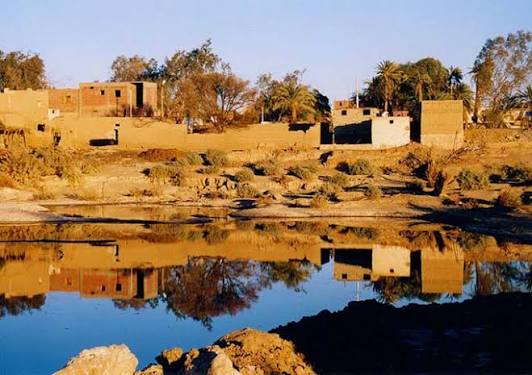
Archaeologists discovered a 1,700-year-old Roman-era mud-brick pyramid-shaped tomb at Bir Al-Shaghala in Egypt’s Dakhla Oasis, highlighting the region’s rich archaeological and cultural heritage.
What is Dakhla Oasis?
- Location: Situated in Egypt’s Western Desert, west of the Nile.
- Administrative Location: Part of New Valley Governorate.
- Oasis System: One of Egypt’s major inhabited desert oases.
- Historical Role: Developed as a settlement and caravan centre because of the availability of groundwater amid an otherwise extremely arid environment.
Geographical Significance
- Groundwater Dependence: Dakhla’s settlements are sustained by groundwater resources associated with the Nubian Sandstone Aquifer System, one of the world’s major fossil groundwater systems.
- Desert Adaptation: The oasis demonstrates how human communities can sustain agriculture and permanent settlements in hyper-arid environments by exploiting groundwater.
- Trade Connectivity: Its position in the Western Desert historically connected settlements through trans-desert caravan routes, facilitating movement of goods, people and ideas.
Archaeological Significance
- Bir Al-Shaghala: The site contains evidence of the Roman-period occupation of the oasis.
- Mud-Brick Architecture: The newly identified pyramid-shaped tomb reflects the distinctive funerary and architectural practices of the Roman-era communities Living in the oasis.
- Historical Continuity: Archaeological layers demonstrate that oases were not isolated desert settlements but important nodes of interaction between the Nile Valley and the wider Sahara.
|
|
Digital, Innovation and AI Hub: Making Technology Gender Responsive
GS II – Social Justice GS III – Science & Technology
Why in News?
- UN Women has launched a Digital, Innovation and AI Hub to promote gender equality amid rapid technological and AIdriven transformation.
- The initiative seeks to ensure that digitalisation and AI become tools of women’s empowerment rather than new channels of inequality.
Key Issues
- Widening Gender Digital Divide: Women continue to experience unequal access to digital devices, internet connectivity, digital skills and technologyrelated employment.
- Algorithmic and Data Bias: AI trained on historically biased datasets may reproduce or amplify genderbased discrimination in areas such as recruitment, credit and public services.
- Changing Nature of Employment: Generative AI may transform or displace routine clerical and administrative work, sectors in which women have substantial representation.
- Digital Glass Ceiling: Women remain underrepresented in AI research, technology entrepreneurship, ownership and senior decisionmaking, limiting diversity in technological governance.
Significance
- Gender Equality: Integrates women’s specific needs and vulnerabilities into technology governance.
- Inclusive Innovation: Greater diversity among technology developers can help identify and address embedded biases.
- Economic Empowerment: Women''s participation in highvalue technology sectors can expand their access to betterpaid and futureoriented employment.
- Safer Digital Spaces: Encourages preventive and rightsbased responses to technologyfacilitated violence.
- SDG Linkage: Contributes particularly to SDG 5 – Gender Equality and SDG 9 – Industry, Innovation and Infrastructure.
|
|
Ehlers-Danlos Syndrome: When Connective Tissue Loses Its Structural Strength
GS III – Science & Technology | Health
Why in News?
Recent research has examined possible associations between Ehlers-Danlos Syndrome (EDS) and factors such as hormonal patterns and sleep-related conditions, drawing attention to the broader systemic effects of connective-tissue disorders.
What is Ehlers-Danlos Syndrome?
- Definition: EDS refers to a group of inherited disorders affecting connective tissue, which provides structural support to various parts of the body.
- Genetic Basis: Many EDS types involve abnormalities in collagen production, structure or processing.
- Affected Systems: Depending on the type, EDS can affect the skin, joints, blood vessels and internal organs.
Key Features
- Joint Hypermobility: Joints may move beyond their normal range because of reduced connective-tissue stability.
- Skin Changes: Skin may be unusually stretchy, soft or fragile.
- Easy Bruising: Fragile connective tissue can make blood vessels and surrounding tissues more susceptible to injury.
- Musculoskeletal Problems: Joint pain, instability and recurrent injuries can occur.
- Variable Severity: EDS is a group of disorders, so clinical features and severity differ considerably between subtypes.
Why is Collagen Important?
- Collagen is a major structural protein that provides strength and elasticity to connective tissues.
- Abnormal collagen synthesis or processing can therefore weaken tissues and affect their ability to withstand mechanical stress.
|
|
Exercise KAZIND-2026
GS II – International Relations | GS III – Security
Why in News?
A 60-member Indian Armed Forces contingent departed for Oskemen, Kazakhstan, for the 9th edition of Exercise KAZIND-2026.
Key Facts
|
Parameter
|
Details
|
|
Exercise
|
KAZIND-2026
|
|
Participants
|
India and Kazakhstan
|
|
Host Country
|
Kazakhstan
|
|
Location
|
Oskemen, Kazakhstan
|
|
Edition
|
9th edition
|
|
Nature
|
Joint military exercise
|
|
Primary Focus
|
Counter-terrorism and interoperability
|
|
Terrain
|
Semi-urban and mountainous terrain
|
|
Indian Contingent
|
60 personnel
|
|
Key Training Areas
|
Joint operations, counter-terrorism tactics and coordination in challenging terrain
|
|
|
Extradition Portal: Strengthening India’s Fight Against Transnational Crime
GS II – Polity & Governance | International Relations
Why in News?
A new Extradition Portal was launched during the PRAHAAR counter-terrorism conference to improve coordination among Indian agencies involved in bringing fugitives back to India.
Key Features
- Unified Digital Platform: Brings extradition-related information and case monitoring onto a common digital platform.
- Inter-Agency Coordination: Facilitates coordination among the Ministry of Home Affairs (MHA), Ministry of External Affairs (MEA), CBI and State agencies.
- Faster Proceedings: Aims to reduce procedural delays by improving information flow and coordination between investigating, diplomatic and legal authorities.
- Case Monitoring: Enables better tracking of extradition requests and the status of individual cases.
Extradition in India
- Legal Basis: Extradition in India is primarily governed by the Extradition Act, 1962.
- Nodal Ministry: The Ministry of External Affairs (MEA) handles extradition requests through its relevant division and coordinates with foreign governments.
- Role of CBI: The CBI functions as India''s National Central Bureau (NCB) for INTERPOL, facilitating international police cooperation.
- Dual Criminality: As a general principle, the conduct for which extradition is sought should constitute an offence under the laws of both the requesting and requested countries, subject to the applicable extradition treaty or arrangement.
- Rule of Specialty: A person extradited for a particular offence is generally not to be prosecuted for a different offence committed before extradition, except under specified circumstances and applicable legal arrangements.
Significance
- Faster Inter-Agency Coordination: A common digital platform can reduce coordination gaps between investigating agencies, State authorities and diplomatic channels.
- Better Case Management: Digital monitoring can improve the tracking of requests, documentation and procedural stages.
- Combating Transnational Crime: Strengthens India''s institutional capacity to pursue terrorists, organised criminals and fugitive economic offenders located abroad.
|
|
FAO Committee on Forestry: Strengthening Global Forest Governance
GS III – Environment | Biodiversity | International Organisations
Why in News?
India showcased its forest and landscape restoration initiatives at the 28th Session of the FAO Committee on Forestry (COFO 28) in Rome.
About COFO
|
Parameter
|
Key Fact
|
|
Full Name
|
Committee on Forestry (COFO)
|
|
Organisation
|
Food and Agriculture Organization (FAO)
|
|
Nature
|
FAO''s highest statutory global intergovernmental body on forestry
|
|
Venue
|
FAO Headquarters, Rome, Italy
|
|
Frequency
|
Biennial
|
|
Core Focus
|
Global forestry policy, sustainable forest management, forest restoration and conservation
|
|
Key Role
|
Provides policy guidance to FAO and promotes international cooperation on forestry issues
|
Key Functions
- Strategic Direction: Provides strategic guidance on major international forestry issues.
- FAO Advice: Advises the FAO on the formulation and implementation of its forestry programmes.
- International Cooperation: Provides a platform for countries to exchange experiences and coordinate approaches to forest conservation and sustainable management.
- Regional Coordination: Works with FAO Regional Forestry Commissions to strengthen regional cooperation.
India''s Key Initiatives Highlighted
- Bonn Challenge: India has committed to restoring degraded and deforested landscapes under the global restoration initiative.
- Forest and Tree Carbon Sink: Expansion of forest and tree cover contributes to India''s efforts to enhance its carbon sink.
- Aravalli Green Wall Project: Focuses on restoration of degraded landscapes in and around the Aravalli range, with objectives including combating land degradation and improving ecological resilience.
- MISHTI: Promotes mangrove restoration and conservation, strengthening coastal ecosystems and resilience.
- Ek Ped Maa Ke Naam: Encourages public participation in tree planting and environmental conservation.
|
|
Fiji: India’s Pacific Partner in Maritime and Defence Cooperation
GS II – International Relations
Why in News?
India and Fiji held their second Bilateral Joint Working Group meeting, focusing on strengthening defence and maritime cooperation between the two countries.
What is Fiji?
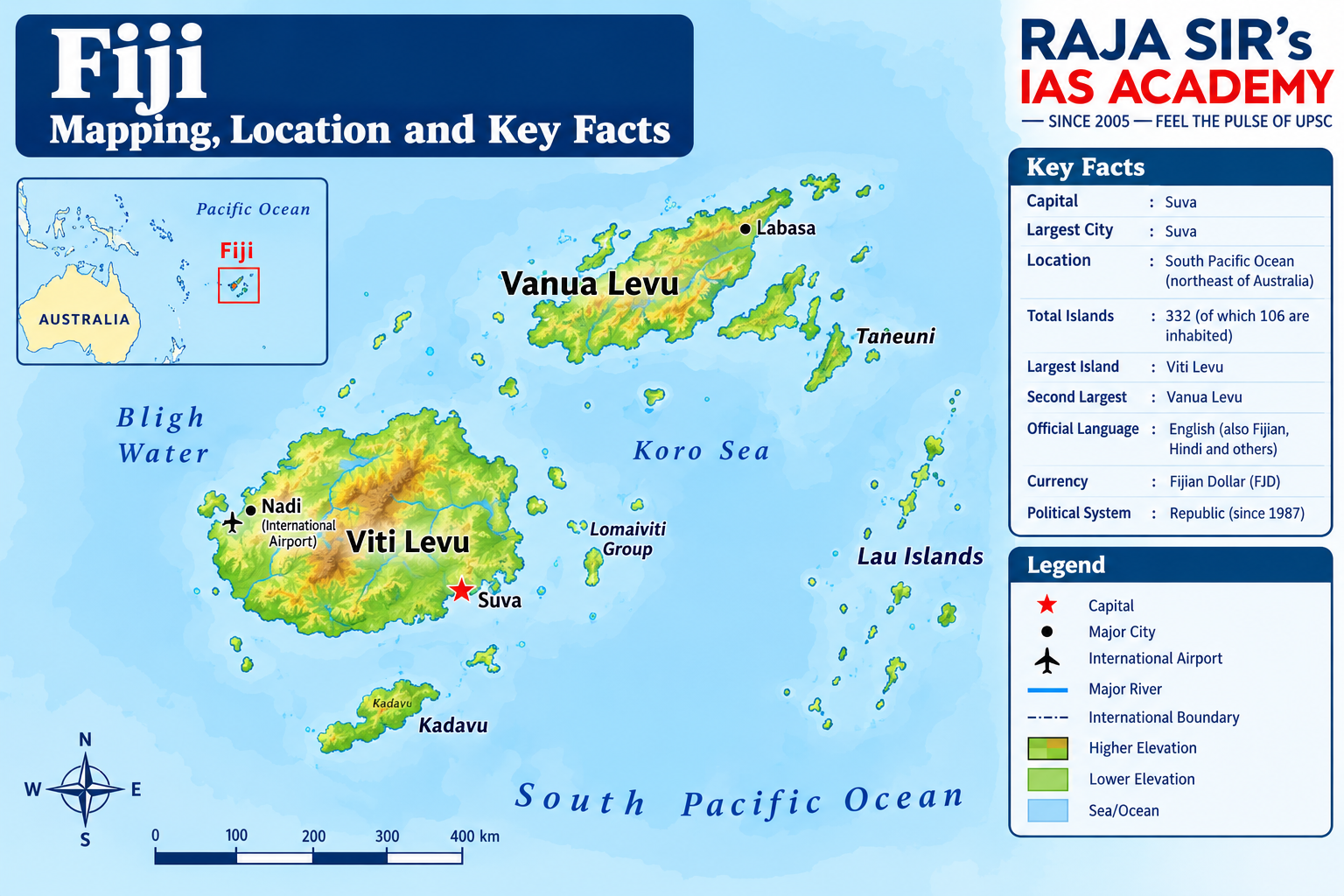
- Capital: Suva.
- Location: An island country in the South Pacific Ocean.
- Subregion: Part of Melanesia in the broader Pacific Islands region.
- Geographical Position: Located northeast of Australia and north of New Zealand.
- Major Islands: Viti Levu and Vanua Levu constitute the country''s principal islands.
Geographical Significance
- Strategic Location: Fiji occupies an important position in the South Pacific, making it relevant to maritime connectivity, ocean governance and regional security.
- 180th Meridian: The 180° meridian passes through Taveuni, one of Fiji''s islands.
- International Date Line: The International Date Line deviates from the 180th meridian and bends around Fiji so that the country remains on the same calendar day.
- Highest Point: Mount Tomanivi, located on Viti Levu, is Fiji''s highest peak.
|
|
Food Loss and Waste in India: From Post Harvest Loss to Circular Agriculture
GS III – Agriculture | Environment | Food Processing
Why in News?
- The International Day of Awareness of Food Loss and Waste is observed on 29 September, highlighting the need to reduce food losses across the supply chain.
- In India, significant losses occur between harvest, storage, transportation, processing, retail and consumption, affecting farmer incomes, food security and environmental sustainability.
Conceptual Distinction
|
Aspect
|
Food Loss
|
Food Waste
|
|
Meaning
|
Reduction in quantity or quality of food before reaching the retail/consumption stage
|
Food discarded at retail, food-service or household consumption stages
|
|
Major causes
|
Poor harvesting, storage, processing and transportation
|
Over-purchasing, poor storage, preparation losses and leftover food
|
|
Typical intervention
|
Cold chains, storage, processing and logistics
|
Consumer awareness, redistribution and better waste management
|
Scale of the Problem
- Economic Loss: Harvest and postharvest losses in India have been estimated at around ₹1.53 lakh crore annually during 2020–22.
- Commodity Vulnerability: Fruits and vegetables are particularly vulnerable because of their high perishability, while cereals and milk generally experience lower postharvest losses.
- Household Waste: Indian households generated around 78 million tonnes of food waste in 2022, highlighting that the problem extends beyond farms and supply chains.
- Embedded Resource Loss: Wasted food also represents wasted water, land, fertilisers, energy and labour used throughout production and distribution.
Major Challenges
- Cold Chain Deficit: Inadequate farm gate pack houses, refrigerated transport and controlled atmosphere storage increase deterioration of perishables.
- Weak Waste Valorisation Markets: Compost, biogas, bioCNG and other waste derived products face fragmented markets and uncertain commercial returns.
Government Initiatives
|
Initiative
|
Relevance
|
|
PM Kisan SAMPADA Yojana
|
Supports food-processing infrastructure and integrated cold chains
|
|
Operation Greens
|
Supports processing, logistics and marketing of selected perishable crops
|
|
Agriculture Infrastructure Fund
|
Facilitates financing for post-harvest and agricultural infrastructure
|
|
Grain Storage Plan
|
Promotes decentralised storage through cooperatives and PACS
|
|
Surplus Food Regulations, 2019
|
Provides requirements for safe handling and redistribution of surplus food
|
|
|
India’s First LNG-Powered Train: Exploring Alternative Railway Fuels
GS III – Infrastructure | Environment | Energy
Why in News?
Indian Railways has introduced India''s first LNG-powered train, marking an experiment with alternative fuels for railway transportation.
The initiative explores the potential of LNG-diesel dual-fuel technology as an alternative to conventional diesel traction.
Key Features
- LNG-Diesel Dual-Fuel System: The train uses LNG along with diesel, with LNG intended to replace a significant portion of conventional diesel consumption.
- Launch: The initiative was launched from Sabarmati, Gujarat.
- LNG: Liquefied Natural Gas is natural gas cooled to approximately −162°C, causing it to become liquid.
- Reduced Volume: Liquefaction substantially reduces the volume of natural gas, making it easier to store and transport.
- Lower Emissions: Natural gas generally produces lower emissions of certain pollutants and CO₂ per unit of energy compared with conventional diesel, although LNG remains a fossil fuel.
LNG vs Hydrogen Trains
|
Feature
|
LNG Train
|
Hydrogen Train
|
|
Fuel
|
LNG + Diesel
|
Hydrogen
|
|
Core Technology
|
Dual-fuel internal combustion engine
|
Hydrogen fuel-cell system
|
|
Energy Conversion
|
Chemical energy → combustion → mechanical energy
|
Chemical energy → electrochemical reaction → electricity
|
|
Main Exhaust Product
|
CO₂, water vapour and other combustion emissions
|
Mainly water vapour
|
|
Nature of Fuel
|
Fossil fuel
|
Can be low-carbon when produced using renewable electricity
|
|
Infrastructure Requirement
|
LNG storage, handling and bunkering facilities
|
Hydrogen production, storage and specialised refuelling infrastructure
|
|
Environmental Profile
|
Lower emissions than conventional diesel in some applications, but remains fossil-fuel based
|
Potentially very low operational emissions, depending on hydrogen production method
|
|
Key Challenge
|
Methane leakage and LNG infrastructure requirements
|
High production cost, storage challenges and limited refuelling infrastructure
|
|
|
International Whaling Commission: From Whaling Regulation to Cetacean Conservation
GS III – Environment | Biodiversity | International Conventions
Why in News?
India reiterated its commitment to science-based cetacean conservation at the 70th meeting of the International Whaling Commission (IWC) held in Hobart, Australia.
About the International Whaling Commission
|
Parameter
|
Key Fact
|
|
Established under
|
International Convention for the Regulation of Whaling (ICRW), 1946
|
|
India Joined
|
1981
|
|
Commercial Whaling Moratorium
|
Adopted in 1982; effective from 1986
|
|
Secretariat
|
Impington, near Cambridge, United Kingdom
|
|
Broad Focus
|
Conservation and management of cetaceans and regulation of whaling
|
|
Key Institutional Role
|
Sets catch limits, promotes scientific research and monitors whale populations and whaling activities
|
Key Functions
- Whaling Regulation: Establishes international rules governing whaling and associated conservation measures.
- Catch Limits: Can prescribe catch limits for regulated whaling activities based on scientific assessments.
- Whale Sanctuaries: Establishes areas where whaling is prohibited or restricted.
- Scientific Assessment: Supports research and assessment of whale populations, stock status and ecosystem impacts.
- Aboriginal Subsistence Whaling: Permits limited whaling for recognised indigenous communities under specific arrangements intended to meet subsistence needs.
Evolution of the IWC
- 1946 – Resource Management: The ICRW was initially established primarily to ensure the conservation of whale stocks and orderly development of the whaling industry.
- 1982 – Conservation Shift: The IWC adopted a commercial whaling moratorium, marking a major shift towards whale conservation.
- Contemporary Approach: The Commission increasingly addresses broader threats to cetacean populations and marine ecosystems, beyond commercial whaling alone.
|
|
Mandar: Traditional Musical Instrument of Jharkhand
GS I – Art & Culture | Tribal Culture | Intellectual Property Rights
Why in News?
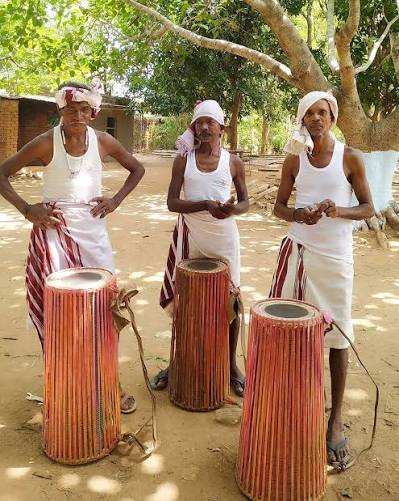
Jharkhand''s traditional folk percussion instrument Mandar has received a Geographical Indication (GI) tag.
About Mandar
|
Parameter
|
Key Fact
|
|
Type
|
Traditional percussion instrument
|
|
Structure
|
Double-headed, barrel-shaped drum
|
|
Materials
|
Traditionally made using red clay and leather
|
|
Region
|
Jharkhand, particularly the Chotanagpur region
|
|
Communities
|
Oraon, Munda, Santhal and Ho, among others
|
|
Uses
|
Festivals, marriages, rituals and community dances
|
|
Playing Method
|
Traditionally suspended from the shoulder and played with the hands
|
|
Cultural Significance
|
Forms an important part of tribal musical and community traditions in Jharkhand
|
Cultural Significance
- Tribal Heritage: Mandar is closely associated with the folk and community traditions of Jharkhand''s tribal societies.
- Community Performance: Its rhythmic use accompanies traditional dances, festivals and social ceremonies, making it an important part of collective cultural expression.
- Traditional Craftsmanship: The instrument reflects indigenous knowledge relating to the selection and preparation of clay, leather and drum construction techniques.
|
|
Mega Ports: New Classification of High-Throughput Ports in India
GS III – Infrastructure | Transport
Why in News?
The Ministry of Ports, Shipping and Waterways has notified Deendayal, Jawaharlal Nehru, Paradip and Mundra as India''s first mega ports.
Key Features
Mega-Port Threshold: The classification is based on prescribed annual cargo throughput, with different thresholds for bulk cargo and containerised cargo.
|
Port
|
Key Fact
|
|
Deendayal Port
|
Mega port located on India''s western coast in Gujarat
|
|
Jawaharlal Nehru Port
|
Major container port located on the western coast of India
|
|
Paradip Port
|
Only east-coast port among the four notified mega ports
|
|
Mundra Port
|
Only non-major port among the four notified mega ports
|
Validity of Status
- Mega-port designation remains valid for five years.
- A port does not automatically lose its mega-port status if its cargo throughput subsequently falls below the prescribed threshold during this period.
Why is the Classification Significant?
- Port Efficiency: Recognises ports handling very large volumes of cargo and highlights their importance to India''s logistics network.
- Trade Facilitation: High-throughput ports are critical for India''s international trade and supply chains.
- Logistics Competitiveness: Identification of mega ports can support greater attention to port connectivity, multimodal logistics and capacity expansion.
- Maritime Development: Supports India''s broader objective of strengthening its port-led development and maritime economy.
|
|
No Personal Law Immunity under POCSO
GS II – Polity & Governance | Social Justice
Why in News?
The Delhi High Court held that personal law cannot provide immunity from the Protection of Children from Sexual Offences (POCSO) Act, 2012 where the case involves sexual intercourse with a minor.
Core Issue
- Primacy of Child Protection: The judgment emphasises that protection of children from sexual offences is a universal statutory obligation, irrespective of the religion or personal law applicable to the parties.
- Personal Law vs Criminal Law: Personal laws governing marriage or family relations cannot be invoked to create an exemption from criminal liability under POCSO.
|
Provision
|
Key Feature
|
|
Objective
|
Protects children below 18 years from sexual assault, sexual harassment and pornography
|
|
Applicability
|
Applies irrespective of the religion or personal law of the parties
|
|
Section 42A
|
Gives POCSO an overriding effect in case of inconsistency with other laws
|
|
Section 29
|
Provides a presumption regarding certain offences, subject to the statutory conditions
|
|
Section 23
|
Restricts disclosure of the child''s identity by the media
|
|
Special Courts
|
Provides for designated courts and child-sensitive procedures for speedy trial
|
|
|
Pluto: The Dwarf Planet Debate
GS III – Science & Technology | Space Science
Why in News?
- Nearly two decades after Pluto''s reclassification, renewed scientific discussion has emerged over whether the definition of a planet should be reconsidered.
- The debate primarily concerns whether the “clearing the neighbourhood” criterion should be retained as an essential requirement for planetary status.
Key Facts about Pluto
|
Parameter
|
Key Fact
|
|
Discovery
|
Discovered in 1930 by American astronomer Clyde Tombaugh
|
|
Location
|
Kuiper Belt, beyond Neptune
|
|
Classification
|
Dwarf planet
|
|
Orbital Period
|
About 248 Earth years
|
|
Moons
|
Five known moons
|
|
Largest Moon
|
Charon
|
|
Spacecraft
|
NASA''s New Horizons
|
|
Historic Flyby
|
New Horizons conducted the first close flyby of Pluto in 2015
|
|
Atmosphere
|
Mainly nitrogen, with methane and carbon monoxide
|
|
Surface
|
Dominated by nitrogen, methane and carbon-monoxide ices
|
|
Planetary Status
|
Reclassified as a dwarf planet in 2006 following the International Astronomical Union''s definition of a planet
|
Why Was Pluto Reclassified?
In 2006, the International Astronomical Union (IAU) established three criteria for a celestial body to be considered a planet:
- Orbits the Sun.
- Has sufficient mass for its self-gravity to overcome rigid-body forces and achieve a nearly round shape.
- Has cleared the neighbourhood around its orbit.
Pluto satisfies the first two criteria but not the third. Its orbital region overlaps with numerous other objects in the Kuiper Belt, meaning it does not gravitationally dominate its orbital neighbourhood.
|
Feature
|
Planet
|
Dwarf Planet
|
|
Orbits the Sun
|
Yes
|
Yes
|
|
Nearly spherical in shape
|
Yes
|
Yes
|
|
Clears its orbital neighbourhood
|
Yes
|
No
|
|
Planetary status
|
Full-fledged planet
|
Dwarf planet
|
|
Examples
|
Earth, Jupiter, Neptune
|
Pluto, Eris, Ceres
|
Why Does the Debate Continue?
- Planetary Definition: Some scientists argue that planetary classification should focus more on a body''s intrinsic physical characteristics and geological complexity rather than its ability to clear its orbital neighbourhood.
- Kuiper Belt Context: Pluto exists within a region containing numerous icy bodies, making its orbital environment fundamentally different from that of the eight recognised planets.
- Geological Complexity: New Horizons revealed Pluto to be a geologically active world with mountains, glaciers, diverse terrain and a complex atmosphere, strengthening scientific interest in how planetary categories should be defined.
|
|
Subansiri River: Hydropower Development in the Eastern Himalayas
GS I – Geography | GS III – Environment & Infrastructure
Why in News?
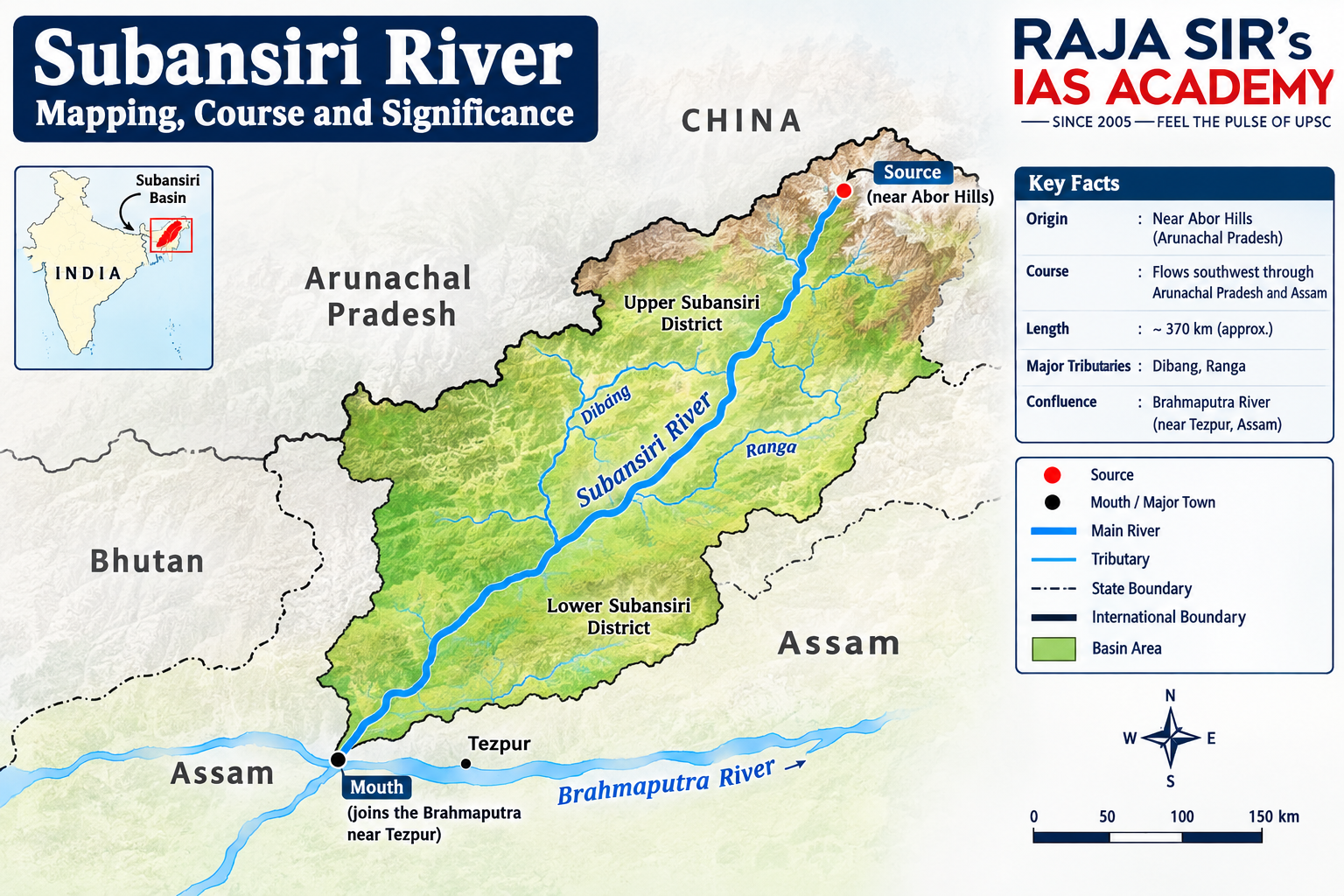
- The Expert Appraisal Committee (EAC) of the Ministry of Environment, Forest and Climate Change has recommended environmental clearance for the 1,605 MW Subansiri Upper Hydroelectric Project in Arunachal Pradesh.
- The recommendation involves diversion of about 2,733 hectares of forest land and potential felling of approximately 1.35 lakh trees, highlighting the ecological trade-offs associated with hydropower development in the Himalayan region.
About the Suban siri River
|
Parameter
|
Key Fact
|
|
River System
|
Brahmaputra River System
|
|
Nature
|
Major right-bank tributary of the Brahmaputra
|
|
Origin
|
Tibet
|
|
States Traversed
|
Arunachal Pradesh and Assam
|
|
Physiographic Region
|
Eastern Himalayas and Trans-Himalayan region
|
|
Lower Course
|
Flows into Assam and joins the Brahmaputra
|
|
Nickname
|
“Gold River”, traditionally associated with gold-bearing sediments
|
|
Economic Importance
|
Hydropower, irrigation, fisheries and livelihoods
|
|
Strategic Importance
|
Important river system in the Eastern Himalayan and Northeast region
|
|
Left-Bank Tributaries
|
Right-Bank Tributaries
|
|
Laro
|
Tsari
|
|
Nye
|
Kamla
|
|
Yume
|
Jiyadhol
|
|
Ranganadi
|
Dikrong
|
Why is the Subansiri Basin Important?
- Hydropower Potential: The steep Himalayan gradient provides substantial potential for hydropower generation. The basin already hosts major projects, including the Subansiri Lower Hydroelectric Project.
- Strategic Geography: The upper basin lies in Arunachal Pradesh, a strategically important frontier region adjoining Tibet/China.
- Ecological Sensitivity: Himalayan river systems are highly sensitive to changes in river flow, sediment transport, forests and aquatic ecosystems.
- Disaster Risk: Hydropower development must account for flash floods, landslides, seismic risks and glacial hazards characteristic of the Himalayan environment.
|
|
UN Declaration on Sea Level Rise: Protecting States, Maritime Rights and Coastal Communities
GS II – International Relations | GS III – Environment
Why in News?
- On 24 September 2026, the UN General Assembly adopted a Political Declaration on addressing the existential threats posed by sea level rise at a high level plenary meeting.
- The declaration treats sea level rise as not merely an environmental concern but also a developmental, humanitarian, economic and legal challenge.
Key Highlights
- Vulnerability of SIDS: The declaration gives particular attention to Small Island Developing States (SIDS) and low lying coastal communities, which face risks from coastal flooding, erosion, saltwater intrusion and loss of livelihoods.
- Continuity of Statehood: It supports the principle that climate induced sea level rise and physical changes to territory should not automatically result in the disappearance of a state''s statehood, sovereignty or international legal personality. The issue has been a major concern for SIDS.
- Stability of Maritime Zones: The declaration recognises the importance of maintaining established maritime zones and associated rights despite physical changes caused by sea level rise.
- International Cooperation: It calls for stronger cooperation, adaptation and resilience measures, including support for vulnerable developing countries.
- Malé Declaration, 1989: The declaration builds on decades of advocacy by vulnerable island states, including the Malé Declaration on Global Warming and Sea Level Rise, adopted in the Maldives in November 1989.
Why Sea Level Rise Matters Beyond Environment
|
Dimension
|
Implication
|
|
Territorial Integrity
|
Physical loss or submergence of territory raises questions about the continuity and territorial existence of states.
|
|
Statehood
|
May create legal questions regarding sovereignty, international legal personality and continued UN membership.
|
|
Maritime Rights
|
Changing coastlines and baselines can create uncertainty over territorial seas, EEZs and other maritime zones.
|
|
Human Security
|
Threatens housing, livelihoods, freshwater availability and food security.
|
|
Development
|
Can damage infrastructure, tourism, fisheries and public finances.
|
|
Migration
|
May increase displacement, internal migration and planned relocation pressures.
|
|
Culture & Identity
|
Threatens cultural heritage, traditional livelihoods and community identity, particularly in island and coastal societies.
|
Significance
- From Environmental to Geopolitical Issue: Sealevel rise increasingly intersects with territorial integrity, sovereignty, maritime rights and international law.
- Climate Justice: Countries that have contributed relatively little to global emissions can face disproportionate exposure to climaterelated risks, strengthening demands for adaptation finance and international support.
- Human Rights and Development: Rising seas affect not only territory but also housing, health, food and water security, livelihoods and cultural heritage.
|