



 Latest News
From Red Corridor to Naxal-Free Bharat
- India is close to achieving a Naxal-free Bharat, with Left-Wing Extremism (LWE) districts reduced from 126 (2014) to 11 (2025) and only 3 most-affected districts remaining.
Reducing the Red Corridor
Trends in Naxalism in India (2014–2025):
- Sharp territorial contraction: Maoist influence shrank from 126 to 11 districts, with core Red Corridor areas dismantled. Eg: Most-affected districts reduced from 36 to 3 by 2025.
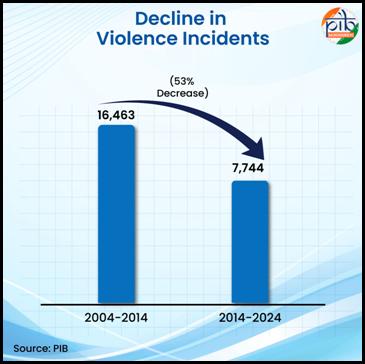
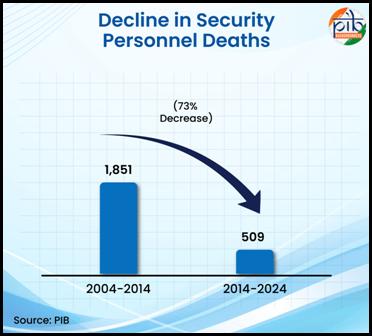
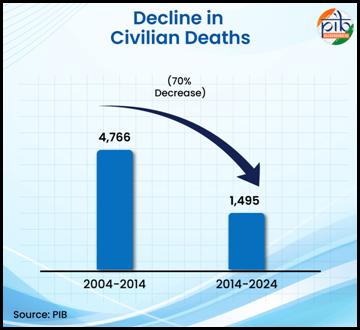
- Steep fall in violence and casualties: Sustained decline in incidents and deaths. Eg: Violent incidents down 53%, civilian deaths down 70%, and security force deaths down 73% compared to 2004–14.
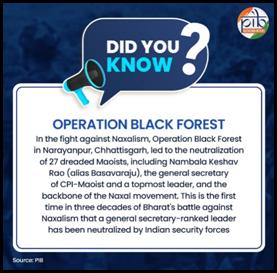
- High cadre attrition: Arrests, surrenders and neutralisation peaked. Eg: 2025 alone saw 317 neutralised, 800+ arrested, ~2,000 surrendered.
- Collapse of Maoist parallel governance: Roads, telecom and policing broke jungle sanctuaries.

History of Naxalism in India
- Origin (1967): The Naxalbari uprising in West Bengal emerged from landlessness and exploitative agrarian relations, turning class conflict into armed mobilisation. Eg: Charu Mazumdar’s line popularised “land to the tiller” through Maoist-inspired revolutionary politics.
- Expansion (1980s–2000s): The movement spread into tribal Fifth Schedule belts where weak administration, land alienation and forest control created deep state-society distrust. Eg: The 2004 formation of CPI (Maoist) unified factions and intensified LWE across central India.
- Peak and decline (2005–2014): Maoists built “liberated zones” and parallel systems, but coordinated state action gradually increased pressure through policing and development. Eg: The Red Corridor expanded from AP to Jharkhand, yet large operations began shrinking safe havens.
- Decisive rollback (2014 onwards): A unified security-development approach with permanent camps, roads and telecom broke Maoist mobility and recruitment networks in core areas. Eg: Strongholds like Bastar and Dandakaranya saw sustained clearance and governance footprint expansion.
|
Naxalism refers to the militant left-wing movement in India rooted in communist ideologies. It aims to address social and economic inequalities through armed struggle. Naxalism operates under various organisational frameworks across India and remains a persistent internal security challenge |
Initiatives taken to counter Naxalism
1. Constitutional & governance measures:-
- Fifth Schedule framework: It provides special governance for Scheduled Areas via Governor powers and Tribal Advisory Councils, aiming to prevent exploitation and land alienation.
- PESA Act, 1996: It empowers Gram Sabhas to control local resources and consent processes, intended to deepen self-rule and reduce outsider domination.
- Forest Rights Act, 2006: FRA recognises individual and community forest rights, correcting historical injustice and strengthening livelihood security for forest dwellers.
2. Development & welfare schemes:-
- Infrastructure saturation: Roads, electricity and telecom reduce isolation, expand service delivery, and allow faster security response in remote interiors.
- Financial inclusion: Banking access cuts cash dependence, enables DBT delivery, and reduces extortion and shadow-economy influence in affected blocks.
- Skill and education push: Training and local employability reduce the recruitment pool by giving youth credible alternatives to insurgent networks.
3. Security & enforcement:-
- Fortified policing: Permanent forward presence prevents Maoist re-occupation, improves area domination, and protects development works from disruption.
- Financial choking: Seizures and attachments disrupt extortion channels, arms procurement and urban networks that sustain the insurgency ecosystem.
- Surrender-cum-rehabilitation policy: Incentives, security guarantees and livelihoods convert cadres into stakeholders of peace and weaken local Maoist manpower.
Challenges to complete eradication:-
- Governance deficits persist: Courts, policing, health and schools remain thin in interiors, making the state visible mainly through coercion, not services. Eg: Low tribal representation in permanent bureaucracy sustains “outsider rule” perceptions.
- Weak implementation of rights laws: If FRA/PESA protections look negotiable, new displacement and distrust can re-create conditions for mobilisation. Eg: Gram Sabha consent bypass in mining belts becomes a recurring grievance trigger.
- Socio-economic vulnerability: Poverty, land disputes and insecure livelihoods keep communities susceptible to coercion, promises of justice, or rent-seeking networks. Eg: Displacement around mineral corridors fuels long-term anger and instability.
- Ideological residue and urban support: Even with territorial losses, propaganda, recruitment narratives and digital influence can persist and re-organise. Eg: Online information warfare can revive legitimacy even when armed capability declines.
Way ahead
- Governance-led consolidation: After security gains, the state must win trust through justice delivery, primary health, schools and grievance redress, not only patrols. Eg: Fast-track courts and tribal health cadres can reduce everyday exploitation.
- Deepen local self-rule: Real devolution of funds/functions to Gram Sabhas makes democracy meaningful and blocks the space for parallel “people’s courts.” Eg: Adopt selective features of Sixth Schedule autonomy where contextually suitable.
- Administrative indigenisation: Recruiting locals into police, revenue and frontline services improves legitimacy, language access and cultural sensitivity in governance. Eg: Scaling the Bastariya Battalion model strengthens ownership of peace.
- Protect rights-based laws: Enforceable consent, CFR recognition and transparent land processes prevent fresh alienation and pre-empt insurgent narratives. Eg: Make Gram Sabha consent mandatory, time-bound, and auditable for projects.
Conclusion:
- India has decisively broken the territorial and military backbone of Naxalism through a calibrated mix of security, development and rehabilitation. The next phase demands governance reform, justice delivery and tribal empowerment to prevent relapse. A post-Maoist India will succeed only when constitutional promises translate into lived realities in Fifth Schedule areas.
POSTED ON 17-12-2025 BY ADMIN
Next previous  General Studies
Political Science and International Relations
Some Reference Essays
List of previous year essay topics (1997-2019)

IAS GOOGLE is googled by the team of Raja Sir’s Cracking IAS Academy. Sources include The Hindu, Indian Express, pib.nic.in, Down To Earth, Economic Times, Vigyan Prasar, AIR and the like. IAS GOOGLE has been prepared in pace with emerging UPSC Trends.