



 Latest News
From MGNREGA to VB-G RAM G
- In December 2025, the Government of India introduced a major overhaul of its rural employment policy, replacing the Mahatma Gandhi National Rural Employment Guarantee Act (MGNREGA) with a new statutory framework called Viksit Bharat – Guarantee for Rozgar and Ajeevika Mission (Gramin), or VB–G RAM G.
Key Changes from MGNREGA to VB–G RAM G
The new Act, which received Presidential assent on December 21, 2025, introduces several structural and operational shifts:-
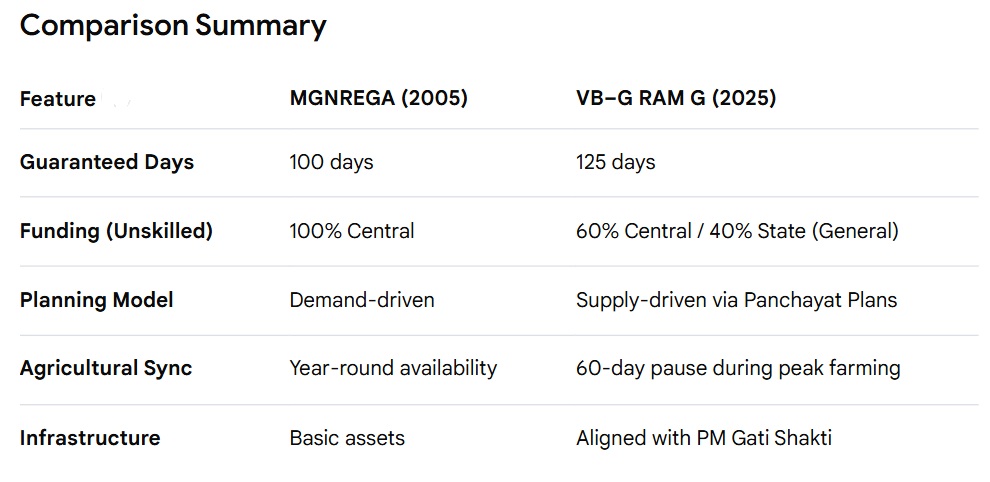
- Increased Employment Days: The statutory guarantee for wage employment has been raised to 125 days per rural household per year, up from the 100 days previously provided under MGNREGA.
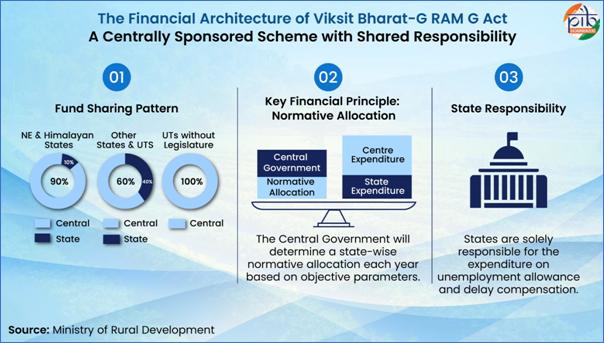
- Funding Structure: The scheme has moved from a central sector model to a centrally sponsored framework. The cost-sharing ratio between the Centre and States is now 60:40 for most states (previously, the Centre bore 100% of unskilled wages), 90:10 for Northeastern/Himalayan states, and 100% for Union Territories.
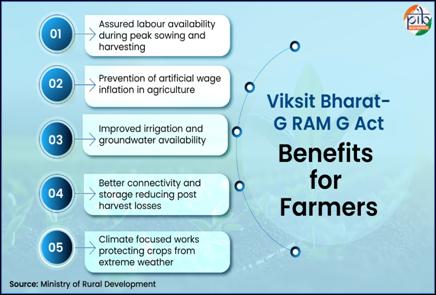
- Seasonal "No-Work" Period: To ensure the availability of agricultural labor during peak seasons, the Act includes an aggregated 60-day no-work period during sowing and harvesting times.
- Decentralized Planning: Projects are now driven by Viksit Gram Panchayat Plans, which are integrated into the PM Gati Shakti National Master Plan for better infrastructure alignment.
- Priority Verticals: Employment is linked to creating durable assets in four specific areas
- Water Security (e.g., lakes, micro-irrigation).
- Rural Infrastructure.
- Livelihood Infrastructure.
- Climate and Disaster Resilience.
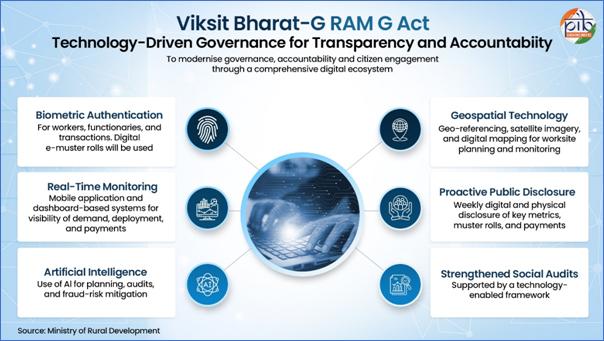
- Digital Governance: The new system mandates biometric authentication, geotagging, and artificial intelligence for audits and fraud risk mitigation.
CRITICISMS
Major criticisms include:
- Erosion of the "Right to Work"
- Critics contend the scheme shifts from a demand-driven model (where work must be provided whenever requested) to a supply-driven model.
- Budget Caps: The Centre now determines "normative allocations" for each state annually. If demand exceeds this cap, states must fund the difference, which critics fear will lead to officials denying work to stay within budget.
- Loss of Universality: Employment is no longer guaranteed across all rural areas; it may be restricted to "notified areas," potentially excluding vulnerable households in non-notified regions.
- Fiscal Burden on States
- The shift from 100% Central funding for unskilled wages to a 60:40 Centre-State split (for most states) is a major point of contention.
- State Finances: Economically weaker states like Bihar, Jharkhand, and Chhattisgarh may struggle to mobilize these funds, leading to uneven implementation.
- Federalism Concerns: Critics, including leaders from Tamil Nadu, Kerala, and West Bengal, argue this forces states to bear a significant financial burden without a corresponding increase in decision-making power.
- Impact of the 60-Day "No-Work" Period
- The Act allows states to pause work for up to 60 days during peak agricultural seasons to ensure labor availability for farmers.
- Loss of Bargaining Power: Activists argue this removes a worker''s alternative source of income, forcing landless laborers into potentially exploitative or lower-paying agricultural work.
- Liquidity Stress: Vulnerable households may face severe income gaps during these "blackout periods" if private farm work is unavailable or insufficient.
- Centralization and Governance
- Top-Down Planning: Critics claim the new "National Rural Infrastructure Stack" overrides local priorities, shifting power away from Gram Sabhas and Panchayats to central technocratic control.
- Digital Barriers: Mandatory biometric authentication and AI-based monitoring are seen as potential hurdles for illiterate or digitally unconnected workers, which could lead to "exclusion errors".
- Symbolic and Political Criticism
- The removal of Mahatma Gandhi''s name from the scheme has been called an "ideological shift" and a "political statement" by opposition leaders. They argue the renaming seeks to claim credit for a revamped version of a scheme the current government previously criticized.
Way Forward
- Strengthening Local Implementation Capacity
- The success of the new Mission hinges on the efficiency of Gram Panchayats, which now have enhanced planning powers.
- Administrative Support: The administrative expenditure ceiling has been increased from 6% to 9% to fund better staffing, training, and technical support at the field level.
- Panchayat-led Planning: Works must originate from local Viksit Gram Panchayat Plans, which are then integrated with national geospatial systems like PM Gati Shakti.
- Ensuring Fiscal Sustainability & Cooperative Federalism
- The shift to a 60:40 cost-sharing pattern requires deep coordination between the Centre and States to prevent financial bottlenecks.
- Normative Allocations: States must manage their budgets within Central "normative allocations".
- State Responsibility: States are now legally liable for unemployment allowances and any expenditure exceeding their normative cap, creating stronger incentives for efficient fund management.
- Bridging the Digital Divide
- To mitigate the risk of technology-driven exclusion, the framework includes specific safeguards:
- Exception Handling: Technology is intended as an enabling tool with "exception handling" for those facing biometric or connectivity issues.
- Last-Mile Connectivity: Expanding the Common Services Centres (CSCs) network—currently at 4.41 lakh rural centres—and the BharatNet project (linking 2.14 lakh Gram Panchayats) will be critical for digital wage payments.
- Balancing Agriculture and Wage Employment
- The 60-day "no-work" period must be precisely tailored to local cropping patterns.
- Dynamic Notifications: States can notify specific pauses for different districts or blocks rather than a blanket statewide ban, ensuring work remains available in non-peak areas.
- Higher Potential Earnings: This period allows workers to earn higher private farm wages while still retaining their 125-day statutory guarantee for the rest of the year.
- Focused Asset Creation
- The Mission moves away from fragmented work toward saturation-based infrastructure across four verticals:
- Water Security (Irrigation and groundwater recharge).
- Core Infrastructure (Roads and connectivity).
- Livelihood Support (Storage, warehouses, and markets).
- Climate Resilience (Disaster mitigation and soil conservation).
Conclusion
- In summary, The Viksit Bharat- Guarantee for Rozgar and Ajeevika Mission (Gramin) Act, 2025, represents a decisive shift in India’s rural employment policy. While MGNREGA achieved significant gains in participation, digitisation, and transparency over time, persistent structural weaknesses limited its effectiveness. The new Act builds on past improvements while addressing their shortcomings through a modern, accountable, and infrastructure-focused framework.
- By expanding guaranteed employment, aligning work with national development priorities, and embedding strong digital governance, the Act repositions rural employment as a strategic instrument for sustainable growth and resilient livelihoods, fully aligned with the vision of Viksit Bharat @ 2047.
POSTED ON 18-12-2025 BY ADMIN
Next previous  General Studies
Political Science and International Relations
Some Reference Essays
List of previous year essay topics (1997-2019)

IAS GOOGLE is googled by the team of Raja Sir’s Cracking IAS Academy. Sources include The Hindu, Indian Express, pib.nic.in, Down To Earth, Economic Times, Vigyan Prasar, AIR and the like. IAS GOOGLE has been prepared in pace with emerging UPSC Trends.