




 Latest News
Quantum Atmanirbharta
- NITI Aayog’s Frontier Tech Hub has released a comprehensive roadmap titled “Transforming India into a Leading Quantum-Powered Economy.”
Transforming India into a Leading Quantum-Powered Economy:
- It is a national strategic roadmap prepared by NITI Aayog (with IBM as knowledge partner) that lays out India’s 2035 vision for quantum computing, communication, sensing and materials, and details actions needed to build a globally competitive quantum ecosystem.
Key Highlights of the Report
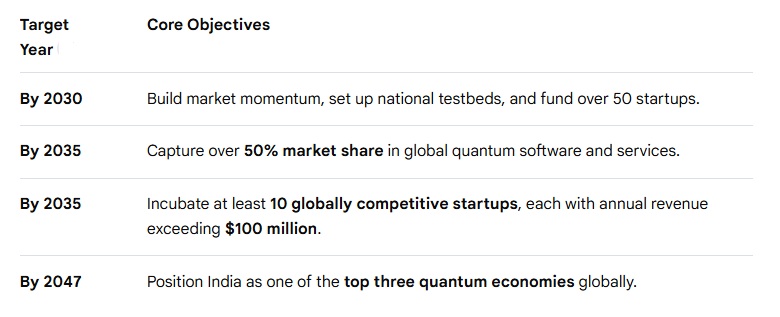
- Vision for 2035: India Among Top 3 Quantum Economies: India aims to become a global leader with 10+ quantum startups achieving USD 100M+ revenue and capturing over 50% of the global quantum software market.
- Deployment Across Strategic Sectors: Quantum tech should be deployed at scale across defence, healthcare, finance, mining, energy and national infrastructure by 2035.
- Full Quantum Supply-Chain Participation: India must achieve “quantum Atmanirbharta” by contributing to quantum hardware, materials, processors, cryogenic systems, and software stacks, while becoming a net exporter.
- Two-Phase Milestone Plan (2025–30 & 2030–35): Milestones include setting up testbeds, 50+ funded startups, sectoral pilots, PQC deployment, and later global leadership, export corridors and supply-chain dominance.
- Workforce Expansion & Talent Readiness: The plan calls for a 10× expansion of quantum-skilled professionals within 2–3 years and making India a top-three global destination for quantum talent.
- Focus on Standards, IP and Global Quantum Diplomacy: India will lead international standard-setting, secure market access through global partnerships, and establish quantum benchmarking consortia.
- Large-Scale Adoption of Quantum-Resilient Cryptography: Mandatory planning for quantum-safe encryption in government systems, deployment of PQC testbeds, and integration into national cybersecurity architecture.
- Strong Emphasis on Industry Participation & Innovation-to-Market Pipeline: The roadmap highlights quantum–HPC integration, sectoral pilots, cloud-based quantum services, accelerators and venture funding to build a strong private-sector ecosystem.
Opportunities for India
- Leapfrog Advantage: Quantum is still nascent globally, giving India a rare chance to lead rather than catch up (greenfield trillion-dollar opportunity).
- High-Value Job Creation: Specialized jobs in algorithms, hardware, cryogenics, sensors, and quantum materials.
- Sectoral Productivity Boost: Logistics, finance, aviation, energy, pharma, and manufacturing can achieve massive optimization and cost savings through quantum advantage.
- Strategic Autonomy: Indigenous quantum communications, PQC and sensing will strengthen defence and national security.
- Export Leadership: Software, PQC libraries, cloud platforms, sensors and components for the Global South market.
High-Impact Sectors
- The roadmap focuses on integrating quantum solutions into sectors critical for national security and economic growth:
- Healthcare & Pharma: Accelerating drug discovery and precision diagnostics.
- Finance: Implementing quantum-safe encryption (Post-Quantum Cryptography) and fraud detection.
- National Security: Developing GPS-free navigation and secure communication networks.
- Logistics: Optimizing supply chains under the PM Gati Shakti framework.
Initiatives Already Taken
- National Quantum Mission (2023–2031) with ₹6000+ crore to build quantum hubs, testbeds, and technologies.
- Start-up support via iDEX and NQM, early industry pilots, and India’s participation in international collaborations.
- Quantum communication trials, QKD networks, and sensing prototypes in strategic sectors.
Challenges Identified in the Report
- Hardware Gaps & Import Dependence: India lacks domestic capability in quantum processors, cryogenic systems, quantum materials, and peripherals.
- Weak Basic Science & Low R&D Investment: India invests only ~0.65% of GDP in R&D; research quality and IP ownership remain low.
- Severe Skill Shortages: Shortage of experts in cryogenics, optics, microwave engineering, hardware–software co-design and techno-business skills.
- Risk-Averse Capital & Limited Industry Adoption: Deep-tech capital is scarce; industry awareness is low; procurement and audit processes hinder innovation.
- Global Geopolitical Risks: China’s dominance in materials, export controls by advanced economies, and global talent competition.
NITI Aayog Roadmap Recommendations
- Build domestic quantum hardware & materials ecosystem: manufacturing for cryo-electronics, detectors, photonics, and processors.
- Set up quantum-specific standards, testbeds, and certification systems to ensure global interoperability.
- Massively scale quantum skilling through universities, online platforms, and national quantum education programmes.
- Accelerate industry pilots in logistics, aviation, energy, pharma, finance, and defence.
- Strengthen international quantum diplomacy for market access, supply-chain security and standards leadership.
- Ensure early transition to PQC across government and critical infrastructure.
- Create a national quantum venture fund and innovation-to-market accelerators.
Conclusion:
- Quantum technology offers India a once-in-a-century opportunity to shape a frontier industry rather than chase it. With coordinated investment, strong R&D, global partnerships and aggressive industry adoption, India can rise as a top-three quantum economy by 2035. The roadmap provides a blueprint to secure technological leadership, economic competitiveness and national security in the coming quantum era.
POSTED ON 05-12-2025 BY ADMIN
Next previous  General Studies
Political Science and International Relations
Some Reference Essays
List of previous year essay topics (1997-2019)

IAS GOOGLE is googled by the team of Raja Sir’s Cracking IAS Academy. Sources include The Hindu, Indian Express, pib.nic.in, Down To Earth, Economic Times, Vigyan Prasar, AIR and the like. IAS GOOGLE has been prepared in pace with emerging UPSC Trends.