
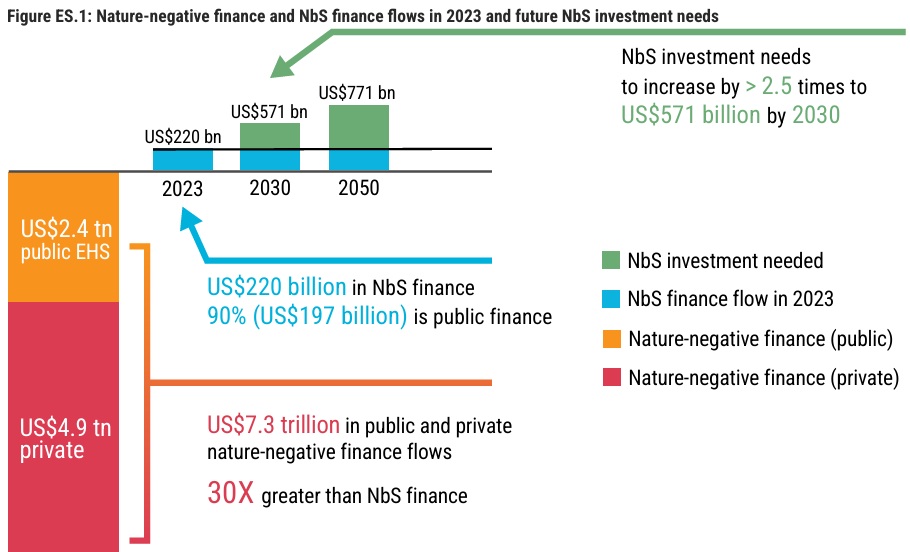
- The United Nations Environment Programme (UNEP) released the State of Finance for Nature 2026 report, warning that nature-negative finance (US$7.3 trillion) vastly outweighs nature-positive investment (US$220 billion).
State of Finance for Nature 2026:
- The State of Finance for Nature (SFN) 2026 is the fourth edition of a flagship report that tracks global capital flows related to nature.
- It provides a financial assessment to help policymakers and businesses transition from an economy that erodes its nature bank account to one that invests in Nature-based Solutions (NbS)—actions that protect, restore, and sustainably manage ecosystems to address societal challenges
Key Findings in the Report
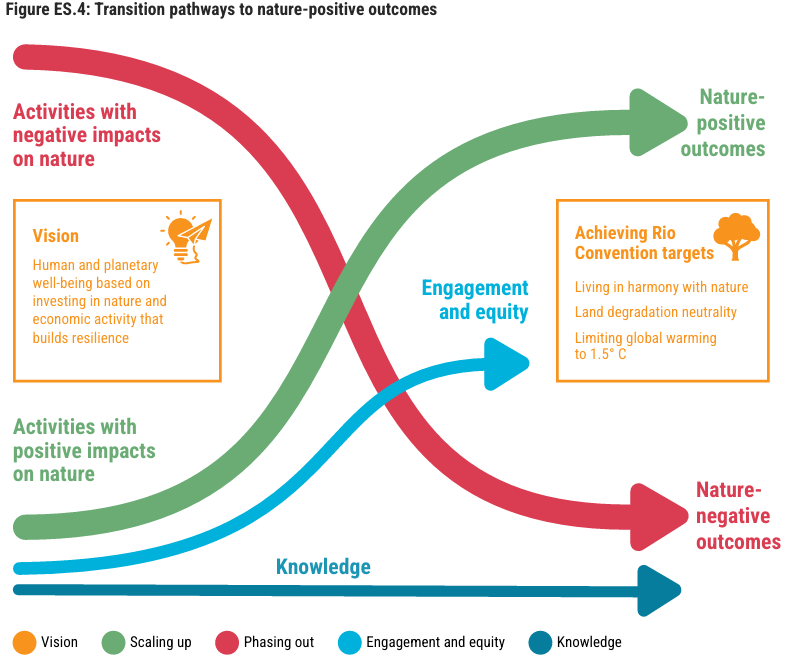
- Massive Finance Gap: To meet global Rio Convention targets, NbS investment must increase 2.5 times to US$571 billion annually by 2030.
- Nature-Negative Dominance: Annual finance flows harming nature reached US$7.3 trillion in 2023, representing roughly 7% of global GDP.
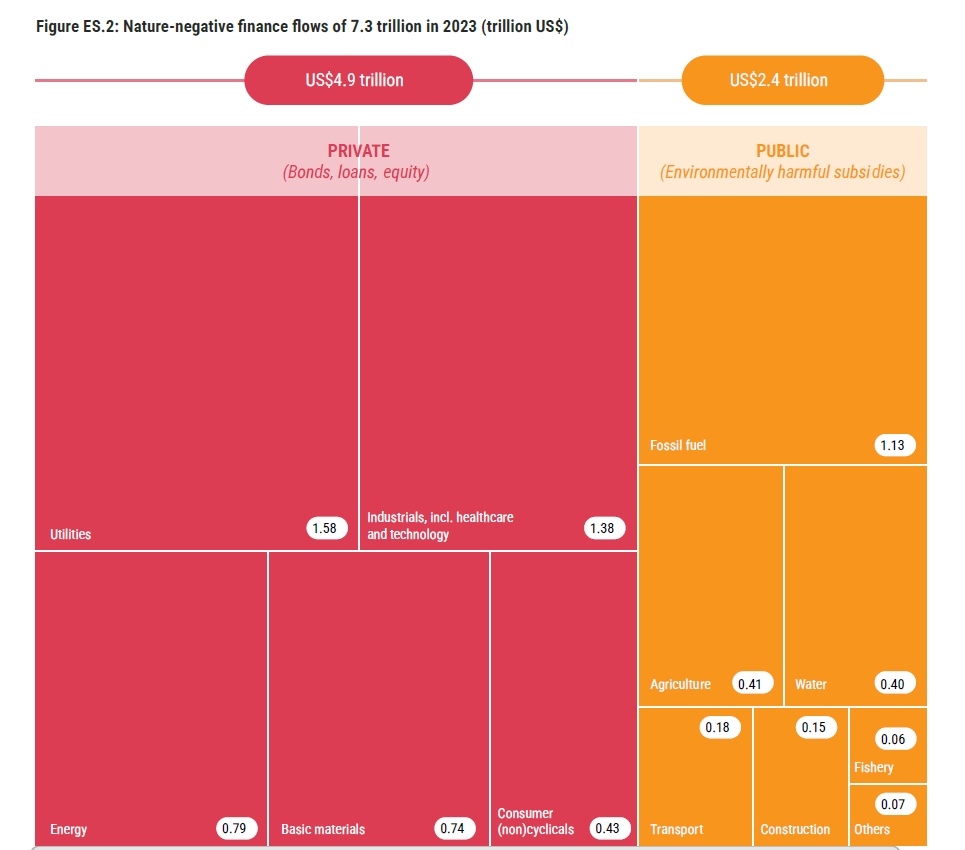
- Public Subsidies: Governments provided US$2.4 trillion in environmentally harmful subsidies (EHS), primarily for fossil fuels (US$1.13 trillion), followed by agriculture and water.
- Private Sector Impact: Private capital flows to nature-negative sectors totaled US$4.9 trillion, concentrated in utilities, industrials, and energy.
- Public Finance as Main NbS Driver: Of the US$220 billion in NbS finance, 90% (US$197 billion) comes from public sources, mostly through domestic expenditure.
- Slow Private NbS Growth: Private investment in NbS is only US$23.4 billion, with biodiversity offsets and certified commodity supply chains being the largest contributors.
- Interdependence of Risks: At least half of the global economy is moderately or highly dependent on nature, making the nature crisis a direct threat to financial stability.
Success:
- Debt-for-Nature Swaps (DNS): Restructured debt to unlock conservation funds.
- E.g. Eight agreements from 2021–2024, including deals in Ecuador, Belize, and Gabon, unlocked significant funds for local conservation.
- Sustainable Bonds for Biodiversity: Growth in debt instruments with nature-focused Use of Proceeds.
- E.g. United Utilities (UK) issued a GBP 300 million bond for peatland and riverbank restoration.
- Innovation in Real Economy Sectors: Using nature to replace harmful industrial processes.
- E.g. Use of bacteria-infused self-healing concrete to extend building life and fungi-based leather in apparel.
- Increasing Disclosure Adopters: Global financial institutions are beginning to track nature-related risks.
- E.g. Over 730 organizations have adopted the Taskforce on Nature-related Financial Disclosures (TNFD) framework.
Failures:
- Persistence of Harmful Subsidies: Global failure to repurpose trillions in EHS that drive degradation.
- E.g. India continues to provide significant fertilizer and power subsidies for agriculture, which can lead to groundwater depletion and soil degradation if not managed sustainably.
- Biodiversity Offset Implementation Gaps: Offsets often fail to provide genuine net gains due to weak enforcement.
- E.g. India’s National Compensatory Afforestation (CAMPA) is one of the world’s largest offset markets (US$0.86 billion), yet it faces challenges in ensuring that new plantations effectively replace the complex biodiversity lost to development.
- Inadequate Private Capital Mobilization: Private NbS finance remains a tiny fraction of what is needed.
- E.g. Despite India’s massive renewable energy push, private debt finance for nature-positive restoration projects lags behind traditional infrastructure lending.
- Erosion of Regulatory Standards: Weakening of environmental laws in some jurisdictions creates uncertainty.
- E.g. Recent amendments to forest and environmental clearance rules have been critiqued for potentially easing industrial expansion at the cost of sensitive ecological zones.
- Underfunded International Cooperation (ODF): International public finance for NbS is under heavy pressure.
- E.g. As a nature-rich developing nation, India requires massive concessional international finance to meet 30×30 goals, but ODF flows remain insufficient compared to the country’s conservation needs.
Recommendations
- Reform Subsidies: Redirect the US$2.4 trillion in harmful public subsidies toward regenerative agriculture and clean energy.
- Mandatory Disclosure: Enact laws requiring all large companies and financial institutions to disclose nature-related risks and impacts.
- Scale Blended Finance: Use public funds to de-risk private investments in NbS through guarantees and co-financing.
- Integrate NbS into Budgets: Embed nature-based infrastructure into national fiscal frameworks and green budgeting.
- Ensure Equity: Protect the rights of Indigenous Peoples and Local Communities, ensuring they are co-creators and beneficiaries of nature finance.
Conclusion:
- The 2026 report serves as a final warning that the global economy is in the red, with a 30:1 bias toward destroying nature rather than protecting it. Achieving a nature-positive future requires an urgent Big Nature Turnaround to repurpose US$7.3 trillion in harmful flows into a trillion-dollar transition economy. Only by embedding nature into every financial and governmental decision can we safeguard the ecosystems that underpin all human well-being and economic growth.