




 Latest News
Summary of the 16th Finance Commission
- Finance Minister Nirmala Sitharaman tabled the 16th Finance Commission (FC) report in Parliament on February 1, 2026, alongside the Union Budget. The government has accepted its key recommendation to maintain the states’ share in central taxes at 41% for the period of 2026-31.
Vertical Devolution: Share of States in Central Taxes
- Key Recommendation: The states’ share in the divisible pool of central taxes remains unchanged at 41%, consistent with the 15th Finance Commission.
- Divisible Pool: Calculated after excluding cesses, surcharges, and the cost of collection from the Centre’s gross tax revenue.
- Impact: Ensures stability in resource transfer to states, maintaining the foundational framework of fiscal federalism.
- Horizontal Devolution: New Criteria for Distribution Among States
The formula for distributing the states’ share has been recalibrated with revised weights and a new parameter.
Devolution Criteria – 15th FC vs. 16th FC
| Criteria | 15th FC Weight | 16th FC Weight | Key Change |
| Income Distance | 45% | 42.5% | Slight reduction. |
| Population (2011) | 15% | 17.5% | Increased weight. |
| Demographic Performance | 12.5% | 10% | Redefined (uses pop. growth 1971-2011). |
| Area | 15% | 10% | Reduced weight. |
| Forest & Ecology | 10% | 10% |
Now includes open forests & growth in forest cover. |
| Tax Effort | 2.5% | 0% | Dropped entirely. |
| Contribution to GDP | 0% | 10% | New parameter rewarding economic size. |
| Total | 100% | 100% |
Key Changes:
- Income Distance: Based on per capita GSDP gap with top-3 states (avg. of 2018-19 & 2023-24, excluding 2020-21).
- Contribution to GDP: New 10% weight to reward states for their economic output, calculated using the square root of GSDP.
- Forest & Ecology: Now more comprehensive, considering increase in forest area (2015-23) and including open forests.
- Demographic Performance: Shift from Total Fertility Rate (TFR) to population growth between 1971-2011.
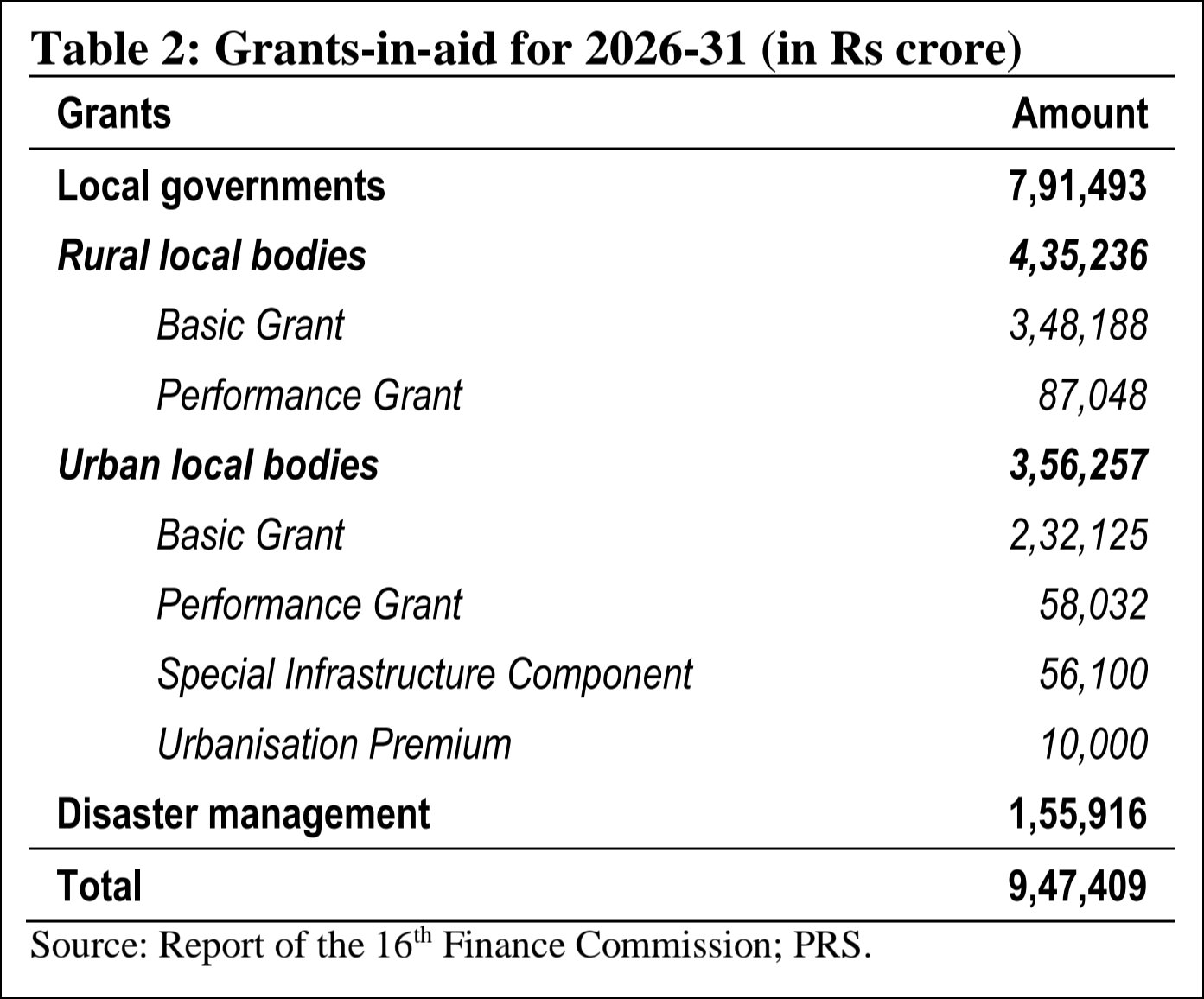
1. Grants-in-Aid to States & Local Bodies (Total: ₹9.47 Lakh Crore)
- The Commission has streamlined grants, discontinuing revenue deficit, sector-specific, and state-specific grants.
- Local Body Grants (₹7,91,493 crore)
- Rural Local Bodies:₹4.35 lakh crore.
- Urban Local Bodies:₹3.56 lakh crore.
- Structure:80% Basic Grant (50% tied to water/sanitation) + 20% Performance Grant.
- New Components for Urban Bodies:
- Special Infrastructure Grant (₹56,100 cr): For wastewater management in cities (10-40 lakh population).
- Urbanisation Premium (₹10,000 cr): One-time grant for merging peri-urban areas and formulating rural-urban transition policies.
- Conditionality: Tied to timely State Finance Commissions, audited accounts, and proper constitution of local bodies.
2. Disaster Management Grants (₹1,55,916 crore)
- Corpus for State Disaster Relief & Management Funds (SDRF/SDMF).
- Centre-State Cost Sharing:
- 90:10 for Northeastern & Himalayan states.
- 75:25 for all other states.
Other Major Recommendations
- Fiscal Roadmap & Debt Management:
- Centre’s Fiscal Deficit: Reduce to 3.5% of GDP by 2030-31.
- State’s Fiscal Deficit: Cap at 3% of
- Off-Budget Borrowings: Strictly discontinue. All such borrowings must be brought on-budget; debt definition to be expanded uniformly.
- Combined Debt: Projected to decline from 77.3% (2026-27) to 73.1% of GDP (2030-31).
- Power Sector Reforms:
- Actively pursue privatisation of DISCOMs (distribution companies).
- Create a Special Purpose Vehicle (SPV) to warehouse existing DISCOM debt.
- Link Central Assistance: States can use funds from the Special Assistance Scheme for Capital Investment only after privatisation is complete.
- Subsidy Rationalisation
- Review and rationalise subsidy expenditure.
- Set clear exclusion criteria for better targeting, move away from unconditional cash transfers.
- Discontinue financing subsidies via off-budget borrowings.
- Adopt uniform accounting and disclosure standards for subsidies/transfers across states.
- Public Sector Enterprise Reforms
- Review & close 308 inactive State PSEs (SPSEs).
- Formulate a state-level disinvestment policy for underperforming PSEs.
- Loss-making PSEs (losses in 3 out of 4 years) must be placed before the Cabinet for a decision on closure, privatisation, or strategic continuation.
POSTED ON 02-02-2026 BY ADMIN
Next previous  General Studies
Political Science and International Relations
Some Reference Essays
List of previous year essay topics (1997-2019)

IAS GOOGLE is googled by the team of Raja Sir’s Cracking IAS Academy. Sources include The Hindu, Indian Express, pib.nic.in, Down To Earth, Economic Times, Vigyan Prasar, AIR and the like. IAS GOOGLE has been prepared in pace with emerging UPSC Trends.