



 Latest News
500% tariffs ahead for India?
- The United States is considering a bipartisan bill allowing tariffs up to 500% on countries, including India, that continue purchasing Russian oil, after US President Donald Trump signalled support for the proposed Sanctioning Russia Act of 2025.
- The Sanctioning Russia Act of 2025, backed by US Senators led by Lindsey Graham, seeks to empower the US President to impose punitive tariffs (up to 500%) on countries buying Russian oil, to choke revenues funding Russia’s war in Ukraine.
Background of the issue:
- After the Russia–Ukraine war (2022), India sharply increased imports of discounted Russian crude to protect energy security.
- The US and G7 imposed a $60/barrel price cap to limit Russian revenues without disrupting global oil markets.
- Despite reducing purchases marginally, India remains one of Russia’s largest oil buyers, leading to earlier US penalty tariffs (25%, later 50%) on Indian exports.
- The proposed Bill escalates pressure by linking energy trade with secondary sanctions.
Key Features Sanctioning Russia Act of 2025:
- Secondary sanctions framework: Empowers the US President to impose secondary tariffs and sanctions on countries that continue purchasing Russian oil, gas, uranium, and petroleum products, even if they are not directly trading with the US.
- Punitive tariff provision: Mandates tariffs of up to 500% on goods and services imported into the US from countries that knowingly engage in trade involving Russian-origin energy products.
- Financial isolation of Russia: Directs the US Treasury to impose property-blocking sanctions on Russian financial institutions and foreign entities transacting with them.
- Presidential discretion: Grants the President authority to determine tariff levels and targets, giving significant leverage in diplomatic negotiations.
- National interest waiver: Allows the President to waive the 500% tariffs for up to 180 days for specific countries, goods, or services if deemed in the US national interest.
- Strategic objective: Aims to cripple Russia’s war-financing capacity and pressure third countries to reduce reliance on discounted Russian energy.
Implications of a 500% U.S. tariff on India
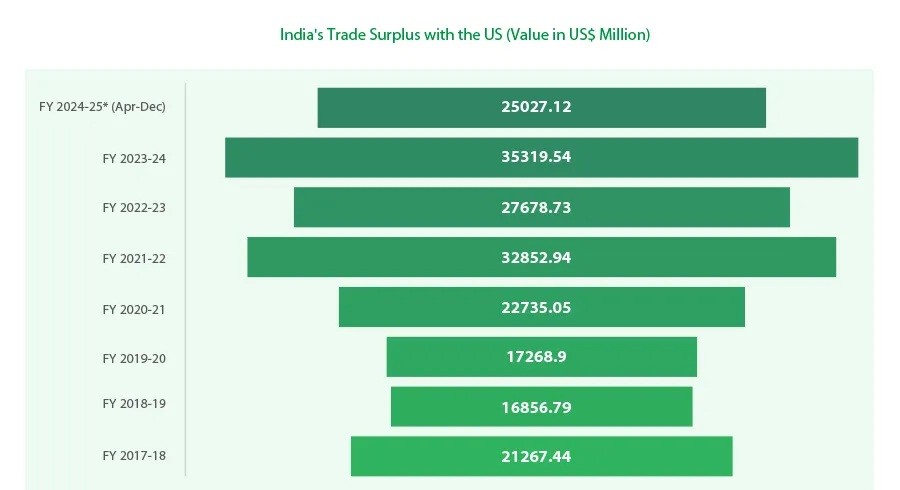
- Trade and export shock: A 500% tariff would operate as a de facto trade embargo, making Indian goods commercially unviable in the U.S. market. E.g. GTRI estimates exports worth ~$120 billion could be hit, with labour-intensive sectors like textiles, gems and jewellery—already under 50% tariffs since Aug 2025—facing closures and job losses.
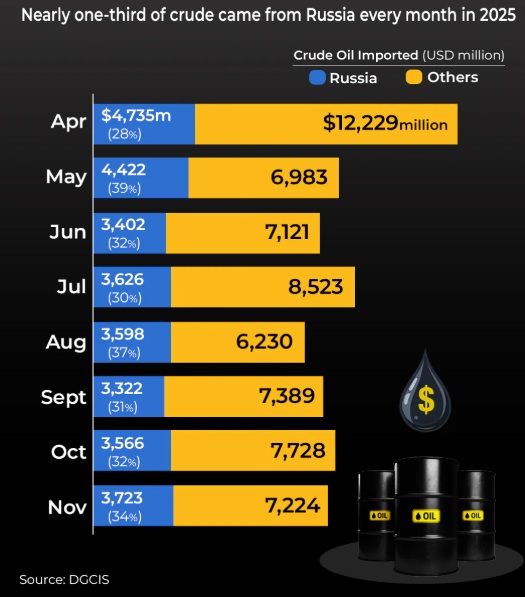
- Energy security dilemma: Cheap Russian crude has helped India manage inflation and fiscal stress, making sudden disengagement economically costly. E.g. Early-2026 assessments suggest shifting away from Russian oil could raise India’s import bill by $9–11 billion, prompting refiners like Reliance to pause Russian cargoes to avoid sanctions exposure.
- Geopolitical strain: The tariff threat strains the India–US Comprehensive Global Strategic Partnership and raises concerns of selective enforcement. E.g. Indian officials note the contradiction that China, the largest buyer of Russian energy, has largely avoided equivalent penalties, undermining trust in a rules-based order.
- Global market distortion: Extreme secondary sanctions risk fragmenting energy markets and financial systems, accelerating economic bloc formation. E.g. Legal scrutiny in the US over using IEEPA for such tariffs could push countries like India and Brazil toward non-dollar payment systems, accelerating de-dollarisation.
- Pressure on strategic autonomy: India’s ability to balance ties with Washington and Moscow faces its sternest test since the Cold War. E.g. The US exit from the International Solar Alliance (Jan 2026) alongside tariff threats signals a shift toward transactional diplomacy that constrains India’s policy independence.
Way ahead for India
- Accelerate energy diversification: Reducing exposure to Russian crude lowers vulnerability to sanctions-driven coercion. E.g. India is expanding sourcing from Guyana, Brazil and West Asia to bring Russian oil dependence below a “sanction-safe” threshold.
- Diplomatic price-cap renegotiation: India must frame its oil imports as stabilising, not distorting, global energy markets. E.g. High-level talks led by EAM S. Jaishankar can highlight how Indian buying prevents oil spikes to $120/barrel, which would hurt US consumers too.
- Hedge via new FTAs: Diversifying export markets can cushion MSMEs from U.S. tariff shocks. E.g. Fast-tracking UK and EU FTAs can provide alternate demand channels for tariff-hit sectors like apparel and engineering goods.
- Legal and multilateral recourse: Unilateral tariffs of this scale challenge core trade law principles. E.g. A coordinated challenge at the WTO or G20 could question 500% tariffs as violations of MFN obligations.
- Structural energy transition: Reducing fossil fuel dependence weakens external economic leverage over India. E.g. Scaling up the National Green Hydrogen Mission and EV adoption can permanently dilute crude-oil-linked geopolitical pressure.
Conclusion:
The proposed 500% tariff threat goes beyond trade, challenging India’s energy security and strategic autonomy. While Russian oil remains economically attractive, prolonged confrontation with the US carries high costs. A calibrated mix of diplomacy, diversification, and energy transition will be crucial to safeguard India’s economic and geopolitical interests.
POSTED ON 08-01-2026 BY ADMIN
Next previous  General Studies
Political Science and International Relations
Some Reference Essays
List of previous year essay topics (1997-2019)

IAS GOOGLE is googled by the team of Raja Sir’s Cracking IAS Academy. Sources include The Hindu, Indian Express, pib.nic.in, Down To Earth, Economic Times, Vigyan Prasar, AIR and the like. IAS GOOGLE has been prepared in pace with emerging UPSC Trends.