




 Latest News
India a Global Cooperative Powerhouse
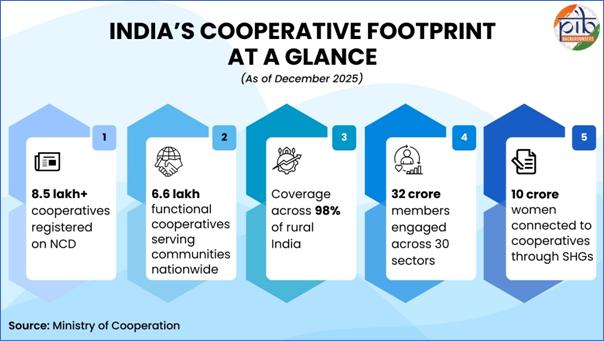
- The United Nations has declared 2025 as the International Year of Cooperatives (IYC), highlighting India’s emergence as a global leader with over 8.5 lakh registered cooperatives and a renewed policy focus under the vision of “Sahkar Se Samriddhi.”
Key Data and Statistics on Indian Cooperatives:
- Scale: India accounts for approximately 27% of all cooperatives worldwide, making it one of the largest organized economic networks globally.
- Membership: As of late 2025, there are nearly 32 crore members, covering roughly 98% of rural India across 30 different sectors.
- Functional Strength: Out of 8.5 lakh registered societies, approximately 6.6 lakh are fully operational, including nearly 80,000 Primary Agricultural Credit Societies (PACS).
- Financial Inclusion: The sector includes 1,457 urban cooperative banks holding assets worth ₹7.38 trillion and deposits of roughly ₹5.84 trillion as of March 2025.
- Women Empowerment: Through links with Self-Help Groups (SHGs), the cooperative framework has integrated nearly 10 crore women into the organized economy.
Historically
Cooperatives in Pre-Independence Era -
- First Cooperative Act in India: Indian Famine Commission (1901) led to the enactment of the first Cooperative Credit Societies Act in 1904 followed by the (amended) Cooperative Societies Act, 1912.
- Maclagan Committee: In 1915, a committee headed by Sir Edward Maclagan, was appointed to study and report whether the cooperative movement was proceeding on economically and financially sound lines.
- Montague-Chelmsford Reforms: Through the Montague-Chelmsford Reforms of 1919, co-operation became a provincial subject which gave further impetus to the movement.
- Post Economic Depression, 1929: Various committees were appointed in Madras, Bombay, Travancore, Mysore, Gwalior, and Punjab to examine the possibilities of restructuring the Cooperative societies.
- Gandhian Socialist Philosophy: Cooperation according to Gandhiji was necessary for the creation of a socialistic society and complete decentralisation of power.
- He was of the opinion that cooperation was one of the important means to empower people.
- In South Africa, Mahatma Gandhi instituted the ''Phoenix Settlement'' as a cooperative in a socialistic pattern.
- He established the Tolstoy Farm as a rehabilitation cooperative settlement for the families affected by the South African freedom struggle during the period.
Cooperatives in Post- Independence India:
- First Five-Year Plan (1951-56): Highlighted the promotion of cooperatives for comprehensive community development.
- Multi-State Co-operative Societies Act, 2002: Provides for the formation and functioning of multi-state co-operatives.
- Multi-State Co-operative Societies (Amendment) Act, 2022 introduced the Co-operative Election Authority to oversee board elections in multi-state co-operative societies.
- 97th Constitutional Amendment Act of 2011: Established the right to form cooperative societies as a fundamental right (Article 19).
- Introduced a new Directive Principle of State Policy on Cooperative Societies (Article 43-B).
- Added a new Part IX-B to the Constitution titled "The Co-operative Societies" (Articles 243-ZH to 243-ZT).
- Empowered Parliament to enact laws governing multi-state cooperative societies (MSCS) and delegated authority to state legislatures for other cooperative societies.
- Establishment of Union Ministry of Cooperation (2021): Assumed responsibility for cooperative affairs, previously overseen by the Ministry of Agriculture.
Importance of Cooperatives in India:
- Grassroots Credit Access: They provide essential short-term liquidity to farmers who may be underserved by commercial banks. E.g. PACS are being computerized to link directly with NABARD, ensuring transparent and easy credit flow to remote villages.
- Market Integration for Small Producers: Cooperatives aggregate small-scale produce to give farmers better bargaining power and market reach. E.g. Amul (GCMMF) connects millions of milk producers directly to a global supply chain, ensuring fair pricing.
- Food Security and Storage: They play a vital role in decentralizing grain storage to reduce post-harvest losses. E.g. The World’s Largest Grain Storage Plan has already completed godowns in 112 PACS to create 68,702 MT of local storage capacity.
- Promoting Sustainable Livelihoods: Cooperatives allow for the diversification of income through allied activities like fisheries and organics. E.g. National Cooperative Organics Limited (NCOL) helps farmers transition to organic farming by providing “Bharat Organics” branding and pesticide testing.
- Affordable Service Delivery: They act as multi-service hubs providing essential goods and healthcare at the village level. E.g. Over 800 PACS have been assigned store codes to operate as Pradhan Mantri Bhartiya Janaushadhi Kendras, providing low-cost medicines to rural residents.
Key Initiatives Taken for Cooperatives
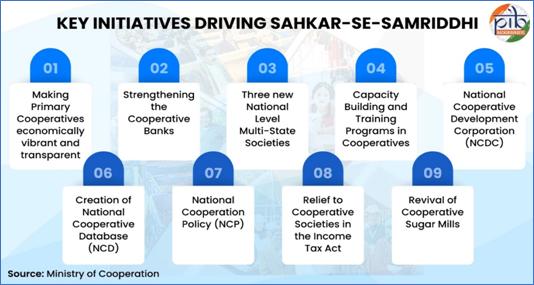
- Digitalization & ERP: A ₹2,925 crore project to computerize PACS using a common national software (ERP) available in 14 languages to ensure real-time auditing.
- Establishment of Apex Multi-State Societies: Creation of three new national bodies: NCEL (Exports), NCOL (Organics), and BBSSL (Seeds) to provide end-to-end support to primary societies.
- White Revolution 2.0: A strategic plan to increase milk procurement by 50% in five years by setting up 20,070 new Dairy Cooperative Societies across 31 States/UTs.
- Legislative and Fiscal Reforms: Reducing the cooperative surcharge from 12% to 7% and enabling PACS to undertake 25+ new business activities under Model Bye-laws.
Success of Cooperatives in India:
- Global Competitiveness: Indian cooperatives are now recognized on the world stage for their scale and professional management. E.g. 15 Indian entities currently feature in the Global Top 300 rankings of cooperatives based on turnover and impact.
- Export Market Penetration: Cooperatives are successfully moving beyond local markets to international trade. E.g. National Co-operative Exports Limited (NCEL) recently exported 13.77 LMT of commodities worth over ₹5,500 crore to 28 countries.
- Digital Transformation: The transition from manual ledgers to digital transparency has minimized leakages and improved member trust. E.g. Nearly 60,000 PACS are now actively using ERP software, with over 34 crore transactions processed digitally.
- Social Inclusivity: The movement has successfully bridged the gap for marginalized sections of society. E.g. NCDC has disbursed over ₹95,000 crore recently, with dedicated schemes like Nandini Sahakar specifically targeting women-led cooperatives.
Impact of Cooperatives:
- Empowering Marginalised Communities: The Amul Dairy Cooperative in Gujarat, with over 3.6 million milk producers (many from small & marginal farms), empowers rural communities by providing fair prices for milk and fostering economic independence, particularly for women.
- Boosting Agricultural Productivity and Marketing: Indian Farmers Fertiliser Cooperative Limited (IFFCO) is the world''s largest fertiliser producer. Cooperatives like IFFCO provide farmers with essential agricultural inputs like fertilisers, seeds, and credit at competitive prices, leading to increased productivity and farm incomes.
- Facilitating Access to Essential Services: Kerala State Milk Marketing Federation (Milma), a dairy cooperative, procures milk from farmers and supplies it to consumers in Kerala at affordable prices. This ensures market access for producers and provides essential dairy products to the population.
- Promoting Inclusive Growth and Job Creation: A NITI Aayog report highlights that sugar cooperatives in Maharashtra provide employment to over 5 lakh people (direct and indirect), contributing significantly to rural job creation and income generation.
Challenges to Cooperatives in India:
- Regional Imbalance: Cooperative growth is concentrated in a few states, leaving others with underdeveloped networks.
- E.g. While Maharashtra leads with 2.21 lakh societies, many North-Eastern states still struggle with low cooperative density and functional capacity.
- Infrastructure Gaps: Many primary societies lack the modern hardware or storage facilities needed to be economically viable.
- E.g. Despite the storage plan, current capacity remains insufficient for the total national produce, requiring massive scaling beyond the 112 pilot PACS.
- Operational Inefficiency: Older societies often suffer from “Uncle Judge Syndrome” (nepotism) or lack of professional management.
- E.g. The need for Tribhuvan Sahkari University highlights the current shortage of a professionally trained workforce specifically for the cooperative sector.
- Financial Constraints: Many cooperatives face high levels of Non-Performing Assets (NPAs) and limited capital for technology adoption.
- E.g. Urban Cooperative Banks still require rigorous onboarding to the RBI Integrated Ombudsman Scheme to improve their governance and financial stability.
|
International Year of Cooperatives 2025
Key Aspects of IYC 2025:
|
Way Ahead:
- Universal Professionalization: Establishing Tribhuvan Sahkari University and specialized training modules will create a cadre of professional managers to replace archaic governance with modern business practices.
- Pan-India Expansion: Efforts must be intensified to replicate the successful cooperative models of Maharashtra and Gujarat in Eastern and North-Eastern states to ensure balanced regional development.
- Technological Deepening: Beyond initial computerization, the integration of AI and Blockchain in the National Cooperative Database can ensure end-to-end traceability and fraud-proof auditing for all 8.5 lakh societies.
- Credit-Plus Services: Transforming all functional PACS into Multi-Service Centers will diversify their revenue streams and ensure long-term financial sustainability.
- Global Brand Building: Aggressively scaling the “Bharat” brand for seeds and organics through the NCEL will allow small Indian farmers to capture a larger share of the high-value global export market.
Conclusion:
- India’s cooperative sector has transformed into a broad economic pillar supporting nearly one-fourth of the world’s cooperatives. Digital reforms and new export and organic institutions are empowering 32 crore members at the grassroots. As the world marks the International Year of Cooperatives 2025, India offers a global model of inclusive, collective-led development.
POSTED ON 18-01-2026 BY ADMIN
Next previous  General Studies
Political Science and International Relations
Some Reference Essays
List of previous year essay topics (1997-2019)

IAS GOOGLE is googled by the team of Raja Sir’s Cracking IAS Academy. Sources include The Hindu, Indian Express, pib.nic.in, Down To Earth, Economic Times, Vigyan Prasar, AIR and the like. IAS GOOGLE has been prepared in pace with emerging UPSC Trends.